
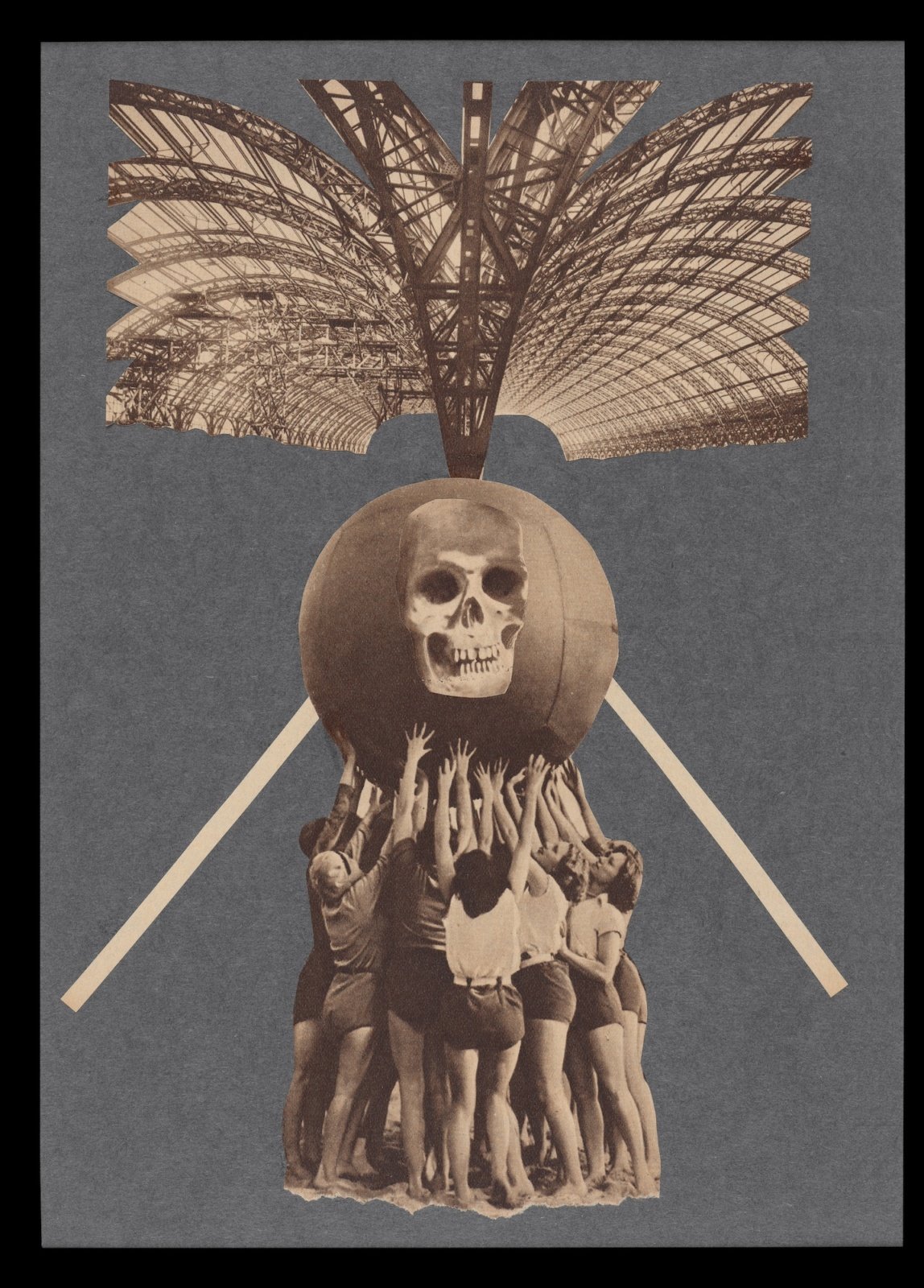
The feminist possibilities of the cut image
Co-published by Thames & Hudson and V&A, Fiona Rogers’ Cut Out is a 240-page dive into photo collage, photomontage and assemblage, framing the cut as both a technique and a way of thinking. From Lorna Simpson’s cosmic reworking of the pin-up and Helen Chadwick’s visceral blue photocopies to the Surrealist experiments of Claude Cahun and Dora Maar, Rogers traces how artists have pulled photography apart to make it speak in new ways. Anneka French reads Cut Out as a wide-ranging account of feminist image-making, arguing that Rogers connects practices shaped by race, colonialism, climate, and digital technology to a broader challenge to photography’s claims of authority, visibility and possession.
Anneka French | Book review | 2 July 2026
Join us on Patreon
A woman sits on a bed, legs folded beneath her, a soft purple fabric wrapped around her waist. The woman’s dark eyes, defined brows and glossy hair are accentuated because the rest of her body is cut away. Rendered as a map of the night sky, her body is filled with tiny bursts of starlight shining against a black expanse. This is Brooklyn-born Lorna Simpson’s Everrrything (2021), one of a ten-part work Sky Pin Ups (2021–present), a series of photo collages that reclaim the Black female body by partially removing the original context of a sexualised image and reworking it within the expansive and radical possibilities of the cosmos. The word ‘VISIBLE’ appears, and the central subject, framed by a deep indigo surround that mimics the sky, emphasising the infinite scale of the series’ ambition.
Everrrything is one of the images in Cut Out, Fiona Rogers’ 240-page book that examines photo collage, photomontage and assemblage through a feminist lens. While it is not the first work that appears, Simpson’s piece is indicative of Rogers’ intentions. Indeed, Alona Pardo’s text on Simpson, part of the chapter ‘Feminisms,’ argues that the women in these collages ‘give form to speculative realms…’ and ‘are the creators of their own universe,’ sentiments that feel apt throughout Rogers’ book.
The Oval Court (1986) by British artist Helen Chadwick is another expansive example. A vast installation composed of life-sized Prussian blue photocopies, collaged on to a low plinth, it shows Chadwick’s naked body amid a collection of dead mammals, birds and insects, accompanied by plant life and other assorted objects. In the section of The Oval Court illustrated, a small axe appears, wound with rope and laid up Chadwick’s stomach and crotch, a gesture that references the violence, precision and creative potential of a sharp blade.
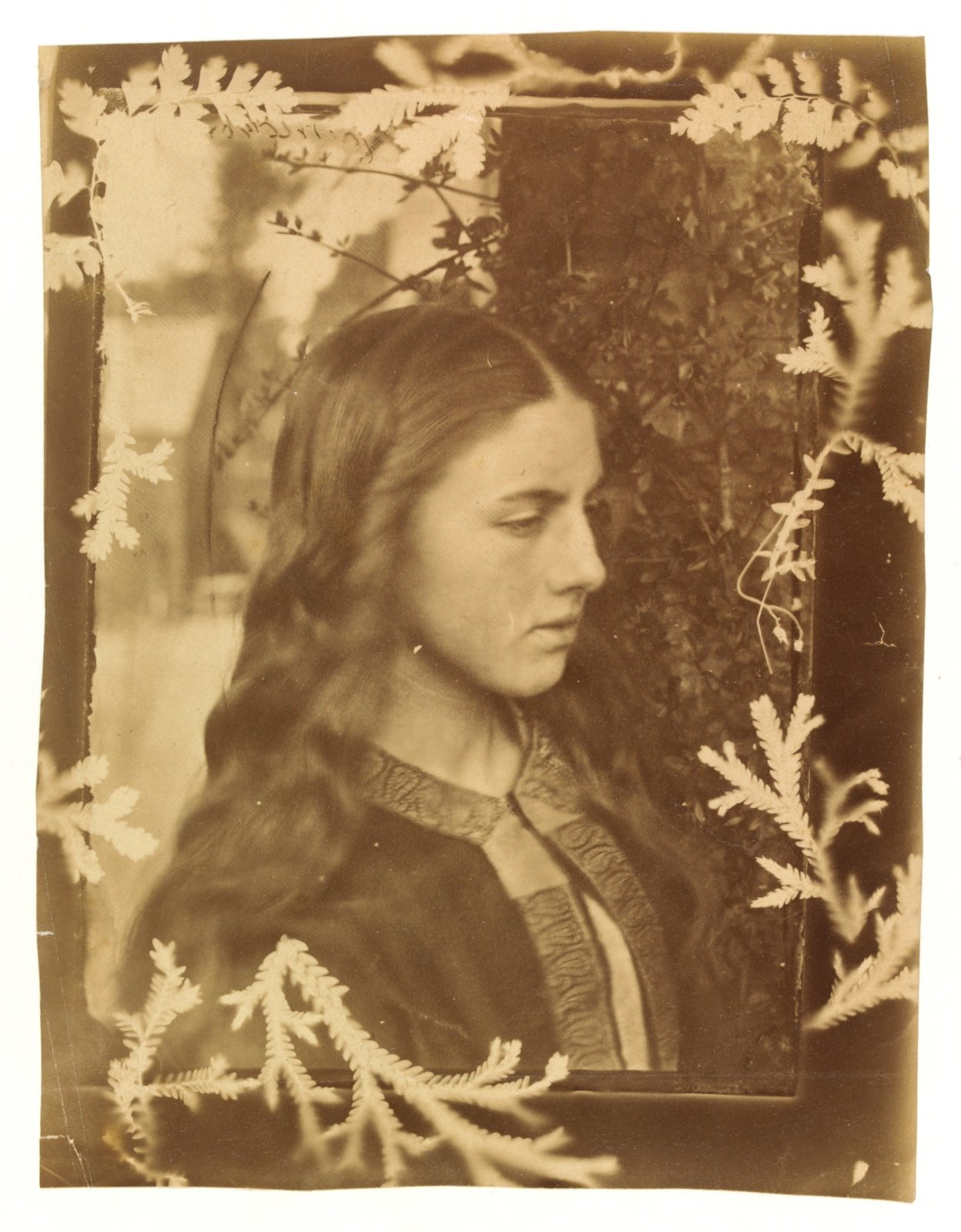
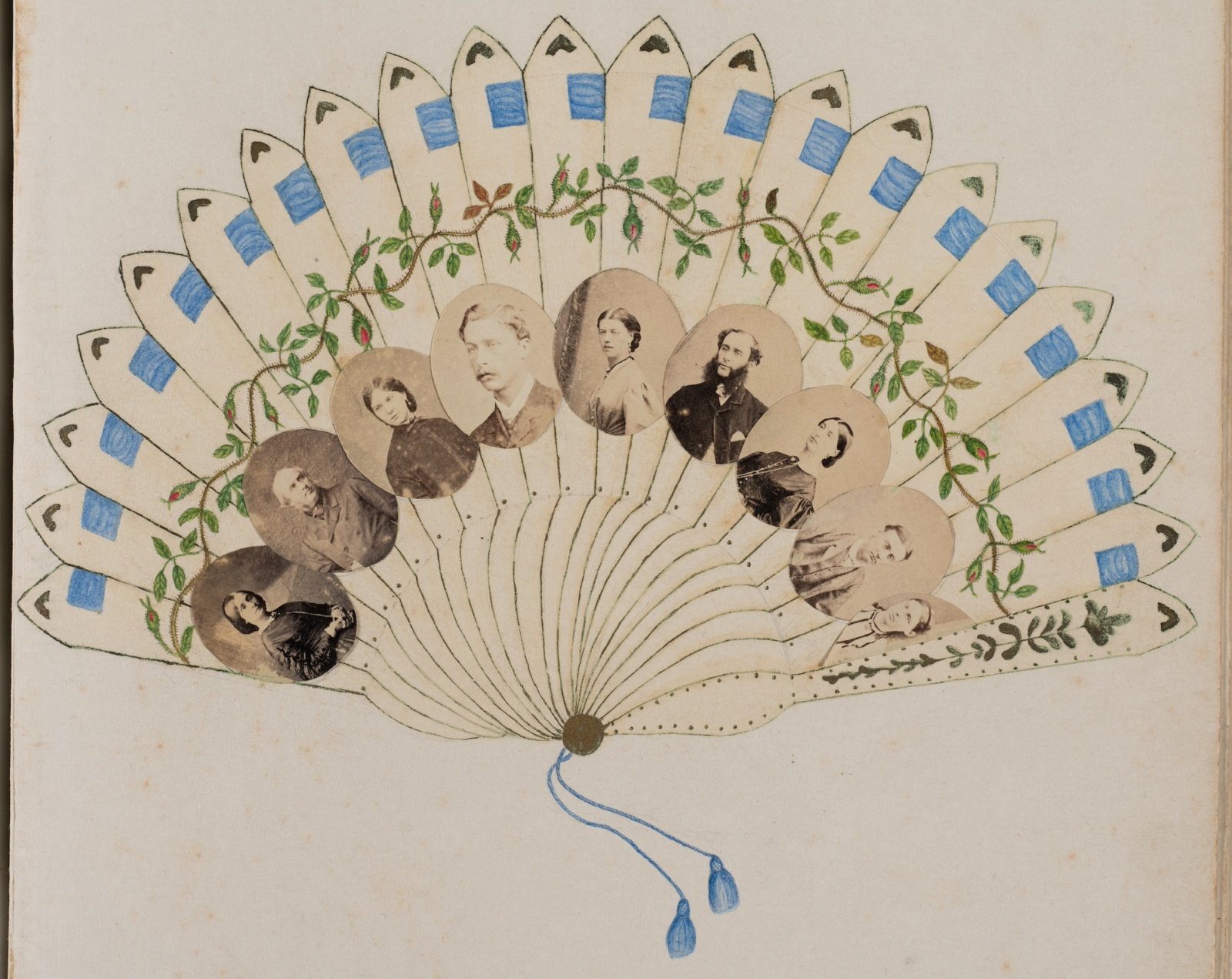
Rogers, the V&A Parasol Foundation Curator of Women in Photography, here presents artists and photographers on a global scale, each one making a significant contribution to subject or process, with insight provided via thematic introductions and by texts from a range of critical contributors. The vast majority of these works are owned by the V&A, a collection that holds almost a million photographs. The first chapter ‘Early Pioneers’ features Anna Atkins, Julia Margaret Cameron and Edith Mary Paget, experimenters with cyanotype, photogram, multiple and cut negatives, watercolour, and mixed media collage. Later chapters centralise more bodily feminist concerns. Joy Gregory’s cyanotypes explore the Western world’s obsession with the female blonde; Joanne Leonard’s prints from Journal of a Miscarriage (1973) portray the personal, visceral sweep of emotions experienced through the loss of a pregnancy; Linder’s photomontages recontextualise pornographic and consumerist depictions of the female body; Maria Magdalena Campos-Pons is represented through a photogravure in which eyes are ‘tattooed’ across her back, collaging both voyeurism and ritual within one provocation.
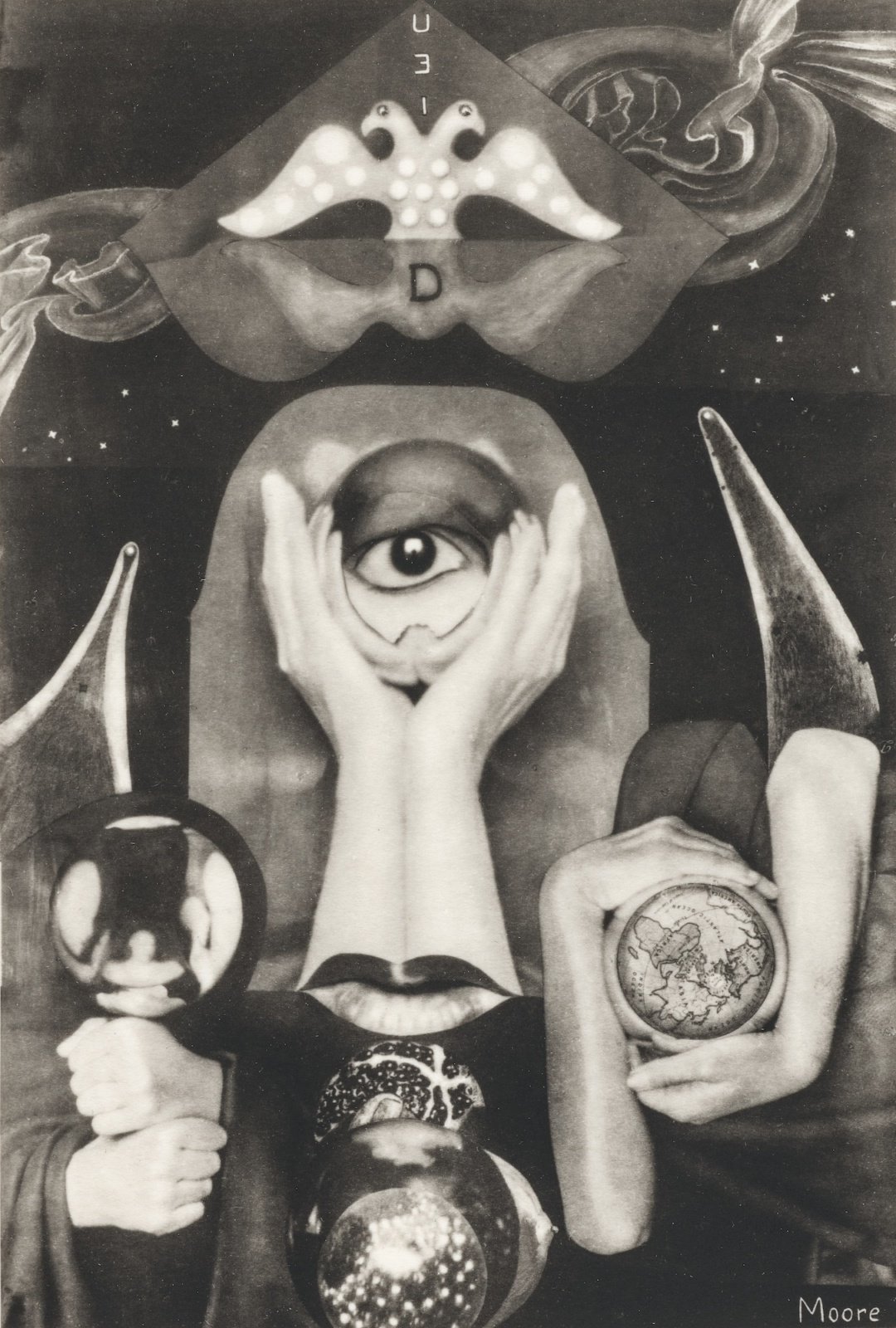
‘Experimental Forms’ includes some of the most well-known but nonetheless extraordinary photographers selected for this anthology, many of whom have been the subject of major solo exhibitions in recent years. Claude Cahun’s practice, for instance, is illustrated through eight symbolically loaded pieces, reprinted from half-plate negatives: Surrealist compositions of faces, eyes, hands, cacti, scissors, and a game of chess. Dora Maar is here shown through silver gelatin Surrealist photomontages from the 1930s including Untitled (Hand Shell) (1934) and The Pretender (or The Simulator) (1935). Meticulously rephotographing different motifs, cropping, reorienting, and retouching these, Maar’s work taps into the emotionally atmospheric and enigmatic possibilities of the technique to reinvent. Japanese artist Toshiko Okanoue, meanwhile, via Fantasy (1953) and Modern History (1956), uses photocollage via platinum prints, imaginative experimentations developed by building upon the technique of chigiri-e, where softly textured collages are formed from torn paper components.
The power of photography in combination with interdisciplinary gestures such as printing, stitching, projecting, and piercing, are most evident in the ‘Reclaiming Histories’ chapter. Reclamation, reparation, collaboration, and appropriation offer approaches to examine the archival, canonical, traditional, traumatic, and inherited. Works by Swiss-Haitian, Helsinki-based, Sasha Huber, employ a supremely-impactful layer of staples that disrupt the photographic surface to give a kind of armoured exterior to Black female subjects; Joana Choumali’s embroidered prints are means to personally and psychologically connect to a landscape devastated by terrorism in Côte d’Ivoire; cyanotype self-portraits by Tarrah Krajnak address a dislocation from her birth city of Lima via projections of political violence on to her Indigenous body. The recovery of female subjectivity and autonomy is apparent across the whole book but in works such as Mickalene Thomas’ Le Déjeuner sur l’herbe: Les trois femmes noires (2010), this gesture is made in direct reference to art historical representation, to Édouard Manet’s 1863 oil on canvas. Other of Thomas’ photographic prints and collages are overlaid with rhinestones, tape and fibreglass mesh, all part of the ‘incandescent magic’ of her practice, as curator Renée Mussai’s longer text describes it.
‘Speculative Futures’ presents work that engages with the digital, the climate crisis and interrelations between these subjects. Echoing Pardo’s words on Simpson’s practice, ‘I have a world to build… and I’m not waiting around for this world to end before I begin to build the next – we, travas, have already begun that’, says Ventura Profana. Profana, a Brazilian artist who uses photomontage as a tool for divination, queering and climate justice is here included by way of the hyperreal digital montage Balm of Gilead (2020). This chapter also includes Barbados-born, Glasgow-based Alberta Whittle, French artist Noémie Goudal and an extended text by curator Pelumi Odubanjo on the abstract mixed-media collages of Kenyan-American artist Wangechi Mutu. In Uruguayan artist Liliana Farber’s large-scale series, Isolarii (2022), also within this section, historical cartography is layered with contemporary digital mapping processes to create ‘data collages’ shaped by politically controlled borders, colonialised territories and technologised perspectives.
The final text within the book is an artist’s, that of Justine Kurland, the American who, following Valerie Solanas, developed SCUMB (The Society for Cutting Up Men’s Books), a body of work in which photobooks by canonical white, male photographers have been cut up and reconfigured into something new, something shape-shifting, bold and radical. In an extract from her manifesto, Kurland writes, ‘I thrive in the stagnant waste of your boring photography… I’m coming for you with a blade.’♦
Cut Out: A Feminist History of Photo Collage, Montage and Assemblage by Fiona Rogers is co-published by Thames & Hudson and V&A.
—
Anneka French is a writer, editor and curator based in Birmingham. She is Project Editor at publishing house Anomie and contributes to Art Quarterly, Burlington Contemporary and Photomonitor among other titles.
Images:
1-Julia Margaret Cameron (1815–79), Kate Dore with Photogram Frame of Ferns, photograph by Oscar Gustav Rejlander in collaboration with Julia Margaret Cameron. © The Victoria and Albert Museum
2-Mabel Annie Burnip (1893–1984), from photographic album with albumen prints and hand illustrations, c. 1870s. © The Victoria and Albert Museum
3-Claude Cahun (1894–1954), Aveux non Avenus [Disavowed Confessions], 1930. © The Victoria and Albert Museum
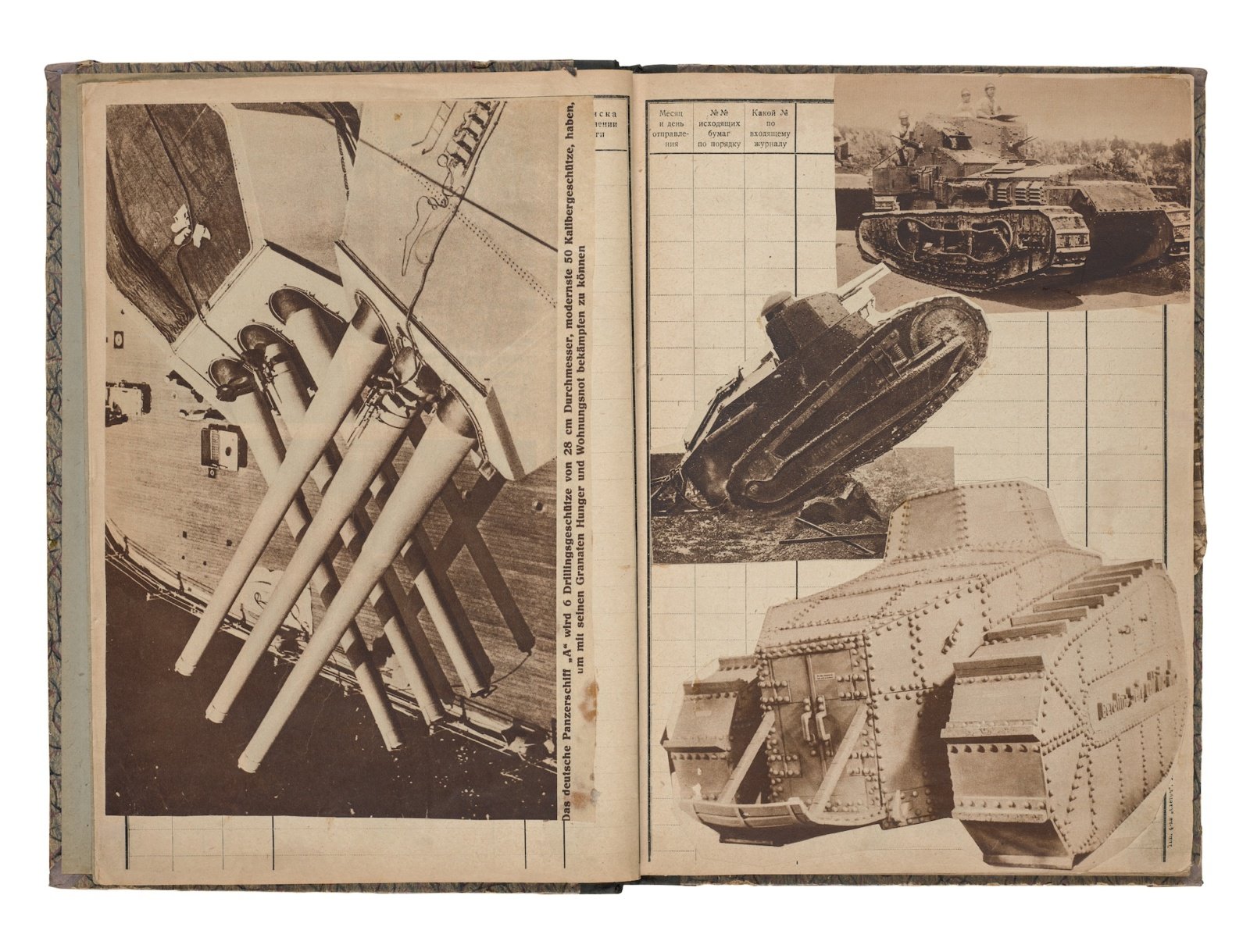
4-Muza Vladimirovna Luppian (1912–42) Military collage album, c. 1935. © The Victoria and Albert Museum
5-Elemérné Marsovszky (1895–1944), Untitled (women holding ball with skull emblem), c. 1930. © The Victoria and Albert Museum
1000 Words favourites
• Renée Mussai on exhibitions as sites of dialogue, critique and activism
• Roxana Marcoci navigates curatorial practice in the digital age
• Tanvi Mishra reviews Felipe Romero Beltrán’s Dialect
• Discover London’s top five photography galleries
• Tim Clark in conversation with Hayward Gallery’s Ralph Rugoff on Hiroshi Sugimoto
• Academic rigour and essayistic freedom as told by Taous Dahmani
• Shana Lopes reviews Agnieszka Sosnowska’s För
• Valentina Abenavoli discusses photobooks and community
• Michael Grieve considers Ute Mahler and Werner Mahler’s posthumous collaboration with their late family member
• Elisa Medde on Taysir Batniji’s images of glitched video calls from Gaza
Join us on Patreon today and be part of shaping the future of photographic discourse


