Paris Photo 2025: Essential Exhibitions Beyond The Grand Palais

A cultural primer for the week ahead, this guide highlights key exhibitions taking place across the city during Paris Photo, from major museum retrospectives to experimental presentations, offering readers an overview of what to see and where to go amid one of photography’s most anticipated moments in the events calendar.


1000 Words | Resource | 7 Nov 2025
Join us on Patreon

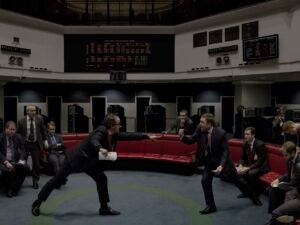
Luc Delahaye, The Echo of the World – Jeu de Paume
10 October – 4 January

Long recognised for his vastly significant contributions to the field of contemporary photography, Luc Delahaye is the focus of a monographic exhibition at Jeu de Paume showcasing work that spans the last 25 years. During this time, Delahaye has notably transitioned from photojournalism to fine art photography, deliberately moving away from the immediacy of reportage toward the creation of monumental, painterly tableaux that often depict the aftermath of war, the solemnity of international summits or the quiet dignity of displaced individuals. The exhibition, the first in Paris to show Delahaye’s work since 2005, brings together approximately 40 large-format photographs, including previously unseen works and a video installation centred on the Syrian conflict, and is a testament to the documentary form as it tipped into crafted construction.

Rebekka Deubner, Thermal Seasons – Shmorévaz, Photo Saint Germain
6 November – 29 November

For close to a month, Photo Saint-Germain animates venues across the Left Bank with a rolling programme of exhibitions. In the experimental, independent space of Shmorévaz, housed in a former shop and known for its feminist, queer, erotic and political programming, Rebekka Deubner’s Thermal Seasons (a work in progress since 2021) explores the usage of thermal contraception, probing intimacy, parenthood, masculinities, and the gendered distribution of mental labour. Through her careful, intimate gaze on bodies in close proximity, and her attention to the rhythms of communal life, Deubner restores them a kind of tender plasticity, offering a delicate vision of masculinity.

Edward Weston, Becoming Modern – MEP
15 October – 25 January

MEP pays tribute to the celebrated American photographer Edward Weston, offering a unique for Parisiens and visitors to Paris to experience the richness and precision of his modernist vision. Through more than one hundred vintage prints drawn entirely from the prestigious collection of the Wilson Centre for Photography, the exhibition reveals Weston’s fascination with form, texture and the interplay of light and shadow, alongside the gaze and pioneering practice that marked a major turning point in the history of photography. In tandem, MEP also presents the first solo exhibition in France by famed contemporary photographer Tyler Mitchell, meanwhile in the Studio space, the ever fascinating Felipe Romero Beltrán’s image-based series Dialect documents the liminal lives of nine young Moroccan minors navigating the asylum process in Spain.

Donna Gottschalk and Hélène Giannecchini with Carla Williams, (Nos Autres) We Others – Le Bal
20 June – 16 November

Donna Gottschalk and Carla Williams make their French debut in Le Bal’s latest exhibition, We Others, accompanied by an interpretive text by Hélène Giannecchini, bringing together first-person narratives and a wide range of photographs spanning decades to tell stories, explore invisibility and consider intergenerational connections. Gottschalk’s work, inseparable from the emerging movements for LGBT+ rights in which she was involved at a time when homosexual relationships were still illegal in the United States, is situated alongside Williams’ intimate self-portraits, continuing the memory and preservation of marginalised queer lives and framing archival practice as relational and intergenerational. The exhibition’s spatial design and vivid atmosphere owe much to Julie Héraut’s thoughtful curation and deft scenography of Cyril Delhomme, and powerfully forms a bio-dimensional experience that visitors have typically come to expect from this important institution.

Hoda Afshar, Performing the Invisible – Musée du quai Branly – Jacques Chirac
30 September – 25 January 

Hoda Afshar’s first major French solo takes place at the Musée du quai Branly – Jacques Chirac, uniting two chapters of her work: Speak the Wind (2015–20) and The Fold (2023–25). The latter draws on archival research at the museum, confronting orientalist and colonial legacies through photographs taken by psychiatrist Gaëtan de Clérambault in Morocco between 1918 and 1919. Speak the Wind, meanwhile, traces the beliefs, myths and stories carried on the winds that shape life on the islands of the Strait of Hormuz. Across photography, video, sound and printed mirrors, the unique installation threads Afshar’s projects into the living lines of her research. ♦

–1000 Words

Images:

1-Luc Delahaye, Trading Floor, 2013. Courtesy the artist and Galerie Nathalie Obadia, Paris/Brussels

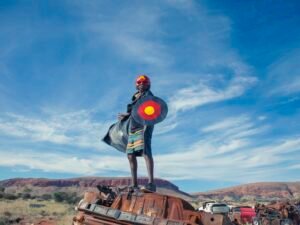
2-Rebekka Deubner, Felix en sicile, 2022

3-Edward Weston, Charis, Santa Monica (Nude in doorway), 1936. Courtesy Wilson Centre of Photography

4-Donna Gottschalk, Self-portrait during a GLF meeting, E. 9th Street, New York, 1970

5-Hoda Afshar, Speak the Wind, 2015-20


1000 Words favourites

• Renée Mussai on exhibitions as sites of dialogue, critique and activism

• Roxana Marcoci navigates curatorial practice in the digital age

• Tanvi Mishra reviews Felipe Romero Beltrán’s Dialect

• Discover London’s top five photography galleries

• Tim Clark in conversation with Hayward Gallery’s Ralph Rugoff on Hiroshi Sugimoto

• Academic rigour and essayistic freedom as told by Taous Dahmani

• Shana Lopes reviews Agnieszka Sosnowska’s För

• Valentina Abenavoli discusses photobooks and community

• Michael Grieve considers Ute Mahler and Werner Mahler’s posthumous collaboration with their late family member 

• Elisa Medde on Taysir Batniji’s images of glitched video calls from Gaza


Join us on Patreon today and be part of shaping the future of photographic discourse


Excluded or Exoticised? The European Gaze in Indigenous Spaces

Across Europe, North America and Latin America, the images of Indigenous photographers are emerging with renewed visibility in exhibitions, biennials and collections, calling us to reconsider, as Sergio Valenzuela-Escobedo does, what it means to speak of ‘Indigenous photography’ in both historical and contemporary contexts. Through an interrogation of photographic and curatorial legacies shaped by colonial discourse, and the field of ‘contemporary art’ more broadly, he writes that the recognition of Indigenous artists should not become an excuse to perpetuate exoticisation, nor a pretext for evading responsibility for those who sustain structural relations of power.


Sergio Valenzuela-Escobedo | Opinion | 23 Oct 2025
Join us on Patreon

Faced with the question of whether the art market might be exploiting the trend in which Indigenous voices rearticulate their own discourses and express them in the first person within the art world – or, alternatively, ‘tokenising’ the presence of Indigenous artists – and whether some states might, in turn, attempt to redeem historical guilt, it becomes necessary to broaden our perspective with a brief review of recent and upcoming events in Europe.


Tony Albert (Kuku Yalanji), David Charles Collins and Kieran Lawson, Warakurna Superheroes #1, 2017. Courtesy the artist and Sullivan+Strumpf.

In the programme of Les Rencontres d’Arles 2025, entitled by its director Christoph Wiesner ‘Indocile Images,’ the Louis Roederer Foundation Discovery Prize was awarded to Octavio Aguilar (Ayuuk), along with three exhibitions with a strong Indigenous presence: On Country: Photography from Australia, Ancestral Futures and Echoes from a Near Future.

The festival’s official poster features the image of an Indigenous child dressed as Captain America – part of the Warakurna Superheroes series by Indigenous artist and artistic director of the National Indigenous Art Triennial Tony Albert (Girramay, Yidindji and Kuku Yalanji), in collaboration with David Collins and children from a remote Aboriginal community in Australia’s Northern Territory. According to its authors, this work interrogates the way optimism can help overcome adversity and dismantle stereotypes, especially those imposed on the nation’s forgotten populations.

Yet, the reality for many Indigenous children diverges painfully from such heroic representation, as evidenced by the winning photograph of Hoda Afshar, recipient of the National Portrait Gallery of Australia’s Portrait Prize 2025. In these communities, children between the ages of 10 and 17 account for only 6.6% of their age group in the general population, yet they are 29 times more likely to be incarcerated.

Three out of five children deprived of liberty are Indigenous, and two out of three of them suffer from a diagnosed mental illness. From an early age, they carry the burden of structural disadvantages, discrimination and criminalisation. What they need is love, care and a supportive community; instead, they are often met with punishment. Detention centres and police stations, far from being spaces of healing, become sites of trauma, abuse and systemic failure. And yet, this reality is tolerated, as if an implicit hierarchy justifies certain forms of violence as normal – or even inevitable. Although Indigenous culture and identity in Australia may be celebrated as heroic, playful and aspirational, the surrounding society often fails to protect its children.

Beyond the French context, it is significant to look toward Venice, where the Golden Lion was awarded to the Australian Aboriginal multimedia artist Archie Moore at the 2024 Venice Biennale, curated by Brazilian Adriano Pedrosa, who affirmed that his biennale opened the door to the global art scene, and thus to Indigenous artists. This declaration is paradoxical, evoking the experience of feeling foreign in one’s own land – a consequence of cultural erasure, territorial dispossession, and, in extreme cases, the extermination of entire peoples – all within the framework of a biennale still divided into national pavilions.

Another case is that of Jeffrey Gibson (Choctaw/Cherokee), who became the first Indigenous artist to represent the United States by occupying the entire pavilion. Already in 1932, Hopi creators such as Fred Kabotie and Awa Tsireh had participated, yet Pedrosa’s opening and Venice’s influence led Tate Modern in London to launch a dedicated fund to increase the representation of Indigenous works in its collection.

In photography, particular attention must be given to the work of Inuuteq Storch (Kalaallit), who represented Denmark and is scheduled to open a new exhibition at the Hasselblad Foundation in Gothenburg in February 2026. Those photographed, like Storch himself, belong to a postcolonial generation. For some, their artistic, social or political choices express a deliberate will to distance themselves from the Danish gaze, in a critical and decolonial perspective. For others – and this is Storch’s case – it is less about reacting to the past than about creating aesthetics rooted in Inuit culture or in dialogue with the global world, outside the colonial prism. Similarly, we can appreciate the work of Seba Calfuqueo (Mapuche), who presented Nunca Serás un Weye (2015) as part of the Disobedience Archive project, and who exhibited their work in Becoming Ocean curated by Ann-Marie Yemsi at the Villa Arson Art Centre in Nice, and who also participated in Activating Environments: New Ways of Thinking of Land, Sea and Life at Art Basel.

Seba Calfuqueo in Conversations: Activating Environments: New Ways of Thinking of Land, Sea and Life. Art Basel, June 2024.

In this list, which does not claim to be exhaustive, one can clearly perceive the intensity of international activity, and less so the anxiety and pressure of a market eager for novelty and commodification. Inspired by this theme, many countries have chosen to explore the ideas of nationality, belonging and diplomacy from Indigenous perspectives. To ‘discover’ a Maya, Mapuche, Yagán, Shipibo, or Inuit photographer has become both a cultural trophy and a mirror reflecting the tensions and contradictions inherent in cultural funding.

Such is the case with investment policies that condition access to natural resources through private companies (some European), such as the mining giant BHP or the oil company Total – entities that sponsor many exhibitions and cultural programmes in Europe while being among the main perpetrators of ecocide in the Amazon. In this context, one cannot forget the suicide of Jaider Esbell during the São Paulo Biennial. At 41 years old, shortly before his death, he wrote a poem titled For the Day of My Departure:

At this moment, my soul must be seeing everything from above,
just as I always dreamed, absolutely free
with no need for protection, foundation, or material connection of any kind.
Below, only the cold and comforting emptiness of infinity.1

This raises the question: How long will the art market – with its collections, festivals and biennials –  continue to contemplate the ‘superstitious from the transversal valleys at the ends of the earth’2 without assuming responsibility for the structural problems afflicting these communities?

Among these issues are the loss of ancestral lands, political marginalisation, economic exploitation, cultural and linguistic discrimination, and the impact of state policies that threaten their ways of life. While the works of these artists are celebrated and commercialised3, many of their communities continue to face poverty, displacement and the erasure of their rights, creating a profound contrast between the aesthetics consumed and the reality ignored. At the heart of the Indigenous art system beats a neoliberal paradox that seems irresolvable.

View of the Danish Pavilion by artist Inuuteq Storch, curated by Louise Wolthers, at the 60th Venice Biennale, Italy, 2024. Courtesy the artist and Venice Biennale.

As mentioned, Octavio Aguilar, an Ayuuk artist, recently received the Discovery Award from the Louis Roederer Foundation, awarded by curator César González-Aguirre at Les Rencontres d’Arles 2025. His work is part of a continuum within Latin American visual arts programmes, in which Indigenous voices rework their own discourses and express them in the first person.

In this article, we will focus specifically on Indigenous photographers and Indigenous artists who employ photography, distinguishing them from non-Indigenous artists who may be intellectually ‘committed’ to the defence of Native peoples. The history of Indigenous photographers is less known and finds its seminal figure in Martín Chambi (Quechua), while also traversing the work of collectives and projects: Taller de Historia Oral Andina (1983), Chiapas Photography Project (1992), Aiwin, la imagen de la sombra (2008), Encuentro de las Culturas Indígenas (2016), up to Maxita Yano (2025) and the Colectivo Lakapoy (2025), which recently inaugurated exhibitions at the Instituto Moreira Salles in São Paulo and the Inhotim Museum, respectively.

Aguilar’s work is situated within the tradition of contemporary Indigenous art but from a distinctive perspective: that of an Ayuuk artist representing his own community in the first person. His work avoids the external gaze typical of ‘intellectualised’ or academic indigenismo, which historically has perpetuated stereotypes and simplifications of Native peoples. Instead, Aguilar proposes a direct communal self-representation, where lived experience and the collective memory of his Ayuuk community become the central axis of artistic creation.

Octavio Aguilar receiving the Louis Roederer Foundation Discovery Award from curator César González-Aguirre, at Les Rencontres d’Arles 2025. Photo: Eulalie Pernelet.

In his exhibition Tajëëw its Kontoy, presented at Arles, Aguilar combines silkscreen, drawing, sculpture, sound, and photography within an installation that constructs a contemporary Indigenous imaginary. His images reveal the coexistence of ancestral and modern elements – traditional papier-mâché masks alongside contemporary sportswear, ritual landscapes juxtaposed with everyday objects – thus generating a dialogue between past and present that challenges the idea of Indigenous culture as something ‘frozen in time.’

In this way, his work reinterprets indigenismo not as an external gaze toward the Other, but as an internal narrative, where culture and identity are expressed from within, marked by irony, subtlety and aesthetic freedom. Moreover, Aguilar frames his work within a critical commitment to power structures and historical memory. Each image functions as an act of reactivating ancestral knowledge, showing how photography and other artistic practices can become tools of cultural and political resistance. By placing his own lived experience at the centre, Aguilar demonstrates that language recovery is not merely a nostalgic gesture, but a creative and emancipatory act that redefines contemporary indigenismo.


Octavio Aguilar, Kontoy, 2020. Courtesy of the artist and Parallel Oaxaca.

Aguilar’s photographic methodology can be defined, from the standpoint of cultural anthropology, as rooted in participatory observation. It stems from his direct involvement with Ayuuk oral traditions – particularly those of his grandmother, Aurea Romero, who constitutes a key figure in this work (as he notes in his introductory text). She has guided him in understanding his cultural genealogy. Through this relationship, Aguilar has reconstructed the memories of Santiago Zacatepec. His conversations with her and with other community members enabled him to develop a narrative that resists the various processes of symbolic colonisation. In the photographs that comprise the project, Aguilar’s friends embody Tajëëw and Kontoy, the ancestors of the Ayuuk people, drawing on visual codes specific to the communal imaginary.

This visuality is organised in different moments that regenerate a memory diluted by the passage of time and the processes of cultural segregation imposed on Indigenous groups throughout Mexican history. Thus, Aguilar’s work reveals the process of neoculturation: a phenomenon that goes beyond the group of men and women often considered marginal – those who constituted the nucleus of the first exchange between metropolis and colonies, that is, between Europe and the Americas – integrating foreign cultural manifestations into their own lives and, consequently, into their own cultures.

Neoculturation responds, first and foremost, to the conditions of a new mestizo culture. Since the creation of this concept, several related terms have emerged: Silvia Rivera Cusicanqui’s notion of ‘ch’ixi’ (grey), Ticio Escobar’s ‘mestizo methodology’, Viveiros de Castro’s ‘cosmopolitics’, Walter Mignolo’s ‘epistemic disobedience’, Oswald de Andrade’s ‘anthropophagy’, and Édouard Glissant’s ‘créolité’. All these ideas advocate cultural pluralism as a way of denouncing and deactivating various forms of discrimination.

Fernando Ortiz coined the term ‘transculturation’ in his analysis of mestizo culture, and simultaneously proposed implicit concepts: deculturation or excultration for the first historical phase of colonial destruction; inculturation, as a substitute for acculturation, to describe the linear phenomenon of submission to the conqueror’s culture; transculturation, for the complete process that fosters reciprocal exchange; and, finally, neoculturation, to defend the creation of a plural culture resulting from the entire process.

Having recalled these conceptual frameworks, the question that remains is whether, in this context, an authentic Indigenous photography can exist. To approach this question, we may examine a self-portrait titled Self-Portrait with Glass Plate (1925) by the photographer Martín Chambi, recognised historically as the first Indigenous photographer. The image speaks to transculturation by placing the Indigenous subject before his own likeness, created with a European and colonising technique on a glass plate. Jorge Heredia, curator of the exhibition Martín Chambi (1891–1973): Photographer of the Andes at the Museum of Ethnography in Rotterdam (1992), writes:

‘Chambi appears as a rotating double-sided mirror in which different subjects contemplate themselves simultaneously from both sides, separated by the same mirror, which at once is the vehicle projecting each image. By a twist of fate, the reverse of the mirror, by the force of physics, projects the image once more, even if only as a reflection in another mirror, leaving only an imaginary trace of that opposed otherness that was there before, perceived at a distance as an inevitable closeness with that other, who is likewise caught in the same trance. Nothing dissolves; everything is present in the same place with brutal nakedness, and yet nothing seems exactly what it appears to be: there is always something more. No one can exist without the other’.4

Like Chambi, other groups also took control of the camera and, consequently, faced the double and the trance of their own representation. Some peoples adopted the photographic medium very early, discreetly capturing images of their own communities. Among them were Jennie Cross Cobb (Cherokee) in Oklahoma and Richard Throssel (Cree) in Montana. From this first generation, Horace Monroe Polar (Kiowa) stands out as one of the few professional Indigenous photographers in North America. In South America, the only comparable figure of the same period is Chambi himself. While little known in the South, two exhibitions of Chambi’s photographs were already held in 1936 – one at the headquarters of the newspaper La Nación and another at the Casino de Viña del Mar, in Chile.


Dorothy Chocolate at VISIONS: The Photographer’s Union conference, Ontario, 1985

In North America, the exhibitions 7 Views of Hopi (1983) and Vision (1985) marked two important, albeit belated, milestones. Vision was both an exhibition and the first conference on Indigenous photography, organised in Canada by a group of Inuit photographers. For its part, 7 Views of Hopi, held at the Northlight Gallery of the University of Arizona, presented the work of Hopi artists Jean Fredericks, Owen Seumptewa, Freddie Honghongva, Merwin Kooyahoema, Georgia Masayesva, and Victor Masayesva. This exhibition revealed a different conception of photography, with one image featuring a wooden figure known as Kwikwilyaqa. Victor Masayesva, filmmaker, video artist and photographer writes:

‘…When I was photographing an elder, he called me Kwikwilyaqa. At that moment, I laughed at how much the comparison fit, at what I was doing with the camera. He likened me to a Katrina, one of those spiritual beings within the Katrina categories devoted to buffoonery, burlesque and social commentary. It appears this way: wearing white man’s clothes, shoes, holding a cane in one hand and a rattle in the other. It has a black mask with protruding cylindrical eyes and a mouth painted black and white. What made me laugh was imagining how much I must have resembled him, leaning over my camera. The cloth surely resembled the juniper bark covering that Kwikwilyaqa wears on his head. Later I realised that perhaps this was the point: when Kwikwilyaqa appears in the central plaza, he casts his shadow on everyone he encounters, imitating each action of his chosen subject, quickly becoming a nuisance’.5

This testimony opens reflection onto a new perspective: the nuisance – understood as a factor that affects health, well-being or environment. Photographers, Indigenous or not, record a singular history that transcends mere technical photography to question relationships with knowledge and beliefs, including the superstitions that shaped these cultures6. Often, the myth is invoked that Indigenous people refused to be photographed for fear that the camera would ‘steal their soul.’ This idea, widely diffused through colonial accounts, is in fact a Western myth that attributed symbolic value to images captured by explorers. In reality, Indigenous resistance to photography is far more complex: it could refer to the taking of the image itself, to the unauthorised circulation of one’s portrait, to the asymmetry inherent in the photographic act, to misunderstandings of the camera’s mechanism, and above all, to the political and spiritual consequences that the act could entail. An analysis of superstitions generated by photography requires us first to reflect on the role of the camera, both as a technical invention and as a Western model of thought imposed on Indigenous cultures – particularly in their funerary rituals7. This raises two important questions: What could be the origin of Indigenous photography? Does there exist an Indigenous technology that approximates the idea of a photographic mechanics based on mimesis?

While the answers to these questions could fill an entire book, it is worth noting that the shutter speed and aperture – the cuts introduced into space-time that generate an image through luminous imprint – are notions entirely foreign to Indigenous conceptions of imitation and vision. One hypothesis would be to establish a parallel between the photographic ‘alteration’ of time, which produces an image from a luminous imprint, and certain visionary shamanic practices that provoke mental images. In this sense, Claude Lévi-Strauss opens a path in La pensée sauvage (1962), reminding us that:

‘Instead of opposing magic and science, it would be preferable to place them in parallel as two modes of knowledge, unequal in their theoretical and practical results (for in this respect, it is true that science achieves greater success than magic, although magic prefigures science insofar as it too sometimes succeeds), but not in terms of the type of mental operations they suppose, which differ less in nature than in the function of the phenomena to which they are applied’.8

In considering these different ‘ways of seeing’ that might be set in parallel, it is necessary to address another topic closely linked to colonial history: the idea that, from the United States to Patagonia,

Indigenous art is defined by geometric abstraction, chromatic richness and decorative diversity – from the pre-Columbian period to the present. Yet, as we shall see, such characteristics find little correspondence in the history of contemporary photography by Indigenous creators.

In recent history, we find a 1995 portfolio of photographs published in Aperture magazine: Strong Hearts: Native American Visions and Voices. It included works by Walter Bigbee (Comanche), Luci Tapahonso (Navajo), Jeffrey M. Thomas (Iroquois/Onondaga), N. Scott Momaday (Kiowa), Paul Chaat Smith (Comanche), and Zig Jackson (Mandan/Hidatsa/Arikara). This portfolio accompanied the exhibition of the same name at the Smithsonian Museum in Washington in 1996 (it is worth noting that Zig Jackson is the first contemporary Indigenous photographer represented in the collections of the U.S. Library of Congress, after donating twelve large gelatin silver prints in 2015). Among them is the ironic series Indian Photographing Tourist Photographing Indian (1992), where Jackson portrays intrusive tourists pointing their cameras at Indigenous faces in a reservation. What deserves emphasis in this series is a central problem: the notion of the apparatus (dispositif), understood as the constitutive mediation that organises the relationship between photographer and photographed. From the perspective of an Indigenous photographer – or any photographer – it acquires particular epistemological weight, as it structures ways of seeing and representing. The apparatus, as defined by Czech-Brazilian philosopher Vilém Flusser, is:

‘A complex toy (the apparatus), so complex that those who play with it cannot fully understand it. Playing with it consists in combining the symbols contained in its programme – a programme that is itself inscribed in a meta- programme – and the outcome of the play is formed by other programmes still. While fully automated apparatuses can dispense with human intervention, many others require man as both player and functionary.’9

Zig Jackson, Camera in face, Taos, New Mexico, 1992. Courtesy the artist and Library of Congress, Prints & Photographs Division.

In his essay Ghost in the Machine, published in the same 1995 issue of Aperture, Paul Chaat Smith (Comanche) offers an overview of the specific perspective of the ‘Indigenous functionary,’ borrowing Flusser’s language. His text illuminates a particular relationship with the apparatus, one shaped by the history of Indigenous peoples:

‘In 1840, when the war against us was going badly, a visionary Texas Ranger named Sam Walker undertook an extraordinary journey. Walker knew that only a considerably improved firearm could guarantee the success of his Rangers. He therefore went to the Colt factory in Paterson, New Jersey, and worked with Colt himself to develop the world’s first repeating revolver: the ‘Walker Colt’ .44 calibre. The revolver that revolutionised warfare against the Indians and weaponry in general – was a machine designed with a single purpose: to kill Comanches. To underscore this, each weapon bore an engraving of a battle between Comanches and Texas Rangers. We tried desperately to acquire these new weapons, but our success was limited: imagine a member of the Crips attempting to buy a dozen Stinger shotguns during the Los Angeles riots in 1992 – not impossible, but very, very difficult. It would have been necessary to invent a special camera to photograph Indians as well, given the considerable influence of photography on us. If one machine nearly annihilated us – we were little more than a thousand when my grandparents were born at the beginning of the century – another gave us immortality.’10

From the earliest days of photography, theorists such as Roland Barthes, Siegfried Kracauer and Susan Sontag have identified within it a notion of immortality – as Chaat Smith observes – linked to the trace that bears witness to events and to the photographer’s presence in a given place. Yet the idea that the camera could grant immortality in the spirit of a Comanche transforms our understanding of anthropological photography, as well as colonial and decolonial discourses. While certain historical photographs allow the recovery of forgotten traditions, more recent productions expand the global visibility of Indigenous struggles. They are increasingly accompanied by the participation of Indigenous artists and curators in the contemporary art world, whose repercussions were analysed earlier in this article.

More recent examples include the prize awarded to Octavio Aguilar, as well as the work of Wendy Red Star (Apsáalooke), who in 2020 was invited to guest-edit Aperture for a special issue devoted to Indigenous photography and practice. Titled Native America, it was the first time Aperture had been edited by an Indigenous artist, signaling an evolution from the historical invisibility that long affected these creators. In Chile, several artists are now entering the international contemporary art circuit. Such is the case with Sebastián Calfuqueo and Paula Baeza Pailamilla, who work with photography and video, following in the footsteps of Francisco Huichaqueo and Bernardo Oyarzún – the first Mapuche artist to represent Chile at the Venice Biennale in 2007 with the project Werken, an artistic inquiry into his Mapuche roots begun in the late 1990s under the curatorship of Ticio Escobar.

Despite concentrated efforts to increase visibility, specifically Indigenous photographic practice remained largely isolated up to the year 2000; it did not significantly displace the entrenched visual stereotypes that folklorise tribes and communities. Even so, the work of these Indigenous photographers began to influence institutional policies around image acquisition and dissemination. More importantly, photography continued to be central to rebuilding Indigenous personal and collective identity. Yet, at this stage, ‘Indigenous photography’ should not be considered solely through the lens of cultural difference; doing so would obscure the numerous stylistic similarities that characterise our era across cultures. Furthermore, Indigenous photography is directly connected to concerns that are not only identitarian but also global.

In other words, it is necessary to consider it at the level of the individual, independently of ethnic belonging. Although practices are singular, these artists share a common objective: to promote the reappropriation of their various cultures by the communities themselves, rather than by outsiders, as was long the norm. For decades, photographs of Indigenous peoples made by settlers perpetuated unreal symbols or showed only the negative aspects of life. Whereas the humanity of these peoples was absent from thousands of stereotyped images, today the Indigenous photographer, equipped with a camera, produces a productive estrangement in order to return what is captured to the community itself – now functioning as a steward of memory.

My partial conclusion is that the notion of ‘Indigenous photography’ is a myth. To approach a truly Indigenous photography, the artist must unravel, within their own inheritance, the ‘photographic programmes’ that condition their gaze and embrace the enigma of the camera’s darkness as a creative principle. The search for an Indigenous point of view should be undertaken only by someone from the community – underscoring the impossibility for an external observer to define a position vis-à-vis the apparatus’ programmes. Ultimately, however, this issue concerns any photographer or artist who wishes to occupy the photographic medium for creative ends: it compels attention to the apparatus and to the challenges of the global photo industry, placing the ‘black box’ at the centre, simultaneously observed by the photographer and those photographed. It may be worthwhile to explore concepts such as pre-photography, always with the awareness that the artist – freed from the dictates of Mr. Kodak, Canon, or Nikon – can untangle their own heritage and confront the camera’s enigma. Only then can a truly photographic act emerge: not as nostalgia for the authentic, but as a radically new creation founded on cultural genealogy.


Kwikwilyaqa, from the James T. Bialac Native American Art Collection

Octavio Aguilar is not oblivious to this problematic. In his photographic work, he operates a device that inevitably intertwines modern and colonial inheritances. After a close examination of each proposal by the eight artists selected by curator César González-Aguirre, the jury unanimously decided to award the prize to Aguilar for his project Tajëëw its Kontoy.

The decision rested on a shared conviction: in a European context where the inclusion of historically marginalised communities is perceived as an ethical and aesthetic urgency, it is indispensable to expand the visual and artistic spectrum. Recognising aesthetics distant from traditional European canons is not merely a gesture of openness; it is the very condition for introducing new visual codes into contemporary discourse on cultural diversity. This inevitably provokes suspicion, since – as we noted earlier – these new visual codes can be leveraged to capitalise on recent curatorial work by institutions that position themselves critically vis-à-vis their own histories. It is a cultural opportunism we should continue to scrutinise carefully.

The jury emphasised the value of orally transmitted narrative forms, passed down from generation to generation, recognising them as legitimate carriers of knowledge and memory. In this context, Aguilar’s portraits – staged in environments that evoke the Ayuuk imaginary – dialogue with fragments of punk textiles, printed with slogans in favour of Indigenous autonomy, constituting a visual space where tradition and contemporaneity intersect, tension and mutually amplify. His multidisciplinary work thus appears as an act of symbolic resistance: it preserves transcultural memory in the face of vertiginous globalisation and the homogenisation of ways of life, transforming his photographic practice into a terrain of identity affirmation and aesthetic experimentation.

The jury, speaking in French and Spanish, underlined with particular emphasis that this was not a ‘discovery’ – a term heavy with colonial resonances, as when the Americas were ‘discovered’ – but rather an acknowledgement of continuity and visual genealogy, and with it, the assertion of a legitimate place within the contemporary photographic community.

Ultimately, the recognition of Indigenous artists should not become an excuse to perpetuate exoticisation, nor a pretext for evading responsibility for those who sustain structural relations of power. Although these artists contest stereotyped representations and hegemonic discourses by giving voice to their communities and making visible realities too often ignored, it remains insufficient so long as their voices are kept within contemporary art institutions without reaching parliaments – as suggested by Michael Cook (Bidjara) in his photographic series from 2014, Majority Rule.

In this context, we might ask whether a more forceful political gesture is not required. Indigenous artists are well aware of this situation – Michael Cook or Seba Calfuqueo state it clearly. In a conversation in Basel, Calfuqueo says:

‘…the art world has always been an uncomfortable space. I have no point of reference within my community, because no one else occupies the position I have now. Even so, this conflict is part of what it means to exist in the art world. At some point, I think we choose to remain in this space because we accept and even embrace that discomfort. I have come to understand that the uncomfortable zone can be a space for creativity’.11

Perhaps we must transform our perception of the apparatus and, in a metaphorical sense, invert the camera – direct it toward those responsible, not only toward victims. This is a critical stance that seeks to expose structures of power, injustices and responsibilities implicated in each situation. It entails shifting the gaze from representations centred on vulnerable subjects to images that lay bare the actors, institutions and systems that perpetuate inequality. In this way, photography could become a tool for deconstruction and social critique, a strategy of institutional subversion that goes beyond mere documentation.

This perspective inevitably forms part of a broader discussion on political art and the limits of its real efficacy: Why do we trust that contemporary art institutions can influence political decision-making?

Perhaps the true task is not to inscribe oneself in the field of contemporary art, but to explore ‘something else’ that as yet lacks a name. Otherwise, the gesture risks shrinking to a politics of visibility – the capacity to occupy space in museums and institutions – rather than an artistic creation in its own right. This raises new questions: Why seek recognition as a contemporary artist? What does it mean to aspire to participate in an international festival? And why should a curator assume the role of mediating an Indigenous artist’s discourse under the codes of Western museology?

If Europe continues to look toward the Americas, it must go beyond aesthetic findings and recognise the histories, struggles and resiliencies that undergird these creations, incorporating into exhibitions their contexts of production and the consequences for communities. Only then can it cease to be a showcase of exoticisms and become a space of dialogue, justice and authentic visibility. It is necessary, however, to remember that the system is not innocuous. Even as exhibitions foster alliances with Indigenous peoples, confront extractivism and promote environmental education, Europe remains ensnared in ethical-political paradoxes, where good intentions collide with entrenched structures of power.♦


Sergio Valenzuela-Escobedo is an artist and researcher whose practice lies at the confluence of artistic research, curatorial work and education. He holds a PhD in photography from the École Nationale Supérieure de la Photographie (ENSP, Arles). Valenzuela-Escobedo has curated numerous exhibitions, including Mapuche at the Musée de l’Homme in Paris, as well as Monsanto: A Photographic Investigation and Bosques Geométricos, both of which premiered at Les Rencontres d’Arles. Monsanto was the winner of the Paris Photo/Aperture Book Award and shortlisted for the Deutsche Börse Foundation Photography Prize 2018. In 2023, he presented the trilogy Mama Coca, Ipáamamu and Oro Verde at Fotofestiwal in Łódź, Poland. In 2025 he curated Lightseekers for Bienal’25 Fotografia do Porto, Portugal. He is Associate Curator of the Guyane Biennale 2027 and serves as Artistic Director of Double Dummy. As an art critic and researcher, Valenzuela-Escobedo regularly contributes to publications such as Inframince, 1000 Words, Mirá, and Letargo.

References:

1 Jaider Esbell, Para el día de mi partida, in Tardes de Agosto, Manhãs de Setembro, Noites de Outubro, Boa Vista, 2013.

2 Eugenio Dittborn, Nous les artistes de provinces lointaines, in ArtPress 62, Paris, 1982.

3 The study of pre-Columbian art collections is a field of great interest in my research, particularly in the case of the collection assembled by Louise and Walter Arensberg, which is currently held at the Philadelphia Museum of Art.

4 Jorge Heredia, La imagen elusiva de Martín Chambi, Espacio Graf (online), Mérida, 1992.

5 Victor Masayesva Jr. and Erin Younger, Hopi Photographers / Hopi Images, Tucson, University of Arizona Press, 1983.

6 Two expressions establish themselves as the princeps notions in my argument in favour of an Aboriginal science, for lack of another way to name it. The first is the popular expression among the Fuegian people, Toumayacha Alakana, which means “to look with one’s head covered by a veil.” The second corresponds to the Yanomami expression Noreshi Toway, which means “to take the double of a person.” These two expressions are at the origin of my thesis on the atavistic fear of image capture.

7 For further study on the subject, see: Sergio Valenzuela-Escobedo, MÄNK’ÁČEN: Photographic Mechanics, Mysticism, and Superstition among the Indigenous Peoples of South America, dissertation in practice and theory of artistic and literary creation, École Nationale Supérieure de Photographie (ENSP Arles) and Université d’Aix-Marseille, 2021.

8 Claude Lévi-Strauss, La pensée sauvage, Paris, Plon, 1962.

9 Vilém Flusser, Pour une philosophie de la photographie [Für eine Philosophie der Fotografie, 1983], Paris, Circé, 1996.

10 Paul Chaat Smith, Ghost in the Machine, in Aperture no. 139 (Strong Hearts: Native American Visions and Voices), New York, Aperture Foundation, 1995.

11 Seba Calfuqueo in Basel Conversations: Activating Environments: New Ways of Thinking of Land, Sea and Life. Art Basel, June 2024.


1000 Words favourites

• Renée Mussai on exhibitions as sites of dialogue, critique and activism

• Roxana Marcoci navigates curatorial practice in the digital age

• Tanvi Mishra reviews Felipe Romero Beltrán’s Dialect

• Discover London’s top five photography galleries

• Tim Clark in conversation with Hayward Gallery’s Ralph Rugoff on Hiroshi Sugimoto

• Academic rigour and essayistic freedom as told by Taous Dahmani

• Shana Lopes reviews Agnieszka Sosnowska’s För

• Valentina Abenavoli discusses photobooks and community

• Michael Grieve considers Ute Mahler and Werner Mahler’s posthumous collaboration with their late family member 

• Elisa Medde on Taysir Batniji’s images of glitched video calls from Gaza


Join us on Patreon today and be part of shaping the future of photographic discourse


10 Must-See Exhibitions: Autumn 2025

Our quarterly guide to the global art calendar is back with must-see exhibitions for Autumn 2025, taking in galleries, museums, festivals, and project spaces from Milan to Beijing.


1000 Words | Resource | 7 Oct 2025
Join us on Patreon

Nan Goldin, This Will Not End Well – Pirelli HangarBicocca, Milan
11 October – 15 February

At Milan’s Pirelli HangarBicocca is the most comprehensive presentation of Nan Goldin’s slideshows to date, billed as her debut solo exhibition as a filmmaker. As with its previous presentation in Berlin, Goldin’s works are housed within structures designed by architect Hala Wardé, a longtime collaborator of the artist. In what she calls a ‘village,’ Goldin’s hallmark themes; intimacy and connection, the everyday alongside wild parties, and the tension between autonomy and dependency, are brought to life and into conflict in a way that mirrors the complexity and instability of the lives she chronicles. The show also features two works making their European museum debut alongside a newly commissioned sound installation.

Poulomi Basu, Phantasmagoria – Fotomuseum Winterthur, Switzerland
25 October – 15 February

Phantasmagoria, the title of Poulomi Basu’s first major solo exhibition at Fotomuseum Winterthur, draws on the ghostly spectacle of 18th-century lantern shows – those early cinematic illusions that conjured spirits, staged the supernatural and flirted with resurrection. This legacy of apparitions and imagined worlds threads Basu’s own transmedia universe, where photography, virtual reality, film, and performance collide. For over a decade, Basu has immersed herself in the lives of some of the world’s most marginalised women and through this prolonged, often deeply personal engagement, her documentary mode meets ecofeminist myth, and the real slips, hauntingly, into the fantastical.

Richard Avedon, In The American West – Fondation Cartier Bresson, Paris
30 April – 12 October

To mark 40 years since the publication of In the American West, Fondation Henri Cartier-Bresson has taken a bold look back at Richard Avedon’s iconic portrait series. Shot over five years and spanning more than 1,000 sitters from miners to performers to salesmen Avedon’s stark, white-backdropped images strip away frontier mythology to reveal the raw human drama of the American West. The exhibition assembles over 100 master prints from the original book, presenting the complete photographic series for the first time in Europe, and features previously unpublished archival materials that document its formation and imprint. Abrams has reissued the long out-of-print book, returning a classic to shelves.

Lisa Barnard & Isadora Romero, After Nature Photography Prize 25 – C/O Berlin
27 September – 28 January

C/O Berlin announces the winners of the After Nature Photography Prize 25: Lisa Barnard and Isadora Romero. Accompanied by a dedicated publication from Hartmann Books, a double exhibition of Barnard’s and Romero’s work is on view at C/O Berlin before travelling to the Open Space of the Crespo Foundation in Frankfurt in spring 2026.

Barnard’s project, You Only Look Once, takes inspiration from Thomas Nagel’s essay What Is It Like to Be a Bat?, investigating how emerging technologies – from animal echolocation to driverless vehicles, lithium mining, and nuclear test sites – reshape human sensory experience and ecological awareness. Notes on How to Build a Forest is described as ‘a decolonial reflection on our relationship to the world,’ in which Romero examines the colonial framing of tropical rainforests, combining classical documentary photography, organic materials, and experimental development processes to propose a more thriving relationship between environment and inhabitants.

I Still Dream of Lost Vocabularies – Autograph, London
10 October – 21 March

Autograph hosts a major group exhibition curated by Bindi Vora that interrogates the photograph as a site of mutability, a site to be fragmented, sutured and recharged through the idioms of collage and photomontage. Probing the politics of representation and its limits, the participating artists complicate the ‘constructed’ image, questioning whether it can bear the weight of contested narratives where language falters. With over 90 works by 12 contemporary artists, the participating artists turn to collage and summon its long history of political dissent to splinter the photograph’s presumed coherence and loosen the knots between image and the political.

Alice Poyzer, Other Joys – Serchia Gallery, Bristol
30 October – 30 November

Tucked into a Victorian house on the hillside in Cotham, Bristol, Serchia Gallery is a not-for-profit space run by Christine Marie Serchia. Other Joys, introduces the work of young British photographer Alice Poyzer, who recently received the British Journal of Photography’s Female in Focus Award, among other accolades. Poyzer, in her own words, describes the project as “an ongoing body of work that highlights my special interests as a woman with autism, through portraits and constructed imagery.” The resulting black-and-white photographs linger on butterflies, animal shows, and pieces of taxidermy; precise images that gently affirm self-acceptance and open a window onto Poyzer’s way of moving through the world.

Sam Contis, Moving Landscape – The Art Gallery of Western Australia
31 May – 9 November

AGWA hosts the first Australian solo exhibition of acclaimed US photographer Sam Contis, presenting over 85 works in dialogue with the histories of photography and film, and broadly with narratives of gender, place‑making and belonging. Bringing together the series Deep Springs, Overpass and Cross Country, Moving Landscape follows Contis’ exploration of how bodies and landscapes shape one another, from the deserts of the American West to the footpaths of rural England and the cross-country trails of Pennsylvania. It is a welcome selection of works, rhythmically composed, yet carrying us on a complex journey through terrain, through time and through ourselves.

Hoda Afshar, Performing the Invisible – Musée du quai Branly – Jacques Chirac
30 September – 25 January 

Hoda Afshar’s research into the history of gazes and her visual experiments with the image converge at the Musée du quai Branly – Jacques Chirac, which presents her first major exhibition in France. The show brings two chapters of her practice into conversation: Speak the Wind (2015–20) and The Fold (2023–25). The latter draws from archival materials uncovered during Afshar’s own research at the museum, confronting orientalist and colonial photographic legacies. Meanwhile, Speak the Wind journeys to Iran’s southern coast, exploring the beliefs and stories tied to the winds that shape life on the islands of the Strait of Hormuz. Through photographs, videos, sound, and printed mirrors, a bridged path emerges between the two where invisible narratives begin to take form.

Chow and Lin, Even If It Looks Like Grass – Bounded Space, Beijing
6 September – 8 October

Artist duo Chow and Lin’s first solo exhibition in Beijing brings together previously shown works that investigate the systems of wheat and data centres across 10,000 years of human history, alongside new pieces created for this multi-room installation, incorporating AI models, food security research and immersive sensory experiences. The Beijing-based husband-and-wife duo, long active on the international stage for their engagement with global policy and research, continue their inquiry into how statistical, mathematical, and computational methods map the world’s vulnerabilities – a chance to see works from 8 projects across Chow and Lin’s 15-year art journey.

New Photography 2025, Lines of Belonging – MoMA, New York
14 September – 17 January

True to its name and marking its 40th anniversary, the New Photography programme brings together 13 international artists and collectives from Johannesburg, Kathmandu, New Orleans, and Mexico City, each presenting distinct bodies of work for the first time. Exploring the tangible and intangible forces that bind communities together, the show “draws out connective threads within, across, and beyond the idea of borders,” says curator, Roxana Marcoci. Highlights include Sandra Blow’s vibrant portraits of LGBTQ+ youth in Mexico City, The Public Life of Women project chronicling Nepali women’s experiences, and Gabrielle Garcia Steib’s installations linking Latin America and the American South, among others.♦

–1000 Words

Images:

1-Nan Goldin, Self-Portrait with Eyes Turned Inward, Boston, 1989

2-Poulomi Basu, from the series Fireflies, 2019

3-Richard Avedon, Annette Gonzales, housewife, and her sister Lydia Ranck, secretary, Santuario de Chimayo, New Mexico, Easter Sunday, 4/6/80. © The Richard Avedon Foundation

4-Isadora Romero & Ailín Blasco, Palms at Mache Chindul, 2024

5-Sheida Soleimani, Magistrate; from the series Flyways, 2024

6-Alice Poyzer, A taxidermy kitten, with additional wings, held in the air; from the series, Other Joys

7-Sam Contis, Clover 2019

8-Hoda Afshar, Untitled #2, 2015-20

9-Chow and Lin, Even If It Looks Like Grass, 2024. Courtesy the artists and Bounded Space

10-Prasiit Sthapit, Saloni and friends (2013); from Change of Course, 2012-18


1000 Words favourites

• Renée Mussai on exhibitions as sites of dialogue, critique and activism

• Roxana Marcoci navigates curatorial practice in the digital age

• Tanvi Mishra reviews Felipe Romero Beltrán’s Dialect

• Discover London’s top five photography galleries

• Tim Clark in conversation with Hayward Gallery’s Ralph Rugoff on Hiroshi Sugimoto

• Academic rigour and essayistic freedom as told by Taous Dahmani

• Shana Lopes reviews Agnieszka Sosnowska’s För

• Valentina Abenavoli discusses photobooks and community

• Michael Grieve considers Ute Mahler and Werner Mahler’s posthumous collaboration with their late family member 

• Elisa Medde on Taysir Batniji’s images of glitched video calls from Gaza


Join us on Patreon today and be part of shaping the future of photographic discourse


How can hair be a political symbol?

At Museum Folkwang, GROW IT, SHOW IT! investigates the relationship between hair, identity and gender performance across cultures. Spanning 150 years of photographic history, from Victorian cartes de visite to TikTok screenshots, the exhibition presents hair as both personal expression and a political symbol. Drawing on lived experience and cultural movements – feminism, queer identity, civil rights, and post-colonial struggles – Song Tae Chong charts the shifting significance of hair over the course of time.


Song Tae Chong | Exhibition review | 28 Nov 2024

One of my favourite sets of childhood memories is of my grandmother and I. Every morning before I went to school, she would carefully sit me down in front of the fire that she had built in our living room. My socks would be hanging on the smoke screen, warmed for my always too cold feet. Out came her comb, and she would carefully part my hair down the middle, quickly putting my hair into one of three hairstyles: a ponytail, two long braids down my back, or my personal favourite, one long braid starting at the nape of my neck done in the traditional Korean style for young girls. She would either adorn my hair with a ribbon or barrettes, but would always tie up my long strands with hair elastics that had big plastic balls attached. They would sit on my head, like a crown of precious plastic gems. The daily ritual that my grandmother and I had ended once I entered my preteen years and embarked on my own path of hair self-discovery.

When I braid my own hair now, although it is never as neatly and symmetrically arranged as when she did, I think of her and these moments we had, ones that I knew she had with her own grandmother. It was those memories that came flooding back as I opened the pages of the sprawling catalogue produced in conjunction with the exhibition of the same name, GROW IT, SHOW IT! A Look at Hair from Arbus to TikTok by Museum Folkwang in Essen, Germany.

Early on in the exhibition, Hoda Afshar’s triptych of images from the series Turn (2022) depicting women both braiding and holding hair, the braids both ordered and fragile as tendrils escape their pattern and are blown by the wind, speaks to its prevailing themes: connection and community. The subject of hair is explored through a variety of media, from art photographs to images from fashion and advertising as well as anonymous vernacular photographs. These images speak to the ways in which every day people use hair as a means of identity formation and assertion, cultural and social connection, whether for personal, social and political reasons and, of course, for aesthetics.

Spanning approximately 150 years of photographic activity, the catalogue also situates hair within historical contexts. Highlighting queer, feminist, post-colonial, and oppositional politics as well as conventional beauty standards and representations, the photographs assembled show how all of these movements have shaped and reshaped our understanding of hair as visual culture. The catalogue and exhibition serve as both an overview of hair as style and as political and cultural communication. Led by Thomas Seelig and Miriam Bettin, it is an ambitious and expansive curatorial endeavour utilising a wide array of representations of hair. Cartes de visite showing flowing locks of Victorian era hair and screenshots from TikTok refer to the long-standing relationship between hair as the subject of photography and image culture.

Punctuating a diverse and extensive survey of images are critical essays, placing these works within discourses that help to anchor them within a critical context. Lori L. Tharps’ essay “Hair I am” speaks to the legacy of disruption as well as cultural erasure via hair within the history of African people, both as colonised in situ as well as in the forced diaspora of the circum-Atlantic slave trade. Broken lineages, broken cultures, erasure of community building and status symbols, all of this played out in the politics of hair. She writes, ‘For better or worse, the hairstyles worn by African American people, from the 18th century through modern times, continued to signal a person’s status in society. From their politics to their profession, Black hairstyles supposedly said it all.’ Many of the featured works help to illustrate this idea. In a photograph from the archives of The Awa Women’s Group at the Bopp Social Center, a group of women are shown reading and laughing together, each with a unique head wrap as adornment and personal expression of style. A photograph of Angela Davis, with her afro, show how the disruption of attempts to control and tame Blackness played a pivotal role in political movements. The series by Nakeya Brown Sof-m-Free, Afro Curls, X-Possessions: Black Beauty Still Lives (2020/2024) depict objects of self-care, the material culture of black beauty and the symbolic codes understood and shared amongst black women as well as the impact that these products and their packaging had on beauty standards.

GROW IT, SHOW IT! also looks at the importance of hair and its relationship to identity and gender performance across different cultures. Paul Kookier’s Untitled 2020 is both a photographic abstraction and stark depiction of male body hair, to be viewed as a symmetrical form while at the same time challenging the visual culture of male body representation. Images from Satomi Niyoung’s ’70s Tokyo LONG HAIR INVERTED, itself a study on the typology of the hairstyles of the time, suggests the disappearing self, in silhouette or as the inverted image, only distinguished by the outline and shape of hair.

GROW IT, SHOW IT!  with its various points of emphasis invites the viewer to think again at the photographs that they have looked at, providing essential frameworks for interpretation. The project obliges viewers to read the semiotics of hair with renewed perspectives, across contexts and time. Viewers are invited, even nudged, to look closer, to probe deeper, to survey the wide array of photographs presented. The images also invite nostalgia and moments of levity. As historical and social and cultural indicators and signifiers, these representations of hair or even its absence within certain visual cultures ask us to reconsider its place in our own lives and how we construct meaning. ♦

GROW IT, SHOW IT! A Look at Hair from Arbus to TikTok runs at Museum Folkwang, Essen, Germany, until 12 January 2025


Song Tae Chong is a Berlin and New York based photography curator, advisor, and writer. Her research focus is on postcolonial visual culture, epistemologies of memory and documentary photography. She is currently a Trustee of the Martin Parr Foundation and teaches photography and theory at UE Berlin. 

Images:

1-Hoda Afshar, “Untitled #4”, from In Turn, 2022. Courtesy Milani Gallery, Meeanjin/Brisbane © Hoda Afshar 

2-Chaumont-Zaerpour, Untitled, 2023. Published in The Gentlewoman

3-Dorothea von der Osten, Untitled, 1950s

4-Anna Ehrenstein, Western Girl, 2017

5-Suffo Moncloa, Gucci / The Face Issue 9, 2021

6-Graciela Iturbide, Mujer Ángel, Desierto de Sonora, Mexico, 1979

7-Viviane Sassen, “Kine”, 2011, from Parasomnia. Courtesy Stevenson Gallery © Viviane Sassen

8-Paul Kooiker, Untitled (Hercules), 2020. Courtesy tegenboschvanvreden, Amsterdam © Paul Kooiker

9-Nakeya Brown, “Sof-n-Free” from X-Pressions: Black Beauty Still Lifes, 2020

10-Torbjørn Rødland, Legs and Tail, 2020

11-August Sander, Secretary at Westdeutscher Rundfunk in Cologne, 1931/1982. © The Photographic Collection/SK Foundation for Art and Culture – August Sander Archive, Cologne; VG Bild-Kunst, Bonn 

12-Tessica Brown, Gorilla Glue Girl, 2021. TikTok Reel, 59 seconds

13-Thandiwe Muriu, Camo 2.0 4415, 2018

14-Helmut Newton, Courrèges, French Vogue, 1970. © Helmut Newton Foundation, Berlin

15-Rineke Dijkstra, Almerisa, Wormer, the Netherlands February 21, 1998


1000 Words favourites

• Renée Mussai on exhibitions as sites of dialogue, critique, and activism.

• Roxana Marcoci navigates curatorial practice in the digital age.

• Tanvi Mishra reviews Felipe Romero Beltrán’s Dialect.

• Discover London’s top five photography galleries.

• Tim Clark in conversation with Hayward Gallery’s Ralph Rugoff on Hiroshi Sugimoto.

• Academic rigour and essayistic freedom as told by Taous R. Dahmani.

London city guide

Top five photography galleries

Selected by Tim Clark and Thomas King

As the dust settles on Photo London 2024 and Peckham 24 – the capital’s two key points of reference within the UK photography calendar – we benchmark five leading London galleries and museums who are making a sustained effort to create productive and welcoming spaces for the encounter, use and consideration of photography today.


Tim Clark with Thomas King | City guide | 14 June 2024 | In association with MPB

At a time when the funding climate in the UK is at its least favourable in decades, setting up – let alone sustaining – a gallery dedicated to the art of photography, public or otherwise, is far from straightforward. The sector is currently groaning under the weight of government funding cuts, exorbitant energy bills, messy logistical and bureaucratic ramifications arising from Brexit, the fallout of the pandemic and cost of living crisis; not to mention the constant undermining of the arts in education in favour of science, technology, engineering and mathematics (STEM) subjects at the hand of the outgoing Tory party, allied with pedalling culture wars and all round anathema.

Yet, despite – and even in spite of – these significant challenges, the UK government’s own estimates show that the creative industries generated £126 billion in gross value added to the economy and employed 2.4 million people in 2022 alone. A global leader clearly, but one that is woefully underfunded, leaving an increasing amount of arts organisations out to dry as they struggle to thrive in one of the world’s most expensive cities. In a parallel universe, the city of Berlin’s culture budget for 2024 is set at €947 million (with a population of 3.56 million) while the entire culture budget for England in 2024 pales in comparison at £458.5 million (with a population of 57 million): two wildly different per capita spends.

Meanwhile, in March this year, opposition party leader Kier Starmer spoke at the Labour Creatives Conference claiming he would “build a new Britain out of the ashes of the failed Tory project” and restore, what he called, the UK’s “diminished” status on the global stage. His top line pledges were as follows: getting art and design courses back on the curriculum, supporting freelancers’ rights, cracking down on ticket touting and improving access to creative apprenticeships. Essentially, promising to ensure creative skills are a necessity, not a luxury. To use the creative industries as a form of soft power. But it will require a detailed arts strategy coupled with fierce and charismatic advocates, and, crucially, increases in funding for the arts to European levels to get the UK’s cultural infrastructure back on sturdier ground. It is nothing short of a miracle, then, to have London gallery and museum spaces fully participating in a civic society at such a high calibre level.

What follows is a rundown of five leading London galleries and museums who are making a sustained effort to create productive and welcoming spaces for the encounter, use and consideration of photography today. It should be noted that there are a handful of medium specific spaces that haven’t been included, but doubtless could be. Among them: the ambitious British Centre for Photography currently looking for a permanent home; Tate, whose new Senior Curator of Photography and International Art, Singaporean Charmaine Toh, is just a few months in post; beloved and sorely missed Seen Fifteen (its founding director Vivienne Gamble now channels her energies towards growing the annual photography festival Peckham 24); Webber Gallery, which has seemingly shifted the emphasis of its exhibitions’ focus to a vast Los Angeles space; not neglecting to mention stalwart dealer Michael Hoppen whose eponymous gallery no longer operates from its multi-floor premises on Jubilee Place, instead opting for a location in Holland Park. Hopefully that goes some way to account for their omissions. There are other bricks and mortar spaces too: Hamiltons, MMX, Atlas, IWM’s Blavatnik Art, Film and Photography Galleries, TJ Boutling, Huxley-Parlour, Leica, Photofusion, Albumen, Purdy Hicks, Camera Eye, Augusta Edwards Fine Art and Doyle Wham, all worthy of a mention and giving much cause for celebration.

Autograph

Autograph
Rivington Place, London, EC2A 3BA
+44 020 7729 9200
autograph.org.uk

Every exhibition that Autograph stages is unmissable. The organisation’s remit is to ‘champion the work of artists who use photography and film to highlight questions of race, representation, human rights and social justice’, and it offers opportunity after opportunity to see powerful and vitally important work. Far from jumping on any bandwagon, this mission has long been embedded within the organisation, its practices and via ambitious work. Autograph was established in 1988 to support black photographic practices, and began in a small office in the Bon Marché building in Brixton, when it was known as the Association of Black Photographers (ABP). It applied for charitable status and moved to a permanent home at Rivington Place in Shoreditch in 2007, the first purpose-built space dedicated to the development and presentation of culturally diverse arts in England, decades before museums considered it necessary to start rethinking themselves.

Autograph punches significantly above its weight, and has long been an essential port of call for any photography lover living in or coming through the city, not to mention the impact on the capital’s culture at large. Largely owing to the skill and determination of visionary director Mark Sealy OBE – in post since 1991 – and talented and rigorous curator Bindi Vora, exhibitions at Autograph are born out of a professional methodology that is fundamentally interdisciplinary and grounded in both real-life research and experience. Yet it also moves past cultures of “them and us” to routinely bring to life transgressive and inclusive commissions, projects and publications.

As one of Arts Council England’s National Portfolio Organisations (NPO), Autograph saw a 30% uplift increase from £712,880 to £1,012,880 a year to support its work for the period of 2023–2026 (as per the last round of funding decisions announced in 2022). Stuart Hall once served as a chair on the board and Autograph’s unique collection contains works by Rotimi Fani-Kayode, Zanele Muholi, James Barnor, Lina Iris Viktor, Yinka Shonibare, Ingrid Pollard, Joy Gregory, Colin Jones, Phoebe Boswell, Raphael Albert, Ajamu and others.

V&A Photography Centre

V&A Photography Centre
Cromwell Road, London, SW7 2RL
+44 020 7942 2000
vam.ac.uk/info/photography-centre

Two transformative moments in the recent history of the V&A’s longstanding relationship with photography have been, firstly, the appointment of scholarly curator Duncan Forbes as the inaugural Director of Photography in 2020, who came from the Getty Research Institute, Los Angeles, and then the launch of The Parasol Foundation in Women Photography Project in 2022, spearheaded by the prodigious Fiona Rogers. Dedicated to supporting women artists though acquisitions, research and education, augmented through a commissioning programme with support from the Parasol Foundation Trust, Rogers’ programme also features an increasingly important prize established to identify, support and champion women artists. It attracted over 1,400 submissions for the 2024 edition produced in partnership with Peckham24.

Prior to this, its vast photography holdings were bolstered when the Royal Photographic Society (RPS) Collection was transferred in 2017, and the collection now runs to over 800,000 photographs that span the 1820s to the present day. Programmes have evolved amidst a backdrop of institutional accountability and inclusivity during the dramatic changes we’ve witnessed in recent years and has embraced dynamic contemporary practices as well as pivoted to account for the medium’s many histories. It’s now the largest space in the UK dedicated to a permanent photography collection, with a total of seven galleries, three rooms of which focus on contemporary international practices with Noémie Goudal and Hoda Afshar commanding ample space, the mighty impressive resource that is The Kusuma Gallery – Photography and the Book, and The Meta Media Gallery – Digital Gallery. Fledging curators: take note of The Curatorial Fellowship in Photography opportunity, supported by The Bern Schwartz Family Foundation, aimed to facilitate in-depth research into under-recognised aspects of the photography collection.

The Photographers’ Gallery

The Photographers’ Gallery 
16-18 Ramillies St, London, W1F 7LW
+44 020 7087 9300
thephotographersgallery.org.uk

While the restrictive nature of its building – a converted, six story former textiles warehouse situated off Oxford Street in the heart of Soho – doesn’t make for an optimum exhibition experience, The Photographers’ Gallery remains an important and well-visited public gallery for photography in London. TPG spaces are tricky given the premises’ vertical orientation and warren-like galleries, but recent exhibitions such as the exemplary Daido Moriyama: A Retrospective, guest curated by Thyago Nogueira of São Paulo’s Instituto Moreira Salles, did well to turn the entire gallery into something coherent.

Founded by the late Sue Davies OBE (1933-2020) in 1971 as the UK’s first public gallery dedicated to photography, TPG has a strong legacy and recently saw is funding maintained at £918,867 per year as one of Arts Council England’s NPOs during the 2022 announcement, the same year it launched its outdoor cultural space, Soho Photography Quarter – a rotating open air programme with much potential. It’s the world-class education and talks offer, programmed and curated by Janice McLaren and Luisa Ulyett, that are among its standout qualities. Workshops and short courses are just some of the events that broaden access and steer conversation. At street and basement level there is an innovative Digital Wall catering for photography’s increased automated and networked lives, a print sales gallery, well-stocked bookshop and much-loved café area providing a condensation point for a range of different publics. TPG’s annual exhibition, The Deutsche Börse Photography Foundation Prize, an award of £30,000, has also entered a new phase since 2020 to include a broader range of voices as evidenced by the past five winners: Mohamed Bourouissa, Cao Fei, Deana Lawson, Samuel Fosso and Lebohang Kganye.

Former Photoworks director Shoair Mavlian took the helm in 2023, positive news given her curatorial background, NPO experience and canny thought leadership. Of course, it takes a couple of years for a new incumbent to put their stamp on a place like this but TPG is primed to reap the benefits of Mavlian’s ethos – contemporary, generous and diverse – and question what the space can be and who it can be for in order to thrive into the future.

Large Glass Gallery

Large Glass Gallery
392 Caledonian Road, London, N1 1DN
+44 020 7609 9345
largeglass.co.uk

In 2011, former director of Frith Street Gallery, Charlotte Schepke established a contemporary art gallery that leans heavily into photography: the innovative and elegant Large Glass Gallery based near Kings Cross on the edge of central London. Large Glass bills itself as an ‘alternative to the mainstream commercial gallery scene’, a description that is wholly warranted in light of its original and inquisitive approach to exhibition-making. From the inaugural exhibition, a precedent was set: channelling the energy of Marcel Duchamp by way of eclectic presentations of artworks, design pieces and found objects that take inspiration from the father of Conceptual Art, not only nodding to his famed work The Bride Stripped Bare by Her Bachelors, Even (1915–1923), more commonly known as ‘The Large Glass’, but through embracing experimental juxtapositions.

Playful use of concepts and materials are still to be found and the current “rolling” exhibition is in case in point. Staged in three parts, After Mallarmé is curated by Michael Newman, who is Professor of Art Writing at Goldsmiths, University of London. The heady thematic exhibition riffs off the works and legacy of French poet Stéphane Mallarmé to reflect on ideas of spaces, the page, the book, chance, mobility and contingency. Whereas, previously this year, Francesco Neri: Boncellino offered a more classic take via a selection of quiet and meditative, mostly black-and-white portraits of farmers and the farming community in the countryside around Modena in northern Italy, ‘a census of a village’s population’. Large Glass’ represented artists are: Hélène Binet, Guido Guidi, Hendl Helen Mirra, Francesco Neri and Mark Ruwedel.

Flowers Gallery

Flowers Gallery
21 Cork Street, London, W1S 3LZ
+44 020 7439 7766

82 Kingsland Road, London, E2 8DP
+44 020 7920 777
flowersgallery.com

Heavyweight Canadian photographer Ed Burtynsky may occupy much of the limelight at Flowers Gallery and their presence at art fairs such as Photo London and Paris Photo (Burtynsky was recently the subject of back-to-back exhibitions at the gallery’s Cork Street space which coincided with Saatchi Gallery’s major 2024 retrospective, BURTYNSKY: EXTRACTION / ABSTRACTION, the largest exhibition ever mounted in Burtynsky’s 40+ year career), but it boasts an impressive roster of photographers. This has been built up over years, first by Diana Poole then Chris Littlewood who established the department now run by Lieve Beumer. Among them: Edmund Clark, Boomoon, Shen Wei, Robert Polidori, Julie Cockburn, Gaby Laurent, Tom Lovelace, Simon Roberts, Esther Teichmann, Lorenzo Vitturi, Michael Wolf, Mona Kuhn, Nadav Kander and Lisa Jahovic, all recognised for their engagement with important socio-cultural, political and environmental themes. Aficionados of the medium may hope for further in-depth and major photography exhibitions in due course from the esteemed gallery, but despite Flowers’ deep commitment to photography, it works across a range of media within contemporary art.

Flowers has presented more than 900 exhibitions across global locations, including from New York and Hong Kong outposts, and lists a total of 80 represented artists. Established in 1970 by Angela Flowers (1932–2023), Flowers has long held East End venues, initially in the heart of Hackney with Flowers East on Richmond Road, set up in 1988, before moving to Kingsland Road in Shoreditch in 2002, a 12,000 square foot venue spread over three floors of a 19th century warehouse, arguably London’s most elegant white cube space within which to view photography. ♦


Tim Clark is Editor in Chief at
1000 Words and Artistic Director for Fotografia Europea in Reggio Emilia, Italy, together with Walter Guadagnini and Luce Lebart. He also teaches at The Institute of Photography, Falmouth University.

Thomas King is Editorial Assistant at 1000 Words and a student on BA (Hons) Culture, Criticism, Curation at Central Saint Martins, University of the Arts London.

Images:

1-Autograph, London. © Kate Elliot

2-Hélène Amouzou: Voyages exhibition at Autograph. 22 September 2023-20 January 2024. Curated by Bindi Vora. © Kate Elliot

3-Wilfred Ukpong: Niger-Delta / Future-Cosmos exhibition at Autograph. 16 February-1 June 2024. Curated by Mark Sealy. © Kate Elliot

4-Gibson Thornley Architects, V&A Photography Centre. Installation view of Untitled (Giant Phoenix), 2022, Noemié Goudal, Photography Now – Gallery 96 © Thomas Adank

5-Gibson Thornley Architects, V&A Photography Centre – Photography and the Book – Gallery 98 © Thomas Adank

6-Gibson Thornley Architects, V&A Photography Centre – Photography Now – Gallery 97 © Thomas Adank

7-The Photographers’ Gallery, London. © Luke Hayes

8>9-Daido Moriyama: A Retrospective exhibition at The Photographers’ Gallery. 6 October 2023-11 February 2024. © Kate Elliot

10-Ursula Schulz-Dornburg: Memoryscapes exhibition at Large Glass Gallery. 13 May-1 July 2023. © Stephen White and Co

11-Francesco Neri: Boncellino exhibition at Large Glass Gallery. 19 January–16 March 2024. © Stephen White and Co

12-Guido Guidi: Di sguincio exhibition at Large Glass Gallery. 3 February-11 March 2023. © Stephen White and Co

13-Flowers Gallery, Cork Street. © Antonio Parente

14-Edward Burtynsky, New Works exhibition at Flowers Gallery, Cork Street. 28 February-6 April 2024. © Antonio Parente


1000 Words favourites

• Renée Mussai on exhibitions as sites of dialogue, critique and activism

• Roxana Marcoci navigates curatorial practice in the digital age

• Tanvi Mishra reviews Felipe Romero Beltrán’s Dialect

• Discover London’s top five photography galleries

• Tim Clark in conversation with Hayward Gallery’s Ralph Rugoff on Hiroshi Sugimoto

• Academic rigour and essayistic freedom as told by Taous Dahmani

• Shana Lopes reviews Agnieszka Sosnowska’s För

• Valentina Abenavoli discusses photobooks and community

• Michael Grieve considers Ute Mahler and Werner Mahler’s posthumous collaboration with their late family member 

• Elisa Medde on Taysir Batniji’s images of glitched video calls from Gaza

Challenging historical narratives of control and subjugation

Acts of Resistance, a collaborative exhibition by the South London Gallery and V&A Parasol Foundation for Women in Photography, confronts the systemic brutalisation and circumscription of women’s bodies worldwide — from persecution in Bangladesh, oppression in India to solidarity with Palestinian freedom. As Max Houghton writes, this is not a show for performative activists; it’s really doing the work — the exhibition fosters a reparative gaze, challenging historical narratives of control and subjugation, and calling for greater community involvement and institutional accountability. 


Max Houghton | Exhibition review | 4 Apr 2024

Even before entering Acts of Resistance: Photography, Feminism and the Art of Protest, a curatorial collaboration between South London Gallery and V&A Parasol Foundation for Women in Photography, the content guidance reveals the show’s necessity: ‘Artwork in this exhibition includes references to […] sexual violence, femicide, female genital mutilation, gender and sexuality-based discrimination, genocide and racism.’ This short institutional statement tells us precisely how the world is structured and how the bodies of women+ are circumscribed and brutalised, deliberately and systematically. Stepping in, the first visible work, suspended from the ceiling, takes gentle possession of the viewer, who is immediately enfolded into the plaited hair of young Iranian women. Three larger-than-life prints by Hoda Afshar are responding to Iran’s Women Life Freedom movement with the symbolism of unveiled hair, of the plait’s own revolutionary turn, or pichesh-e-moo, and of the dove’s flight between peace and martyrdom. The death of Mahasa Amini at the hands of Iran’s morality police weighs heavily, as does the courage of the women who protest, risking their own lives. My thoughts turn too to the immorality and illegality of the Metropolitan Police on this city’s streets; to the lives and legacies of Nicole Smallman and Bibaa Henry, of Sarah Everard, of Chris Kaba; and to what kind of imaging or imagining might bring justice to them.

The first message, then, of the show’s images is that they open a space within which such global ultraviolence can be considered, resisted and perhaps – rarely – extinguished. Two artists whose works are curated close by, Poulomi Basu and Sofia Karim, are committed activists, whose work has given rise to legal change. Basu’s multimedia work and its dissemination contributed to the banning of Chapaudi in Nepal, a practice which sees girls and women banished from society during menstruation; left to inhabit unlit, unsanitary temporary huts, at risk of assault in remote fields.

Karim’s activism was ignited by the political imprisonment and subsequent torture of her uncle, the renowned photojournalist Shahidul Alam, in Bangladesh. Like human rights activist G. N. Saibaba, for whom she has also campaigned through her exquisite drawings and letter exchange, Alam was eventually released. Karim’s work, Turbine Bagh (2020–ongoing), resonates in any setting, though in a night at the museum, it would surely leap off its designated shelf and populate a central artery through the space. Significantly, it is the only work in the show that foregrounds the art of other activists, which Karim has transferred onto samosa packets, conferring an increased sense of sociality and hospitality within these acts of resistance. For this show, whilst works centring women’s experience have been selected, in terms of anti-rape protests in Bangladesh or Muslim girls’ right to wear a hijab in Karnataka, India, Karim’s feminism also insists upon exposing the cruelties of the caste system via a Dalit protest in Una, and the Kerala Sisterhood’s support for Palestinian freedom. From her series Sisters of the Moon (2022), Basu’s futuristic self-portraits pool, siren-like, across the gallery walls, seducing the viewer into uncertain territory, incanting through their worldly knowledge the names of pain. The spectral image of Basu on a bed, uncannily placed at the shore’s edge, alongside water urns, invites questions of refuge, of sanctuary, of survival, and helped raise £5million for WaterAid.

This is not a show for performative activists; it’s really doing the work. Three major London institutions have curated feminist/activist shows in the past year; a welcome and vital taking up of art space by, for and with women+. This outpouring of activist-propelled art, in terms, for example, of the vast scale of Re/Sisters (2023) at the Barbican and Tate’s Women in Revolt! (2024), or the geographical breadth of Acts of Resistance, is indicative of the fact that such shows are long overdue, and we have so much to say. I say this in the year the Royal Academy offered its first ever solo show to a female artist, Marina Abramovic, in its 250-year history.[i]

This show has taken the idea of the “fourth wave” feminism of the last decade as its timeframe, which is at once necessary to fit the available space, ensures intersectional and expansive feminisms – a plurality noted in the show’s subtitle – and yet misses the chance to visually connect these present concerns through time. Such legacies are not, however, absent. The show’s first section, “Body as Battleground”, is essentially a dedication to Barbara Kruger, whose own solo show at the Serpentine took place earlier this year. The legacy of the Saint of Christopher Street gay liberation campaigner and trans activist Marsha P. Johnson is enshrined in Happy Birthday Marsha! (2018) by Tourmaline and Sasha Wortzel, which reimagines the night of the 1969 Stonewall uprising, when, yet again, the role of the police as guardians of the most vulnerable is found entirely wanting. The way Johnson inhabited her personal freedom was revolutionary; achingly beautifully rendered in this short film, in what Saidiya Hartman might call a ‘critical fabulation’, in which historical or archival omissions of a life are reconstructed. This work occupies the emotional heart of the show, along with that of Aida Silvestri’s Unsterile Clinic (2015). By any measure, this is an astonishingly visceral work, on a subject no one but no one wants to talk about, yet is transformed by the artist’s loving hands into artworks of such grace, they turn silence into speech. Drawing on her own experience of female genital mutilation, she has been able to work collaboratively with other similarly-affected women to visualise the different forms the procedure has taken, creating models, on display here in a vitrine, which are now used for identification – over 200 million women and girls are affected globally – by the NHS in the UK. The work also takes the form of a single, non-identifying self-portrait, in which the artist wears a wedding dress, embellished with razor blades in place of pearls, and embroidered red thread, flowing beyond the frame. The image pulsates with the injustice of the religious and social construct of virginity and every act of violence it has engendered.

I unite these two specific works in the strongest spirit of the right to self-determination – and its frequent absence – which courses throughout the exhibition. Of the two vital works on the subject of abortion, in this instance, I would have selected Winant’s The Last Safe Abortion (2023) for the light it sheds on the recent overturning of Roe v. Wade in the US, and invited Laia Abril to show her work On Rape (2020–ongoing), or Femicides (2019–ongoing), as another bloody framing for the show as a whole. Yet, as always with her meticulously researched work, Abril’s situating of abortion as a global institutional failure bristles with eloquent rage. The last time I wrote about Nan Goldin’s Memory Lost, the V&A was still funded by Sackler, a position it reversed in 2022; the result of a sustained campaign by Goldin and PAIN, which included a die-in at the museum, indicting the creators of Oxycontin, the highly addictive opioid, for their life-destroying crimes. Goldin’s way of being in the (art) world – she has been called a “harm reductionist”, surely an aspirational epithet – is propelled by honesty, and, I can’t say it too often, by love. The wrong things, she says, are kept secret. They still are, and the shame that encircles such secrecy kills with the same violence as a blade or a gun.

Much of the work in this ground-breaking show pierces such shame with love, and Raphaela Rosella’s work HOMEtruths (2022) explodes with love and care for and with a First Nations community in New South Wales, Australia. This entirely unsentimental, joyful, heart-breaking, polyvocal three-screen film shows the effects of the incarceration of women on them and their families. Part of a wider work, You’ll Know It When You Feel It (2012–ongoing), Rosella’s co-creational approach resists, intervenes in and often completely overturns juridical and bureaucratic representation and replaces it with rich familial bonds in a form of justice, both aesthetic and restorative, which is exceptionally deeply felt.

In terms of the photographic image, these artists are pushing the discipline forward, far from its histories of control and subjugation. In their hands, we encounter sculptural, filmic, archival, collaged and embroidered forms, which make for multi-sensory ways of seeing, decentring the camera’s power; a reparative gaze. Questions for the next shows foregrounding women+, no doubt already in production, include how to understand the gallery as even more of a forum, involving more community groups and building on existing links with brilliant but underfunded and therefore precarious local resources. How can the institutions that fail us, that maim, that kill, be further held publicly accountable via image-led or art-based discussion? How can artists whose practice isn’t defined within the confines of socially engaged practice in and of itself expand the social purpose of their work in a gallery space? And how can the white Western female curatorial approach, expansive and assiduous as it surely is, in terms of Sarah Allen and Fiona Rogers, as well as Alona Pardo and Linsey Young – brava to all – continue to find ways to share its considerable power ever more effectively? Not because it isn’t showing us the most pertinent, mind-expanding, courageous work, not because it isn’t taking great care of the people who make it, but because of what it – and I – just can’t see.♦

All images courtesy South London Gallery

Acts of Resistance: Photography, Feminism and the Art of Protest, with a public programme curated by Lola Olufemi, runs at South London Gallery until 9 June 2024.


Max Houghton is a writer, curator and editor working with the photographic image as it intersects with politics and law. She runs the MA in Photojournalism and Documentary Photography at London College of Communication, University of the Arts London, where she is also co-founder of the research hub Visible Justice. Her writing appears in publications by The Photographers’ Gallery and Barbican Centre, as well press such as Granta, The Eyes, Foam, 1000 Words, British Journal of Photography and Photoworks. She is co-author, with Fiona Rogers, of Firecrackers: Female Photographers Now (Thames and Hudson, 2017) and her latest monograph essay appears in Mary Ellen Mark: Ward 81 Voices (Steidl, 2023). She is undertaking doctoral research into the image and law at University College London and is the 2023 recipient of the Royal Photographic Society award for education. 

References:

[i] I say this in a year when the police force with responsibility for London remains institutionally sexist, racist and homophobic. I say this when two women this week, as every week, will be killed in the UK by the hands of their partner or former partner. I say this on a day when the US abstained from the UN vote for a ceasefire in Gaza, where sexual violence is being frequently reported as a weapon of war.

Images:

1-Hoda Afshar, Untitled #14 from the series In Turn, 2023. © Hoda Afshar. Image courtesy the artist and Milani Gallery, Meeanjin / Brisbane.

2-Sethembile Msezane, Chapungu – The Day Rhodes Fell, 2015. Photo: Courtesy the artist

3-Tourmaline and Sasha Wortzel, Happy Birthday Marsha!, 2018. Courtesy the artists and Chapter NY, New York.

4-Poulomi Basu, from the series Sisters of the Moon, 2022. Courtesy the artist, TJ Boulting and JAPC.

5-Guerrilla Girls, History of Wealth & Power, 2016. © Guerrilla Girls, courtesy guerrillagirls.com

6-Mari Katayama, just one of those things #002, 2021. © Mari Katayama

7-Zanele Muholi, Bester, New York, 2019. © Zanele Muholi. Courtesy Yancey Richardson, New York.

8-Sheida Soleimani, Delara, 2015. © Sheida Soleimani. Courtesy Edel Assanti.

Top 10 (+1)

Photobooks of 2021

Selected by Alessandro Merola and Tim Clark

As the year draws to a close, an annual tribute to some of the exceptional photobook releases from 2021 – selected by Editor in Chief, Tim Clark, with words from Assistant Editor, Alessandro Merola.

1. Gilles Peress, Whatever You Say, Say Nothing
Steidl

What Gilles Peress has achieved with Whatever You Say, Say Nothing – unsurprisingly shortlisted for the Deutsche Börse Photography Foundation Prize 2022 – is astonishing, and surely must rank amongst the highest feats in photobook history. In some 2,000 pages, sprawled across two volumes as well as an almanac entitled Annals of the North, the esteemed French photographer embarks on a visual and philosophical exploration of the ethno-nationalist conflict that engulfed Northern Ireland from the late 1960s to 1998. With no beginning, middle or end, Peress’ tale defies the orthodoxies of linear narrative by orchestrating 22 semi-fictional “days”: days that recycle, over and over, the rituals of violence, protest and grieving; days in which the carnage becomes inseparable from the quotidian. That said, whilst Peress exploits photography’s “reality effect” to register the material specifics of the Troubles, it’s in the work’s accumulation that the strife operates synecdochically. For it expresses – like a photographic Finnegans Wake (1939) – what is elsewhere – or, rather, everywhere: the simultaneity of good and evil; the push and pull of power; the helicoidal unravelling of time. That this work speaks to such profound, ineffable ideas is a testament to the potential of the photobook when it finds its upper limits. And, indeed, few could have executed this unison between content, structure and form so flawlessly as Gerhard Steidl has: a book of all books, unlike anything that has come before.

2. Gregory Eddi Jones, Promise Land
Self Publish, Be Happy Editions

With the mounting complexities which define our times requiring increasingly sophisticated modes of storytelling, it is exciting to witness an artist invent something so utterly imaginative that it makes us see the world anew. Promise Land, by Gregory Eddi Jones, is one such example. In this whirling, poetic mashup, Jones riffs off T. S. Eliot’s apocalyptic epic, The Waste Land (1922), of course penned in the wake of the First World War and influenza pandemic. Aligned with Eliotean tactics of appropriation, Jones’ sequences are comprised of stock photographs: consumerist fantasies which, for the artist, not only bespeak the excesses of contemporary culture, but represent photography in its most hollow, debased and regurgitative state. Through a profusion of détournements – cropping, compositing, inverting, inkjet hacking and digital retouching – Jones makes implicit values explicit, inviting readers to re-evaluate the relationship between photography and truth, or sever their ties altogether. Here is a work that is bold, irreverent and oftentimes chilling, not least for the bookending displays of a composer waving his wand before a spell-bound audience; suggestions that there may be as much method as madness in this heap of broken images.

3. Hoda Afshar, Speak The Wind
MACK

From start to close – and vice versa – Hoda Afshar’s Speak The Wind entrances with its eloquent rendition of zār: the wind spirits which, for millennia, have shaped the topography and traditions of the islanders of the Strait of Hormuz, an oil passageway joining the Arabian Gulf and the Gulf of Oman. They are said to inflict disease, placated only through ritual dialogues conducted with the gusts themselves. Situated somewhere between the sacred and the baleful, Afshar’s incantatory, cinematically-paced photographs do not so much conjure a people but channel their psychic entanglement with place. Punctuating the book are bound pages depicting wind-sculpted mountains; they form pockets that conceal islanders’ drawings and writings describing their experiences of being possessed by zār. Afshar’s dimensional switches cleverly rupture photography’s predispositions for certainties; those which can be clutched, seen. It’s easy to get swept up by these pages, to concede to forces greater than us, yet Afshar also empowers readers like she does her subjects. Setting foot on twinkling black sands, or setting sail through seas as red as blood, we are ultimately met by a crossroads: between reality and fiction; between this world and another.

4. Tarrah Krajnak, El Jardín de Senderos Que Se Bifurcan
Dais Books

The breakthrough of Tarrah Krajnak has been one of the most significant of the year, and the artist’s nuanced handling of archival material is on full view in this precious book. Borrowing the title and parable blueprint of Jorge Luis Borges’ short story, The Garden of Forking Paths (1941), it plays a deep concern with the circumstances surrounding her birth: amidst the terror of Peru’s military dictatorship in the 1970s, Krajnak’s biological mother travelled to Lima to work as a maid; she was raped, and gave birth to Krajnak in 1979, ‘the year of the orphans’. Instead of attempting to resolve these personal and political narratives, Krajnak invents mothers, imagines lineages and initiates what she calls ‘misremembrance’. The asymmetrical sequences pull our attention in fractured ways, moving through re-photographed images from political magazines, oral testimonies of women born in 1979 and the artist’s interactions with projections in which temporalities enmesh like palimpsests. Krajnak’s sharp prose and deliberate mistranslations bestow an added intensity to this book’s reckoning with subjectivity as much as history, all the while collapsing the boundaries between them. With El Jardín de Senderos Que Se Bifurcan, Krajnak shows that affinity can be innate, even historical, persisting in the psyches of those separated by space and time yet linked by collective knowledge, memory and trauma. Theirs is a storied history, seen through a glass, darkly.

5. Catherine Opie
Phaidon

Boasting lavish printing and impeccable production values, Phaidon’s survey of Catherine Opie’s prodigious output is of the highest order and entirely befitting of one of the great chroniclers of this century. There is much to be praised for the ways in which over 300 photographs, spanning 40 years, have been mapped, not chronologically, but thematically across three chapters: People, Place and Politics. Yet, the lines which delineate them are almost non-existent. One spread pairs a headshot of Pig Pen (Opie’s long-time friend and subject) donning a fake moustache with a photograph of a lesbian couple seated in their backyard with arms interlocked; another the iconic ‘Self-Portrait/Cutting’ (1993) with a literal manifestation of the domestic scene carved-out on Opie’s back. They are juxtapositions that steer us towards the central paradox of Opie’s oeuvre: for all its supposed extremity in staging the queer body as a site of self-actualisation, there is, at its heart, a yearning for the fundamental. Because, whether documenting human, ecological or architectural subjects, she never strays far from home, hence the tome’s modest, perfectly-judged cover, which displays the young artist photographing herself in the mirror alongside potted plants and a wood burning stove. Opie’s work feels vital; it always did.

6. Raymond Meeks, Somersault
MACK

Raymond Meeks’ very beautiful and affecting ode to ­his daughter, Abigail, is a charged companion piece to his much admired aubade, ciprian honey cathedral (2020). Through imperceptible yet tenderly convicted narrative shifts, Meeks unveils the inner-world of a young woman on the cusp of adulthood and leaving home. He coaxes out Abigail’s emotional subtleties in a way perhaps only a parent could; she is alternately timid, whimsical, inquisitive and fearless. However, Meeks honours the guarded mysteries of adolescence, too. Abigail becomes, for her father, a horizon where intimacy and loneliness converge, as mirrored by Meeks’ sublime evocation of the wilderness that envelops their home, delicately tethered by train tracks, telephone wires and wilting daisies. His impossibly lucid visions crackle with longing throughout until we reach the parting words of Abigail herself, who recalls the innocent daydream of her younger self: ‘She wants to climb on a train and go where it takes her.’ The grace of Somersault is to measure distance whilst recognising that few distances are ever fixed.

7. Zora J Murff, True Colors (or, Affirmations in a Crisis)
Aperture

Where Zora J Murff ’s previous book, At No Point in Between (2019), takes as its subject the historically Black neighbourhood of North Omaha, Nebraska, his new book is nation-wide in scope. Beneath the swirling surface of True Colors (or, Affirmations in a Crisis) – currently displayed in exhibition form at Webber Gallery, London – lies a provocative meditation on America: its fragile bonds, elective affinities and colonial legacies. From police brutality and lynching to redlining and economic oppression, violence – fast and slow – runs through the veins of this book, so arresting in its dense web of image types: vernacular photography, newspaper clippings, Internet screenshots, video stills, landscapes, portraiture and more. Murff’s dexterous use of juxtaposition – often contextualising his own photographs alongside found and appropriated material – brings into focus the medium’s complicity in creating and maintaining racial hierarchies through the spectacle, commodification or erasure of Black bodies. This book serves as not only a complicated, oft-impenetrable ‘manual’ for coming to terms with the country’s past and navigating its present, but – true to its title – an autobiographical retelling of the epiphanies of a young Black artist finding his voice. And it’s emphatic.

8. Massao Mascaro, Sub Sole
Chose Commune

Sub Sole ­– a classical, richly-layered piece of narrative work which was recently exhibited in an elegant show curated by Fannie Escoulen at Fondation A Stichting, Brussels – follows after Homer’s The Odyssey (c.750 BC), traversing the coasts of the Mediterranean Sea. Its waters have, since time immemorial, been a crucible for voyages: some mythical and heroic; some real and tragic. Against the backdrop of such tense, intersecting contexts, Massao Mascaro furnishes our gaze across relics, architecture and the gestural relations between those who have sought refuge in Europe. These passing impressions are loosely arranged through nine visual poems, each introduced by a literary fragment which rolls along the bottom edges. The clarity of Mascaro’s frames; the lyricism of his sequences; the mesmerising gradations of Mediterranean light: all of them are a function of the casual grandeur of the world he has crafted. Yet, there is also a deeply disturbing cycle to this book, which ultimately feels suspended in time – timeless even – as intimated by the dialless clock that decorates its front cover, or the line from which its title derives: ‘There is nothing new under the sun’ (Ecclesiastes, 1:10).

9. Frida Orupabo
Sternberg Press and Kunsthall Trondheim

Although the subversive strategies of Frida Orupabo are best experienced via her Instagram feed, @nemiepeba, and on the gallery wall, this debut monograph affords a persuasive translation of her work in book form. The opening black pages (preceding incisive essays by Stefanie Hessler, Lola Olufemi and Legacy Russell) showcase Orupabo’s social media images, offering flashes of the artist’s extraordinary online archive – a ‘voluptuous trail of black continuity’, as Arthur Jafa called it – which she uses as a laboratory to make her paper collages. Whilst the inclusion of installation views here attests to the uneasy transitions these physical pieces undergo when they enter the gallery’s white space, it also evinces the manifold ways of seeing Black bodies that Orupabo compels. W. E. B. Du Bois’ notion of ‘double consciousness’ – that is, viewing oneself through the coloniser’s eyes – is undeniable, but so too is bell hooks’ ‘oppositional gaze’. Orupabo’s greatest triumph might be in the transmission of a wholly new consciousness, found in the unforgettable, searing stares of her feminine protagonists. Their pasts are fraught, but, in Orupabo’s curative hands, they embody the spirit of resistance that literally underpins them.

10. Alexis Cordesse, Talashi
Atelier EXB

The catalytic inquiry of Alexis Cordesse’s subtle entry into the vernacular genre is this: how does one evoke a tragedy that is paradoxically made invisible through too many images? The tragedy in question is the Syrian civil war, an ongoing conflict that has displaced over half the country’s population since 2011. Seeking an alternative to the sentimental dramatisations of war all too often circulated by mainstream media, Cordesse performs an act of collective remembrance by collating personal photographs belonging to those living in exile in Turkey, Germany and France; those who entrusted him enough to share the memories they hold dear. These artefacts have, like their owners, survived perilous journeys, for, if they had been seized as pieces of evidence at the borders, they might not have made it – and, indeed, many didn’t. Such is the precarity of Talashi, whose title translates from Arabic to Fragmentation, Erosion or Disappearance. Slowly weaving what ultimately becomes an ever-vanishing tapestry of home, this book quakes with a quiet, mournful energy: a reminder that though all photographs are silent, some are more silent than others.

+1. What They Saw: Historical Photobooks by Women, 1843–1999
10×10 Photobooks

The advent of photobook history – a still relatively new field of study – set in motion the books-on-photobooks. Although doing much to further our understanding of the medium, they have failed to redress the canon’s long-standing male biases. Enter What They Saw: Historical Photobooks by Women, 1843–1999. In the foreword to this important anthology, editors Russet Lederman and Olga Yatskevich stress the issues of access and funding or lack thereof; ergo their necessary expansion of what constitutes a “photobook” via the inclusion of albums, scrapbooks and maquettes. Indeed, marginalised histories are not just a question of gender, but of class and race too, hence the scarcity of, for example, African photobooks as opposed to books-on-Africa. The anthology countervails these factors through its signature turn: an interwoven, parallel timeline that charts publishing, magazine and small press events which might not have realised “photobooks” in the narrow, Western sense, but certainly influenced history. Many of these notations are incomplete, acting more like leads. Of course, one wishes that such a sole dedication to female authors did not have to exist. However, until it doesn’t, it prevails as a critical resource for discovering forgotten parts of photobook history: a history that is longstanding, forever rich yet still being written.♦


Alessandro Merola is Assistant Editor at 1000 Words.

Tim Clark is Editor in Chief at 1000 Words, and a writer, curator and lecturer at The Institute of Photography, Falmouth University. He lives and works in London.

Images:

1-Gilles Peress, Whatever You Say, Say Nothing (Steidl, 2021). Courtesy the artist and Steidl.

2-From the chapter ‘The Last Night’ in Gilles Peress, Whatever You Say, Say Nothing (Steidl, 2021). Courtesy the artist and Gilles Peress Studio.

3-‘Betterland’ (2019) from Gregory Eddi Jones, Promise Land (Self Publish, Be Happy Editions, 2021). Courtesy the artist and Self Publish, Be Happy Editions.

4-‘Untitled’ from Hoda Afshar, Speak The Wind (MACK, 2021). Courtesy the artist and MACK.

­5-‘Dead Ringer/Self-Portrait as Found Photograph (1979 Lima, Peru)’ (2018) from Tarrah Krajnak, El Jardín de Senderos Que Se Bifurcan (Dais Books, 2021). Courtesy the artist and Dais Books.

6-‘Joanne, Betsy & Olivia, Bayside, New York’ (1998) from Catherine Opie (Phaidon, 2021). Courtesy the artist and Regen Projects, Los Angeles; Lehmann Maupin, New York/Hong Kong/Seoul/London; Thomas Dane Gallery, London and Naples and Peder Lund, Oslo.

7-‘Untitled’ from Raymond Meeks, Somersault (MACK, 2021). Courtesy the artist and MACK.

8-‘Stole-On (or, I wanna be a world star)’ (2021) from Zora J. Murff, True Colors (or, Affirmations in a Crisis) (Aperture, 2021). Courtesy the artist and Webber Gallery, London.

9-‘Untitled’ from Massao Mascaro, Sub Sole (Chose Commune, 2021). Courtesy the artist and Chose Commune.

10-‘Untitled’ (2017) from Frida Orupabo (Sternberg Press and Kunsthall Trondheim, 2021). Courtesy the artist, Sternberg Press and Kunsthall Trondheim.

11-‘Untitled’ from Alexis Cordesse, Talashi (Atelier EXB, 2021). Courtesy the artist and Atelier EXB.

12-Spread from Christina Broom and Isabel Marion Seymour, Women’s Social and Political Union Postcards Album (self-published, 1908–14). Courtesy Museum of London.

Hoda Afshar

Speak The Wind

Book review by Taous R. Dahmani

Taous R. Dahmani considers Hoda Afshar’s use of magical realism as a strategy which seeks to redeem documentary photography from its propensity for an Orientalist discourse.


Is photography redeemable? What I mean by that is: is it able to be recovered or saved from its past faults? More specifically, is documentary photography redeemable? As a photo historian, I regularly ask myself these questions, and, as a lens-based artist, Hoda Afshar has been centring these inquiries into her practice – especially since 2014, when she started her series In the exodus, I love you more, which marked her return to the documentary form. Born in Tehran in 1983 and now based in Naarm (Melbourne), Afshar pursues her investigations into the potentialities and limits of the medium with her newest editorial project entitled Speak The Wind, published by MACK. Historically, photography, and particularly documentary photography, has been a powerful imperial language, one of the many colonial tools facilitating, in particular, visual constructions of East/West and South/North dichotomies. In 1978, Edward Saïd wrote that the “Orient” and the “Occident” were man-made, and I would add that they have been perpetuated by man-made photographs in which the Other became a character of a Western narrative.

In her practice, Afshar wishes to “embrace the limitations of photography”, and, by doing so, proposes a tale of dismantlement, decentring and restructuring. It is from the locus of liminality that she takes apart her medium, challenging representation from within. The first and last images that frame Speak The Wind are a colour and a black-and-white photograph of the same wind-carved feature taken from two opposite perspectives. Through this structuring, Afshar seems to suggest that her creative documentary practice is embedded within a flux of change. As Trinh T. Minh-ha wrote: ‘To create is not so much to make something new as to shift’ (1991). Speak The Wind does not offer objects or characters to gaze at, but an articulation of images to consider, an assemblage of enunciations.

Here, Afshar roams several islands in the Strait of Hormuz. Located on the southern coast of Iran, in the Persian Gulf, the islands have been a cornerstone of international trade since Antiquity and is still today a hotbed of geopolitics. Every day, the islands’ inhabitants can watch hundreds of oil tankers passing by and observe their natural resources – such as ochre, iron and copper – being exported. Beyond these economic realities, minerals moulded the islands and shaped their landscapes. In 2015, for her first trip, Afshar arrived as “the Iranian” – the non-insular, the Outsider – and set foot for the first time on the black sand of Hormuz’s beaches, walked on its red soil and witnessed its ochre horizon. Having learned of local shamanic curing practices, Afshar did not expect to experience the magical gusts. During her many trips to the island, not worried about being afflicted by zār ­­­(the local, “harmful wind” believed to cause discomfort or illness), Afshar pursued her creative negotiation and critical engagement with the medium. Little by little, her visits transformed her participant observation into an observing participation. Rather than forging a typology, like an ethnographer might do, the photographer started crafting a topography – as understood by Chela Sandoval as a feminist oppositional consciousness (1956) – tied to the specificity of Hormuz as a contact zone, a multi-layered territory and a crossroads of realities and fictions.

In Speak The Wind, Afshar has conceived the renditions of her practice and journey methodically, and, as such, the book echoes Nancy Fraser’s theory of ‘participatory parity’ (2005): the subjects are not only spoken about but speak themselves. Indeed, the book includes anthropomorphic drawings of the winds made by the islanders and interviews conducted by Afshar about the experience of being possessed by zār. Through this polyphony, the photographer developed an alternative vision, a conscious third eye, to take up Fatimah Tobing Rony’s notion (1995): a hybrid gaze, between heart and brain; a bodily experience generating ‘pensive images’, as considered by Trinh (1991): ‘The image is subversive, not through violence and aggression, but through duration and intensity. The eye that gazes with passion and acuteness is one that induces us vaguely to think – as the object it sees is an object that speaks. The image that speaks and speaks volumes for what it is not supposed to say – the pensive image – is one that does not facilitate consumption and challenges the mainstream.’

Afshar’s ‘pensive images’ are a subversion of the medium’s propensity for an Orientalist discourse, in particular through her choice of addressing “non-rational” elements. Her images work as a transformation of states: from gaseous to solid, from ungraspable winds to tangible photographs. And so, I ask myself, can magical realism – current in literature and in paintings ­– play a role in the development of a truly multicultural and decolonial photographic sensibility? Can Afshar use magical realism’s subversiveness as a strategy to (partly) redeem photography? Can she reconcile the distinction suggested by Martha Rosler when she wrote: ‘photography is something you do; magic is an ineffable something that happens’ (2004). In texts, magical realism serves marginal voices, submerged traditions and stories driven by local knowledge: all three elements are included in Afshar’s book. There are no literary works that are wholly conceived out of magical realism, but rather passages, yet the effect of these moments affects our entire reading. In the same way, the photographer offers moments of pure magic as well as other moments when the images are aware of their own artifice, thus maintaining a flow between fact and fiction. A red cloud in green water. Glittering black sand enabling us to walk on a starlit ground. The red waves of a bleeding sea. The marvellous grows organically out of the ordinary, “abating” Cartesian distinctions. In Ben Okri’s novel The Famished Road (1991), the tales of the adventures of Azaro, the child narrator – who exists between the real and the spirit worlds – says: “The wind of several lives blew into my eyes.” With Speak The Wind, Afshar shares with us a magical gaze dialoguing with unseen winds.♦

Images courtesy the artist and MACK © Hoda Afshar

Taous R. Dahmani is a photography historian, PhD researcher and critic, working between Paris and London. She is interested in the links between photography and politics. She regularly gives talks at Les Rencontres d’Arles, Paris Photo and Tate Modern. She is on the editorial board of MAI:Visual Culture and Feminism and co-editor of The Eyes magazine.