
Staying with the trouble: interview with Andy Sewell
Invoking Donna Haraway’s question, ‘How do we stay engaged, how do we stay with the trouble?’, photographer and recipient of the Lewis Baltz Research Fund #12 Andy Sewell talks to Tim Clark about Slowly and Then All at Once. Exhibited in Reggio Emilia, Italy, as part of Fotografia Europea 2025, the project visualises climate crisis, elite power and protest. From Extinction Rebellion demonstrations to high-level climate diplomacy, Sewell discusses photography’s ability to convey both the fragility and interconnection of these moments, and the slim but real space for hope, and possibly change.
Andy Sewell | Interview | 26 Feb 2026
Join us on Patreon
Tim Clark: What was the starting point for this new project, Slowly and Then All at Once? What prompted you to make photographs about high-level climate diplomacy and protest?
Andy Sewell: People will now be familiar with the slogan, ‘Make Hope Normal Again’, which the Green Party (in England and Wales) are using. It’s a line that I think nails something about the time we’re in and gets at what’s behind this work. I can always trace a project back to many places, but where it begins, and what I keep returning to as I’m working, is the question: How does this feel? How does it feel to be living now? For me, and I think many others, living now can often feel overwhelming. We see ecological and political breakdown unfolding around us, live streamed genocide there on our phones, authoritarianism on the rise, out of control levels of inequality… Things are getting worse. What we’re doing clearly isn’t working and it can feel like there’s no path to something better.
This work is a way of trying to acknowledge these feelings, my anxieties and anger, while, to quote Thomas Hirschhorn, not just reproducing my disappointments. It’s an attempt to capture a sense of immersion, fragility, uncertainty, and, through this, a sense of possibility. To create something generous and generative, with a feeling of interconnection and an understanding of power that might help us believe in, and work towards, a future that gets better and not worse.
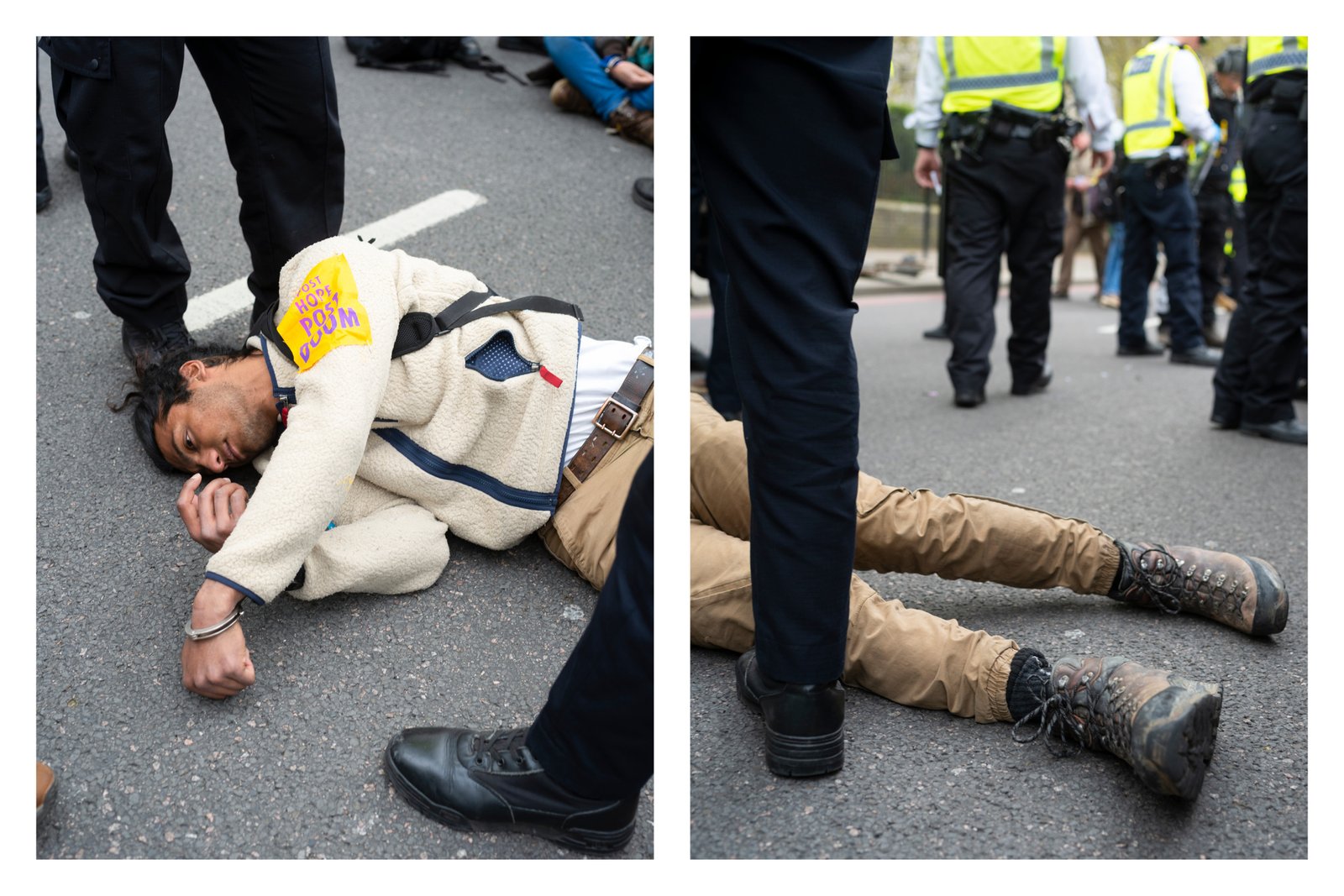
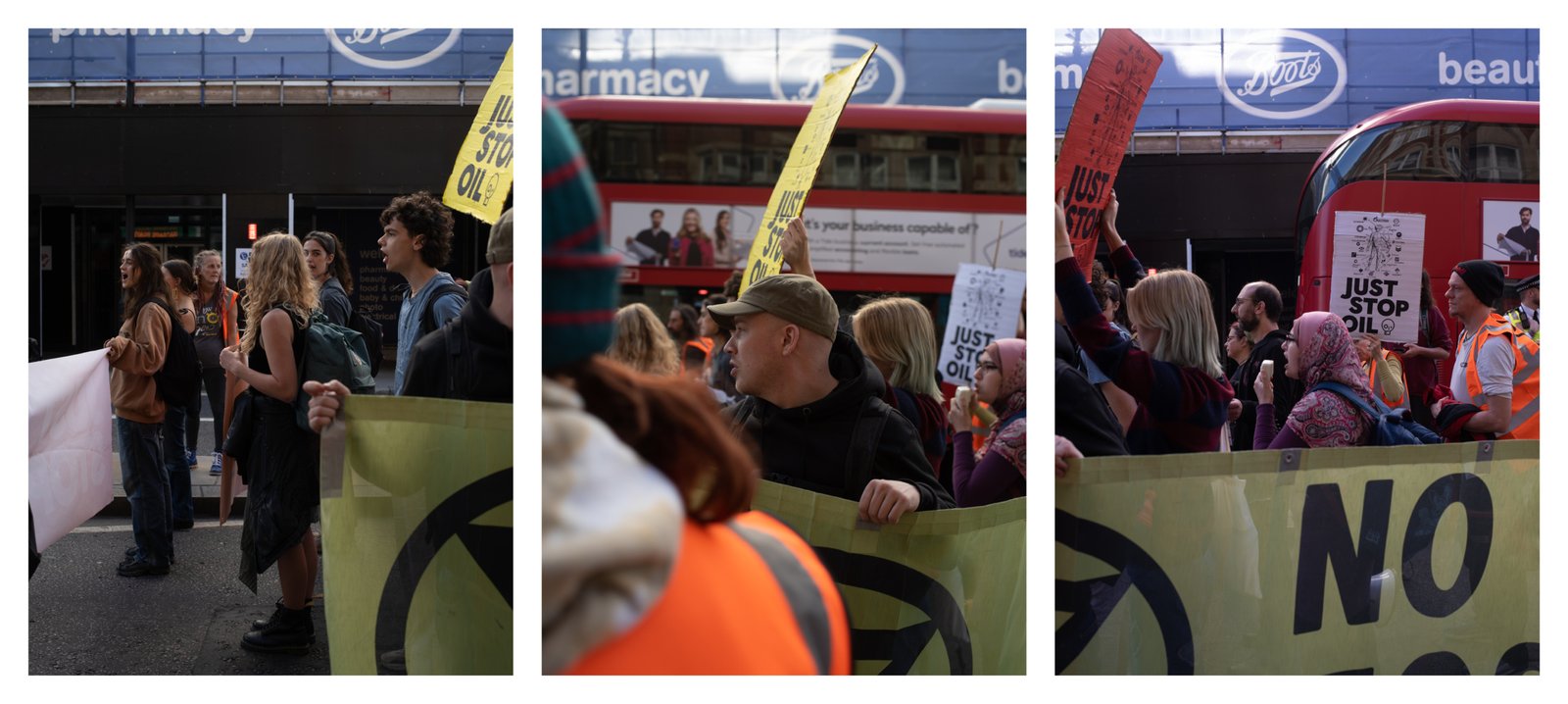
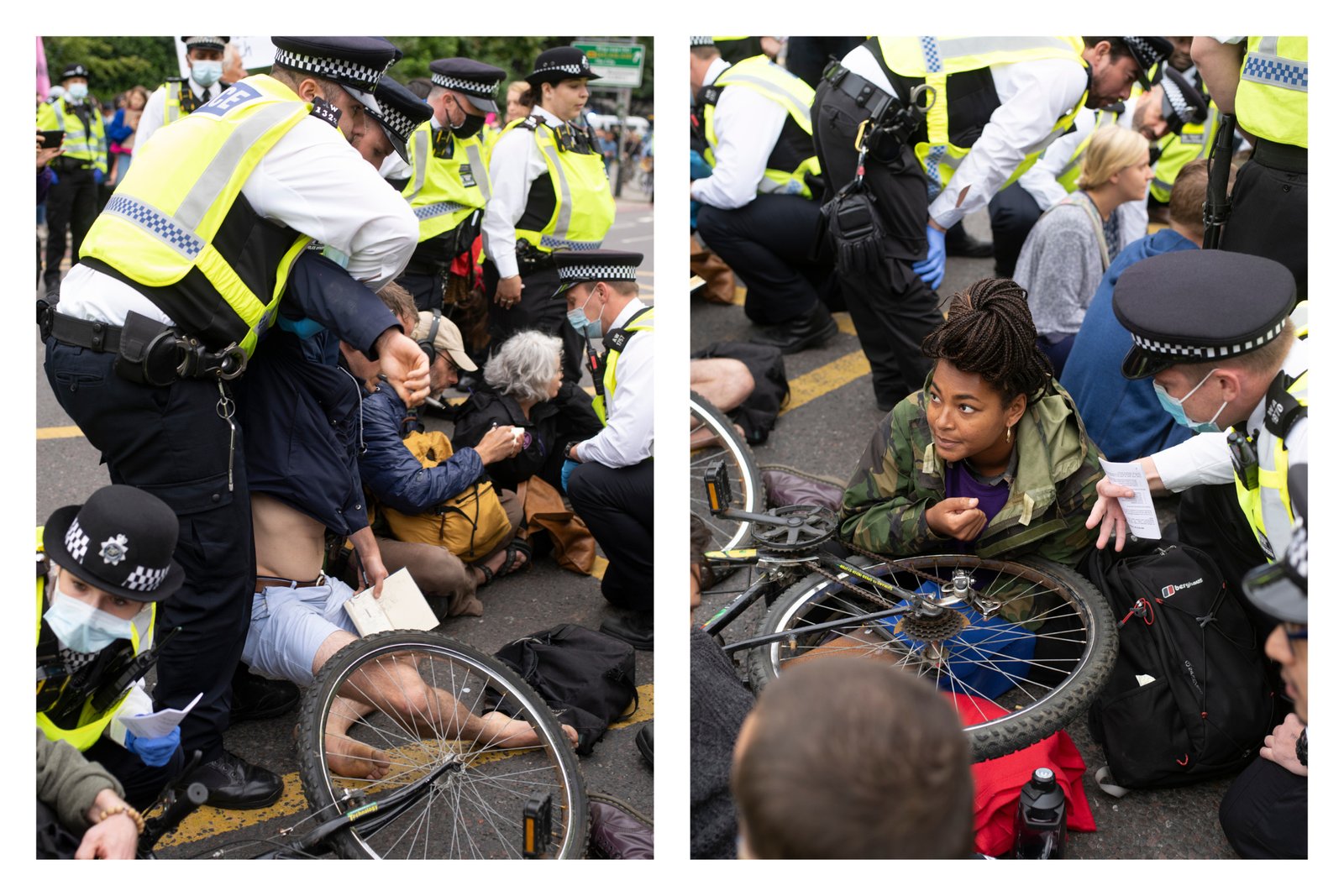
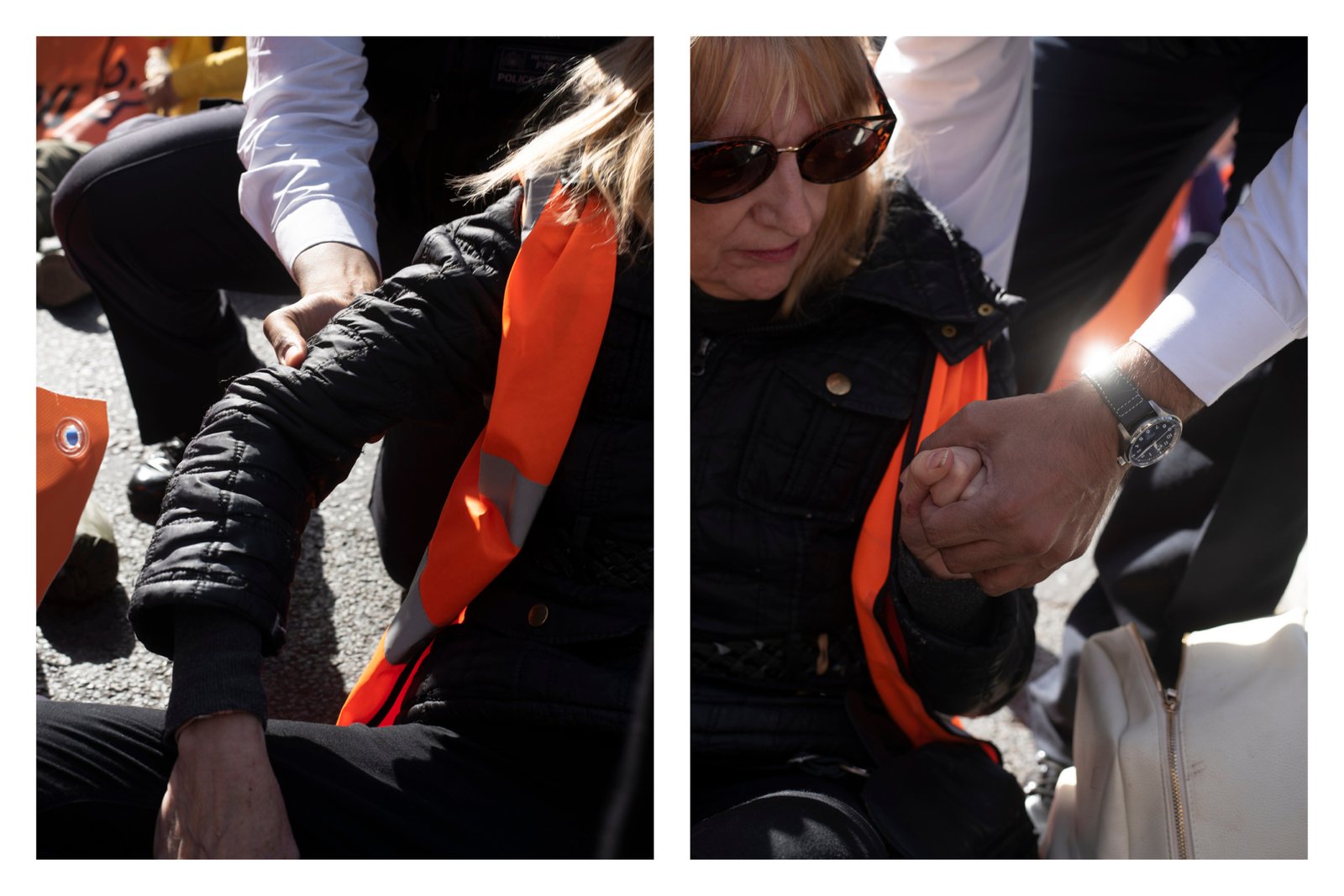
One of the places the project started to take shape was at the first big Extinction Rebellion protest in London in 2019. I was there, just wanting to be part of it, not thinking I would be making pictures or beginning a new body of work. But, on that first day of the protest, on one of the blocked bridges in central London, I saw something that made me start taking the kind of pictures this work grew out of.
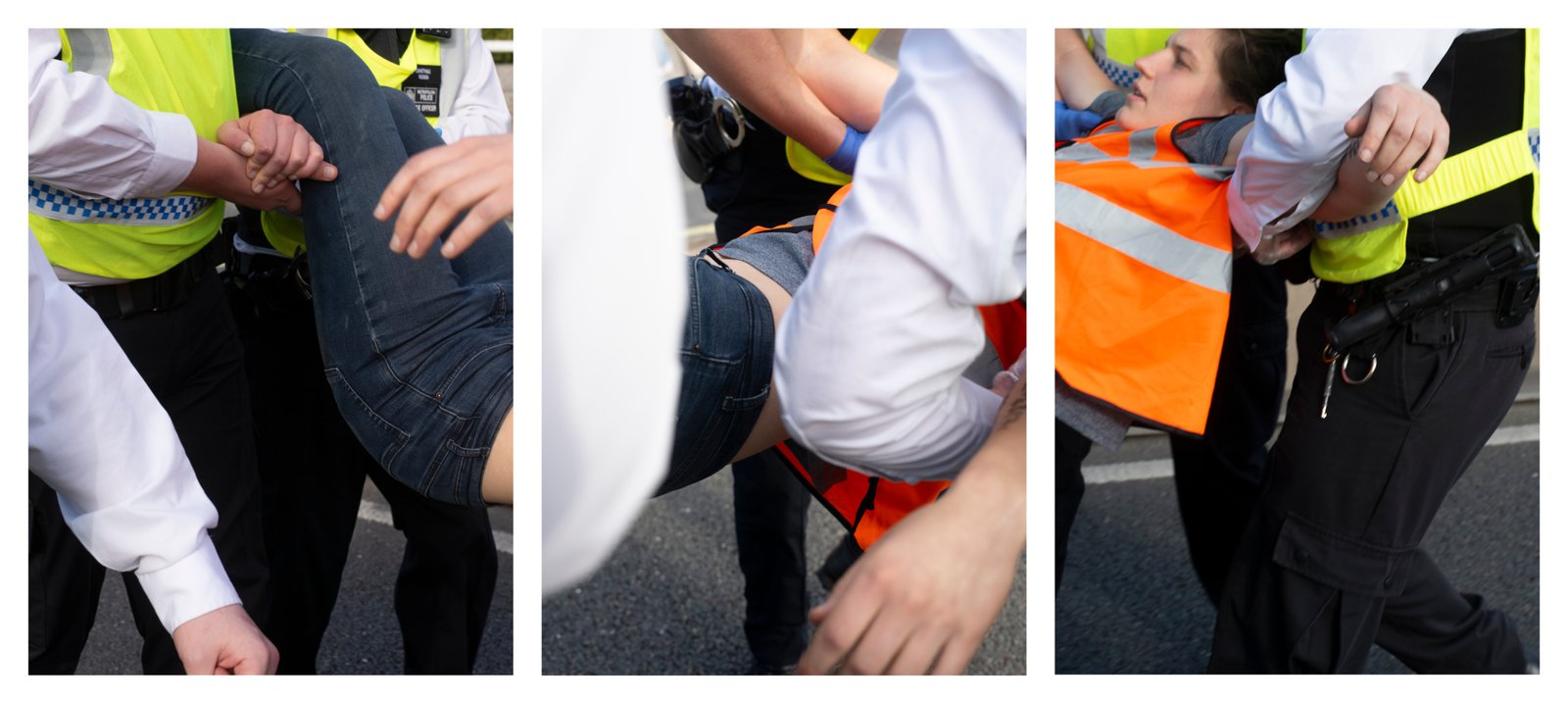
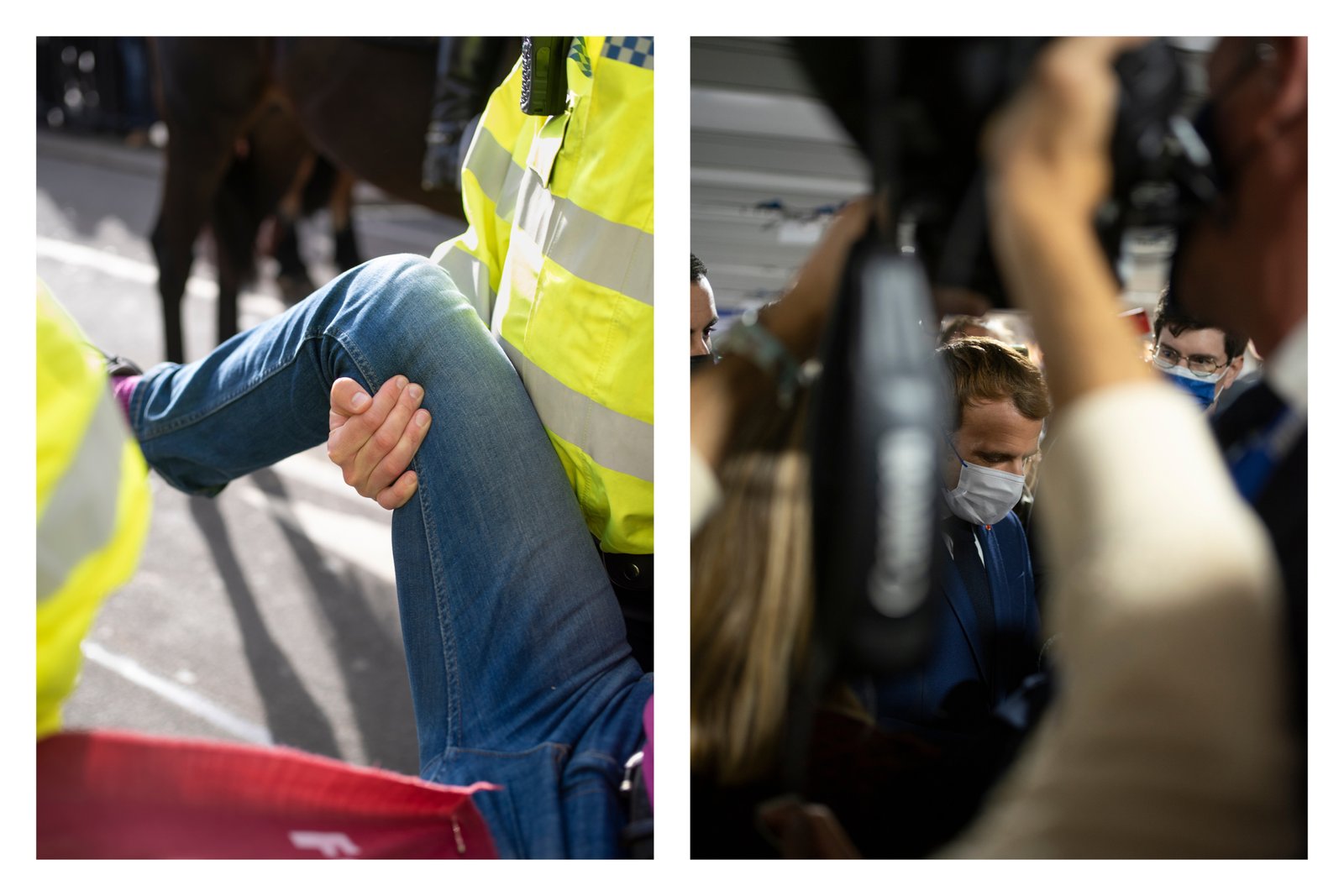
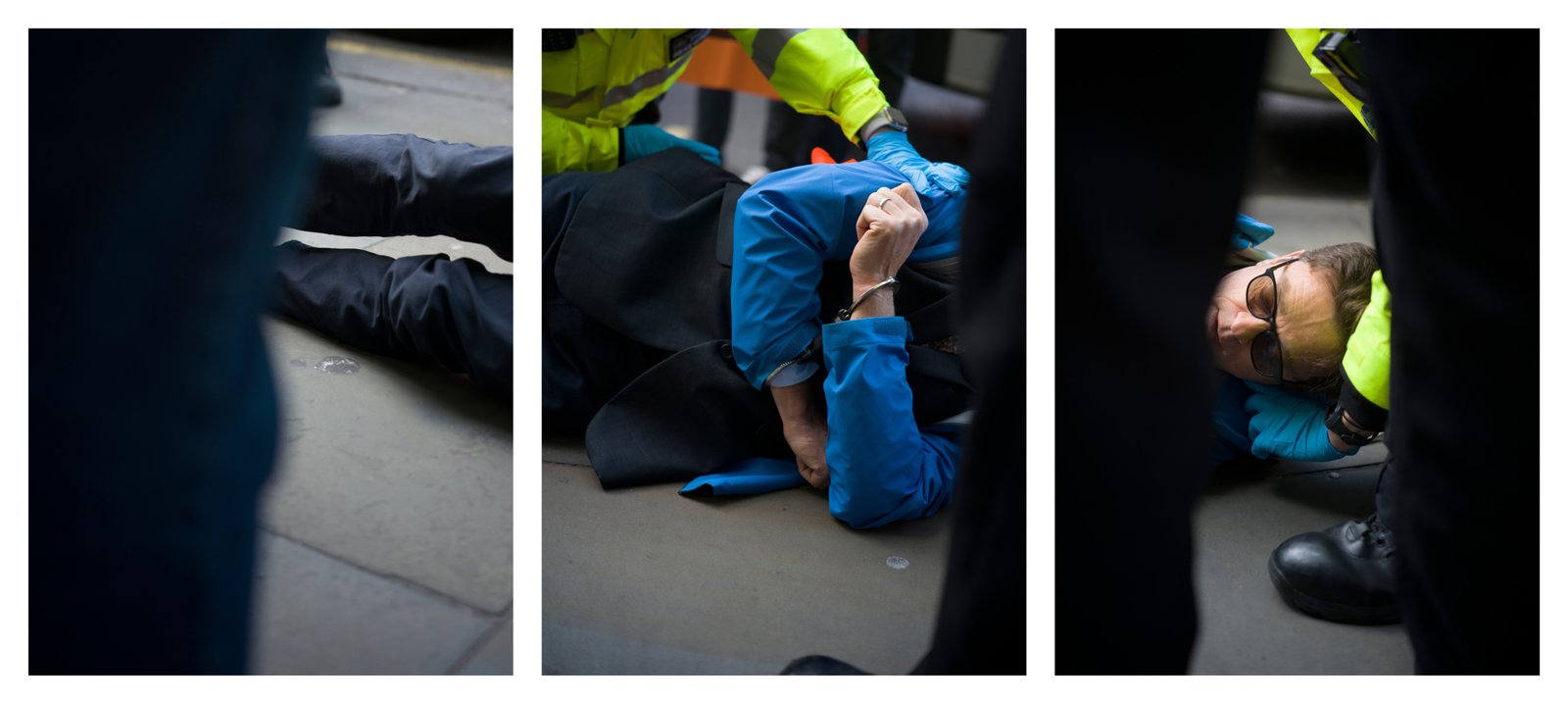
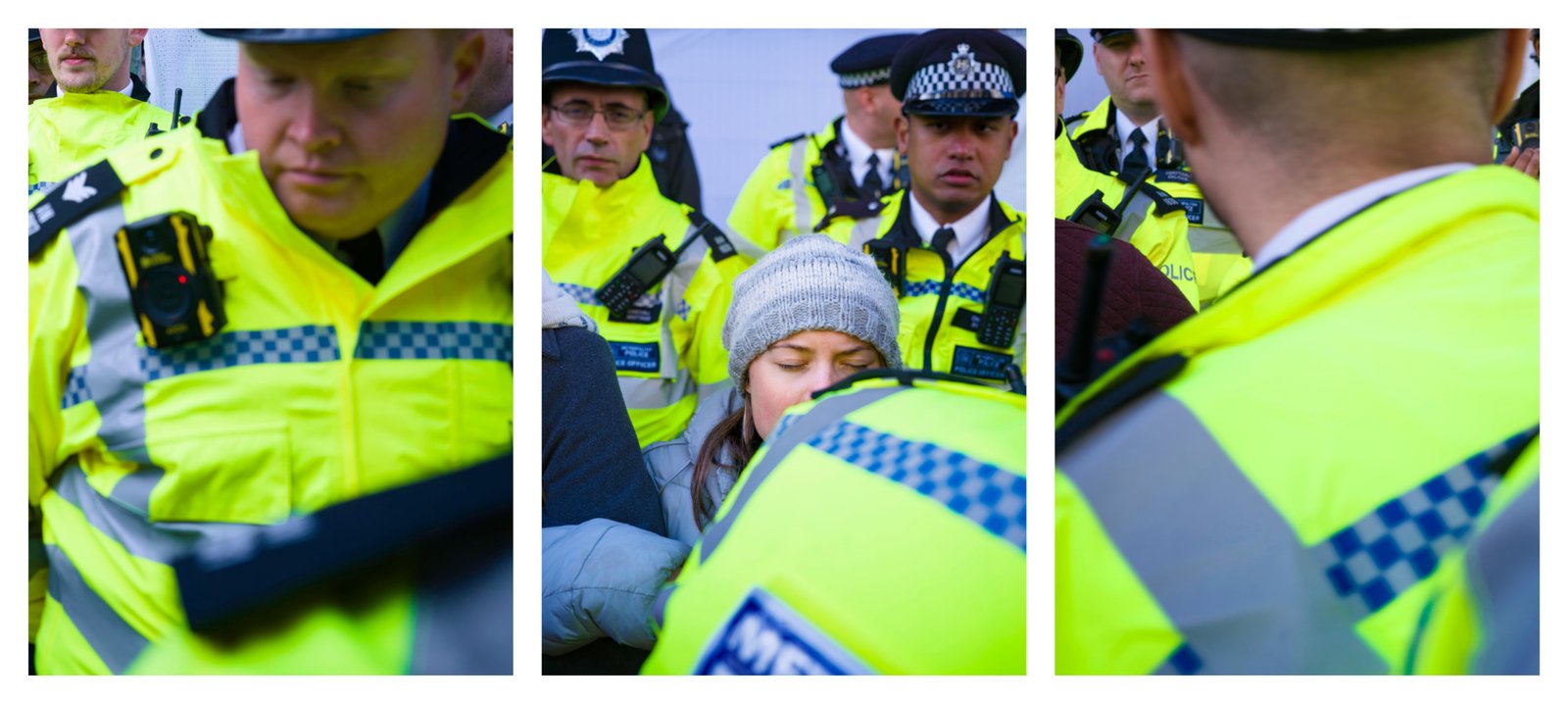
What I saw was the way the bodies of the police and those being arrested came into contact with each other. In this point of confrontation, the protesters had a tactic of physically softening, of going floppy. The hands of the police – an embodiment of state power used to maintain the status quo – connecting with soft, relaxed looking limbs, in a way that was visually and emotionally destabilising, could almost be mistaken for care or dance. The violence of arrest met by a kind of radical suppleness. The sight was powerful, absurd, beautiful, sad. As hundreds of protesters, many very old or very young, were lifted into the air, the line taking action and losing control kept going through my head. It felt like, on both sides of the power divide, something was slipping, like what we’d thought of as normal was changing.
I spent the following days, and then the years since, photographing these points of contact.
TC: How did it evolve in terms of building out a structure for the series?
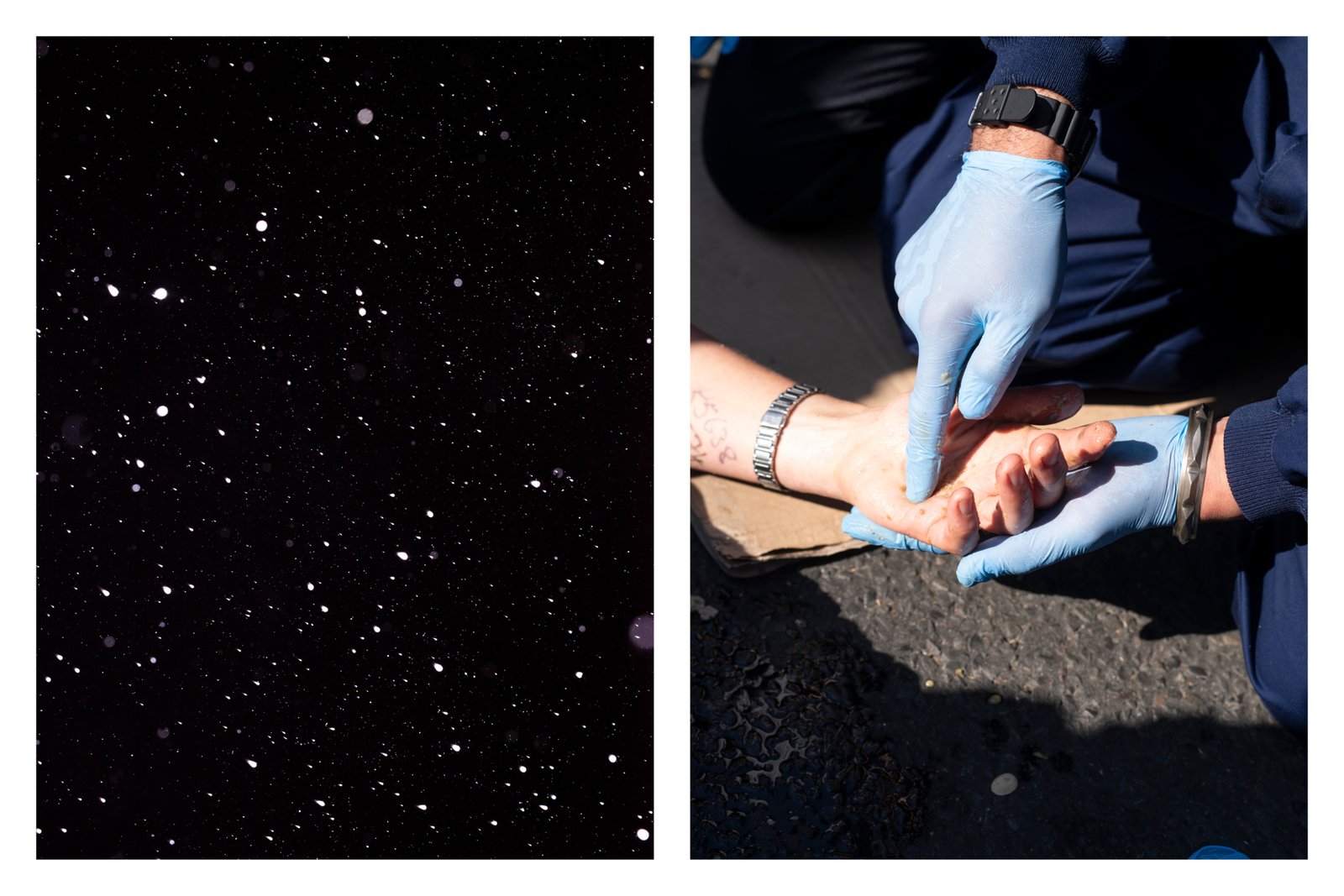
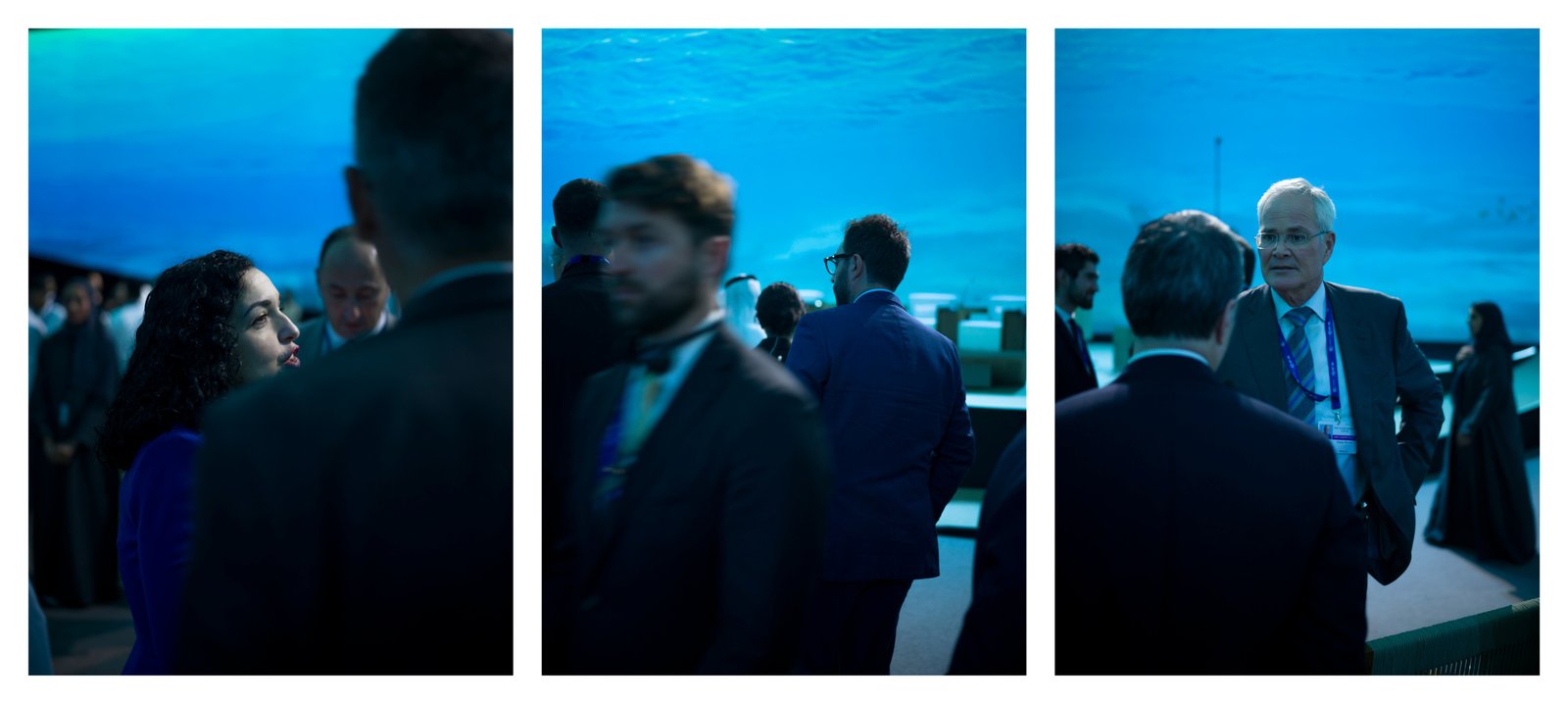
AS: What I realised later, back in the studio looking at the images, was that I could arrange the individual pictures – these close-up details taken in chaotic moments – to build larger scenes. For example, a triptych in which we see a protester being carried by the police, their feet lifted off the ground in the first image, their body 60 metres away being carried through the air in the second, and further down the road still their head in the arms of the police in the third. Multiple pictures, taken in different moments and positions, but that read as a continuous scene. The sweet spot I’m looking for is one where we see the image as both continuous and fragmented, simultaneously. A traditional single point perspective and something full of gaps and out of joint.
This shimmering back and forth in the way we read the image creates an energy – a sense of movement, destabilisation, possibility. A feeling of being swept up, entangled, part of something extending outward rather than standing at a distance and observing a scene neatly contained within a frame.
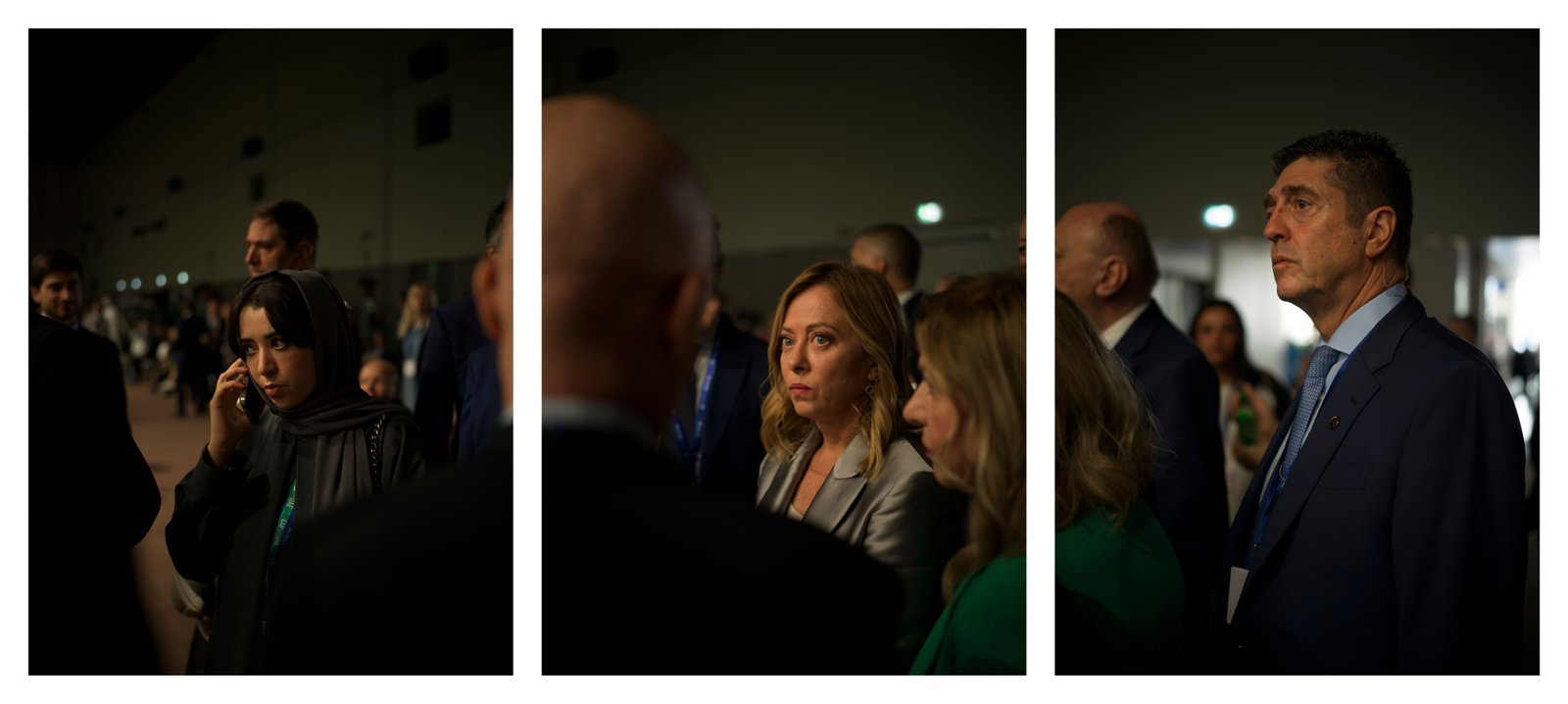
These compound pictures felt visually exciting and spoke to feelings and questions about power and interrelation that are driving the work. They seemed like a beginning, and I wanted to see if I could bring these depictions of bottom-up power into relation with images showing other forms of power – the top-down as well as the bottom-up, the human and the more than human.
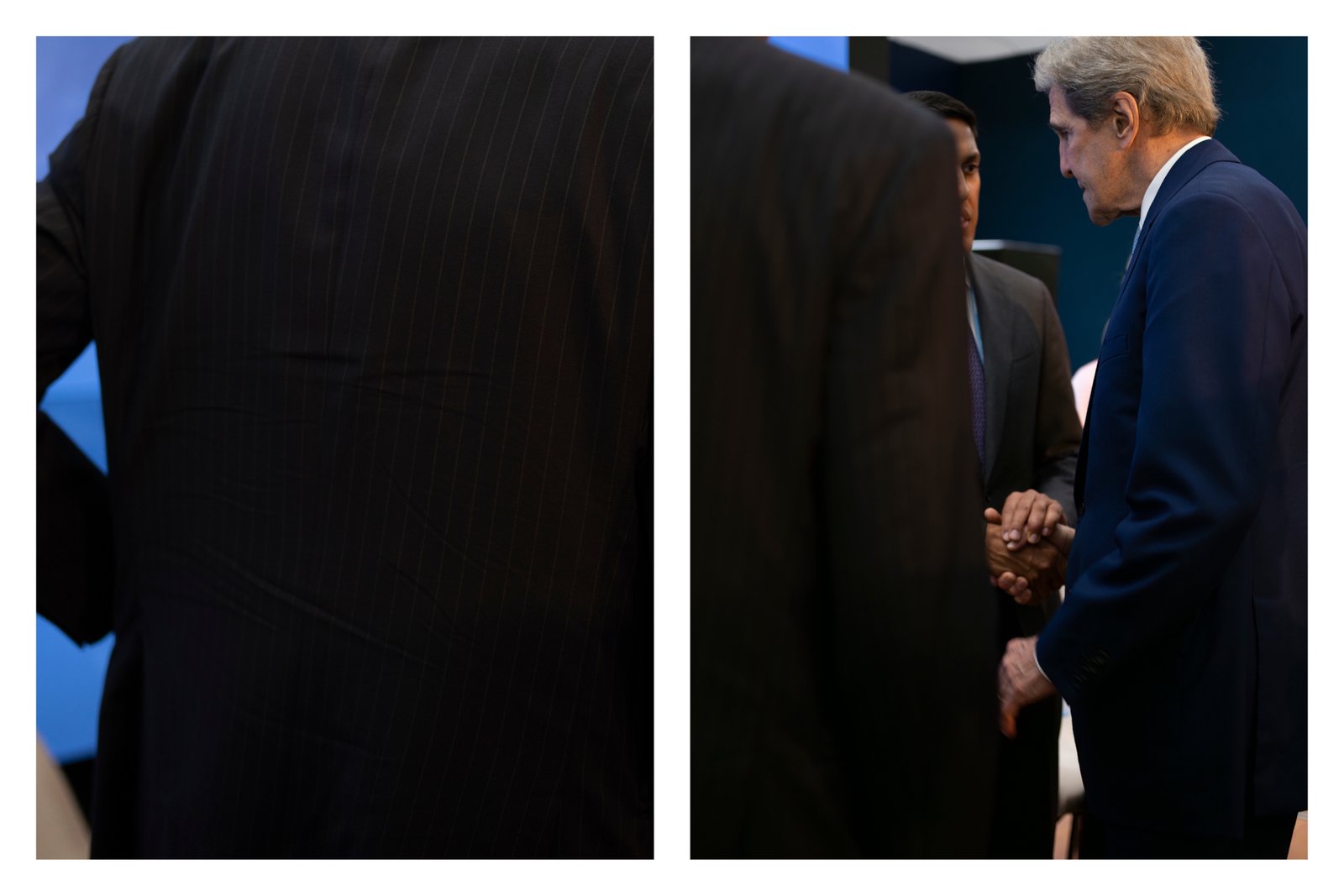
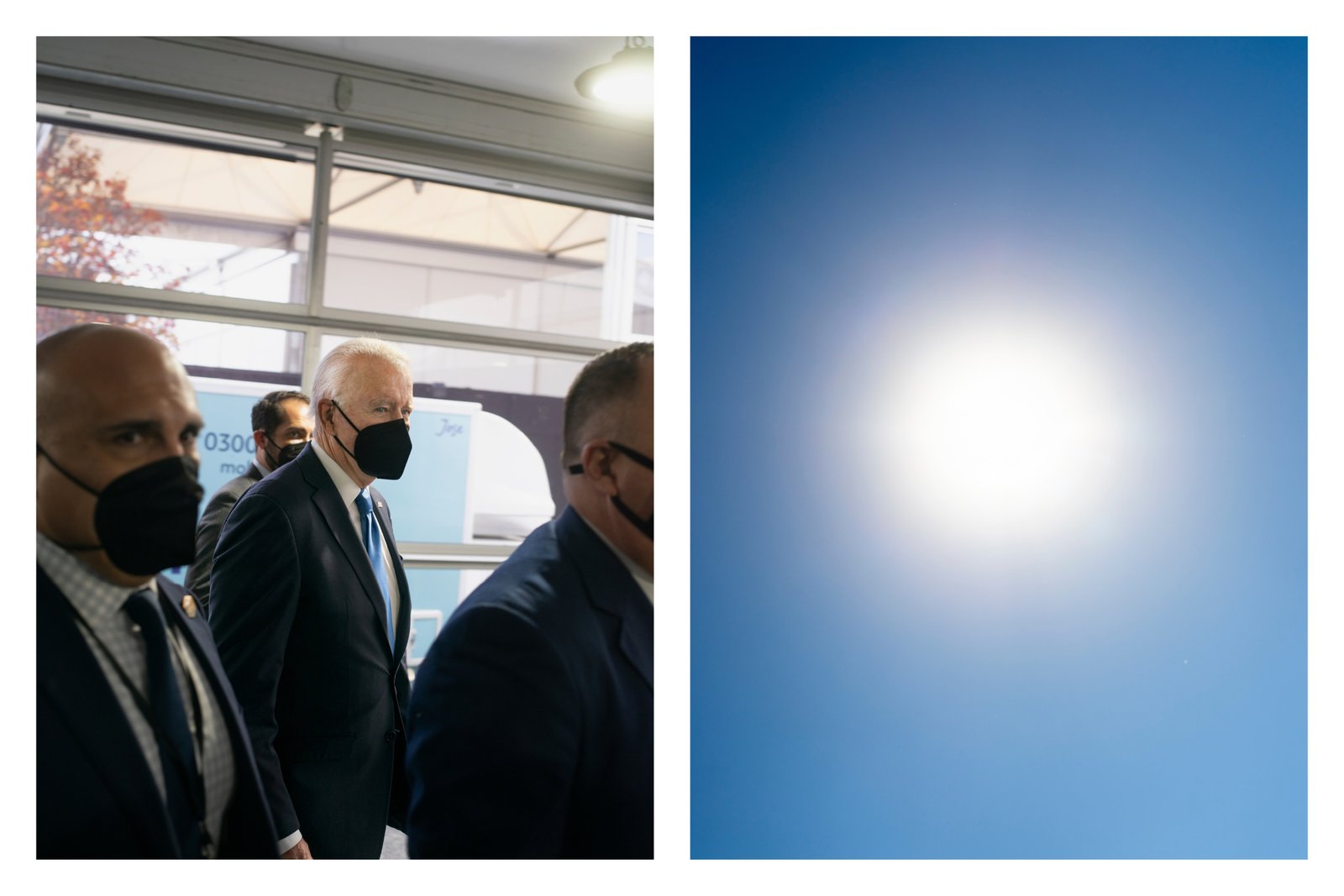
So, I ended up inside the gathering of elite-power that is COP, the UN Climate meetings, in Glasgow, Sharm El-Sheikh and Dubai. In these spaces I was able to make pictures, using a similar approach, with an energy like those I’d made at the protests. We see heads of state, CEOs, and the rest, as also immersed, bodies fragile and entangled, in these chaotic and complex spaces.
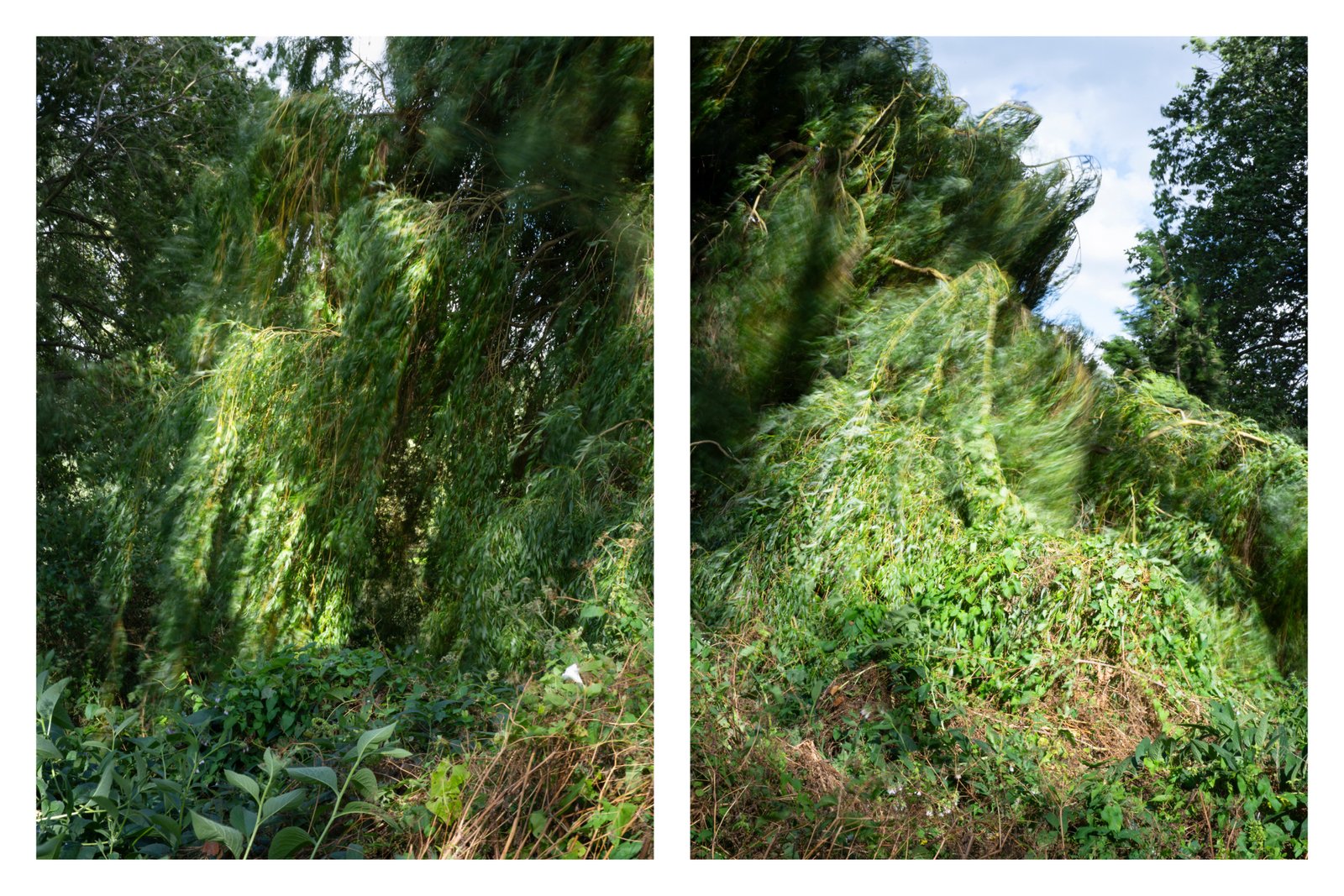
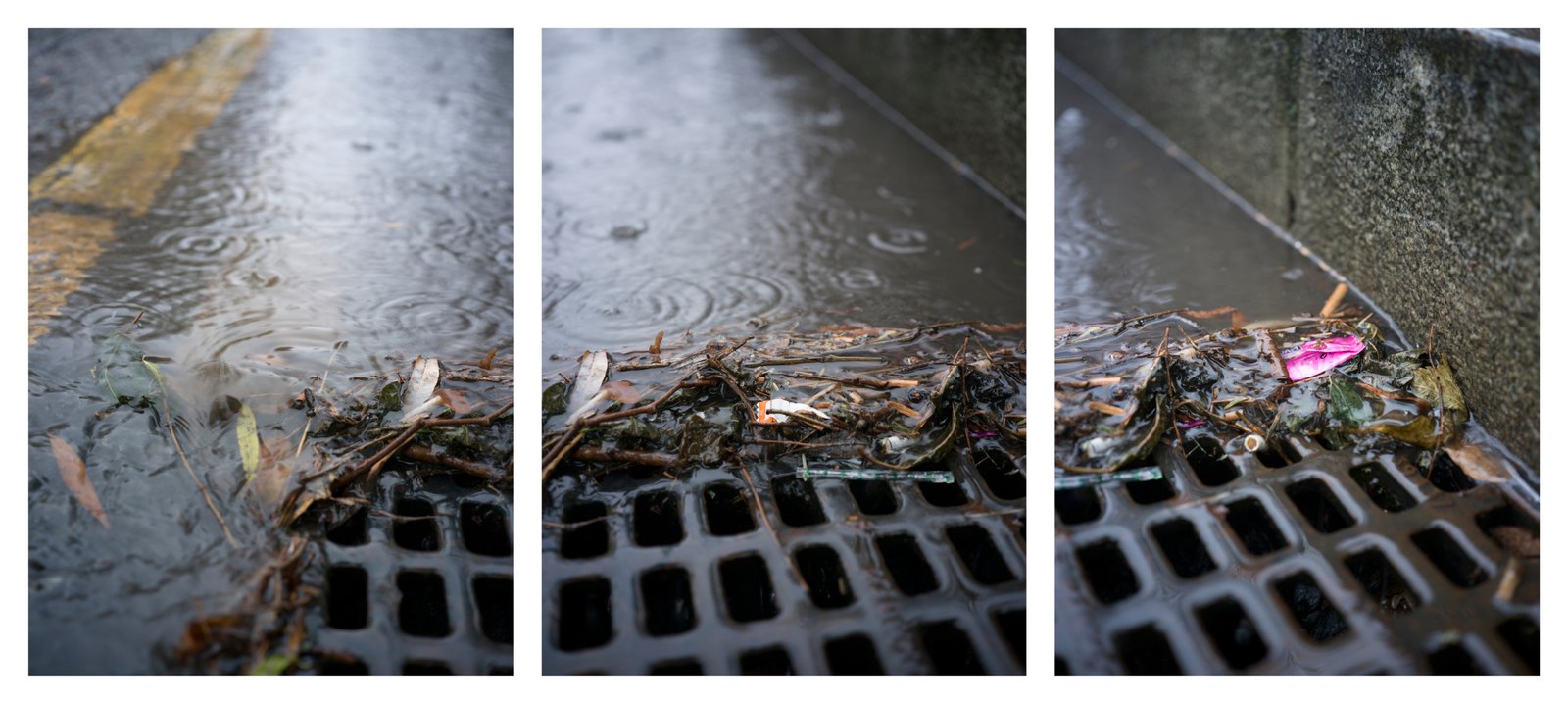
The structure of this work developed through finding ways of weaving together, as prints and as large-scale multi-screen projections, these forms of human power with each other and with a third strand of, quieter, more personal pictures from a kind of visual weather diary I’d been making.
It’s pretty easy to hold, intellectually, the idea that everything is connected, but feeling this, and its implications, is much more difficult I think. Giving form to this interrelation is something that’s been central to all the work I have made over that last 15 years or so. Here, in Slowly and Then All at Once, one of the things pointing towards these connections does is help to affirm a reality that makes hope possible. The fact that political and corporate elites are caught up in systems far bigger than themselves, and, as we are also a part of those systems, it is possible to reach them, it is possible to change course.
TC: With regard to the everyday images of your east London neighbourhood of Hackney – a kind of visual weather diary as you refer to it – how does this level of imagery function and matter for you?
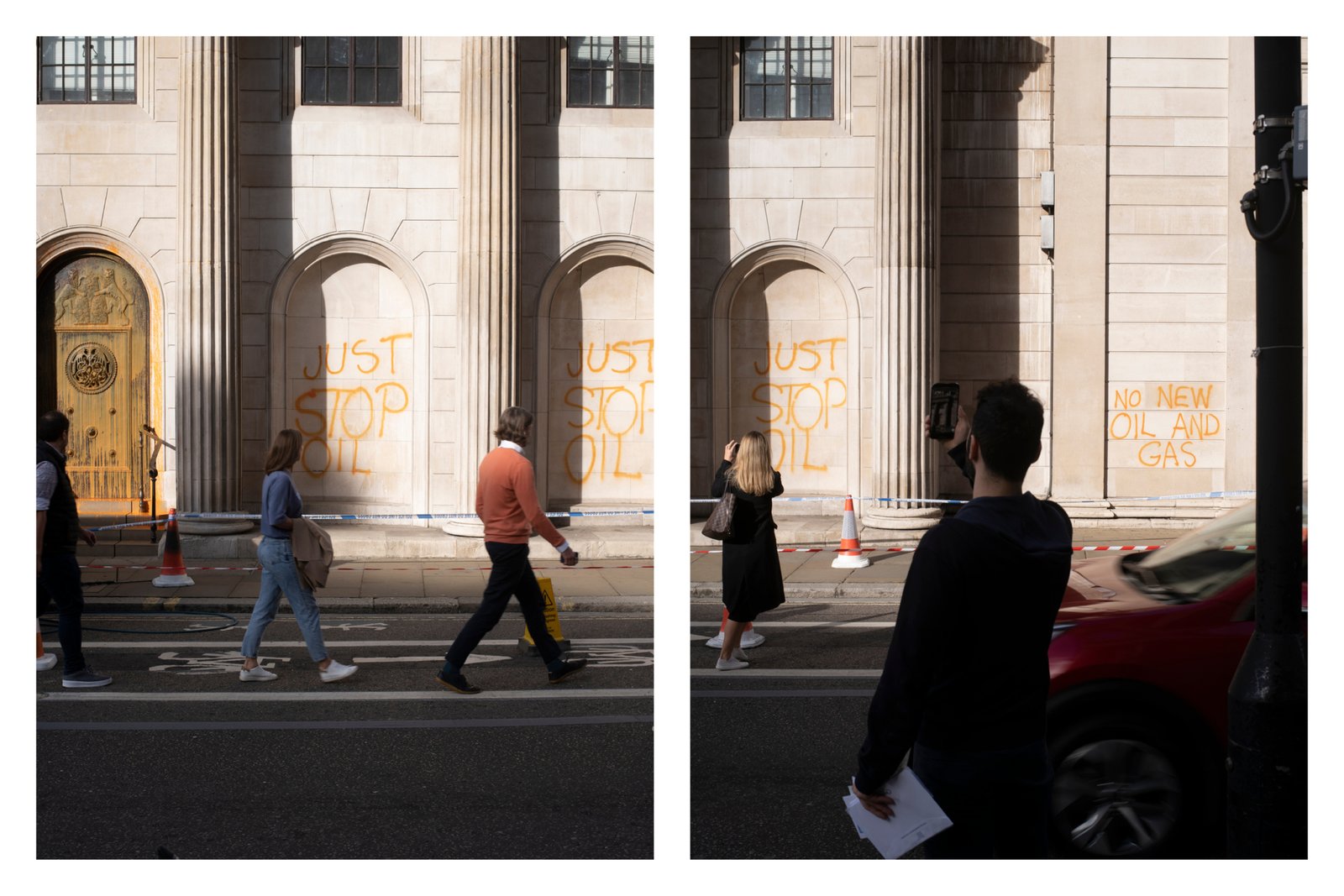
AS: I’ve been making these weather diary pictures for years, long before the other strands in the work. They’re a way of tuning in to what’s around me, noticing and appreciating how the weather looks and feels like on a particular day. Of course, these were also shaped by an unease, by the way that ‘talking about the weather’ is no longer small talk, but something infused with what we know about climate change and the feeling of being within a system far bigger than ourselves that’s changing in dangerous, and hard to predict ways.
These images function in a few ways. In the work we have two very clear strands of imagery, the protests and the diplomacy, moments of intensity where the danger and absurdity of the situation we find ourselves in feels closer to the surface than usual. This third strand of quieter more day-to-day images, helps to provide a change in the rhythm and emotional texture of the work, a variation in tone that hopefully holds the viewers interest longer and allows them to go deeper. The work could very easily be overwhelming, too much, something dystopian we just want to hide from. I’m conscious of wanting to create an experience with an energy that pulls you in, but in a way that is generative rather than depleting.
This fluctuating intensity is also a way of capturing how it feels to understand the world ecologically – the strangeness of knowing that climate collapse, genocide, the dizzying increase in inequality are all happening now, as I type these words sitting in the garden with the sun hot on my hands, and although they may, for now, feel distant there is no way I can fully disentangle myself from them.
TC: In what ways do you see the body of work as subverting traditional norms of photo-journalistic languages and art documentary forms?
AS: Protests, and gatherings of world leaders, are familiar staples of photojournalism. When we see these press images it’s easy to feel we know what they are, almost before we look at them, and move on immediately. The compound images in Slowly and Then All at Once are a way of slowing the viewer down a bit and helping them engage more deeply with what they’re seeing. And, in doing this, while using the action and drama of classic reportage photography, I want to make something that’s seductive, visually compelling, that pulls us in.
Much of the photography I love challenges the tropes of photojournalism – rejecting the buzz of the ‘decisive moment,’ the focus on the heroic individual, the ‘great man’ theory of history, etc. This documentary work, that tends to sit in the art world, is often pulling us back, taking a view that includes a larger slice of space and time, showing us what’s happening around the action, how the bit that is normally framed for us is part of a larger context. I think this is valuable and is something I’m trying to do with this work.
However, there’s also a danger in this approach that I’m working against. The single point perspective picture, especially when showing a pulled back landscape view, can be a powerful way of reinforcing a sense of being on the outside looking in, it can give us the comforting illusion of standing at a safe distance, observing things happening but not being a part of them.
In Slowly and Then All at Once, I’m using the up-close mode of photojournalism, the interest in body language and the individual’s relationship to the world, to get at structural issues – around power, interrelation, etc – often addressed in art world documentary practice through a more distanced aesthetic. I want to take us close, sweep us up, and place us physically and conceptually into a complex ecological relationship to the world around us.
I want to challenge the pervasiveness of what philosophers call cynical distance. The position of being detached – standing on the outside with a clear view that tells us any deviation from the status quo is impossible – which is fundamentally illusory. We’re not outside. We’re always caught up, woven in, part of a complex ecosystem, with only a partial understanding of what will actually happen next. Through this work I’m looking to surface and weaken this illusion of distance within myself and for the viewer.
It’s not that the third person position in itself is a problem. Stepping imaginatively outside is freeing, wonderful, powerful! It helps us understand problems, and what we should be doing. But, unfortunately, it doesn’t seem to be enough when it comes to doing what is necessary. And, if we get stuck there, if we mistake the illusion for reality, it can become a way of numbing ourselves and justifying inaction.
TC: Connections between image pairings are clearly important. Sometimes these are subtle and in other moments they can be pronounced, but nowhere is the sense of entanglement and immersion more evident than in the slideshows, the multi-panel cross-cutting sequences that were projected as part of your exhibition at Fotografia Europea 2025. Is there a specific relationship you wanted to establish between these rhythms and strategies of fragmentation and our experience of climate discourse and action?
AS: The aesthetic strategies I’m using, the slippery fragmentation within the diptychs and triptychs, the rhythmic crosscutting and visual assonance between these works in a sequence, are more about affirming the sense of interconnection rather than a specific relationship as such.
In a way, this work is about me trying to find a theory of change I can believe in, something that feels hopeful and plausible. What seems obvious about our experience of climate discourse and action is the gap between what we know and what is being done. We know broadly what the problems are and what we need to do to address them – stop burning fossil fuels and move to a renewable energy, we could help pay for this by taxing the massive gains in wealth the very richest have enjoyed over the last years and decades, and in doing so would also move towards correcting the huge problems produced by current levels of inequality… And yet, we’re in a situation where what the powerful mostly offer us is hugely inadequate tinkering with the status quo and/or simple authoritarian narratives that increase fear and hate while doing nothing to address the actual problems.
Our systems need to fundamentally change and yet the people currently in power seem unable or unwilling to do what is necessary. If the gap between them and us is unbridgeable, if there is no relationship, no way we can reach them, then we are in a very bleak situation. But if we understand the world ecologically we know this isn’t the case. What happens next is not fixed, the future will be the result of a tangled and as yet undetermined ecology of interactions, of which we are all, inescapably, a part.
These connections are difficult to picture, we don’t often experience them directly, as something happening in front of us, and large parts of our culture work to deny this truth and insist we’re inherently separate from each other. So, in the work, I’m using different tools available to me as an artist to draw the energy of these spaces into a relationship we can feel.
Thanks for what you say about the power the work has when projected as a sequence across multiple screens. Recently, a film director friend after seeing these, said, “are you sure you’re not a filmmaker?”. I know what he means, in these projections I’m using those aesthetic strategies I mentioned plus time to create a kind of cinematic experience. The same friend also said this work could only be made with still images, and I think this is true too. A large part of its energy comes from a tension between the continuous and the disjointed formed in the way we – consciously and unconsciously – want to make connections across the gaps, to join the lines and knit things together.
TC: You’ve ventured that the work is concerned with ‘different forms of power – top down and bottom up, human and more than human’. What are the key questions that you would like to focus your viewers’ attention on?
AS: I’m trying draw our attention towards power, who gets to hold it, how is it used. We know what we need to do, but it’s not happening. Why is this?
For me the question is: ‘What has got us into this absurd situation?’ A situation where the accumulation of capital is prioritised over everything else and at any cost. Where what we direct our ingenuity and our resources towards is making private jets and algorithms that make us sad and mad, rather than ensuring that everyone has enough for a good life in a world that is healthy and stable. Where renewable energy is cheaper than fossil fuels, but fossil fuels are more profitable, and so that is where capital flows. Where the wealth of the very richest grows exponentially, and, as most people’s lives get harder and more unstable, the loudest voices answering those concerns say it’s all the fault of the weakest in society.
Changing this will be very hard. Many of the people holding the most power seem highly motivated to keep things the way they are. And so, another key question I want to focus on in the face of this is: how do we stay engaged? How do we maintain hope and ‘stay with the trouble’ as Donna Haraway puts it.
TC: You’ve talked before about wanting to push back against the dead-end cynicism and the overwhelming sense of futility many people experience in the face of environmental collapse. In many exhibitions that speak up for environmental justice, a framework is often established in which terms such ‘radical care’ and ‘ecologies of hope’ are deployed to conjure feelings of hope or optimism. One criticism that is typically levelled at these kinds of endeavours is that they only ever ‘address’ or ‘engage with’ the climate crisis. How can art move beyond the limits of critique towards praxis to bring about a more concerted effort towards action?
AS: This is true. I’m trying to make something that pushes back against an overwhelming sense of futility many people, including myself, often experience in the face of where we find ourselves today. However, as an artist, my focus isn’t primarily on driving specific change. Sometimes I might make pictures for causes and organisations I believe in, using my skills as a photographer to try and create images that close down multiple interpretations and make the viewer feel and do specific things. This is the mode of advertising or propaganda, and in this activist context that is great, important. However, the kind of work I’m making here is focused on offering something as open as possible, in which the viewer can find their own connections between things, while, at the same time, trying to close off possible interpretations that I feel are toxic, that are adding to the problems rather than supporting us through them.
When I was starting this work it felt like an exciting time, the climate strikes and protests suddenly had so much energy and the discourse seemed to be changing. Previously climate denying politicians and organisations were making statements and pledges that were a move in the right direction. In the UK parliament there was a leader of the Labour Party, a socialist, who for the first time in my life was pushing back against a neoliberal consensus that’s fuelled so many of today’s problems. The Overton window was shifting in a way that was positive. Things felt in flux, much as they do today, but it felt a lot easier to be hopeful. I’d hoped this work would track a growing optimism rather than the ways in which power pushed back against the calls for much needed progressive change. But, in the face of where we are now, the job of pointing towards interrelation and to the ways in which power is working against us feels even more urgent.
The situation is overwhelming. It can feel hopeless, it can make us want to give up, disengage, or turn to the narratives offered by the far right who appear to offer ‘simple explanations.’ And, if enough of us believe that the situation is hopeless then that becomes a reality. This work attempts to counter these feelings, to create something with a physicality, a rhythm, an intensity that pushes through the dead ends of cynicism and resignation.
Rebecca Solnit, Frederick Douglass, Mark Fisher, and many others have written about the relationships between hope, uncertainty, interconnection, cynicism, action, and power; and this work is in sympathy with those ideas. What I’m trying to do is develop them in a way that is visceral, that is felt in the body as well as something we can get at intellectually. To give form, as I said before, to a feeling of interconnection and an understanding of power that might help us not only critique but to meet the challenges in front of us.
TC: Your title Slowly and Then All at Once is reminiscent of Ernest Hemingway’s famed line in The Sun Also Rises where he describes one of the characters going bankrupt (‘gradually, then suddenly’). Did this phrase come into contact with your imagination at any particular point?
AS: Yes, Slowly and Then All at Once is a common misquote of that Hemingway line.
I like how it’s a description of a tipping point. The point at which the conditions in a system have built up to a level where what was normal before can no longer be sustained and suddenly everything changes. This feels like a good description of what’s currently happening in our ecological and political systems. These changes could take us somewhere much better or much worse. As Robert Reich puts it, ‘there is no non-radical future with the climate crisis. Either we take radical action to stop it, or our lives will continue to be radically changed by it.’
TC: Are there any opportunities to take this work into spaces outside the art world? What research methodologies might you implement in order to help drive change in different contexts?
AS: I hope so. I’ve had the opportunity to present the work to groups of people in positions of power during the sort of sessions that happen in spaces like Climate Week. This has been really interesting, the response has been strong, the work has made people cry (in a good way) and I’ve had many conversations in which people said how much it connects to things they are struggling with. I think, within these spaces, as well as outside them, there are a lot of people whose basic assumptions about the world, about the way power works, have been upended in recent years. There are also people who have had a clear vision from the beginning and have been battling against a system that punishes this insight their whole career. Both of these groups talk a lot about burn out and the work seems to connect to this in ways that are helpful.
Around future shows I’d like to build a programme of events connecting to the urgency of this moment. Drawing on links I have with individuals and organisations across politics and activism, to invite people working in different fields to share their embodied, emotional, responses to the exhibition and to use this as a way of exploring the ideas it provokes around power, cynicism, interrelation, hope,, and action. These events would be a way of bringing into conversation people holding different kinds of power to share their experiences, fears and theories of change. And, to ask how we might come together to work around current blockages and find our way to a place where it is possible to believe in a future that gets better and not worse.♦
All images courtesy the artist. © Andy Sewell
—
Andy Sewell’s work uncovers feelings of immersion, fragility, connection, and possibility. It questions assumed boundaries and looks at the relationships between the ideas we hold about the world and our embodied experience of it. The work brings into relation things we often think of as separate; the ocean and the internet, for example, in Know and Strange Things Pass, and different forms of power – top-down and the bottom up, human and the more than human – in Slowly and then All at Once.
His work can be found in the collections of the V&A, Tate, Fondazione MAST, Columbia University Art Collection and London Museum, among others. He has been the subject of solo shows in US, France, Italy, Poland, Germany, China, and South Korea, and has been nominated for Oskar Barnack Award, Prix Pictet and Deutsche Börse Photography Foundation Prize. He is the winner of the International Photobook Award and is included in Martin Parr and Gerry Badger’s The Photobook: A History Vol. III. In 2025 he was awarded The Lewis Baltz Research Fund.
Tim Clark is Editor in Chief at 1000 Words and Artistic Director for Fotografia Europea in Reggio Emilia, Italy, together with Walter Guadagnini, Luce Lebart and Arianna Catania. He also teaches at The Institute of Photography, Falmouth University.
1000 Words favourites
• Renée Mussai on exhibitions as sites of dialogue, critique and activism
• Roxana Marcoci navigates curatorial practice in the digital age
• Tanvi Mishra reviews Felipe Romero Beltrán’s Dialect
• Discover London’s top five photography galleries
• Tim Clark in conversation with Hayward Gallery’s Ralph Rugoff on Hiroshi Sugimoto
• Academic rigour and essayistic freedom as told by Taous Dahmani
• Shana Lopes reviews Agnieszka Sosnowska’s För
• Valentina Abenavoli discusses photobooks and community
• Michael Grieve considers Ute Mahler and Werner Mahler’s posthumous collaboration with their late family member
• Elisa Medde on Taysir Batniji’s images of glitched video calls from Gaza
Join us on Patreon today and be part of shaping the future of photographic discourse


