
Excluded or Exoticised? The European Gaze in Indigenous Spaces
Across Europe, North America and Latin America, the images of Indigenous photographers are emerging with renewed visibility in exhibitions, biennials and collections, calling us to reconsider, as Sergio Valenzuela-Escobedo does, what it means to speak of ‘Indigenous photography’ in both historical and contemporary contexts. Through an interrogation of photographic and curatorial legacies shaped by colonial discourse, and the field of ‘contemporary art’ more broadly, he writes that the recognition of Indigenous artists should not become an excuse to perpetuate exoticisation, nor a pretext for evading responsibility for those who sustain structural relations of power.
Sergio Valenzuela-Escobedo | Opinion | 23 Oct 2025
Join us on Patreon
Faced with the question of whether the art market might be exploiting the trend in which Indigenous voices rearticulate their own discourses and express them in the first person within the art world – or, alternatively, ‘tokenising’ the presence of Indigenous artists – and whether some states might, in turn, attempt to redeem historical guilt, it becomes necessary to broaden our perspective with a brief review of recent and upcoming events in Europe.
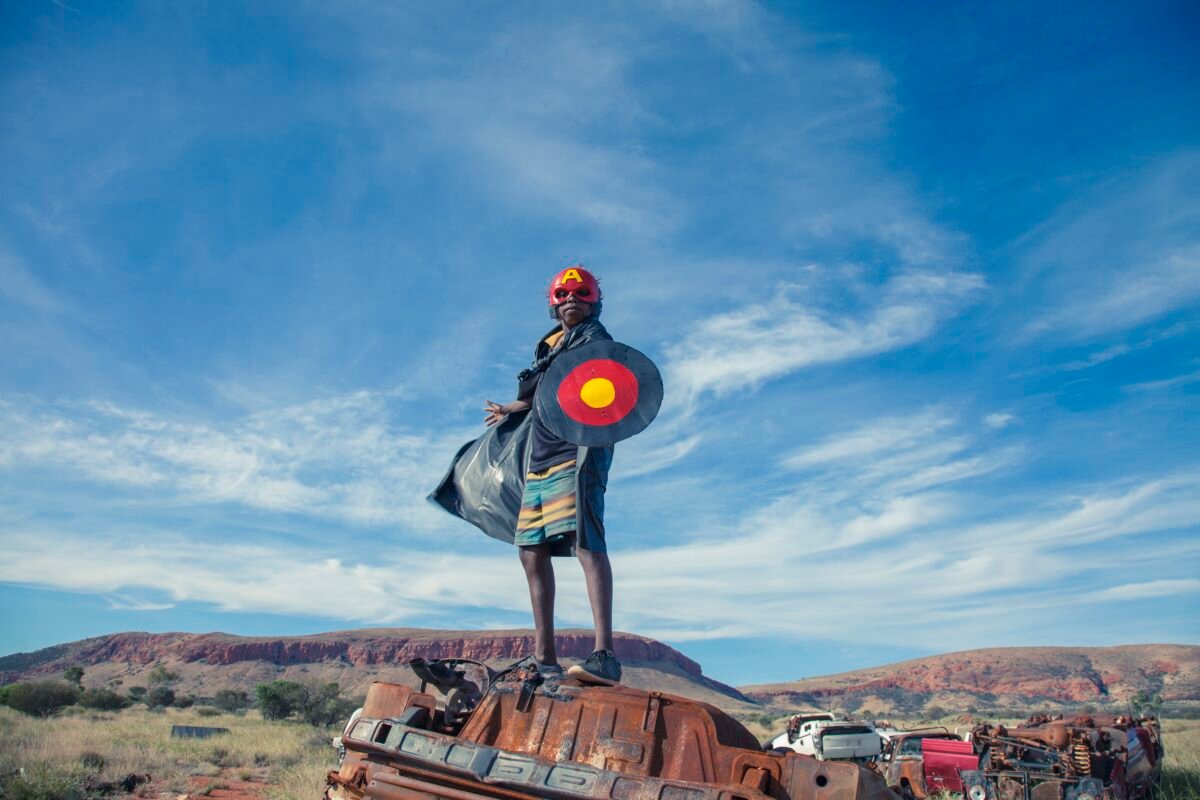
Tony Albert (Kuku Yalanji), David Charles Collins and Kieran Lawson, Warakurna Superheroes #1, 2017. Courtesy the artist and Sullivan+Strumpf.
In the programme of Les Rencontres d’Arles 2025, entitled by its director Christoph Wiesner ‘Indocile Images,’ the Louis Roederer Foundation Discovery Prize was awarded to Octavio Aguilar (Ayuuk), along with three exhibitions with a strong Indigenous presence: On Country: Photography from Australia, Ancestral Futures and Echoes from a Near Future.
The festival’s official poster features the image of an Indigenous child dressed as Captain America – part of the Warakurna Superheroes series by Indigenous artist and artistic director of the National Indigenous Art Triennial Tony Albert (Girramay, Yidindji and Kuku Yalanji), in collaboration with David Collins and children from a remote Aboriginal community in Australia’s Northern Territory. According to its authors, this work interrogates the way optimism can help overcome adversity and dismantle stereotypes, especially those imposed on the nation’s forgotten populations.
Yet, the reality for many Indigenous children diverges painfully from such heroic representation, as evidenced by the winning photograph of Hoda Afshar, recipient of the National Portrait Gallery of Australia’s Portrait Prize 2025. In these communities, children between the ages of 10 and 17 account for only 6.6% of their age group in the general population, yet they are 29 times more likely to be incarcerated.
Three out of five children deprived of liberty are Indigenous, and two out of three of them suffer from a diagnosed mental illness. From an early age, they carry the burden of structural disadvantages, discrimination and criminalisation. What they need is love, care and a supportive community; instead, they are often met with punishment. Detention centres and police stations, far from being spaces of healing, become sites of trauma, abuse and systemic failure. And yet, this reality is tolerated, as if an implicit hierarchy justifies certain forms of violence as normal – or even inevitable. Although Indigenous culture and identity in Australia may be celebrated as heroic, playful and aspirational, the surrounding society often fails to protect its children.
Beyond the French context, it is significant to look toward Venice, where the Golden Lion was awarded to the Australian Aboriginal multimedia artist Archie Moore at the 2024 Venice Biennale, curated by Brazilian Adriano Pedrosa, who affirmed that his biennale opened the door to the global art scene, and thus to Indigenous artists. This declaration is paradoxical, evoking the experience of feeling foreign in one’s own land – a consequence of cultural erasure, territorial dispossession, and, in extreme cases, the extermination of entire peoples – all within the framework of a biennale still divided into national pavilions.
Another case is that of Jeffrey Gibson (Choctaw/Cherokee), who became the first Indigenous artist to represent the United States by occupying the entire pavilion. Already in 1932, Hopi creators such as Fred Kabotie and Awa Tsireh had participated, yet Pedrosa’s opening and Venice’s influence led Tate Modern in London to launch a dedicated fund to increase the representation of Indigenous works in its collection.
In photography, particular attention must be given to the work of Inuuteq Storch (Kalaallit), who represented Denmark and is scheduled to open a new exhibition at the Hasselblad Foundation in Gothenburg in February 2026. Those photographed, like Storch himself, belong to a postcolonial generation. For some, their artistic, social or political choices express a deliberate will to distance themselves from the Danish gaze, in a critical and decolonial perspective. For others – and this is Storch’s case – it is less about reacting to the past than about creating aesthetics rooted in Inuit culture or in dialogue with the global world, outside the colonial prism. Similarly, we can appreciate the work of Seba Calfuqueo (Mapuche), who presented Nunca Serás un Weye (2015) as part of the Disobedience Archive project, and who exhibited their work in Becoming Ocean curated by Ann-Marie Yemsi at the Villa Arson Art Centre in Nice, and who also participated in Activating Environments: New Ways of Thinking of Land, Sea and Life at Art Basel.
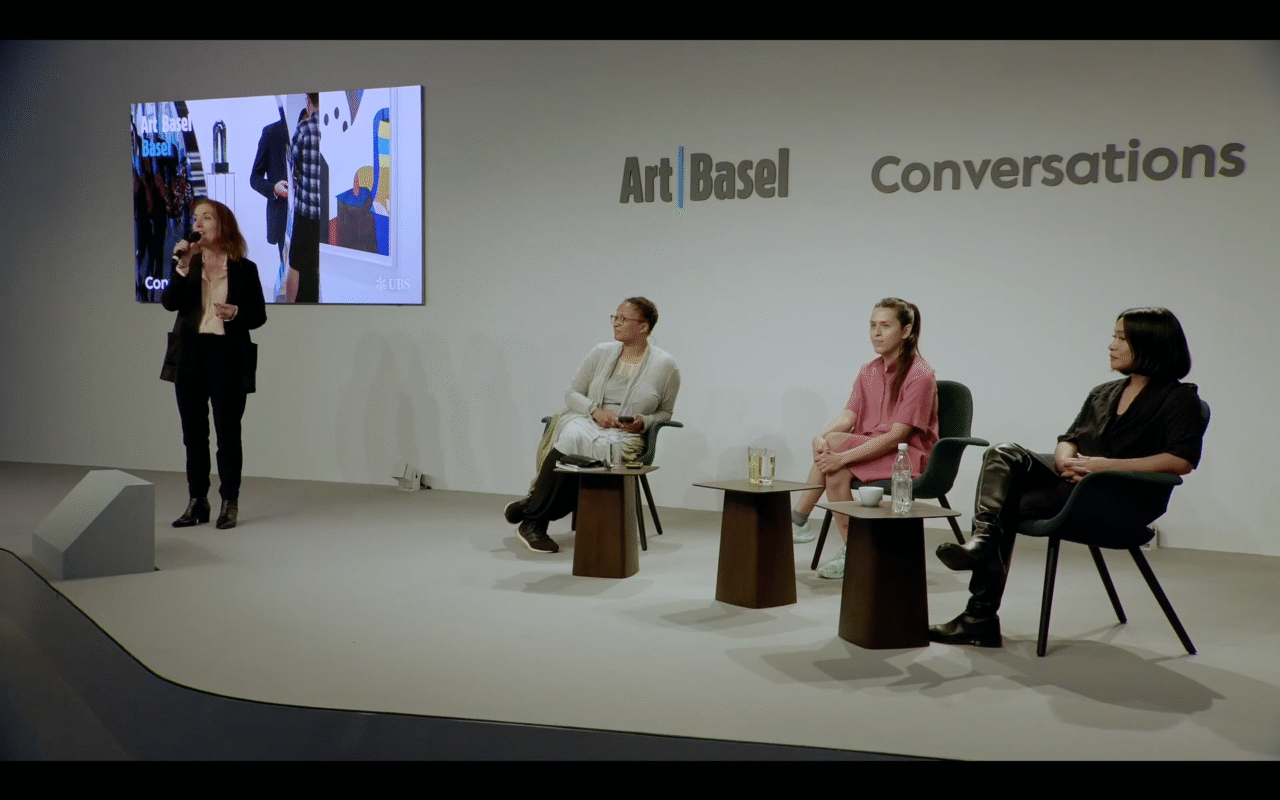
Seba Calfuqueo in Conversations: Activating Environments: New Ways of Thinking of Land, Sea and Life. Art Basel, June 2024.
In this list, which does not claim to be exhaustive, one can clearly perceive the intensity of international activity, and less so the anxiety and pressure of a market eager for novelty and commodification. Inspired by this theme, many countries have chosen to explore the ideas of nationality, belonging and diplomacy from Indigenous perspectives. To ‘discover’ a Maya, Mapuche, Yagán, Shipibo, or Inuit photographer has become both a cultural trophy and a mirror reflecting the tensions and contradictions inherent in cultural funding.
Such is the case with investment policies that condition access to natural resources through private companies (some European), such as the mining giant BHP or the oil company Total – entities that sponsor many exhibitions and cultural programmes in Europe while being among the main perpetrators of ecocide in the Amazon. In this context, one cannot forget the suicide of Jaider Esbell during the São Paulo Biennial. At 41 years old, shortly before his death, he wrote a poem titled For the Day of My Departure:
At this moment, my soul must be seeing everything from above,
just as I always dreamed, absolutely free
with no need for protection, foundation, or material connection of any kind.
Below, only the cold and comforting emptiness of infinity.1
This raises the question: How long will the art market – with its collections, festivals and biennials – continue to contemplate the ‘superstitious from the transversal valleys at the ends of the earth’2 without assuming responsibility for the structural problems afflicting these communities?
Among these issues are the loss of ancestral lands, political marginalisation, economic exploitation, cultural and linguistic discrimination, and the impact of state policies that threaten their ways of life. While the works of these artists are celebrated and commercialised3, many of their communities continue to face poverty, displacement and the erasure of their rights, creating a profound contrast between the aesthetics consumed and the reality ignored. At the heart of the Indigenous art system beats a neoliberal paradox that seems irresolvable.
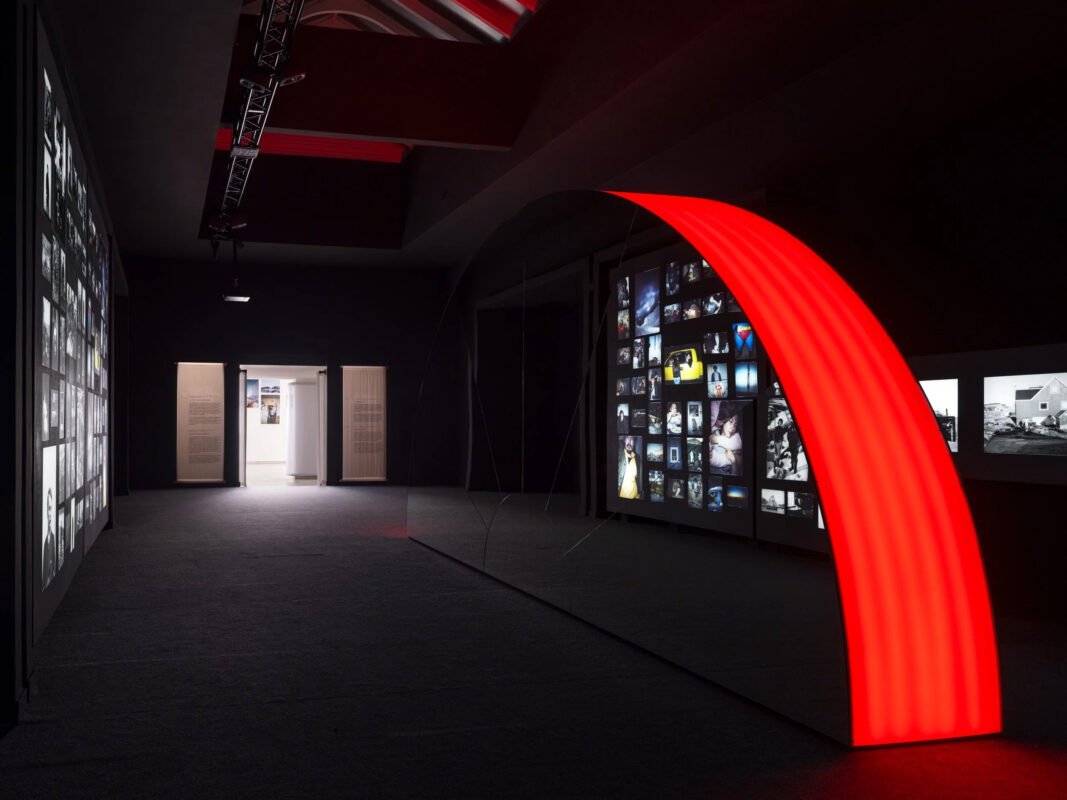
View of the Danish Pavilion by artist Inuuteq Storch, curated by Louise Wolthers, at the 60th Venice Biennale, Italy, 2024. Courtesy the artist and Venice Biennale.
As mentioned, Octavio Aguilar, an Ayuuk artist, recently received the Discovery Award from the Louis Roederer Foundation, awarded by curator César González-Aguirre at Les Rencontres d’Arles 2025. His work is part of a continuum within Latin American visual arts programmes, in which Indigenous voices rework their own discourses and express them in the first person.
In this article, we will focus specifically on Indigenous photographers and Indigenous artists who employ photography, distinguishing them from non-Indigenous artists who may be intellectually ‘committed’ to the defence of Native peoples. The history of Indigenous photographers is less known and finds its seminal figure in Martín Chambi (Quechua), while also traversing the work of collectives and projects: Taller de Historia Oral Andina (1983), Chiapas Photography Project (1992), Aiwin, la imagen de la sombra (2008), Encuentro de las Culturas Indígenas (2016), up to Maxita Yano (2025) and the Colectivo Lakapoy (2025), which recently inaugurated exhibitions at the Instituto Moreira Salles in São Paulo and the Inhotim Museum, respectively.
Aguilar’s work is situated within the tradition of contemporary Indigenous art but from a distinctive perspective: that of an Ayuuk artist representing his own community in the first person. His work avoids the external gaze typical of ‘intellectualised’ or academic indigenismo, which historically has perpetuated stereotypes and simplifications of Native peoples. Instead, Aguilar proposes a direct communal self-representation, where lived experience and the collective memory of his Ayuuk community become the central axis of artistic creation.
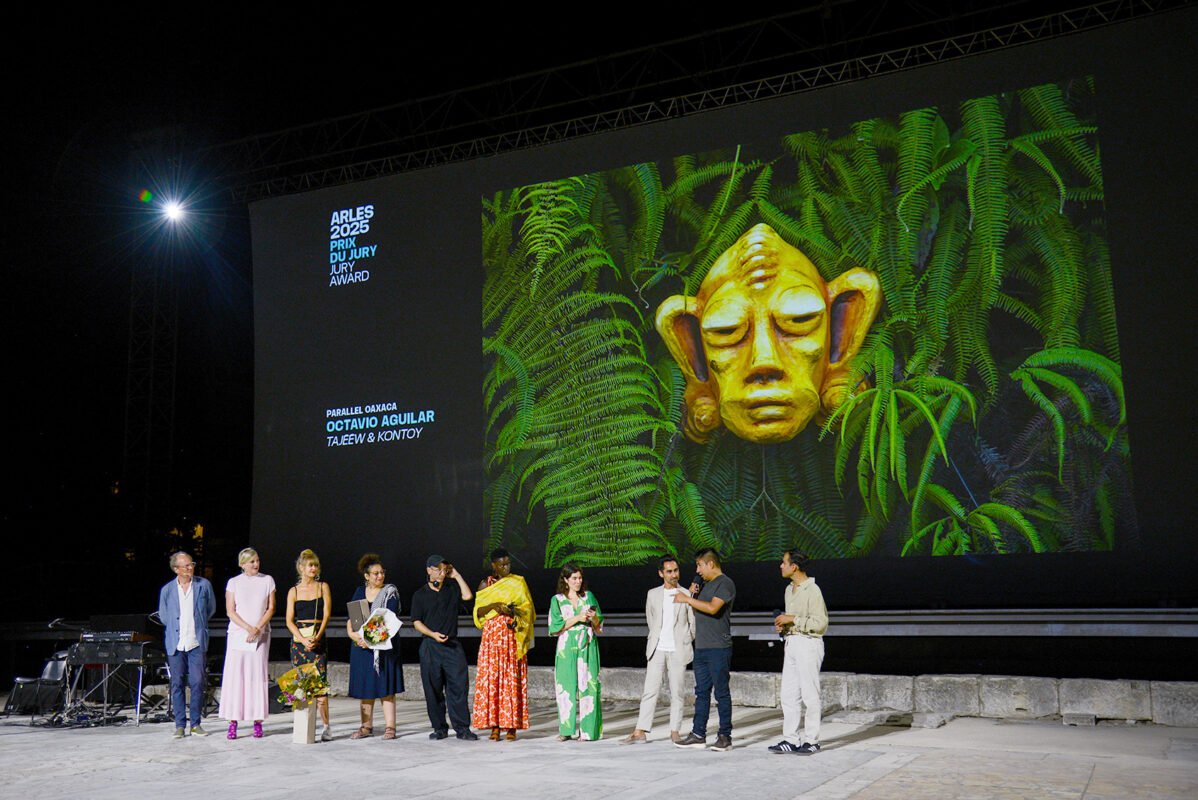
Octavio Aguilar receiving the Louis Roederer Foundation Discovery Award from curator César González-Aguirre, at Les Rencontres d’Arles 2025. Photo: Eulalie Pernelet.
In his exhibition Tajëëw its Kontoy, presented at Arles, Aguilar combines silkscreen, drawing, sculpture, sound, and photography within an installation that constructs a contemporary Indigenous imaginary. His images reveal the coexistence of ancestral and modern elements – traditional papier-mâché masks alongside contemporary sportswear, ritual landscapes juxtaposed with everyday objects – thus generating a dialogue between past and present that challenges the idea of Indigenous culture as something ‘frozen in time.’
In this way, his work reinterprets indigenismo not as an external gaze toward the Other, but as an internal narrative, where culture and identity are expressed from within, marked by irony, subtlety and aesthetic freedom. Moreover, Aguilar frames his work within a critical commitment to power structures and historical memory. Each image functions as an act of reactivating ancestral knowledge, showing how photography and other artistic practices can become tools of cultural and political resistance. By placing his own lived experience at the centre, Aguilar demonstrates that language recovery is not merely a nostalgic gesture, but a creative and emancipatory act that redefines contemporary indigenismo.
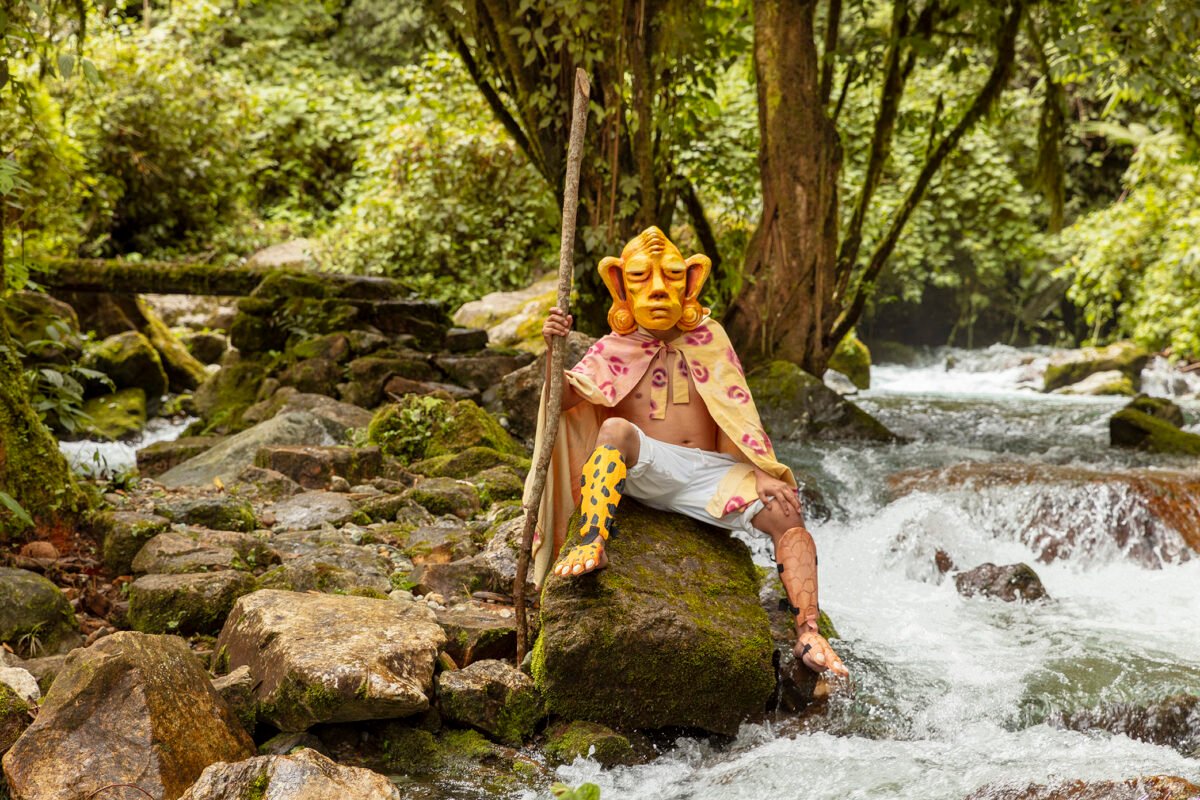
Octavio Aguilar, Kontoy, 2020. Courtesy of the artist and Parallel Oaxaca.
Aguilar’s photographic methodology can be defined, from the standpoint of cultural anthropology, as rooted in participatory observation. It stems from his direct involvement with Ayuuk oral traditions – particularly those of his grandmother, Aurea Romero, who constitutes a key figure in this work (as he notes in his introductory text). She has guided him in understanding his cultural genealogy. Through this relationship, Aguilar has reconstructed the memories of Santiago Zacatepec. His conversations with her and with other community members enabled him to develop a narrative that resists the various processes of symbolic colonisation. In the photographs that comprise the project, Aguilar’s friends embody Tajëëw and Kontoy, the ancestors of the Ayuuk people, drawing on visual codes specific to the communal imaginary.
This visuality is organised in different moments that regenerate a memory diluted by the passage of time and the processes of cultural segregation imposed on Indigenous groups throughout Mexican history. Thus, Aguilar’s work reveals the process of neoculturation: a phenomenon that goes beyond the group of men and women often considered marginal – those who constituted the nucleus of the first exchange between metropolis and colonies, that is, between Europe and the Americas – integrating foreign cultural manifestations into their own lives and, consequently, into their own cultures.
Neoculturation responds, first and foremost, to the conditions of a new mestizo culture. Since the creation of this concept, several related terms have emerged: Silvia Rivera Cusicanqui’s notion of ‘ch’ixi’ (grey), Ticio Escobar’s ‘mestizo methodology’, Viveiros de Castro’s ‘cosmopolitics’, Walter Mignolo’s ‘epistemic disobedience’, Oswald de Andrade’s ‘anthropophagy’, and Édouard Glissant’s ‘créolité’. All these ideas advocate cultural pluralism as a way of denouncing and deactivating various forms of discrimination.
Fernando Ortiz coined the term ‘transculturation’ in his analysis of mestizo culture, and simultaneously proposed implicit concepts: deculturation or excultration for the first historical phase of colonial destruction; inculturation, as a substitute for acculturation, to describe the linear phenomenon of submission to the conqueror’s culture; transculturation, for the complete process that fosters reciprocal exchange; and, finally, neoculturation, to defend the creation of a plural culture resulting from the entire process.
Having recalled these conceptual frameworks, the question that remains is whether, in this context, an authentic Indigenous photography can exist. To approach this question, we may examine a self-portrait titled Self-Portrait with Glass Plate (1925) by the photographer Martín Chambi, recognised historically as the first Indigenous photographer. The image speaks to transculturation by placing the Indigenous subject before his own likeness, created with a European and colonising technique on a glass plate. Jorge Heredia, curator of the exhibition Martín Chambi (1891–1973): Photographer of the Andes at the Museum of Ethnography in Rotterdam (1992), writes:
‘Chambi appears as a rotating double-sided mirror in which different subjects contemplate themselves simultaneously from both sides, separated by the same mirror, which at once is the vehicle projecting each image. By a twist of fate, the reverse of the mirror, by the force of physics, projects the image once more, even if only as a reflection in another mirror, leaving only an imaginary trace of that opposed otherness that was there before, perceived at a distance as an inevitable closeness with that other, who is likewise caught in the same trance. Nothing dissolves; everything is present in the same place with brutal nakedness, and yet nothing seems exactly what it appears to be: there is always something more. No one can exist without the other’.4
Like Chambi, other groups also took control of the camera and, consequently, faced the double and the trance of their own representation. Some peoples adopted the photographic medium very early, discreetly capturing images of their own communities. Among them were Jennie Cross Cobb (Cherokee) in Oklahoma and Richard Throssel (Cree) in Montana. From this first generation, Horace Monroe Polar (Kiowa) stands out as one of the few professional Indigenous photographers in North America. In South America, the only comparable figure of the same period is Chambi himself. While little known in the South, two exhibitions of Chambi’s photographs were already held in 1936 – one at the headquarters of the newspaper La Nación and another at the Casino de Viña del Mar, in Chile.
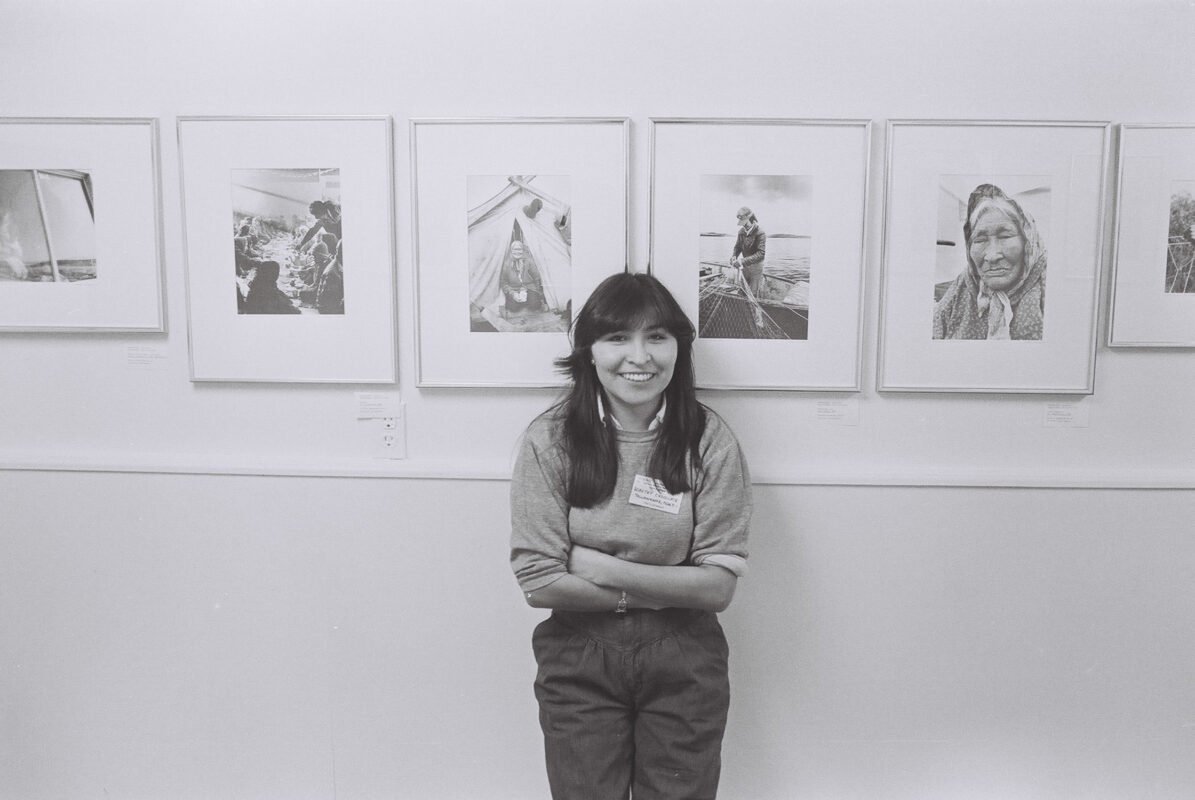
Dorothy Chocolate at VISIONS: The Photographer’s Union conference, Ontario, 1985
In North America, the exhibitions 7 Views of Hopi (1983) and Vision (1985) marked two important, albeit belated, milestones. Vision was both an exhibition and the first conference on Indigenous photography, organised in Canada by a group of Inuit photographers. For its part, 7 Views of Hopi, held at the Northlight Gallery of the University of Arizona, presented the work of Hopi artists Jean Fredericks, Owen Seumptewa, Freddie Honghongva, Merwin Kooyahoema, Georgia Masayesva, and Victor Masayesva. This exhibition revealed a different conception of photography, with one image featuring a wooden figure known as Kwikwilyaqa. Victor Masayesva, filmmaker, video artist and photographer writes:
‘…When I was photographing an elder, he called me Kwikwilyaqa. At that moment, I laughed at how much the comparison fit, at what I was doing with the camera. He likened me to a Katrina, one of those spiritual beings within the Katrina categories devoted to buffoonery, burlesque and social commentary. It appears this way: wearing white man’s clothes, shoes, holding a cane in one hand and a rattle in the other. It has a black mask with protruding cylindrical eyes and a mouth painted black and white. What made me laugh was imagining how much I must have resembled him, leaning over my camera. The cloth surely resembled the juniper bark covering that Kwikwilyaqa wears on his head. Later I realised that perhaps this was the point: when Kwikwilyaqa appears in the central plaza, he casts his shadow on everyone he encounters, imitating each action of his chosen subject, quickly becoming a nuisance’.5
This testimony opens reflection onto a new perspective: the nuisance – understood as a factor that affects health, well-being or environment. Photographers, Indigenous or not, record a singular history that transcends mere technical photography to question relationships with knowledge and beliefs, including the superstitions that shaped these cultures6. Often, the myth is invoked that Indigenous people refused to be photographed for fear that the camera would ‘steal their soul.’ This idea, widely diffused through colonial accounts, is in fact a Western myth that attributed symbolic value to images captured by explorers. In reality, Indigenous resistance to photography is far more complex: it could refer to the taking of the image itself, to the unauthorised circulation of one’s portrait, to the asymmetry inherent in the photographic act, to misunderstandings of the camera’s mechanism, and above all, to the political and spiritual consequences that the act could entail. An analysis of superstitions generated by photography requires us first to reflect on the role of the camera, both as a technical invention and as a Western model of thought imposed on Indigenous cultures – particularly in their funerary rituals7. This raises two important questions: What could be the origin of Indigenous photography? Does there exist an Indigenous technology that approximates the idea of a photographic mechanics based on mimesis?
While the answers to these questions could fill an entire book, it is worth noting that the shutter speed and aperture – the cuts introduced into space-time that generate an image through luminous imprint – are notions entirely foreign to Indigenous conceptions of imitation and vision. One hypothesis would be to establish a parallel between the photographic ‘alteration’ of time, which produces an image from a luminous imprint, and certain visionary shamanic practices that provoke mental images. In this sense, Claude Lévi-Strauss opens a path in La pensée sauvage (1962), reminding us that:
‘Instead of opposing magic and science, it would be preferable to place them in parallel as two modes of knowledge, unequal in their theoretical and practical results (for in this respect, it is true that science achieves greater success than magic, although magic prefigures science insofar as it too sometimes succeeds), but not in terms of the type of mental operations they suppose, which differ less in nature than in the function of the phenomena to which they are applied’.8
In considering these different ‘ways of seeing’ that might be set in parallel, it is necessary to address another topic closely linked to colonial history: the idea that, from the United States to Patagonia,
Indigenous art is defined by geometric abstraction, chromatic richness and decorative diversity – from the pre-Columbian period to the present. Yet, as we shall see, such characteristics find little correspondence in the history of contemporary photography by Indigenous creators.
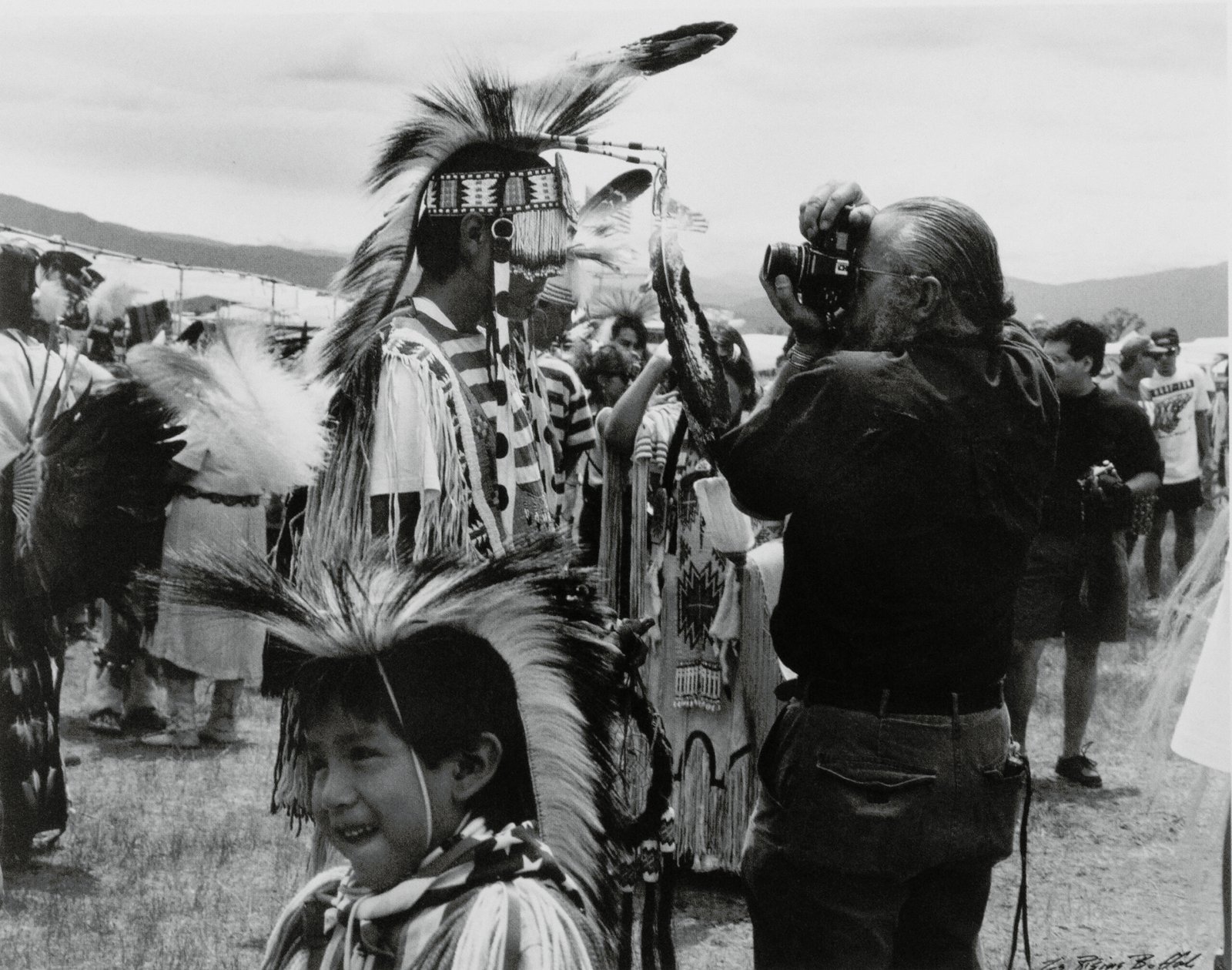
In recent history, we find a 1995 portfolio of photographs published in Aperture magazine: Strong Hearts: Native American Visions and Voices. It included works by Walter Bigbee (Comanche), Luci Tapahonso (Navajo), Jeffrey M. Thomas (Iroquois/Onondaga), N. Scott Momaday (Kiowa), Paul Chaat Smith (Comanche), and Zig Jackson (Mandan/Hidatsa/Arikara). This portfolio accompanied the exhibition of the same name at the Smithsonian Museum in Washington in 1996 (it is worth noting that Zig Jackson is the first contemporary Indigenous photographer represented in the collections of the U.S. Library of Congress, after donating twelve large gelatin silver prints in 2015). Among them is the ironic series Indian Photographing Tourist Photographing Indian (1992), where Jackson portrays intrusive tourists pointing their cameras at Indigenous faces in a reservation. What deserves emphasis in this series is a central problem: the notion of the apparatus (dispositif), understood as the constitutive mediation that organises the relationship between photographer and photographed. From the perspective of an Indigenous photographer – or any photographer – it acquires particular epistemological weight, as it structures ways of seeing and representing. The apparatus, as defined by Czech-Brazilian philosopher Vilém Flusser, is:
‘A complex toy (the apparatus), so complex that those who play with it cannot fully understand it. Playing with it consists in combining the symbols contained in its programme – a programme that is itself inscribed in a meta- programme – and the outcome of the play is formed by other programmes still. While fully automated apparatuses can dispense with human intervention, many others require man as both player and functionary.’9
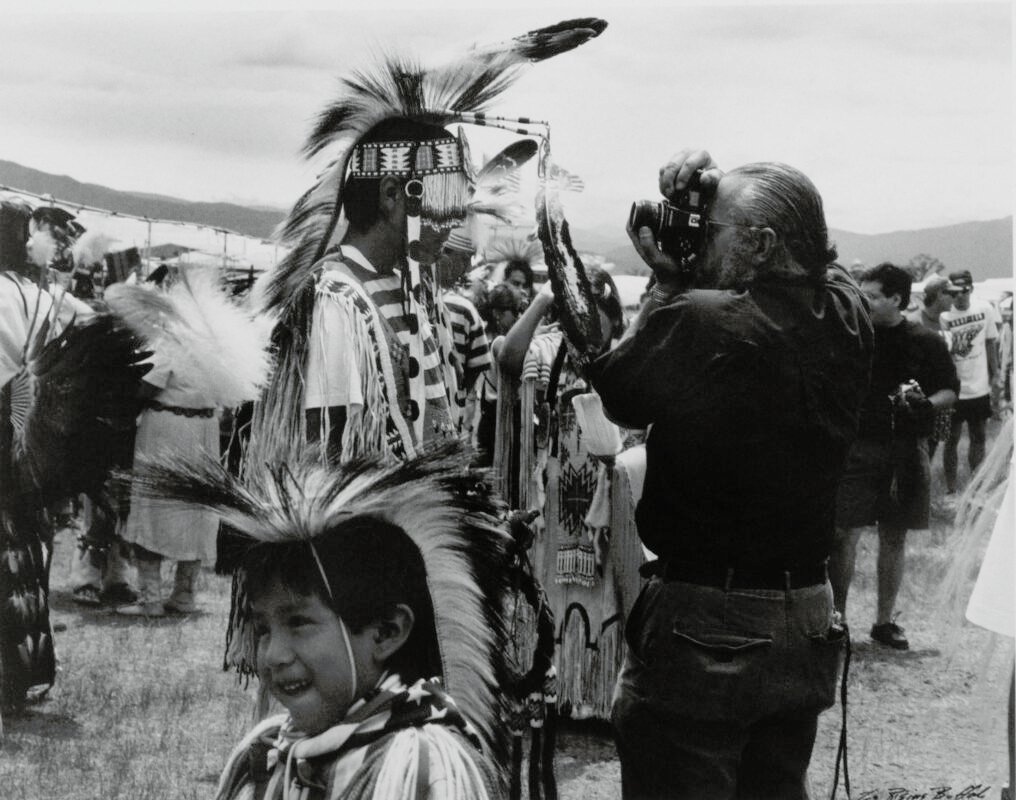
Zig Jackson, Camera in face, Taos, New Mexico, 1992. Courtesy the artist and Library of Congress, Prints & Photographs Division.
In his essay Ghost in the Machine, published in the same 1995 issue of Aperture, Paul Chaat Smith (Comanche) offers an overview of the specific perspective of the ‘Indigenous functionary,’ borrowing Flusser’s language. His text illuminates a particular relationship with the apparatus, one shaped by the history of Indigenous peoples:
‘In 1840, when the war against us was going badly, a visionary Texas Ranger named Sam Walker undertook an extraordinary journey. Walker knew that only a considerably improved firearm could guarantee the success of his Rangers. He therefore went to the Colt factory in Paterson, New Jersey, and worked with Colt himself to develop the world’s first repeating revolver: the ‘Walker Colt’ .44 calibre. The revolver that revolutionised warfare against the Indians and weaponry in general – was a machine designed with a single purpose: to kill Comanches. To underscore this, each weapon bore an engraving of a battle between Comanches and Texas Rangers. We tried desperately to acquire these new weapons, but our success was limited: imagine a member of the Crips attempting to buy a dozen Stinger shotguns during the Los Angeles riots in 1992 – not impossible, but very, very difficult. It would have been necessary to invent a special camera to photograph Indians as well, given the considerable influence of photography on us. If one machine nearly annihilated us – we were little more than a thousand when my grandparents were born at the beginning of the century – another gave us immortality.’10
From the earliest days of photography, theorists such as Roland Barthes, Siegfried Kracauer and Susan Sontag have identified within it a notion of immortality – as Chaat Smith observes – linked to the trace that bears witness to events and to the photographer’s presence in a given place. Yet the idea that the camera could grant immortality in the spirit of a Comanche transforms our understanding of anthropological photography, as well as colonial and decolonial discourses. While certain historical photographs allow the recovery of forgotten traditions, more recent productions expand the global visibility of Indigenous struggles. They are increasingly accompanied by the participation of Indigenous artists and curators in the contemporary art world, whose repercussions were analysed earlier in this article.
More recent examples include the prize awarded to Octavio Aguilar, as well as the work of Wendy Red Star (Apsáalooke), who in 2020 was invited to guest-edit Aperture for a special issue devoted to Indigenous photography and practice. Titled Native America, it was the first time Aperture had been edited by an Indigenous artist, signaling an evolution from the historical invisibility that long affected these creators. In Chile, several artists are now entering the international contemporary art circuit. Such is the case with Sebastián Calfuqueo and Paula Baeza Pailamilla, who work with photography and video, following in the footsteps of Francisco Huichaqueo and Bernardo Oyarzún – the first Mapuche artist to represent Chile at the Venice Biennale in 2007 with the project Werken, an artistic inquiry into his Mapuche roots begun in the late 1990s under the curatorship of Ticio Escobar.
Despite concentrated efforts to increase visibility, specifically Indigenous photographic practice remained largely isolated up to the year 2000; it did not significantly displace the entrenched visual stereotypes that folklorise tribes and communities. Even so, the work of these Indigenous photographers began to influence institutional policies around image acquisition and dissemination. More importantly, photography continued to be central to rebuilding Indigenous personal and collective identity. Yet, at this stage, ‘Indigenous photography’ should not be considered solely through the lens of cultural difference; doing so would obscure the numerous stylistic similarities that characterise our era across cultures. Furthermore, Indigenous photography is directly connected to concerns that are not only identitarian but also global.
In other words, it is necessary to consider it at the level of the individual, independently of ethnic belonging. Although practices are singular, these artists share a common objective: to promote the reappropriation of their various cultures by the communities themselves, rather than by outsiders, as was long the norm. For decades, photographs of Indigenous peoples made by settlers perpetuated unreal symbols or showed only the negative aspects of life. Whereas the humanity of these peoples was absent from thousands of stereotyped images, today the Indigenous photographer, equipped with a camera, produces a productive estrangement in order to return what is captured to the community itself – now functioning as a steward of memory.
My partial conclusion is that the notion of ‘Indigenous photography’ is a myth. To approach a truly Indigenous photography, the artist must unravel, within their own inheritance, the ‘photographic programmes’ that condition their gaze and embrace the enigma of the camera’s darkness as a creative principle. The search for an Indigenous point of view should be undertaken only by someone from the community – underscoring the impossibility for an external observer to define a position vis-à-vis the apparatus’ programmes. Ultimately, however, this issue concerns any photographer or artist who wishes to occupy the photographic medium for creative ends: it compels attention to the apparatus and to the challenges of the global photo industry, placing the ‘black box’ at the centre, simultaneously observed by the photographer and those photographed. It may be worthwhile to explore concepts such as pre-photography, always with the awareness that the artist – freed from the dictates of Mr. Kodak, Canon, or Nikon – can untangle their own heritage and confront the camera’s enigma. Only then can a truly photographic act emerge: not as nostalgia for the authentic, but as a radically new creation founded on cultural genealogy.
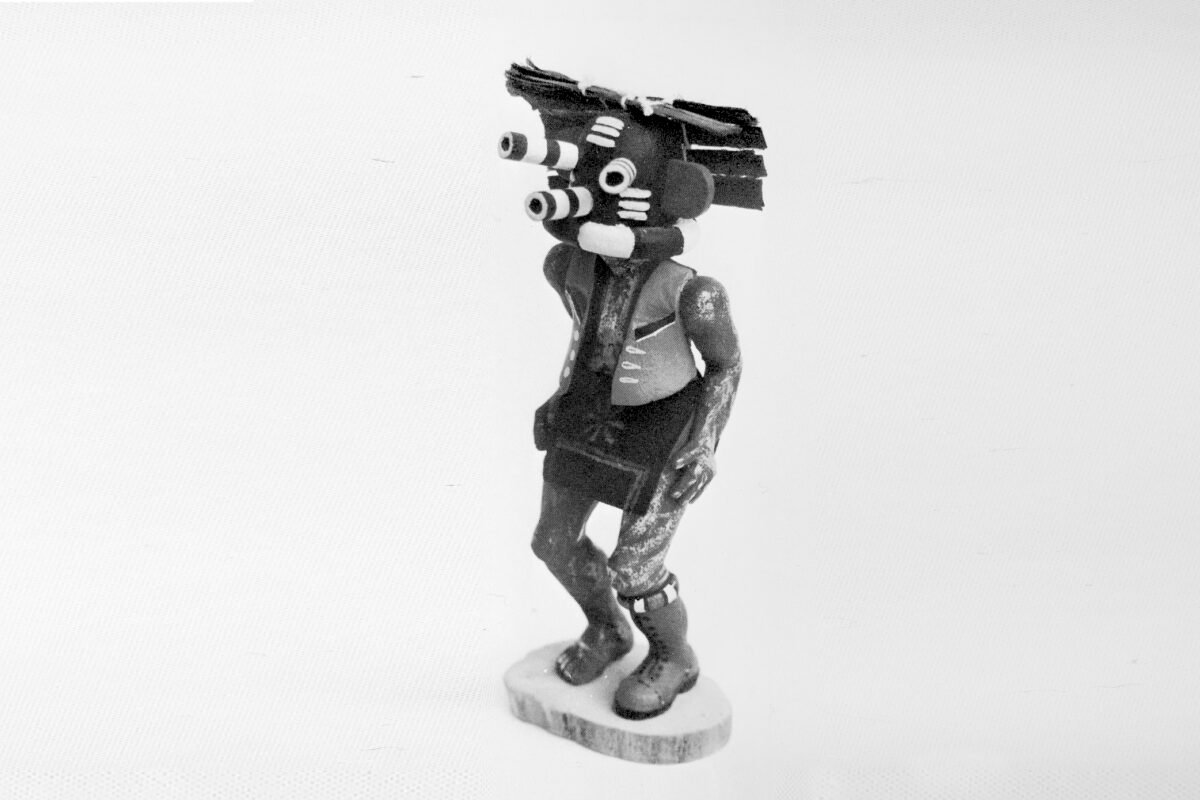
Kwikwilyaqa, from the James T. Bialac Native American Art Collection
Octavio Aguilar is not oblivious to this problematic. In his photographic work, he operates a device that inevitably intertwines modern and colonial inheritances. After a close examination of each proposal by the eight artists selected by curator César González-Aguirre, the jury unanimously decided to award the prize to Aguilar for his project Tajëëw its Kontoy.
The decision rested on a shared conviction: in a European context where the inclusion of historically marginalised communities is perceived as an ethical and aesthetic urgency, it is indispensable to expand the visual and artistic spectrum. Recognising aesthetics distant from traditional European canons is not merely a gesture of openness; it is the very condition for introducing new visual codes into contemporary discourse on cultural diversity. This inevitably provokes suspicion, since – as we noted earlier – these new visual codes can be leveraged to capitalise on recent curatorial work by institutions that position themselves critically vis-à-vis their own histories. It is a cultural opportunism we should continue to scrutinise carefully.
The jury emphasised the value of orally transmitted narrative forms, passed down from generation to generation, recognising them as legitimate carriers of knowledge and memory. In this context, Aguilar’s portraits – staged in environments that evoke the Ayuuk imaginary – dialogue with fragments of punk textiles, printed with slogans in favour of Indigenous autonomy, constituting a visual space where tradition and contemporaneity intersect, tension and mutually amplify. His multidisciplinary work thus appears as an act of symbolic resistance: it preserves transcultural memory in the face of vertiginous globalisation and the homogenisation of ways of life, transforming his photographic practice into a terrain of identity affirmation and aesthetic experimentation.
The jury, speaking in French and Spanish, underlined with particular emphasis that this was not a ‘discovery’ – a term heavy with colonial resonances, as when the Americas were ‘discovered’ – but rather an acknowledgement of continuity and visual genealogy, and with it, the assertion of a legitimate place within the contemporary photographic community.
Ultimately, the recognition of Indigenous artists should not become an excuse to perpetuate exoticisation, nor a pretext for evading responsibility for those who sustain structural relations of power. Although these artists contest stereotyped representations and hegemonic discourses by giving voice to their communities and making visible realities too often ignored, it remains insufficient so long as their voices are kept within contemporary art institutions without reaching parliaments – as suggested by Michael Cook (Bidjara) in his photographic series from 2014, Majority Rule.
In this context, we might ask whether a more forceful political gesture is not required. Indigenous artists are well aware of this situation – Michael Cook or Seba Calfuqueo state it clearly. In a conversation in Basel, Calfuqueo says:
‘…the art world has always been an uncomfortable space. I have no point of reference within my community, because no one else occupies the position I have now. Even so, this conflict is part of what it means to exist in the art world. At some point, I think we choose to remain in this space because we accept and even embrace that discomfort. I have come to understand that the uncomfortable zone can be a space for creativity’.11
Perhaps we must transform our perception of the apparatus and, in a metaphorical sense, invert the camera – direct it toward those responsible, not only toward victims. This is a critical stance that seeks to expose structures of power, injustices and responsibilities implicated in each situation. It entails shifting the gaze from representations centred on vulnerable subjects to images that lay bare the actors, institutions and systems that perpetuate inequality. In this way, photography could become a tool for deconstruction and social critique, a strategy of institutional subversion that goes beyond mere documentation.
This perspective inevitably forms part of a broader discussion on political art and the limits of its real efficacy: Why do we trust that contemporary art institutions can influence political decision-making?
Perhaps the true task is not to inscribe oneself in the field of contemporary art, but to explore ‘something else’ that as yet lacks a name. Otherwise, the gesture risks shrinking to a politics of visibility – the capacity to occupy space in museums and institutions – rather than an artistic creation in its own right. This raises new questions: Why seek recognition as a contemporary artist? What does it mean to aspire to participate in an international festival? And why should a curator assume the role of mediating an Indigenous artist’s discourse under the codes of Western museology?
If Europe continues to look toward the Americas, it must go beyond aesthetic findings and recognise the histories, struggles and resiliencies that undergird these creations, incorporating into exhibitions their contexts of production and the consequences for communities. Only then can it cease to be a showcase of exoticisms and become a space of dialogue, justice and authentic visibility. It is necessary, however, to remember that the system is not innocuous. Even as exhibitions foster alliances with Indigenous peoples, confront extractivism and promote environmental education, Europe remains ensnared in ethical-political paradoxes, where good intentions collide with entrenched structures of power.♦
–
Sergio Valenzuela-Escobedo is an artist and researcher whose practice lies at the confluence of artistic research, curatorial work and education. He holds a PhD in photography from the École Nationale Supérieure de la Photographie (ENSP, Arles). Valenzuela-Escobedo has curated numerous exhibitions, including Mapuche at the Musée de l’Homme in Paris, as well as Monsanto: A Photographic Investigation and Bosques Geométricos, both of which premiered at Les Rencontres d’Arles. Monsanto was the winner of the Paris Photo/Aperture Book Award and shortlisted for the Deutsche Börse Foundation Photography Prize 2018. In 2023, he presented the trilogy Mama Coca, Ipáamamu and Oro Verde at Fotofestiwal in Łódź, Poland. In 2025 he curated Lightseekers for Bienal’25 Fotografia do Porto, Portugal. He is Associate Curator of the Guyane Biennale 2027 and serves as Artistic Director of Double Dummy. As an art critic and researcher, Valenzuela-Escobedo regularly contributes to publications such as Inframince, 1000 Words, Mirá, and Letargo.
References:
1 Jaider Esbell, Para el día de mi partida, in Tardes de Agosto, Manhãs de Setembro, Noites de Outubro, Boa Vista, 2013.
2 Eugenio Dittborn, Nous les artistes de provinces lointaines, in ArtPress 62, Paris, 1982.
3 The study of pre-Columbian art collections is a field of great interest in my research, particularly in the case of the collection assembled by Louise and Walter Arensberg, which is currently held at the Philadelphia Museum of Art.
4 Jorge Heredia, La imagen elusiva de Martín Chambi, Espacio Graf (online), Mérida, 1992.
5 Victor Masayesva Jr. and Erin Younger, Hopi Photographers / Hopi Images, Tucson, University of Arizona Press, 1983.
6 Two expressions establish themselves as the princeps notions in my argument in favour of an Aboriginal science, for lack of another way to name it. The first is the popular expression among the Fuegian people, Toumayacha Alakana, which means “to look with one’s head covered by a veil.” The second corresponds to the Yanomami expression Noreshi Toway, which means “to take the double of a person.” These two expressions are at the origin of my thesis on the atavistic fear of image capture.
7 For further study on the subject, see: Sergio Valenzuela-Escobedo, MÄNK’ÁČEN: Photographic Mechanics, Mysticism, and Superstition among the Indigenous Peoples of South America, dissertation in practice and theory of artistic and literary creation, École Nationale Supérieure de Photographie (ENSP Arles) and Université d’Aix-Marseille, 2021.
8 Claude Lévi-Strauss, La pensée sauvage, Paris, Plon, 1962.
9 Vilém Flusser, Pour une philosophie de la photographie [Für eine Philosophie der Fotografie, 1983], Paris, Circé, 1996.
10 Paul Chaat Smith, Ghost in the Machine, in Aperture no. 139 (Strong Hearts: Native American Visions and Voices), New York, Aperture Foundation, 1995.
11 Seba Calfuqueo in Basel Conversations: Activating Environments: New Ways of Thinking of Land, Sea and Life. Art Basel, June 2024.
1000 Words favourites
• Renée Mussai on exhibitions as sites of dialogue, critique and activism
• Roxana Marcoci navigates curatorial practice in the digital age
• Tanvi Mishra reviews Felipe Romero Beltrán’s Dialect
• Discover London’s top five photography galleries
• Tim Clark in conversation with Hayward Gallery’s Ralph Rugoff on Hiroshi Sugimoto
• Academic rigour and essayistic freedom as told by Taous Dahmani
• Shana Lopes reviews Agnieszka Sosnowska’s För
• Valentina Abenavoli discusses photobooks and community
• Michael Grieve considers Ute Mahler and Werner Mahler’s posthumous collaboration with their late family member
• Elisa Medde on Taysir Batniji’s images of glitched video calls from Gaza
Join us on Patreon today and be part of shaping the future of photographic discourse


