Paris Photo 2025: Essential Exhibitions Beyond The Grand Palais

A cultural primer for the week ahead, this guide highlights key exhibitions taking place across the city during Paris Photo, from major museum retrospectives to experimental presentations, offering readers an overview of what to see and where to go amid one of photography’s most anticipated moments in the events calendar.


1000 Words | Resource | 7 Nov 2025
Join us on Patreon

Luc Delahaye, The Echo of the World – Jeu de Paume
10 October – 4 January

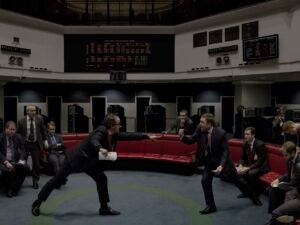
Long recognised for his vastly significant contributions to the field of contemporary photography, Luc Delahaye is the focus of a monographic exhibition at Jeu de Paume showcasing work that spans the last 25 years. During this time, Delahaye has notably transitioned from photojournalism to fine art photography, deliberately moving away from the immediacy of reportage toward the creation of monumental, painterly tableaux that often depict the aftermath of war, the solemnity of international summits or the quiet dignity of displaced individuals. The exhibition, the first in Paris to show Delahaye’s work since 2005, brings together approximately 40 large-format photographs, including previously unseen works and a video installation centred on the Syrian conflict, and is a testament to the documentary form as it tipped into crafted construction.

Rebekka Deubner, Thermal Seasons – Shmorévaz, Photo Saint Germain
6 November – 29 November

For close to a month, Photo Saint-Germain animates venues across the Left Bank with a rolling programme of exhibitions. In the experimental, independent space of Shmorévaz, housed in a former shop and known for its feminist, queer, erotic and political programming, Rebekka Deubner’s Thermal Seasons (a work in progress since 2021) explores the usage of thermal contraception, probing intimacy, parenthood, masculinities, and the gendered distribution of mental labour. Through her careful, intimate gaze on bodies in close proximity, and her attention to the rhythms of communal life, Deubner restores them a kind of tender plasticity, offering a delicate vision of masculinity.

Edward Weston, Becoming Modern – MEP
15 October – 25 January

MEP pays tribute to the celebrated American photographer Edward Weston, offering a unique for Parisiens and visitors to Paris to experience the richness and precision of his modernist vision. Through more than one hundred vintage prints drawn entirely from the prestigious collection of the Wilson Centre for Photography, the exhibition reveals Weston’s fascination with form, texture and the interplay of light and shadow, alongside the gaze and pioneering practice that marked a major turning point in the history of photography. In tandem, MEP also presents the first solo exhibition in France by famed contemporary photographer Tyler Mitchell, meanwhile in the Studio space, the ever fascinating Felipe Romero Beltrán’s image-based series Dialect documents the liminal lives of nine young Moroccan minors navigating the asylum process in Spain.

Donna Gottschalk and Hélène Giannecchini with Carla Williams, (Nos Autres) We Others – Le Bal
20 June – 16 November

Donna Gottschalk and Carla Williams make their French debut in Le Bal’s latest exhibition, We Others, accompanied by an interpretive text by Hélène Giannecchini, bringing together first-person narratives and a wide range of photographs spanning decades to tell stories, explore invisibility and consider intergenerational connections. Gottschalk’s work, inseparable from the emerging movements for LGBT+ rights in which she was involved at a time when homosexual relationships were still illegal in the United States, is situated alongside Williams’ intimate self-portraits, continuing the memory and preservation of marginalised queer lives and framing archival practice as relational and intergenerational. The exhibition’s spatial design and vivid atmosphere owe much to Julie Héraut’s thoughtful curation and deft scenography of Cyril Delhomme, and powerfully forms a bio-dimensional experience that visitors have typically come to expect from this important institution.

Hoda Afshar, Performing the Invisible – Musée du quai Branly – Jacques Chirac
30 September – 25 January 

Hoda Afshar’s first major French solo takes place at the Musée du quai Branly – Jacques Chirac, uniting two chapters of her work: Speak the Wind (2015–20) and The Fold (2023–25). The latter draws on archival research at the museum, confronting orientalist and colonial legacies through photographs taken by psychiatrist Gaëtan de Clérambault in Morocco between 1918 and 1919. Speak the Wind, meanwhile, traces the beliefs, myths and stories carried on the winds that shape life on the islands of the Strait of Hormuz. Across photography, video, sound and printed mirrors, the unique installation threads Afshar’s projects into the living lines of her research. ♦

–1000 Words

Images:

1-Luc Delahaye, Trading Floor, 2013. Courtesy the artist and Galerie Nathalie Obadia, Paris/Brussels

2-Rebekka Deubner, Felix en sicile, 2022

3-Edward Weston, Charis, Santa Monica (Nude in doorway), 1936. Courtesy Wilson Centre of Photography

4-Donna Gottschalk, Self-portrait during a GLF meeting, E. 9th Street, New York, 1970

5-Hoda Afshar, Speak the Wind, 2015-20


1000 Words favourites

• Renée Mussai on exhibitions as sites of dialogue, critique and activism

• Roxana Marcoci navigates curatorial practice in the digital age

• Tanvi Mishra reviews Felipe Romero Beltrán’s Dialect

• Discover London’s top five photography galleries

• Tim Clark in conversation with Hayward Gallery’s Ralph Rugoff on Hiroshi Sugimoto

• Academic rigour and essayistic freedom as told by Taous Dahmani

• Shana Lopes reviews Agnieszka Sosnowska’s För

• Valentina Abenavoli discusses photobooks and community

• Michael Grieve considers Ute Mahler and Werner Mahler’s posthumous collaboration with their late family member 

• Elisa Medde on Taysir Batniji’s images of glitched video calls from Gaza


Join us on Patreon today and be part of shaping the future of photographic discourse


Excluded or Exoticised? The European Gaze in Indigenous Spaces

Across Europe, North America and Latin America, the images of Indigenous photographers are emerging with renewed visibility in exhibitions, biennials and collections, calling us to reconsider, as Sergio Valenzuela-Escobedo does, what it means to speak of ‘Indigenous photography’ in both historical and contemporary contexts. Through an interrogation of photographic and curatorial legacies shaped by colonial discourse, and the field of ‘contemporary art’ more broadly, he writes that the recognition of Indigenous artists should not become an excuse to perpetuate exoticisation, nor a pretext for evading responsibility for those who sustain structural relations of power.


Sergio Valenzuela-Escobedo | Opinion | 23 Oct 2025
Join us on Patreon

Faced with the question of whether the art market might be exploiting the trend in which Indigenous voices rearticulate their own discourses and express them in the first person within the art world – or, alternatively, ‘tokenising’ the presence of Indigenous artists – and whether some states might, in turn, attempt to redeem historical guilt, it becomes necessary to broaden our perspective with a brief review of recent and upcoming events in Europe.


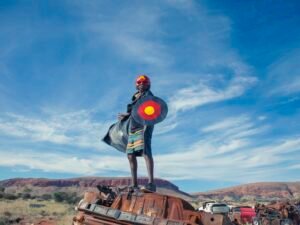
Tony Albert (Kuku Yalanji), David Charles Collins and Kieran Lawson, Warakurna Superheroes #1, 2017. Courtesy the artist and Sullivan+Strumpf.

In the programme of Les Rencontres d’Arles 2025, entitled by its director Christoph Wiesner ‘Indocile Images,’ the Louis Roederer Foundation Discovery Prize was awarded to Octavio Aguilar (Ayuuk), along with three exhibitions with a strong Indigenous presence: On Country: Photography from Australia, Ancestral Futures and Echoes from a Near Future.

The festival’s official poster features the image of an Indigenous child dressed as Captain America – part of the Warakurna Superheroes series by Indigenous artist and artistic director of the National Indigenous Art Triennial Tony Albert (Girramay, Yidindji and Kuku Yalanji), in collaboration with David Collins and children from a remote Aboriginal community in Australia’s Northern Territory. According to its authors, this work interrogates the way optimism can help overcome adversity and dismantle stereotypes, especially those imposed on the nation’s forgotten populations.

Yet, the reality for many Indigenous children diverges painfully from such heroic representation, as evidenced by the winning photograph of Hoda Afshar, recipient of the National Portrait Gallery of Australia’s Portrait Prize 2025. In these communities, children between the ages of 10 and 17 account for only 6.6% of their age group in the general population, yet they are 29 times more likely to be incarcerated.

Three out of five children deprived of liberty are Indigenous, and two out of three of them suffer from a diagnosed mental illness. From an early age, they carry the burden of structural disadvantages, discrimination and criminalisation. What they need is love, care and a supportive community; instead, they are often met with punishment. Detention centres and police stations, far from being spaces of healing, become sites of trauma, abuse and systemic failure. And yet, this reality is tolerated, as if an implicit hierarchy justifies certain forms of violence as normal – or even inevitable. Although Indigenous culture and identity in Australia may be celebrated as heroic, playful and aspirational, the surrounding society often fails to protect its children.

Beyond the French context, it is significant to look toward Venice, where the Golden Lion was awarded to the Australian Aboriginal multimedia artist Archie Moore at the 2024 Venice Biennale, curated by Brazilian Adriano Pedrosa, who affirmed that his biennale opened the door to the global art scene, and thus to Indigenous artists. This declaration is paradoxical, evoking the experience of feeling foreign in one’s own land – a consequence of cultural erasure, territorial dispossession, and, in extreme cases, the extermination of entire peoples – all within the framework of a biennale still divided into national pavilions.

Another case is that of Jeffrey Gibson (Choctaw/Cherokee), who became the first Indigenous artist to represent the United States by occupying the entire pavilion. Already in 1932, Hopi creators such as Fred Kabotie and Awa Tsireh had participated, yet Pedrosa’s opening and Venice’s influence led Tate Modern in London to launch a dedicated fund to increase the representation of Indigenous works in its collection.

In photography, particular attention must be given to the work of Inuuteq Storch (Kalaallit), who represented Denmark and is scheduled to open a new exhibition at the Hasselblad Foundation in Gothenburg in February 2026. Those photographed, like Storch himself, belong to a postcolonial generation. For some, their artistic, social or political choices express a deliberate will to distance themselves from the Danish gaze, in a critical and decolonial perspective. For others – and this is Storch’s case – it is less about reacting to the past than about creating aesthetics rooted in Inuit culture or in dialogue with the global world, outside the colonial prism. Similarly, we can appreciate the work of Seba Calfuqueo (Mapuche), who presented Nunca Serás un Weye (2015) as part of the Disobedience Archive project, and who exhibited their work in Becoming Ocean curated by Ann-Marie Yemsi at the Villa Arson Art Centre in Nice, and who also participated in Activating Environments: New Ways of Thinking of Land, Sea and Life at Art Basel.

Seba Calfuqueo in Conversations: Activating Environments: New Ways of Thinking of Land, Sea and Life. Art Basel, June 2024.

In this list, which does not claim to be exhaustive, one can clearly perceive the intensity of international activity, and less so the anxiety and pressure of a market eager for novelty and commodification. Inspired by this theme, many countries have chosen to explore the ideas of nationality, belonging and diplomacy from Indigenous perspectives. To ‘discover’ a Maya, Mapuche, Yagán, Shipibo, or Inuit photographer has become both a cultural trophy and a mirror reflecting the tensions and contradictions inherent in cultural funding.

Such is the case with investment policies that condition access to natural resources through private companies (some European), such as the mining giant BHP or the oil company Total – entities that sponsor many exhibitions and cultural programmes in Europe while being among the main perpetrators of ecocide in the Amazon. In this context, one cannot forget the suicide of Jaider Esbell during the São Paulo Biennial. At 41 years old, shortly before his death, he wrote a poem titled For the Day of My Departure:

At this moment, my soul must be seeing everything from above,
just as I always dreamed, absolutely free
with no need for protection, foundation, or material connection of any kind.
Below, only the cold and comforting emptiness of infinity.1

This raises the question: How long will the art market – with its collections, festivals and biennials –  continue to contemplate the ‘superstitious from the transversal valleys at the ends of the earth’2 without assuming responsibility for the structural problems afflicting these communities?

Among these issues are the loss of ancestral lands, political marginalisation, economic exploitation, cultural and linguistic discrimination, and the impact of state policies that threaten their ways of life. While the works of these artists are celebrated and commercialised3, many of their communities continue to face poverty, displacement and the erasure of their rights, creating a profound contrast between the aesthetics consumed and the reality ignored. At the heart of the Indigenous art system beats a neoliberal paradox that seems irresolvable.

View of the Danish Pavilion by artist Inuuteq Storch, curated by Louise Wolthers, at the 60th Venice Biennale, Italy, 2024. Courtesy the artist and Venice Biennale.

As mentioned, Octavio Aguilar, an Ayuuk artist, recently received the Discovery Award from the Louis Roederer Foundation, awarded by curator César González-Aguirre at Les Rencontres d’Arles 2025. His work is part of a continuum within Latin American visual arts programmes, in which Indigenous voices rework their own discourses and express them in the first person.

In this article, we will focus specifically on Indigenous photographers and Indigenous artists who employ photography, distinguishing them from non-Indigenous artists who may be intellectually ‘committed’ to the defence of Native peoples. The history of Indigenous photographers is less known and finds its seminal figure in Martín Chambi (Quechua), while also traversing the work of collectives and projects: Taller de Historia Oral Andina (1983), Chiapas Photography Project (1992), Aiwin, la imagen de la sombra (2008), Encuentro de las Culturas Indígenas (2016), up to Maxita Yano (2025) and the Colectivo Lakapoy (2025), which recently inaugurated exhibitions at the Instituto Moreira Salles in São Paulo and the Inhotim Museum, respectively.

Aguilar’s work is situated within the tradition of contemporary Indigenous art but from a distinctive perspective: that of an Ayuuk artist representing his own community in the first person. His work avoids the external gaze typical of ‘intellectualised’ or academic indigenismo, which historically has perpetuated stereotypes and simplifications of Native peoples. Instead, Aguilar proposes a direct communal self-representation, where lived experience and the collective memory of his Ayuuk community become the central axis of artistic creation.

Octavio Aguilar receiving the Louis Roederer Foundation Discovery Award from curator César González-Aguirre, at Les Rencontres d’Arles 2025. Photo: Eulalie Pernelet.

In his exhibition Tajëëw its Kontoy, presented at Arles, Aguilar combines silkscreen, drawing, sculpture, sound, and photography within an installation that constructs a contemporary Indigenous imaginary. His images reveal the coexistence of ancestral and modern elements – traditional papier-mâché masks alongside contemporary sportswear, ritual landscapes juxtaposed with everyday objects – thus generating a dialogue between past and present that challenges the idea of Indigenous culture as something ‘frozen in time.’

In this way, his work reinterprets indigenismo not as an external gaze toward the Other, but as an internal narrative, where culture and identity are expressed from within, marked by irony, subtlety and aesthetic freedom. Moreover, Aguilar frames his work within a critical commitment to power structures and historical memory. Each image functions as an act of reactivating ancestral knowledge, showing how photography and other artistic practices can become tools of cultural and political resistance. By placing his own lived experience at the centre, Aguilar demonstrates that language recovery is not merely a nostalgic gesture, but a creative and emancipatory act that redefines contemporary indigenismo.


Octavio Aguilar, Kontoy, 2020. Courtesy of the artist and Parallel Oaxaca.

Aguilar’s photographic methodology can be defined, from the standpoint of cultural anthropology, as rooted in participatory observation. It stems from his direct involvement with Ayuuk oral traditions – particularly those of his grandmother, Aurea Romero, who constitutes a key figure in this work (as he notes in his introductory text). She has guided him in understanding his cultural genealogy. Through this relationship, Aguilar has reconstructed the memories of Santiago Zacatepec. His conversations with her and with other community members enabled him to develop a narrative that resists the various processes of symbolic colonisation. In the photographs that comprise the project, Aguilar’s friends embody Tajëëw and Kontoy, the ancestors of the Ayuuk people, drawing on visual codes specific to the communal imaginary.

This visuality is organised in different moments that regenerate a memory diluted by the passage of time and the processes of cultural segregation imposed on Indigenous groups throughout Mexican history. Thus, Aguilar’s work reveals the process of neoculturation: a phenomenon that goes beyond the group of men and women often considered marginal – those who constituted the nucleus of the first exchange between metropolis and colonies, that is, between Europe and the Americas – integrating foreign cultural manifestations into their own lives and, consequently, into their own cultures.

Neoculturation responds, first and foremost, to the conditions of a new mestizo culture. Since the creation of this concept, several related terms have emerged: Silvia Rivera Cusicanqui’s notion of ‘ch’ixi’ (grey), Ticio Escobar’s ‘mestizo methodology’, Viveiros de Castro’s ‘cosmopolitics’, Walter Mignolo’s ‘epistemic disobedience’, Oswald de Andrade’s ‘anthropophagy’, and Édouard Glissant’s ‘créolité’. All these ideas advocate cultural pluralism as a way of denouncing and deactivating various forms of discrimination.

Fernando Ortiz coined the term ‘transculturation’ in his analysis of mestizo culture, and simultaneously proposed implicit concepts: deculturation or excultration for the first historical phase of colonial destruction; inculturation, as a substitute for acculturation, to describe the linear phenomenon of submission to the conqueror’s culture; transculturation, for the complete process that fosters reciprocal exchange; and, finally, neoculturation, to defend the creation of a plural culture resulting from the entire process.

Having recalled these conceptual frameworks, the question that remains is whether, in this context, an authentic Indigenous photography can exist. To approach this question, we may examine a self-portrait titled Self-Portrait with Glass Plate (1925) by the photographer Martín Chambi, recognised historically as the first Indigenous photographer. The image speaks to transculturation by placing the Indigenous subject before his own likeness, created with a European and colonising technique on a glass plate. Jorge Heredia, curator of the exhibition Martín Chambi (1891–1973): Photographer of the Andes at the Museum of Ethnography in Rotterdam (1992), writes:

‘Chambi appears as a rotating double-sided mirror in which different subjects contemplate themselves simultaneously from both sides, separated by the same mirror, which at once is the vehicle projecting each image. By a twist of fate, the reverse of the mirror, by the force of physics, projects the image once more, even if only as a reflection in another mirror, leaving only an imaginary trace of that opposed otherness that was there before, perceived at a distance as an inevitable closeness with that other, who is likewise caught in the same trance. Nothing dissolves; everything is present in the same place with brutal nakedness, and yet nothing seems exactly what it appears to be: there is always something more. No one can exist without the other’.4

Like Chambi, other groups also took control of the camera and, consequently, faced the double and the trance of their own representation. Some peoples adopted the photographic medium very early, discreetly capturing images of their own communities. Among them were Jennie Cross Cobb (Cherokee) in Oklahoma and Richard Throssel (Cree) in Montana. From this first generation, Horace Monroe Polar (Kiowa) stands out as one of the few professional Indigenous photographers in North America. In South America, the only comparable figure of the same period is Chambi himself. While little known in the South, two exhibitions of Chambi’s photographs were already held in 1936 – one at the headquarters of the newspaper La Nación and another at the Casino de Viña del Mar, in Chile.


Dorothy Chocolate at VISIONS: The Photographer’s Union conference, Ontario, 1985

In North America, the exhibitions 7 Views of Hopi (1983) and Vision (1985) marked two important, albeit belated, milestones. Vision was both an exhibition and the first conference on Indigenous photography, organised in Canada by a group of Inuit photographers. For its part, 7 Views of Hopi, held at the Northlight Gallery of the University of Arizona, presented the work of Hopi artists Jean Fredericks, Owen Seumptewa, Freddie Honghongva, Merwin Kooyahoema, Georgia Masayesva, and Victor Masayesva. This exhibition revealed a different conception of photography, with one image featuring a wooden figure known as Kwikwilyaqa. Victor Masayesva, filmmaker, video artist and photographer writes:

‘…When I was photographing an elder, he called me Kwikwilyaqa. At that moment, I laughed at how much the comparison fit, at what I was doing with the camera. He likened me to a Katrina, one of those spiritual beings within the Katrina categories devoted to buffoonery, burlesque and social commentary. It appears this way: wearing white man’s clothes, shoes, holding a cane in one hand and a rattle in the other. It has a black mask with protruding cylindrical eyes and a mouth painted black and white. What made me laugh was imagining how much I must have resembled him, leaning over my camera. The cloth surely resembled the juniper bark covering that Kwikwilyaqa wears on his head. Later I realised that perhaps this was the point: when Kwikwilyaqa appears in the central plaza, he casts his shadow on everyone he encounters, imitating each action of his chosen subject, quickly becoming a nuisance’.5

This testimony opens reflection onto a new perspective: the nuisance – understood as a factor that affects health, well-being or environment. Photographers, Indigenous or not, record a singular history that transcends mere technical photography to question relationships with knowledge and beliefs, including the superstitions that shaped these cultures6. Often, the myth is invoked that Indigenous people refused to be photographed for fear that the camera would ‘steal their soul.’ This idea, widely diffused through colonial accounts, is in fact a Western myth that attributed symbolic value to images captured by explorers. In reality, Indigenous resistance to photography is far more complex: it could refer to the taking of the image itself, to the unauthorised circulation of one’s portrait, to the asymmetry inherent in the photographic act, to misunderstandings of the camera’s mechanism, and above all, to the political and spiritual consequences that the act could entail. An analysis of superstitions generated by photography requires us first to reflect on the role of the camera, both as a technical invention and as a Western model of thought imposed on Indigenous cultures – particularly in their funerary rituals7. This raises two important questions: What could be the origin of Indigenous photography? Does there exist an Indigenous technology that approximates the idea of a photographic mechanics based on mimesis?

While the answers to these questions could fill an entire book, it is worth noting that the shutter speed and aperture – the cuts introduced into space-time that generate an image through luminous imprint – are notions entirely foreign to Indigenous conceptions of imitation and vision. One hypothesis would be to establish a parallel between the photographic ‘alteration’ of time, which produces an image from a luminous imprint, and certain visionary shamanic practices that provoke mental images. In this sense, Claude Lévi-Strauss opens a path in La pensée sauvage (1962), reminding us that:

‘Instead of opposing magic and science, it would be preferable to place them in parallel as two modes of knowledge, unequal in their theoretical and practical results (for in this respect, it is true that science achieves greater success than magic, although magic prefigures science insofar as it too sometimes succeeds), but not in terms of the type of mental operations they suppose, which differ less in nature than in the function of the phenomena to which they are applied’.8

In considering these different ‘ways of seeing’ that might be set in parallel, it is necessary to address another topic closely linked to colonial history: the idea that, from the United States to Patagonia,

Indigenous art is defined by geometric abstraction, chromatic richness and decorative diversity – from the pre-Columbian period to the present. Yet, as we shall see, such characteristics find little correspondence in the history of contemporary photography by Indigenous creators.

In recent history, we find a 1995 portfolio of photographs published in Aperture magazine: Strong Hearts: Native American Visions and Voices. It included works by Walter Bigbee (Comanche), Luci Tapahonso (Navajo), Jeffrey M. Thomas (Iroquois/Onondaga), N. Scott Momaday (Kiowa), Paul Chaat Smith (Comanche), and Zig Jackson (Mandan/Hidatsa/Arikara). This portfolio accompanied the exhibition of the same name at the Smithsonian Museum in Washington in 1996 (it is worth noting that Zig Jackson is the first contemporary Indigenous photographer represented in the collections of the U.S. Library of Congress, after donating twelve large gelatin silver prints in 2015). Among them is the ironic series Indian Photographing Tourist Photographing Indian (1992), where Jackson portrays intrusive tourists pointing their cameras at Indigenous faces in a reservation. What deserves emphasis in this series is a central problem: the notion of the apparatus (dispositif), understood as the constitutive mediation that organises the relationship between photographer and photographed. From the perspective of an Indigenous photographer – or any photographer – it acquires particular epistemological weight, as it structures ways of seeing and representing. The apparatus, as defined by Czech-Brazilian philosopher Vilém Flusser, is:

‘A complex toy (the apparatus), so complex that those who play with it cannot fully understand it. Playing with it consists in combining the symbols contained in its programme – a programme that is itself inscribed in a meta- programme – and the outcome of the play is formed by other programmes still. While fully automated apparatuses can dispense with human intervention, many others require man as both player and functionary.’9

Zig Jackson, Camera in face, Taos, New Mexico, 1992. Courtesy the artist and Library of Congress, Prints & Photographs Division.

In his essay Ghost in the Machine, published in the same 1995 issue of Aperture, Paul Chaat Smith (Comanche) offers an overview of the specific perspective of the ‘Indigenous functionary,’ borrowing Flusser’s language. His text illuminates a particular relationship with the apparatus, one shaped by the history of Indigenous peoples:

‘In 1840, when the war against us was going badly, a visionary Texas Ranger named Sam Walker undertook an extraordinary journey. Walker knew that only a considerably improved firearm could guarantee the success of his Rangers. He therefore went to the Colt factory in Paterson, New Jersey, and worked with Colt himself to develop the world’s first repeating revolver: the ‘Walker Colt’ .44 calibre. The revolver that revolutionised warfare against the Indians and weaponry in general – was a machine designed with a single purpose: to kill Comanches. To underscore this, each weapon bore an engraving of a battle between Comanches and Texas Rangers. We tried desperately to acquire these new weapons, but our success was limited: imagine a member of the Crips attempting to buy a dozen Stinger shotguns during the Los Angeles riots in 1992 – not impossible, but very, very difficult. It would have been necessary to invent a special camera to photograph Indians as well, given the considerable influence of photography on us. If one machine nearly annihilated us – we were little more than a thousand when my grandparents were born at the beginning of the century – another gave us immortality.’10

From the earliest days of photography, theorists such as Roland Barthes, Siegfried Kracauer and Susan Sontag have identified within it a notion of immortality – as Chaat Smith observes – linked to the trace that bears witness to events and to the photographer’s presence in a given place. Yet the idea that the camera could grant immortality in the spirit of a Comanche transforms our understanding of anthropological photography, as well as colonial and decolonial discourses. While certain historical photographs allow the recovery of forgotten traditions, more recent productions expand the global visibility of Indigenous struggles. They are increasingly accompanied by the participation of Indigenous artists and curators in the contemporary art world, whose repercussions were analysed earlier in this article.

More recent examples include the prize awarded to Octavio Aguilar, as well as the work of Wendy Red Star (Apsáalooke), who in 2020 was invited to guest-edit Aperture for a special issue devoted to Indigenous photography and practice. Titled Native America, it was the first time Aperture had been edited by an Indigenous artist, signaling an evolution from the historical invisibility that long affected these creators. In Chile, several artists are now entering the international contemporary art circuit. Such is the case with Sebastián Calfuqueo and Paula Baeza Pailamilla, who work with photography and video, following in the footsteps of Francisco Huichaqueo and Bernardo Oyarzún – the first Mapuche artist to represent Chile at the Venice Biennale in 2007 with the project Werken, an artistic inquiry into his Mapuche roots begun in the late 1990s under the curatorship of Ticio Escobar.

Despite concentrated efforts to increase visibility, specifically Indigenous photographic practice remained largely isolated up to the year 2000; it did not significantly displace the entrenched visual stereotypes that folklorise tribes and communities. Even so, the work of these Indigenous photographers began to influence institutional policies around image acquisition and dissemination. More importantly, photography continued to be central to rebuilding Indigenous personal and collective identity. Yet, at this stage, ‘Indigenous photography’ should not be considered solely through the lens of cultural difference; doing so would obscure the numerous stylistic similarities that characterise our era across cultures. Furthermore, Indigenous photography is directly connected to concerns that are not only identitarian but also global.

In other words, it is necessary to consider it at the level of the individual, independently of ethnic belonging. Although practices are singular, these artists share a common objective: to promote the reappropriation of their various cultures by the communities themselves, rather than by outsiders, as was long the norm. For decades, photographs of Indigenous peoples made by settlers perpetuated unreal symbols or showed only the negative aspects of life. Whereas the humanity of these peoples was absent from thousands of stereotyped images, today the Indigenous photographer, equipped with a camera, produces a productive estrangement in order to return what is captured to the community itself – now functioning as a steward of memory.

My partial conclusion is that the notion of ‘Indigenous photography’ is a myth. To approach a truly Indigenous photography, the artist must unravel, within their own inheritance, the ‘photographic programmes’ that condition their gaze and embrace the enigma of the camera’s darkness as a creative principle. The search for an Indigenous point of view should be undertaken only by someone from the community – underscoring the impossibility for an external observer to define a position vis-à-vis the apparatus’ programmes. Ultimately, however, this issue concerns any photographer or artist who wishes to occupy the photographic medium for creative ends: it compels attention to the apparatus and to the challenges of the global photo industry, placing the ‘black box’ at the centre, simultaneously observed by the photographer and those photographed. It may be worthwhile to explore concepts such as pre-photography, always with the awareness that the artist – freed from the dictates of Mr. Kodak, Canon, or Nikon – can untangle their own heritage and confront the camera’s enigma. Only then can a truly photographic act emerge: not as nostalgia for the authentic, but as a radically new creation founded on cultural genealogy.


Kwikwilyaqa, from the James T. Bialac Native American Art Collection

Octavio Aguilar is not oblivious to this problematic. In his photographic work, he operates a device that inevitably intertwines modern and colonial inheritances. After a close examination of each proposal by the eight artists selected by curator César González-Aguirre, the jury unanimously decided to award the prize to Aguilar for his project Tajëëw its Kontoy.

The decision rested on a shared conviction: in a European context where the inclusion of historically marginalised communities is perceived as an ethical and aesthetic urgency, it is indispensable to expand the visual and artistic spectrum. Recognising aesthetics distant from traditional European canons is not merely a gesture of openness; it is the very condition for introducing new visual codes into contemporary discourse on cultural diversity. This inevitably provokes suspicion, since – as we noted earlier – these new visual codes can be leveraged to capitalise on recent curatorial work by institutions that position themselves critically vis-à-vis their own histories. It is a cultural opportunism we should continue to scrutinise carefully.

The jury emphasised the value of orally transmitted narrative forms, passed down from generation to generation, recognising them as legitimate carriers of knowledge and memory. In this context, Aguilar’s portraits – staged in environments that evoke the Ayuuk imaginary – dialogue with fragments of punk textiles, printed with slogans in favour of Indigenous autonomy, constituting a visual space where tradition and contemporaneity intersect, tension and mutually amplify. His multidisciplinary work thus appears as an act of symbolic resistance: it preserves transcultural memory in the face of vertiginous globalisation and the homogenisation of ways of life, transforming his photographic practice into a terrain of identity affirmation and aesthetic experimentation.

The jury, speaking in French and Spanish, underlined with particular emphasis that this was not a ‘discovery’ – a term heavy with colonial resonances, as when the Americas were ‘discovered’ – but rather an acknowledgement of continuity and visual genealogy, and with it, the assertion of a legitimate place within the contemporary photographic community.

Ultimately, the recognition of Indigenous artists should not become an excuse to perpetuate exoticisation, nor a pretext for evading responsibility for those who sustain structural relations of power. Although these artists contest stereotyped representations and hegemonic discourses by giving voice to their communities and making visible realities too often ignored, it remains insufficient so long as their voices are kept within contemporary art institutions without reaching parliaments – as suggested by Michael Cook (Bidjara) in his photographic series from 2014, Majority Rule.

In this context, we might ask whether a more forceful political gesture is not required. Indigenous artists are well aware of this situation – Michael Cook or Seba Calfuqueo state it clearly. In a conversation in Basel, Calfuqueo says:

‘…the art world has always been an uncomfortable space. I have no point of reference within my community, because no one else occupies the position I have now. Even so, this conflict is part of what it means to exist in the art world. At some point, I think we choose to remain in this space because we accept and even embrace that discomfort. I have come to understand that the uncomfortable zone can be a space for creativity’.11

Perhaps we must transform our perception of the apparatus and, in a metaphorical sense, invert the camera – direct it toward those responsible, not only toward victims. This is a critical stance that seeks to expose structures of power, injustices and responsibilities implicated in each situation. It entails shifting the gaze from representations centred on vulnerable subjects to images that lay bare the actors, institutions and systems that perpetuate inequality. In this way, photography could become a tool for deconstruction and social critique, a strategy of institutional subversion that goes beyond mere documentation.

This perspective inevitably forms part of a broader discussion on political art and the limits of its real efficacy: Why do we trust that contemporary art institutions can influence political decision-making?

Perhaps the true task is not to inscribe oneself in the field of contemporary art, but to explore ‘something else’ that as yet lacks a name. Otherwise, the gesture risks shrinking to a politics of visibility – the capacity to occupy space in museums and institutions – rather than an artistic creation in its own right. This raises new questions: Why seek recognition as a contemporary artist? What does it mean to aspire to participate in an international festival? And why should a curator assume the role of mediating an Indigenous artist’s discourse under the codes of Western museology?

If Europe continues to look toward the Americas, it must go beyond aesthetic findings and recognise the histories, struggles and resiliencies that undergird these creations, incorporating into exhibitions their contexts of production and the consequences for communities. Only then can it cease to be a showcase of exoticisms and become a space of dialogue, justice and authentic visibility. It is necessary, however, to remember that the system is not innocuous. Even as exhibitions foster alliances with Indigenous peoples, confront extractivism and promote environmental education, Europe remains ensnared in ethical-political paradoxes, where good intentions collide with entrenched structures of power.♦


Sergio Valenzuela-Escobedo is an artist and researcher whose practice lies at the confluence of artistic research, curatorial work and education. He holds a PhD in photography from the École Nationale Supérieure de la Photographie (ENSP, Arles). Valenzuela-Escobedo has curated numerous exhibitions, including Mapuche at the Musée de l’Homme in Paris, as well as Monsanto: A Photographic Investigation and Bosques Geométricos, both of which premiered at Les Rencontres d’Arles. Monsanto was the winner of the Paris Photo/Aperture Book Award and shortlisted for the Deutsche Börse Foundation Photography Prize 2018. In 2023, he presented the trilogy Mama Coca, Ipáamamu and Oro Verde at Fotofestiwal in Łódź, Poland. In 2025 he curated Lightseekers for Bienal’25 Fotografia do Porto, Portugal. He is Associate Curator of the Guyane Biennale 2027 and serves as Artistic Director of Double Dummy. As an art critic and researcher, Valenzuela-Escobedo regularly contributes to publications such as Inframince, 1000 Words, Mirá, and Letargo.

References:

1 Jaider Esbell, Para el día de mi partida, in Tardes de Agosto, Manhãs de Setembro, Noites de Outubro, Boa Vista, 2013.

2 Eugenio Dittborn, Nous les artistes de provinces lointaines, in ArtPress 62, Paris, 1982.

3 The study of pre-Columbian art collections is a field of great interest in my research, particularly in the case of the collection assembled by Louise and Walter Arensberg, which is currently held at the Philadelphia Museum of Art.

4 Jorge Heredia, La imagen elusiva de Martín Chambi, Espacio Graf (online), Mérida, 1992.

5 Victor Masayesva Jr. and Erin Younger, Hopi Photographers / Hopi Images, Tucson, University of Arizona Press, 1983.

6 Two expressions establish themselves as the princeps notions in my argument in favour of an Aboriginal science, for lack of another way to name it. The first is the popular expression among the Fuegian people, Toumayacha Alakana, which means “to look with one’s head covered by a veil.” The second corresponds to the Yanomami expression Noreshi Toway, which means “to take the double of a person.” These two expressions are at the origin of my thesis on the atavistic fear of image capture.

7 For further study on the subject, see: Sergio Valenzuela-Escobedo, MÄNK’ÁČEN: Photographic Mechanics, Mysticism, and Superstition among the Indigenous Peoples of South America, dissertation in practice and theory of artistic and literary creation, École Nationale Supérieure de Photographie (ENSP Arles) and Université d’Aix-Marseille, 2021.

8 Claude Lévi-Strauss, La pensée sauvage, Paris, Plon, 1962.

9 Vilém Flusser, Pour une philosophie de la photographie [Für eine Philosophie der Fotografie, 1983], Paris, Circé, 1996.

10 Paul Chaat Smith, Ghost in the Machine, in Aperture no. 139 (Strong Hearts: Native American Visions and Voices), New York, Aperture Foundation, 1995.

11 Seba Calfuqueo in Basel Conversations: Activating Environments: New Ways of Thinking of Land, Sea and Life. Art Basel, June 2024.


1000 Words favourites

• Renée Mussai on exhibitions as sites of dialogue, critique and activism

• Roxana Marcoci navigates curatorial practice in the digital age

• Tanvi Mishra reviews Felipe Romero Beltrán’s Dialect

• Discover London’s top five photography galleries

• Tim Clark in conversation with Hayward Gallery’s Ralph Rugoff on Hiroshi Sugimoto

• Academic rigour and essayistic freedom as told by Taous Dahmani

• Shana Lopes reviews Agnieszka Sosnowska’s För

• Valentina Abenavoli discusses photobooks and community

• Michael Grieve considers Ute Mahler and Werner Mahler’s posthumous collaboration with their late family member 

• Elisa Medde on Taysir Batniji’s images of glitched video calls from Gaza


Join us on Patreon today and be part of shaping the future of photographic discourse


10 Must-See Exhibitions: Autumn 2025

Our quarterly guide to the global art calendar is back with must-see exhibitions for Autumn 2025, taking in galleries, museums, festivals, and project spaces from Milan to Beijing.


1000 Words | Resource | 7 Oct 2025
Join us on Patreon

Nan Goldin, This Will Not End Well – Pirelli HangarBicocca, Milan
11 October – 15 February

At Milan’s Pirelli HangarBicocca is the most comprehensive presentation of Nan Goldin’s slideshows to date, billed as her debut solo exhibition as a filmmaker. As with its previous presentation in Berlin, Goldin’s works are housed within structures designed by architect Hala Wardé, a longtime collaborator of the artist. In what she calls a ‘village,’ Goldin’s hallmark themes; intimacy and connection, the everyday alongside wild parties, and the tension between autonomy and dependency, are brought to life and into conflict in a way that mirrors the complexity and instability of the lives she chronicles. The show also features two works making their European museum debut alongside a newly commissioned sound installation.

Poulomi Basu, Phantasmagoria – Fotomuseum Winterthur, Switzerland
25 October – 15 February

Phantasmagoria, the title of Poulomi Basu’s first major solo exhibition at Fotomuseum Winterthur, draws on the ghostly spectacle of 18th-century lantern shows – those early cinematic illusions that conjured spirits, staged the supernatural and flirted with resurrection. This legacy of apparitions and imagined worlds threads Basu’s own transmedia universe, where photography, virtual reality, film, and performance collide. For over a decade, Basu has immersed herself in the lives of some of the world’s most marginalised women and through this prolonged, often deeply personal engagement, her documentary mode meets ecofeminist myth, and the real slips, hauntingly, into the fantastical.

Richard Avedon, In The American West – Fondation Cartier Bresson, Paris
30 April – 12 October

To mark 40 years since the publication of In the American West, Fondation Henri Cartier-Bresson has taken a bold look back at Richard Avedon’s iconic portrait series. Shot over five years and spanning more than 1,000 sitters from miners to performers to salesmen Avedon’s stark, white-backdropped images strip away frontier mythology to reveal the raw human drama of the American West. The exhibition assembles over 100 master prints from the original book, presenting the complete photographic series for the first time in Europe, and features previously unpublished archival materials that document its formation and imprint. Abrams has reissued the long out-of-print book, returning a classic to shelves.

Lisa Barnard & Isadora Romero, After Nature Photography Prize 25 – C/O Berlin
27 September – 28 January

C/O Berlin announces the winners of the After Nature Photography Prize 25: Lisa Barnard and Isadora Romero. Accompanied by a dedicated publication from Hartmann Books, a double exhibition of Barnard’s and Romero’s work is on view at C/O Berlin before travelling to the Open Space of the Crespo Foundation in Frankfurt in spring 2026.

Barnard’s project, You Only Look Once, takes inspiration from Thomas Nagel’s essay What Is It Like to Be a Bat?, investigating how emerging technologies – from animal echolocation to driverless vehicles, lithium mining, and nuclear test sites – reshape human sensory experience and ecological awareness. Notes on How to Build a Forest is described as ‘a decolonial reflection on our relationship to the world,’ in which Romero examines the colonial framing of tropical rainforests, combining classical documentary photography, organic materials, and experimental development processes to propose a more thriving relationship between environment and inhabitants.

I Still Dream of Lost Vocabularies – Autograph, London
10 October – 21 March

Autograph hosts a major group exhibition curated by Bindi Vora that interrogates the photograph as a site of mutability, a site to be fragmented, sutured and recharged through the idioms of collage and photomontage. Probing the politics of representation and its limits, the participating artists complicate the ‘constructed’ image, questioning whether it can bear the weight of contested narratives where language falters. With over 90 works by 12 contemporary artists, the participating artists turn to collage and summon its long history of political dissent to splinter the photograph’s presumed coherence and loosen the knots between image and the political.

Alice Poyzer, Other Joys – Serchia Gallery, Bristol
30 October – 30 November

Tucked into a Victorian house on the hillside in Cotham, Bristol, Serchia Gallery is a not-for-profit space run by Christine Marie Serchia. Other Joys, introduces the work of young British photographer Alice Poyzer, who recently received the British Journal of Photography’s Female in Focus Award, among other accolades. Poyzer, in her own words, describes the project as “an ongoing body of work that highlights my special interests as a woman with autism, through portraits and constructed imagery.” The resulting black-and-white photographs linger on butterflies, animal shows, and pieces of taxidermy; precise images that gently affirm self-acceptance and open a window onto Poyzer’s way of moving through the world.

Sam Contis, Moving Landscape – The Art Gallery of Western Australia
31 May – 9 November

AGWA hosts the first Australian solo exhibition of acclaimed US photographer Sam Contis, presenting over 85 works in dialogue with the histories of photography and film, and broadly with narratives of gender, place‑making and belonging. Bringing together the series Deep Springs, Overpass and Cross Country, Moving Landscape follows Contis’ exploration of how bodies and landscapes shape one another, from the deserts of the American West to the footpaths of rural England and the cross-country trails of Pennsylvania. It is a welcome selection of works, rhythmically composed, yet carrying us on a complex journey through terrain, through time and through ourselves.

Hoda Afshar, Performing the Invisible – Musée du quai Branly – Jacques Chirac
30 September – 25 January 

Hoda Afshar’s research into the history of gazes and her visual experiments with the image converge at the Musée du quai Branly – Jacques Chirac, which presents her first major exhibition in France. The show brings two chapters of her practice into conversation: Speak the Wind (2015–20) and The Fold (2023–25). The latter draws from archival materials uncovered during Afshar’s own research at the museum, confronting orientalist and colonial photographic legacies. Meanwhile, Speak the Wind journeys to Iran’s southern coast, exploring the beliefs and stories tied to the winds that shape life on the islands of the Strait of Hormuz. Through photographs, videos, sound, and printed mirrors, a bridged path emerges between the two where invisible narratives begin to take form.

Chow and Lin, Even If It Looks Like Grass – Bounded Space, Beijing
6 September – 8 October

Artist duo Chow and Lin’s first solo exhibition in Beijing brings together previously shown works that investigate the systems of wheat and data centres across 10,000 years of human history, alongside new pieces created for this multi-room installation, incorporating AI models, food security research and immersive sensory experiences. The Beijing-based husband-and-wife duo, long active on the international stage for their engagement with global policy and research, continue their inquiry into how statistical, mathematical, and computational methods map the world’s vulnerabilities – a chance to see works from 8 projects across Chow and Lin’s 15-year art journey.

New Photography 2025, Lines of Belonging – MoMA, New York
14 September – 17 January

True to its name and marking its 40th anniversary, the New Photography programme brings together 13 international artists and collectives from Johannesburg, Kathmandu, New Orleans, and Mexico City, each presenting distinct bodies of work for the first time. Exploring the tangible and intangible forces that bind communities together, the show “draws out connective threads within, across, and beyond the idea of borders,” says curator, Roxana Marcoci. Highlights include Sandra Blow’s vibrant portraits of LGBTQ+ youth in Mexico City, The Public Life of Women project chronicling Nepali women’s experiences, and Gabrielle Garcia Steib’s installations linking Latin America and the American South, among others.♦

–1000 Words

Images:

1-Nan Goldin, Self-Portrait with Eyes Turned Inward, Boston, 1989

2-Poulomi Basu, from the series Fireflies, 2019

3-Richard Avedon, Annette Gonzales, housewife, and her sister Lydia Ranck, secretary, Santuario de Chimayo, New Mexico, Easter Sunday, 4/6/80. © The Richard Avedon Foundation

4-Isadora Romero & Ailín Blasco, Palms at Mache Chindul, 2024

5-Sheida Soleimani, Magistrate; from the series Flyways, 2024

6-Alice Poyzer, A taxidermy kitten, with additional wings, held in the air; from the series, Other Joys

7-Sam Contis, Clover 2019

8-Hoda Afshar, Untitled #2, 2015-20

9-Chow and Lin, Even If It Looks Like Grass, 2024. Courtesy the artists and Bounded Space

10-Prasiit Sthapit, Saloni and friends (2013); from Change of Course, 2012-18


1000 Words favourites

• Renée Mussai on exhibitions as sites of dialogue, critique and activism

• Roxana Marcoci navigates curatorial practice in the digital age

• Tanvi Mishra reviews Felipe Romero Beltrán’s Dialect

• Discover London’s top five photography galleries

• Tim Clark in conversation with Hayward Gallery’s Ralph Rugoff on Hiroshi Sugimoto

• Academic rigour and essayistic freedom as told by Taous Dahmani

• Shana Lopes reviews Agnieszka Sosnowska’s För

• Valentina Abenavoli discusses photobooks and community

• Michael Grieve considers Ute Mahler and Werner Mahler’s posthumous collaboration with their late family member 

• Elisa Medde on Taysir Batniji’s images of glitched video calls from Gaza


Join us on Patreon today and be part of shaping the future of photographic discourse


What We’re Reading #5: Autumn 2025

From vaporwave-inflected exhibition-making to the recurring debates around Diane Arbus’ work, the latest instalment of What We’re Reading gathers texts that follow the circulation of style, ethics, politics, and power through curation, criticism and photography – exploring, by turns, where art is made palatable and where it speaks with urgency. Ariella Aïsha Azoulay considers how photographs from Gaza might resist their conscription into state propaganda, while Mariam Barghouti’s Eyes of Truth mourns the killing of Palestinian journalists, exposing an economy that prizes accolades over protecting media personnel.


Thomas King | Resource | 18 September 2025
Join us on Patreon

The Eyes of Truth | Mariam Barghouti for DAZED MENA, September 2025

“You see us only in trends of certain events, which would last for hours and then that’s it. We’re just numbers for the world, or non-existent.” So said photojournalist Mariam Riyad Abu Dagga, who was photographed and interviewed for DAZED MENA Issue 3. She was brutally killed just two weeks later by Israeli forces in a targeted strike on Nasser Hospital, along with four other journalists, Ahmed Abu Aziz, Hussam al-Masri, Mohammad Salama, and Moaz Abu Taha. Barghouti writes about Mariam’s wrenching decision to send her son Ghaith out of Gaza after their home was bombed, the loss of her mother soon after and Mariam’s own death.

As Israel’s campaign of slaughter continues, and a leaked White House plan reportedly calls for Gaza’s total displacement under U.S. trusteeship for a decade, Barghouti passionately denounces Western media that offers only belated awards, headlines and hollow sympathy, while never protecting or defending Palestinian media personnel: ‘Say their names, cite their work, defend their lives. Widen the record until it can be held. Allow Ghaith to inherit a world that finally learned to listen.’

Okwui Enwezor | Oluremi C. Onabanjo for 4Columns, September 2025

Duke University Press have published two volumes of selected writings from the larger-than-life figure, Okwui Enwezor, offering an invaluable resource for understanding his multifaceted contributions to contemporary art and curatorial practice. In her review on 4Columns, MoMA’s Oluremi C. Onabanjo casts a clear and discerning eye on the late writer’s intellectual and curatorial legacy; his essays and exhibitions (including his selection to curate the Documenta 11 in 2002) consistently challenging Western-centric art discourses, destabilising conventional notions of geography and periodisation, and foregrounding historically marginalised perspectives. While acknowledging Enwezor’s ‘lack of substantive engagement with Black feminist theorists’ and other contemporary critiques, Onabanjo emphasises a rare synthesis of literary sensibility, curatorial ambition and poetics that positions his varied contributions as foundational for future generations of artists, scholars and curators. These volumes, she writes, ‘demonstrate the continued utility of examining Enwezor’s positions – not only for what he engendered, but for what he provoked.’

A Massive Diane Arbus Exhibition Does So Little | Hakim Bishara for Hyperallergic, June 2025

Hyperallergic’s coverage of the Diane Arbus: Constellation exhibition at New York’s Park Avenue Armory sparked a mixed chorus of responses in the publication’s Instagram comments, reflecting the contentious ethical debates still surrounding her work. In his review, Bishara immediately flags Arbus’ ‘freak photographs of disabled, disfigured, and disenfranchised people,’ often ‘ambushed in asylums and hospitals,’ as caught in a classist gaze and exhibited without confronting this long-standing ethical fault line. He argues the show’s labyrinthine installation, lack of chronology or thematic grouping, and ban on visitor photography turn 455 images into an ahistorical maze, stripped of context, labels and narrative. Pushing back, there are those reminding that Arbus’ work arose from long and sustained collaborations with those she photographed, suggesting there is more at stake in Arbus and photography more broadly than a Sontagian critique allows – which Bishara, unlike other viewers of the show, doesn’t seem to see past. 

A Story of Friendship, Fraud and Fine Art with Orlando Whitfield | Extraordinary Creatives, August 2025

Less what we’re reading and more about what we’re listening to is Ceri Hand’s podcast Extraordinary Creatives. Her vast experience and sensitivity as a host invite guests to share candid reflections and engage in thoughtful conversations about contemporary creative practice. In an episode with Orlando Whitfield, author of All That Glitters, he recounts meeting and befriending Inigo Philbrick at Goldsmiths, University of London, charting the dealer’s meteoric rise and the scheme that became one of the most audacious scandals in art-market history. Through Philbrick’s path – from an internship at White Cube to a network of connections that carried him through various corners of the art world – Whitfield reflects on the possibilities of betrayal in friendship, the breakdowns that ripple through personal and professional relationships, and the bewildering mechanics of value within contemporary art. He also opens up about his own struggles, sharing the moments that drove him away from a field where, in his words, “most artworks have no intrinsic value whatsoever… emotion becomes economics.”

Seeing Genocide: Weaponisation of Images | Ariella Aïsha Azoulay for Doubledummy, July 2025

Anonymous collective, NO-PHOTO, presented a site-specific activation during the opening week of Les Rencontres d’Arles 2025, and to mark the occasion, a new edition of Doubledummy’s free newspaper was released, featuring Ariella Aïsha Azoulay’s Seeing Genocide: Weaponisation of Images.

Azoulay, whom we also discussed in the previous What We’re Reading, following her interview with ArtReview, writes in this text (first published in Boston Review in 2023): ‘There is no such thing as an image of genocide. But images in plural, made over time, can be used to refute the terms of Israel’s battle of images.’ As urgent now as it was then, she goes on to say: ‘The images coming out of Gaza – at least when Israel hasn’t shut down the electricity and Internet – can only falsely be called images, since they capture the people who are calling to stop the genocide in rectangular immaterial forms. These are not discrete images of what has happened but visual megaphones calling us to recognise the decades-long genocide and to stop it now.’

The Rise of Vaporwave Curating | Rahel Aima for Frieze, July 2025

Writing to a malaise that haunts today’s global art exhibitions, Rahel Aima describes a drift toward a vaporwave-inflected curatorial style that cushions political crises in a haze of poetic vagueness and aestheticised melancholy. Its signature is a languid, lyrical framing, a ‘passive voice’ of curation favouring a soothing but hollow affect of community and care that anesthetises political urgency. I’m less convinced of this as a particular ‘style’, or mode, than as a symptom of spaces of suspension where power operates. The task, I think, is not simply to curate with greater ‘stakes,’ but to challenge the conditions that enforce palatability, that render ‘good feelings about bad situations’ comfortably consumable. Perhaps the pressing question, since it is all too true that there exists a ‘dangerous assumption that the art world is inherently progressive, even radical – and that a singular ‘art world’ exists at all,’ is where, and under what circumstances, curation might, if it can, escape these symptoms? ♦


Thomas King is Editorial Assistant at 1000 Words and currently undertaking an MA in Literary Studies (Critical Theory) at Goldsmiths, University of London.

Images:

1-Cover of DAZED MENA Issue 3: Eyes of Truth

2-Covers of Okwui Enwezor Selected Writings, Volume 1. Toward a New African Art Discourse and Okwui Enwezor. Selected Writings, Volume 2. Curating the Postcolonial Condition, edited by Terry Smith, Duke University Press

3-Installation view of Diane Arbus: Constellation, 2023–24, The Tower, Main Gallery, LUMA Arles, France © Adrian Deweerdt

4-Ceri Hand: Extraordinary Creatives

5-Cover of Ariella Aïsha Azoulay, Seeing Genocide: Weaponisation of Images, Doubledummy

6-Screenshot of frieze.com


1000 Words favourites

• Renée Mussai on exhibitions as sites of dialogue, critique and activism

• Roxana Marcoci navigates curatorial practice in the digital age

• Tanvi Mishra reviews Felipe Romero Beltrán’s Dialect

• Discover London’s top five photography galleries

• Tim Clark in conversation with Hayward Gallery’s Ralph Rugoff on Hiroshi Sugimoto

• Academic rigour and essayistic freedom as told by Taous Dahmani

• Shana Lopes reviews Agnieszka Sosnowska’s För

• Valentina Abenavoli discusses photobooks and community

• Michael Grieve considers Ute Mahler and Werner Mahler’s posthumous collaboration with their late family member 

• Elisa Medde on Taysir Batniji’s images of glitched video calls from Gaza


Join us on Patreon today and be part of shaping the future of photographic discourse


Five Must-See Exhibitions: Summer 2025

Designed to guide readers to important cultural events in the global artworld calendar, this new quarterly feature presents a selection of upcoming and just opened exhibitions that engage with diverse perspectives, experimental approaches and nuanced narratives within contemporary photography. Here are our top picks for Summer 2025.


1000 Words | Resource | 3 July 2025
Join us on Patreon

Foreword  –  International Centre for the Image, Dublin
17 July – 14 September

This summer, PhotoIreland opens the International Centre for the Image in Dublin, a new space emerging from research carried out since 2017 into the form a museum for lens-based practices might take. Its inaugural exhibition, Foreword, gathers seventeen artists whose work probes the frictions of image-making between technology and perception, representation and control. Through photography, video, installation, and virtual worlds, the show pulls at the edges of climate collapse, digital decay, cultural memory, and personal loss, asking how images are shaped by the systems that carry them. Featuring several new works, Foreword is a fitting introduction to the space that consolidates PhotoIreland’s impressive project under one roof. Curated by Ángel Luis González Fernández and Julia Gelezova, artists include Alex Prager, Penelope Umbrico, Basil Al-Rawi, and others.

Claudia Andujar, In the Place of the Other  –  Les Rencontres d’Arles 2025
7 July – 5 October

Two years of archival research have uncovered a largely unseen chapter of Claudia Andujar’s oeuvre, revealing the roots of her impassioned human rights activism and the development of her singular visual language. Curated by Thyago Nogueira of Instituto Moreira Salles, this is the first international retrospective devoted exclusively to Andujar’s formative works from the 1960s and ’70s, created in Brazil before her acclaimed engagement with the Yanomami people of the Amazon. The show traces her early ties to vulnerable communities, humanistic photography, graphic experimentation, and a budding environmental consciousness, during a period when she contributed to magazines, exhibited widely and travelled throughout the region.

Mangrove Theatre: The Wartime Photography of Võ An Khánh –  IC Visual Lab Bristol
24 June – 14 September

A member of the North Vietnamese Communist Army, Võ An Khánh was entrusted with the task of capturing the collective spirit of resistance, yet, through immaculate, auteur-like compositions, his photographs reveal moments of quietude rarely associated with frontline conflict. Living amid the country’s mangrove forests, Võ developed a body of work that, in his first European solo exhibition, offers an intimate glimpse into the daily life of the Communist resistance during the Vietnam War. Marking the 50th anniversary of the war’s end and Vietnam’s reunification, Mangrove Theatre centres on sixteen carefully composed scenes that present a profoundly different vision of wartime experience.

Lucas Foglia, Constant Bloom  –  Galerie Peter Sillem, Frankfurt
6 June – 16 August

Galerie Peter Sillem presents Constant Bloom, Lucas Foglia’s latest and ambitious photographic undertaking. Debuting in Germany, Foglia’s project documents the migratory journey of the Painted Lady butterfly, which, over millions of years, has traversed a vast route spanning Kenya to Norway – the longest known butterfly migration across Europe, Africa and the Middle East. As Foglia followed the butterflies on this journey, encountering communities affected by unseasonal droughts, floods and freezes, migration came to embody a metaphor for the permeability of borders and the intricate networks of global interdependence – concerns explored in an accompanying exhibition volume from Nazraeli Press.

Wolfgang Tillmans, Nothing could have prepared us – Everything could have prepared us –  Centre Pompidou, Paris
13 June – 22 September

Who other than Wolfgang Tillmans to take over the 6,000 m² of Level 2 in the Bibliothèque Publique d’Information (Bpi) – marking the first time the vacated library has been used in this way – to stage a profound meditation on image-making, democracy and the contemporary moment through a monumental exhibition spanning over 35 years of practice? Beyond his photographic work, Tillmans has woven moving images, music, sound, and text into an expansive, polyphonic installation, enriched by contributions from performance artists. Reflecting on how to ‘activate and use the space’, Tillmans promises to resist the logic of the retrospective, instead privileging site-responsiveness and exhibition-making as a medium in its own right.♦

–1000 Words

Images:

1-Alex Prager. Film still from Run (2022). Courtesy Alex Prager Studio and Lehmann Maupin, New York, Seoul, and London

2-Claudia Andujar, from the A Sõnia series, São Paulo, SP, circa 1971. Courtesy the artist and Instituto Moreira Salles

3-Võ An Khánh, A song and dance class in the Southwestern region, which had begun in 1970 and lasted more than one year since the students had to simultaneously study and fight the enemy during the war, 1970-71. Courtesy Dogma Collection

4-Lucas Foglia, Erei and Thomas Collecting Painted Lady Butterflies, Mpala Research Centre, Kenya, 2021. Courtesy the artist and Galerie Peter Sillem, Frankfurt

5-Wolfgang Tillmans, Frank, in the shower, 2015. Courtesy the artist and Galerie Buchholz, Galerie Chantal Crousel, Paris, Maureen Paley, London, and David Zwirner, New York


1000 Words favourites

• Renée Mussai on exhibitions as sites of dialogue, critique and activism

• Roxana Marcoci navigates curatorial practice in the digital age

• Tanvi Mishra reviews Felipe Romero Beltrán’s Dialect

• Discover London’s top five photography galleries

• Tim Clark in conversation with Hayward Gallery’s Ralph Rugoff on Hiroshi Sugimoto

• Academic rigour and essayistic freedom as told by Taous Dahmani

• Shana Lopes reviews Agnieszka Sosnowska’s För

• Valentina Abenavoli discusses photobooks and community

• Michael Grieve considers Ute Mahler and Werner Mahler’s posthumous collaboration with their late family member 

• Elisa Medde on Taysir Batniji’s images of glitched video calls from Gaza


Join us on Patreon today and be part of shaping the future of photographic discourse


What We’re Reading #4: Summer 2025

Tensions resurface in different forms in our latest roundup of What We’re Reading. Criticism negotiates altered modes of circulation; imperial violence continues to determine who speaks, who is seen and under what terms; and the metaphysics of development and hierarchy remain inscribed in our institutions and imaginaries. Higher education vacillates between managerial complicity and the appearance of working for us. Meanwhile how are personal narratives, collective memory and the ontologies of works of art navigated in various spaces and public discourse? Thomas King writes.


Thomas King | Resource | 12 June 2025

A Criticism Review 2.0 | Objektiv #25

If we are to carve out new ways of working and being published, what forms must we invent – what rhythms, structures or publics might we compose or dissolve? Who is brought into the fold of a writing community? What constitutes a ‘community’ and what do we call our ‘work’ and ‘practice’?

Objektiv Press describes its 25th issue as a manifesto in which a group of writers – including Susan Bright and Travis Diehl – explore the tensions of textual production, authorship and the shifting, porous networks their work inhabits. Reissued in 2024 with two new contributions, this third and final instalment of Objektiv Editions – a publishing and project initiative in collaboration with Kunstnernes Hus – emerged from the post-pandemic moment: an invitation to reexamine the fragile ecology of writing on photography. Certainly, from our vantage point, the past decade has sharpened awareness of a broader attrition with magazines and certainly newspaper columns folding or shifting online, commissions dwindling and book publishing within photography becoming increasingly rarefied.

Still, there is a sense that through certain publishing initiatives and the communities they cohere, we glimpse not only survival, but potential in other practices, other ways of ‘working’, writing and thinking that resist the logic of scalability and exhaustion. Less a declaration than a provocation, A Criticism Review brings together poetic, precise and contemplative approaches to these questions. It is a work whose provocations are rooted in a specific historical moment, yet the questions it poses resist any easy containment within it – a timely contribution to the ever-evolving conversation about what criticism, and its modes of circulation, might yet become.

‘The Interview: Ariella Aïsha Azoulay’ | ArtReview, April 2025

ArtReview Managing Editor, Yuwen Jiang, writes ahead of her interview that Ariella Aïsha Azoulay is one of today’s key proponents of, and thinkers around, the reversal of imperial violence. Cutting across any formalities, Azoulay asserts that imperial regimes, by positioning colonised peoples as epistemologically subordinate, have relied on a violent metaphysics of development and hierarchy – one that draws rigid boundaries between genres (academic, cinematic, literary, etc.), disciplines and even fundamental categories like adult and child. For Azoulay, these separations are not neutral or natural, but imperial technologies – ‘the colonial, imperial or capitalist way of imposing divisions with force – or amalgamating divisions, as with the imperial violence against diverse Jews, for example, who were forced to be identified as a singular people.’

Throughout the interview, Azoulay speaks across various subjects and phases of her work – at one point reflecting on Golden Threads, a book that draws on moments of Jewish and Muslim artisanship in Fèz, Morocco, as a counterpoint to colonial photographic practices. Confronted with the death of her parents and the birth of her first grandchild, Azoulay says that she had to reckon with her new position as an ancestor. With that, she claims the right to either passively reproduce the colonial disruption of transmission or reverse its curse.

‘Deutsche Börse prize review – Black cowboys, bonkers rock-huggers and a story of shocking loss’ | Charlotte Jansen for The Guardian, March 2025

As the title of Charlotte Jansen’s piece for The Guardian suggests, the 2025 Deutsche Börse Photography Foundation Prize shortlist spans a range of forms – documentary, performance, staged scenes, family archive – all circling questions of place, memory and inheritance, even as they pull in radically different directions. Lindokuhle Sobekwa, a worthy (and indeed eventual) winner in Jansen’s view is nominated for his book I Carry Her Photo with Me published by MACK. His turn to this project seemingly driven by a need to cope with, understand, or immortalise the pain and tragic story of his sister, who suddenly vanished and returned a decade later, ill. Rahim Fortune, shortlisted for Hardtack, a photographic meditation on the American South that, as Taous R. Dahmani observes, finds unexpected resonance with Cowboy Carter, Beyoncé’s album.

Shadowings, an exhibition gathering two decades of Tarrah Krajnak’s work, positions itself as an intricately structured and quietly adversarial project – perhaps the most conceptually ambitious, not least for her work with the cyanotype process. Also shortlisted is Cristina de Middel for Journey to the Centre, exhibited at last year’s Les Rencontres d’Arles, which blends documentary and surrealism to trace the polarised narratives surrounding migration from southern Mexico to California. The flattest of the lot, Jansen writes in her pointed overview of the nominees and the broader concerns shaping their work – a worthy read even following the prize announcement that took place 15 May, followed by the exhibition closing a month later.

‘The Cowardice of Elites’ | Nathan J. Robinson for Current Affairs, April 2025

Harvard’s recent stand against Trump’s mounting demands – which initially included changes to the university’s governance, tighter oversight of international students and increased ‘viewpoint diversity’ in curriculum and hiring – may seem unexpectedly defiant. However, this vaunted ‘show of backbone’ seems little more than a strained performance that can’t quite hide its complicit teeth. The institution had already cancelled programmes on Palestine and adopted the IHRA definition of antisemitism, which equates criticism of Israel with antisemitism. As Nathan J. Robinson writes in Current Affairs, up to this point Harvard had struck a markedly compliant tone, raising fears it might follow Columbia’s path of appeasement to Trump’s orders.

It’s true that in earlier court filings, the university touted ‘meaningful discipline’ for protestors and promoted new efforts to enforce ‘ideological diversity’ and civil discourse in response to ‘erupting protests’. It quietly dismissed the faculty leads of the Centre for Middle Eastern Studies, Cemal Kafadar and Rosie Bsheer, and remained silent on the detention of Kseniia Petrova, leaving international students increasingly fearful for their lives and futures in the U.S. Robinson warns of America’s drift toward dictatorship, expressing concern about a fading reputation overseas – a gesture that feels beside the point in view of history. At this stage, the state’s lawlessness is not an aberration but a function of the order itself. Rights have been recoded as instruments of control and depoliticisation. Can the university be anything other than one of its quiet managers?

AIPAD New York: The photographers, collectors, and dealers who grew the art market, Subtext and Discourse | Art World Podcast

In the third episode of Subtext and Discourse’s special seven-part podcast – produced in collaboration with AIPAD and The Photography Show – Michael Dooney speaks with Howard Greenberg, the influential dealer who helped push photography into the heat of the contemporary art market. Founder of the Center for Photography in Woodstock (1977) and Howard Greenberg Gallery (1981), Greenberg has spent decades forging a cultural and commercial footing for photography equal to that of the so-called major arts.

He reflects on his passage from photographer to gallerist, recalling the generous reception extended by New York’s close-knit photographic community upon the founding of his space – a time when the medium’s institutional footprint was modest enough that “every exhibition could be seen in a single afternoon.” Asked to reflect on a turning point in the recognition of photography as a serious collectible, Greenberg recalls the Getty Museum’s 1984 acquisition of photographs for $30 million, a move that shifted capital, and with it, credibility, into the field. The moment was amplified by coverage in The Wall Street Journal, and the years that followed saw a steady quickening with rising valuations, growing institutional interest and landmark exhibitions, including William Klein’s first solo show at Greenberg’s gallery. Amid the rush, it was discovery – not just market heat – that sustained him. The thrill, he says, was always in uncovering someone new to show. ♦


Thomas King is Editorial Assistant at 1000 Words and a student on BA (Hons) Culture, Criticism, Curation at Central Saint Martins, University of the Arts London.

Images:

1-Cover for A Criticism Review 2.0 (Objectiv, 2024)

2-Ariella Aïsha Azoulay © Yonatan Vinitsky

3-Lindokuhle Sobekwa, Khumalo street where accident happened, Thokoza, Johannesburg, South Africa, 2023; from the series I Carry Her Photo with Me

4-Howard Greenberg © Bastiaan Woudt


1000 Words favourites

• Renée Mussai on exhibitions as sites of dialogue, critique and activism

• Roxana Marcoci navigates curatorial practice in the digital age

• Tanvi Mishra reviews Felipe Romero Beltrán’s Dialect

• Discover London’s top five photography galleries

• Tim Clark in conversation with Hayward Gallery’s Ralph Rugoff on Hiroshi Sugimoto

• Academic rigour and essayistic freedom as told by Taous Dahmani

• Shana Lopes reviews Agnieszka Sosnowska’s För

• Valentina Abenavoli discusses photobooks and community

• Michael Grieve considers Ute Mahler and Werner Mahler’s posthumous collaboration with their late family member 

• Elisa Medde on Taysir Batniji’s images of glitched video calls from Gaza

What We’re Reading #3: Winter 2025

What We’re Reading returns for 2025 by picking up on works that expose the politics of narrative – how history, crisis, and dissent are mediated. From a critique of colonial reenactments that obscure lived realities to a clickbait piece that declares photography’s renaissance given ‘AI becomes harder to detect’, Thomas King traces docudrama, revisits Mike Davis’ urgent interventions on California’s wildfires, The Ecology of Fear: Los Angeles and the Imagination of Disaster, and explores uncompromising responses to institutional narratives – or their reinforcement – via the furore surrounding Nan Goldin’s recent speech at the Neue Nationalgalerie, Berlin.


Thomas King | Resource | 6 Feb 2025

A Kenyan Docudrama | Zoe Samudzi for ArtReview, October 2024

How can we weigh present materialities against historical wounds? In ArtReview, Zoe Samudzi writes about Max Pinckers’ State of Emergency, a close collaboration over ten years between Pinckers and members of the Mau Mau War Veterans Association (MMWVA), wherein the veterans perform vignettes of their experiences, which are juxtaposed against an extended cache of archival photographs and texts. She proffers that, in practice, the work perpetuates a sense of incuriosity about the African present and relies on a narrative approach that favours constant reference to the European archive rather than a fluid multi-directionality in which the violence of the past are readily made visible beyond the bodies of its still-living victims. Samudzi asks why Pinkers would recapitulate and foreground the British narrative by positioning the ‘demonstrations’ as rebuttals against his archival roundups of imperial panics about a wanton and ‘terroristic’ native insurgency or corroborations of the archive’s reluctant admissions of torture.  

For Samudzi, Pinckers’ reliance on the British colonial archive inadvertently re-centres imperial perspectives, undermining the possibility of crafting a genuinely decolonial narrative  reenactments are framed as either refutations or corroborations of imperial fears and reluctant admissions of torture. Yet, they ultimately recapitulate British vantage points, reinforcing rather than dismantling colonial epistemologies. It suggests that alternative epistemic frameworks might better honour the veterans’ agency and the lived realities of postcolonial dispossession. Thus, weighing present materialities against historical wounds demands an approach that neither collapses the past into the present nor isolates them entirely.

Mike Davis, The Ecology of Fear: Los Angeles and the Imagination of Disaster Verso Books, 1998

A close friend who studies at UCLA recently returned to Los Angeles after a weeklong evacuation. ‘Classes have resumed while the city burns around us, and Trump is now president,’ she writes. This served as a reminder of Mike Davis’ classic work, The Ecology of Fear (1998), where he demands that we confront the uncomfortable reality of a world where our environmental and social crises are inextricably bound, democracy has already crumbled, and unchecked economic greed chokes any possibility of ecological salvation. From earthquakes to floods, tornadoes, and a complete systematisation of disaster films and novels, he warns that the danger lies not in the absence of solutions but in a political climate that refuses to tackle problems deemed too vast to fix.

One essay in the book, The Fire Boom, reveals how policymakers and developers abandoned millennia of pre-colonial fire prevention practices in favour of rampant real estate overdevelopment in LA’s mountains. Here, Davis argues that fire-prone buildings prioritise aesthetics and property values over ecological balance, rejecting measures such as controlled burns that could mitigate fire risks: ‘Indeed, a growing risk of entrapment and death is inevitable as long as property values are allowed to dictate firefighting tactics.’ The Lever revealed a year before Davis’ death that efforts to limit high-risk construction, including some houses engulfed in the recent fires, had been blocked by powerful real estate lobbies. Now, his comprehensive exposé of urban vulnerability brings renewed attention to the long-standing environmental inequalities that amplify the impact of disasters, particularly on marginalised communities. ‘In Southern California, we bury our dead and forget,’ he writes.

‘As A.I Becomes Harder to Detect, Photography Is Having a Renaissance’ | Julia Halperin for The New York Times, October 2024

The death of photography has been declared almost since its inception. So, seeing an article in The New York Times touting its “renaissance” is enough to raise an eyebrow especially when juxtaposed with the supposed growing indistinguishability of AI-generated images. Halperin’s article starts with questions about representation, truth and the perception of images, but falters when it tries to shoehorn AI as a justification for the clickbait headline. Perhaps the more accurate assessment comes earlier in the article: Halperin cites those who suggest this alleged resurgence of interest reflects a cooling art market, photography commanding significantly lower price points than high-end painting or sculpture. The claim of this moment’s uniqueness considering the rise of AI stretches thin, amounting to little more than a brief overview of exhibitions indulging in the “nostalgia” of the photograph.

While these shows undoubtedly explore the medium’s rich history, can we genuinely put this down to the rise of AI? Consider the nostalgia surrounding film photography – its physical, tangible nature and graininess – existed long before the advent of AI-generated images (resoundingly familiar to discussions around the advent of digital and rise of the smartphone). It’s questionable whether we’ve reached a point where the rise of AI image generators – Grok-2 on Musk’s X being the latest – has made physical prints ‘all the more like fine art objects’, as the writer suggests. It’s perhaps more productive to explore the relationship between AI and photography with the understanding that if we frame the ease of producing hyper-realistic AI images as a threat to the photograph’s credibility as a truthful representation, we undermine the integrity of photojournalism and documentary photography, not to mention attendant issues around its use as instrument of control, exploitation of the most vulnerable or encroachment on intellectual property.

‘The Fabrication of a Scandal: Nan Goldin at Berlin’s Neue Nationalgalerie’ | The Left Berlin, December 2024

The Left Berlin delivers a trenchant analysis of the events surrounding Nan Goldin’s opening speech at her retrospective at the Neue Nationalgalerie, Berlin, last year. A rigorous critique is levelled not only at the museum director, Klaus Biesenbach, but also at the broader institutional apparatus and what it embodies, namely ‘the absence of genuine dialogue in Germany when it comes to Palestine, the monopoly of narrative in the current German cultural, institutional and political landscape, and the doggedness towards any voice not aligned with the Staatsräson.’

The Berlin publication observes that the controversy originated with a symposium that purported to offer a neutral platform for open discourse. However, as Strike Germany contended, it functioned instead as a pre-emptive defence against any criticism of Biesenbach for presenting the work of a vocal anti-Zionist like Nan Goldin (the strike group described the symposium as advancing a narrowly constrained, highly selective agenda.) Goldin subsequently withdrew and demanded the event’s cancellation. Additional reports of arbitrary exclusions, excessively stringent security protocols, and the barring of key participants compounded the tension. Nan Goldin’s defiance was more than admirable, as were the protesters’ actions during the chaotic opening. And just a little over a week later, we heard Turner Prize winner Jasleen Kaur’s powerful acceptance speech on Palestinian solidarity at Tate Britain. Yet, the impossibility of real dialogue persists within these institutions, including those that claim to support freedom of expression while continuing to perpetuate censorship and marginalise dissenting perspectives.

‘Subversive, warm and wild at heart: David Lynch deserves all his tributes’ | Barbara Ellen for The Observer, January 2025

David Lynch’s passing at the age of 78 has sparked an outpouring of tributes, and understandably so. It’s no exaggeration to say that Lynch didn’t just work within cinema – he remade it in his own image. A “Lynchian” universe is one of multiple genres, features, television, music, and art as a spiritual practice. It is also one of countless artists influenced across generations and all mediums. Lynch began his life’s work, “the art life,” when he attended art college in the 1960s and made his first experimental short, Six Men Getting Sick (1967), while a student at the Pennsylvania Academy of Fine Arts. 

He was notoriously taciturn about explaining away his artwork, uncompromising in his approach, and the eccentricity of much of his output fuelled his cult success, cementing his legendary reputation for capturing the absurdity that resides within all of us. Eraserhead would mark his first feature in 1977, a nightmarish plunge into the deepest recesses of dread and disorientation. Later would come a string of award-winning films, including Blue Velvet (1967), Wild at Heart (1990), Mulholland Drive (2002), and the landmark TV show Twin Peaks (1990). Out of all the comments and tributes to Lynch, the following stood out: “It did not occur to me that David Lynch could die; what a strange world we live in,” as if Lynch’s very existence was inseparable from the surreality of the strange worlds he created. That much is true. ♦


Thomas King is Editorial Assistant at 1000 Words and a student on BA (Hons) Culture, Criticism, Curation at Central Saint Martins, University of the Arts London.

Images:

1-Beninah Wanjugu Kamujeru, John Mwangi, Ndungu Ngondi, Joseph Gachina and Wilfred K. Maina (left to right), Murang’a, 2019; from Max Pinckers et al., State of Emergency, 2014–24. 

2-Cover for Mike Davis, The Ecology of Fear: Los Angeles and the Imagination of Disaster (Verso Books, 1998)

3-Klaus Biesenbach at the opening of the exhibition Nan Goldin. This Will Not End Well at Berlin’s Neue Nationalgalerie, November 2024

4-Kyle MacLachlan in Twin Peaks (1990)


1000 Words favourites

• Renée Mussai on exhibitions as sites of dialogue, critique and activism

• Roxana Marcoci navigates curatorial practice in the digital age

• Tanvi Mishra reviews Felipe Romero Beltrán’s Dialect

• Discover London’s top five photography galleries

• Tim Clark in conversation with Hayward Gallery’s Ralph Rugoff on Hiroshi Sugimoto

• Academic rigour and essayistic freedom as told by Taous Dahmani

• Shana Lopes reviews Agnieszka Sosnowska’s För

• Valentina Abenavoli discusses photobooks and community

• Michael Grieve considers Ute Mahler and Werner Mahler’s posthumous collaboration with their late family member 

• Elisa Medde on Taysir Batniji’s images of glitched video calls from Gaza

Luigi Ghirri: Viaggi

MASI Lugano

Interview with Curator, James Lingwood

Luigi Ghirri: Viaggi. Photographs 1970–1991 is a major exhibition dedicated to the Italian photographer Luigi Ghirri running at MASI Lugano, Switzerland, until 26 January 2025. Featuring 140 colour photographs – primarily vintage prints from the 1970s and 1980s – sourced from both the artist’s estate and the CSAC collection in Parma, the exhibition underscores the role of travel in Ghirri’s oeuvre. An accompanying book, co-published with MACK, situates Ghirri’s photography within both Italian and international contexts, marking his unique relationship with image-making and visual culture. In a conversation with Editor in Chief Tim Clark, curator James Lingwood discusses the making of the exhibition, Ghirri’s playful and reflective approach to photography, his distinctive use of colour, and how his work subtly critiques the impact of mass tourism on the medium.


Tim Clark | Interview | 14 Nov 2024 

Tim Clark: Do you remember your first encounter with the work of Luigi Ghirri?

James Lingwood: Coming across Ghirri’s first book, Kodachrome published in 1978 was a revelation. It has many memorable individual images, but what is really remarkable is its orchestration, the undulating rhythms of the book. It’s not a coincidence that the very first image in the book is of a cloudy sky, with several horizontal lines running across – like a page of sheet music without the notations. Then at the Venice Biennale in 2011, there was a group of Ghirri’s photographs in the main exhibition in the Italian Pavilion, including some he made on the Adriatic coast, with a children’s swing or carousel on an otherwise empty expanse of beach and the horizon line behind. Or it may have been the other way round…

TC: Tell us about the impetus for this show at MASI following the retrospective The Map and the Territory exhibition that toured Museo Nacional de Arte Reina Sofia, Museum Folkwang and Jeu de Paume from 2018–2019 that you curated. How did you want to build on that previous proposition through this notion of ‘the journey, as idea and image’ as a point of emphasis?

JL: The Map and the Territory exhibition was put together to foreground Ghirri’s singular way of thinking about his work, to show how reflective, poetic and also playful it is. I decided to work with the structure of the most important exhibition of his work in his lifetime, Vera Fotografia which was presented in Parma in 1979. Ghirri presented 14 different groups of photographs in the exhibition. It’s important to say that Ghirri considered the group as a work; he used the words interchangeably. Some works had a tight conceptual framework, such as Atlante, a series of photos of close-up details of pages from his atlas, or ‘∞’ Infinito, a grid of 365 photos of the sky, taken every day through 1974. Other groups, (or works!) such as Kodachrome, Diaframma 11, 1/125, Luce Naturale, or Vedute were much more open. The Map and the Territory reprised this structure, and its focus on the first decade of Ghirri’s photography, up to 1979.

Viaggi grew out of the earlier exhibition and develops some of its themes through the prism of the journey. The journey resonates throughout his work; not only because almost all his photographs were made on trips of various kinds, but also because he considered photography to be a ‘journey through images’. It’s implicit in The Map and the Territory, and made more explicit in Viaggi. For example, the selection of photographs from his series Paesaggi di Cartone and Kodachrome concentrates on images of travel and tourism ‘found’ in the urban landscape. There are important groups of photographs from other series such as Diaframma and Vedute which are central to Ghirri’s exploration of the act of the viewing. 

In both shows, it was impossible not to give a prominent space to two important works, to the speculative journeys prompted by the close-up images of details of his atlas in Atlante, and Identikit, Ghirri’s take on Xavier Le Maistre’s novella A Journey around my Room, a group of photographs of the books, LPs, maps and mementoes in his home.

The selection for Viaggi ranges widely across his work from the 1970s and 1980s, and extends to groups of photographs made on Ghirri’s travels to different parts of Italy, both to tourist destinations like Rome, Venice, Naples and Capri, but also to places off the beaten-track, small towns and cities in Puglia or Emilia Romagna. It is more open than the earlier exhibition.

TC: One thing that is clear about the curation here is the fairly fluid layout as opposed to a fixed structure. This allows visitors to seek out connections and consider how travel guided Ghirri to subjects and places. How did you approach this creative aspect of putting together the show? It seems very redolent of Ghirri’s adage that ‘if photography is a journey, it is not so in the classic sense suggested by this word; it is rather an itinerary that is drawn, yet with many diversions and returns, randomness and improvisation, a zigzag line.’

JL: If photography is a journey, so is an exhibition. I love the idea of the zig-zag line, with different routes through the work rather than one prescribed route. I don’t think it helps to present Ghirri in too linear a way, with extended sequences of images on long walls. So we broke up the space at MASI with a smaller walls to create a more open structure, and to offer different pathways through the work. When you reach the ‘end’ of the exhibition, you need to move back through the same spaces, seeing different perspectives and making different connections.    

TC: In your catalogue essay, you summon the words of Arturo Carlo Quintavalle, Ghirri’s friend and interlocutor – who himself was so instrumental to building discourse around photography in Italy from the 1970s onwards – from a small text that accompanied Ghirri’s images in La gita from Enciclopedia pratica per fotografare (1979): ‘The photographic ritual is the ritual of the trip, there is no trip without photography, without adjusting the aperture and recording [the scene … Ghirri’s] research begins with planning, with a trip seen in images, with the map of mountain paths in perspective, and gradually follows different familiar routes, in the mountains, at the seaside, at lakes, and in the city.’

This particular framing of Ghirri’s work suggests a critical reflection on photography’s vital contribution to industrial societies becoming “image junkies” or “modern” (in Susan Sontag’s sense of the word), where consumption and excess built a status for the photographic image beyond that of mere document. How does Ghirri’s work represent a profound shift in the culture of his time, and ours now?

JL: Ghirri sensed the shift and in some of his work, he consciously pictured it. He could see that as the activity of taking photographs, especially on holiday, was becoming commonplace, it was having a profound effect on the experience of the places people travelled to. He thought a lot about the impact this was having on modern culture. However it’s a big jump to today’s “image junkies”.  The consumption of images in Ghirri’s time was moderate compared to today’s excesses. He was critical, but he was not harsh.

TC: You’ve also previously mentioned that Ghirri intentionally positioned his work in ‘proximity to the amateur’ through his distinctive use of tonal range and colour. How would you describe the way colour functions and matters in his photographs?

JL: Ghirri did to some extent side his work closer to the amateur, and to popular and vernacular culture, and away from the approach and look of the photography professional.

Certainly most ‘serious’ photographers in the 1970s favoured bravura black-and-white prints of their landscapes, portraits or still lives. Documentary photography was predominantly black-and-white. Colour was for advertising, for popular magazines. It was at the margins of the serious photography world whilst in the late 60s and early 70s, but at the same time it was of interest to  artists like Ed Ruscha. John Baldessari or Dan Graham, or closer to home Franco Vaccari who embraced the vernacular.

Working in colour was a key decision that Ghirri made right at the beginning, in 1970. In his first piece of published writing, he stated: ‘I photograph in colour because the world is in colour, and because colour film has been invented.’ The film he used through the 1970s was almost always Kodachrome – the same film millions of people would take to be processed in a lab when they got back from their trip. Ghirri did the same, taking his films to a processing lab in Modena. But there is a difference, an important one, both in the type of images he took and their colour. He wasn’t interested in eye-catching effects, whether through dynamic framing, dramatic incident or sharp colour. He was interested in a quieter, more reflective image and he worked closely with Arrigo Ghi, who made the prints in Modena, to develop a tonal range which was in keeping with the quietness of his images. Ghirri’s skies are instructive. The light is often even and flat, and the blue is rarely vivid.

TC: To what extent does Ghirri adopt or eschew the iconic tourist photo?

JL: There are a few if any photos that Ghirri made that simply adopt the iconic tourist view. But he’s very aware of the types of photos that tourists were taking, the stereotypes of postcards, advertising and the like. In 1973 he wrote that when he travelled, he took two kinds of photographs; ‘the typical ones that everyone takes… and then the other ones, the ones I really care about, and the only ones that I really consider “my own.”’ Whereas the tourist image tends to conform to type, Ghirri’s photographs both recognise and diverge from it.

TC: In what ways do you feel Ghirri harnesses and pushes back against the ‘decisive moment’ across some of his different series, let’s say if we compare the overarching concerns of Diaframma 11, 1/125, luce naturale with Vedute?

JL: Decisive moments in photography generally need people and they need movement. There is very rarely any movement or incident in Ghirri’s photographs, and there aren’t many people. When they are present, they are seen from a distance, or from behind, quietly looking at something (a map, a painting, a display in a shop window) or taking in the view. What was important for Ghirri was not so much a moment in time as its distillation.

TC: Can you say something about your own personal journey through Ghirri’s archive? For example, are there any particular pairings of individual images and their resonances that you relished either putting together or recreating in the show?

JL: Spending time with Ghirri’s work feels like being in a story by Calvino which never ends, and which leads you to many different places, some recognisable, and others new. Ghirri delighted in playing with the vast repertoire of possibilities his archive offered and I feel his sense of adventure through a world of images gave me the licence to work in the same spirit, discovering new resonances as well as revisiting familiar. Some of the pairings in Viaggi are straight out of the pages of Kodachrome, like the photo of a tourist from Paris holding a little souvenir of the Eiffel Tower paired with the model Eiffel Tower in a theme park in Rimini. Others were improvised whilst installing the show. Hopefully this makes the journey full of discoveries, diversions and returns…♦

All images courtesy Estate of Luigi Ghirri, MACK and MASI Lugano © Estate of Luigi Ghirri

Luigi Ghirri:Viaggi. Photographs 1970–1991 runs at MASI Lugano, Switzerland, from 8 September 2024 – 26 January 2025, with an accompanying catalogue published by MACK.


James Lingwood is a curator, producer and writer, based in London. From 1991–2023 he was Co-director of Artangel with Michael Morris, producing over 150 new projects by artists, choreographers, composers, filmmakers, and writers.

Tim Clark is Editor in Chief at 1000 Words and Artistic Director for Fotografia Europea in Reggio Emilia, Italy, together with Walter Guadagnini and Luce Lebart. He also teaches at The Institute of Photography, Falmouth University.

Images:

1-Luigi Ghirri, Rimini, 1977. 

2-Luigi Ghirri, Alpe de Siusi, 1979. 

3-Luigi Ghirri, Marina di Ravenna, 1986.

4-Luigi Ghirri, Rifugio Grosté, 1983.

5-Luigi Ghirri, Scandiano, presso la Rocca di Boiardo, 1985.

6-Luigi Ghirri, Modena, 1973.

7-Luigi Ghirri, Versailles, 1985.

8-Luigi Ghirri, Capri, 1981.

9-Luigi Ghirri, Marina di Ravenna, 1972.

10-Luigi Ghirri, Arles, 1979.

11-Luigi Ghirri, Lago Maggiore, 1984.


1000 Words favourites

• Renée Mussai on exhibitions as sites of dialogue, critique and activism

• Roxana Marcoci navigates curatorial practice in the digital age

• Tanvi Mishra reviews Felipe Romero Beltrán’s Dialect

• Discover London’s top five photography galleries

• Tim Clark in conversation with Hayward Gallery’s Ralph Rugoff on Hiroshi Sugimoto

• Academic rigour and essayistic freedom as told by Taous Dahmani

• Shana Lopes reviews Agnieszka Sosnowska’s För

• Valentina Abenavoli discusses photobooks and community

• Michael Grieve considers Ute Mahler and Werner Mahler’s posthumous collaboration with their late family member 

• Elisa Medde on Taysir Batniji’s images of glitched video calls from Gaza

1000 Words archive

15 Years, 15 Picks

Selected by Lucy Soutter

Marking 15 years of 1000 Words, Lucy Soutter takes us on a journey through our archive, offering a selection of features based on her own affinities across the magazine’s history. Capturing the richness of an archive and its ability to generate multiple routes through the material contained within, Soutter’s eclectic picks, as she writes, ‘celebrate the sweep of 1000 Words in embracing a range of 21st century photographic practices.’


Lucy Soutter | Archive highlights | 26 Sept 2024 | In association with MPB

I once spent a week time travelling to the 1960s. I was half-way through a PhD on photography in first-generation Conceptual Art when my supervisor sent me to the library to immerse myself in period art magazines – including Artforum for the avant-garde side of things, and Art in America for a mainstream view. She told me not to worry about reading every article (though I made some useful discoveries) but to skim every single page in chronological order, to immerse myself in the general culture of the time through the pictures, letters pages, ads, layout, etc. My week-long flashback to the decade of my birth gave me untold insights into the aesthetics, politics and general mood of the period. Magazines are traditionally classed as “ephemera,” cultural forms with fleeting significance, important primarily in the moment they are produced. That very topicality makes them an ideal form for studying the conscious and unconscious preoccupations of the time, whether the past or the near-present.

This assignment, to look back over 15 years of 1000 Words (particularly the last 12, as archived on the website) has taken me on a journey through my own past: exhibitions visited, books read, and articles shared in the classroom with students, as well as many important things I missed. At the same time, the exercise clarified trends that have emerged from the flow of visual and written materials. My selections are eclectic to celebrate the sweep of 1000 Words in embracing a range of 21st century photographic practices. I also want to draw attention to the ambition of the editorial teams over the years, led by Tim Clark, in extending the discussion of contemporary photography into new terrain. Although the pieces in this online magazine are short, they are bold in mobilising concepts from an array of academic and pop cultural contexts. The magazine has often been the first to publish emerging artists and writers, many of whom are now familiar names. Tracing the expansion of the field through evolving configurations of genres and presentation formats, it has also played a key role in promoting a broader range of practitioners.

Part of the richness of an archive is its capacity to generate multiple different routes through the material. This set of selections, loosely chronological, are based on my own affinities. I hope that they will invite you to dip in, whether to revisit familiar selections or make fresh discoveries.

1. Esther Teichmann, Drinking Air, and Mythologies
Interview by Brad Feuerhelm
Issue 14, 2012

When I started teaching at art schools in the early 2000s, the UK photography scene was dominated by documentary approaches. Contemporary photography is now so much more eclectic that it is hard to believe that a practice such as Esther Teichmann’s needed to take a stand against this orthodoxy to embrace symbolist themes, painterly gestures and mixed media installation. The images in this portfolio combine with the text to offer a rich field of possibility. Teichmann’s distinctive voice, her embrace of poetics, and the generosity of her approach are all evident in this interview. 1000 Words has provided a platform for a number of artists emerging in parallel expressive modes, including Tereza Zelenkova (28) and Joanna Piotrowska (30).

2. Daisuke Yokota, Back Yard
Essay by Peggy Sue Amison
Issue 15, 2012

‘There is a revolution going on in the work of emerging photographer Daisuke Yokota, a revolution that links the past with the future of Japanese photography.’ In a few deft paragraphs, Peggy Sue Amison provides several different points of entry for viewers seduced by Yokata’s evocative, mysterious images. She sketches in Yokata’s context in relation to the grainy, blurry aesthetic of the Provoke movement and describes how the photographer updates Japanese zine culture with collaborations and a participatory approach. Amison illuminates how his use of experimental processes such as solarisation and rephotographing combine with banal architecture, natural forms and faceless figures to create work that is distinctly Japanese and distinctly contemporary. As with Gordon Macdonald’s essay on Thomas Sauvin’s Beijing Silvermine project (15) or Sergio Valenzuela-Escobedo’s framing of Nadège Mazars’ Mama Coca (38) this concise piece provides essential context for interested readers to pursue further research into an important international practice.

3. Sara-Lena Maierhofer, Dear Clark, A Portrait of a Con Man
Interview by Natasha Christia
Issue 16, 2013

I confess that I was late to the photobook scene. It had been heating up for the first decade of the 2000s before I realised that this was not just a fad or nerdy subculture (though it has its fads and nerdy aspects) and that I needed to pay attention to it. 1000 Words was one of my go-to destinations for reading about new releases. I was so impressed by Natasha Christia’s interview with the author/artist/maker of Dear Clark that I ordered the book and looked with new eyes at its skilful combination of obsessive research, idiosyncratic reenactment and seductive, self-referential layout. As I have learned more about this aspect of contemporary photography culture, I have come to appreciate the extent to which the book reviewers for 1000 Words (variously photographers, writers, book-makers, curators and editors themselves) have contributed both to defining the photobook as a form with its own unique concerns, and to creating a canon-in-progress of its plural possibilities.

4. Julian Stallabrass, Memory of Fire: Images of War and the War of Images
Book Review by James McArdle
Issue 16, 2013

In 2008 – five years into a war that had seen the US, UK and allies invade and occupy Iraq – Julian Stallabrass curated the Brighton Photo Biennial as a searing critique of the uses of photography as a tool of pro-war propaganda, exploring the ways photographers past and present can work against the conventions of the genre to provoke other forms of understanding. How can war photography serve as a lesson or a warning rather than just pulling us into its quasi-pornographic thrall? James McArdle draws some of the key issues out of Stallabrass’ 2013 anthology of projects, essays, and interviews related to the festival, pointing to artists including Trevor Paglen, Adam Broomberg & Oliver Chanarin, and Coco Fusco, and writers including Sarah James and Stefaan Decostere.

5. Duane Michals, Storyteller: The Photographs of Duane Michals
Essay by Aaron Schuman
Issue 18, 2014

In this feature on Duane Michals, Aaron Schuman traces the historical roots of staged, narrative photography far beyond Cindy Sherman’s Untitled Film Stills to Victorian tableau photography. Schuman argues convincingly that in Michals’ hands the genre does not merely advance photography as an art form, but also grapples with aspects of experience that transcend ordinary vision. Although it may be difficult to identify the direct impact of Michals on contemporary photographers whose work, like his, is filmic (like Jeff Wall), fictive (like Gregory Crewdson) or constructed (like Matt Lipps), Schuman points out that the sophisticated use of series and sequence by photographers such as Paul Graham and Alec Soth owes a debt to Michals’ storytelling capabilities. (The final image in this portfolio, Michals’ This photograph is my proof is my all-time favourite image + text work).

6. Laura El-Tantawy, In the Shadow of the Pyramids
Book Review by Gerry Badger Issue 19, 2015
Matthew Connors, Fire in Cairo
Book Review by Max Houghton
Issue 20, 2015

It is difficult for a magazine, which in its previous format, only came out a couple of times a year to respond to current events or political crises like the Arab Spring, especially when photographic projects, like novels, sometimes take years to come to fruition*. Gerry Badger’s 2015 review of Laura El-Tantawy’s book In the Shadow of the Pyramids describes the artist’s response to the events in Tahir Square in 2011 in the context of her own life inside and outside Egypt. In response to this blend of document and personal archive, Badger provides a personal meditation on how we create photographic narratives out of the messy flow of life. Max Houghton’s review of Matthew Connors’ Fire in Cairo in the following issue is a more wrought, imagistic essay, a perfect fit for Connor’s disorienting, back-to-front combination of surreal images and fragmented fiction. Together, these two reviews open a space to consider how we see, remember and understand protest and its aftermath.

7. Saul Leiter Retrospective
Essay by Francis Hodgson
Issue 21, 2016

One of the important tasks of the critic is to return to older works and read them afresh in light of current developments. Events may be fixed in the past, but their importance for us shifts in significant ways that need to be acknowledged and articulated. This review illuminates one of the things we take for granted about contemporary photography – that most of it is in colour – and reminds us that it was not always so. Roving across Leiter’s street photography, fashion work and painterly ambitions, Hodgson’s essay and selection of images offer a celebration of Leiter’s glowing Kodachrome aesthetic and illuminate its contemporary appeal. 

8. Richard Mosse, Incoming
Essay by Duncan Wooldridge
Issue 25, 2017

1000 Words has provided a constructive platform for encountering 21st century social documentary photographers who use strategies from contemporary art. Photographers like Lisa Barnard (25), Salvatore Vitale (26) and Gideon Mendel (36) offer projects that are rigorously researched, visually and technically innovative, and presented in layered, imaginative forms designed to jolt us out of familiar understandings of social situations. Such work can be highly controversial. This essay by Duncan Wooldridge provides a response to a flurry of topical online debates (by writers including Daniel C. Blight, Lewis Bush and JM Colberg) around Richard Mosse’s exhibition at the Barbican Centre, London and book Incoming from 2017, and its controversial use of military-grade thermal imaging technology to create eerie, spectacular video and still imagery of migrants from the Middle East and Global South. Fiercely analytical and ethically engaged, Woodridge frames the project in the philosophy of Judith Butler and Giorgio Agamben, while keeping an eye on the economic and institutional dilemmas of being a (materially successful) political artist.

9. Lebohang Kganye, Dipina tsa Kganya
Interview with Sarah Allen
Issue 34, 2021

For centuries, self-portraiture has provided artists with a way to explore their own identity and self-presentation. A new generation of artist photographers including Arpita Shah (27) Kalen Na’il Roach (32) and Sheida Soleimani (38) are turning to archival imagery, family albums and strategies of montage to counter dominant colonial (and frequently racist) histories with imaginative autonarratives. In this interview with Sarah Allen, Lebohang Kganye (Deutsche Börse Photography Foundation Prize 2024 winner) explores the complexities of figuring her own identity within post-apartheid South Africa, and how the interweaving of family photography and performance gives her scope to recuperate personal, familial and tribal memory within the context of an exhibition in a Bristol slave owner’s 18th century home.

10. Curator Conversations #11: Alona Pardo Features, 2020

At their best, exhibitions can define practices and the ways they are understood, bringing new ideas into focus. To make this work happen, curators must embody various qualities: administrative, collaborative, critical and visionary. In her contribution to the Curator Conversations feature series, subsequently drawn together into a book, Alona Pardo discusses the layers of consideration that went into the exhibitions she curated at the Barbican before leaving to be Head of the Arts Council Collection. Her drive to facilitate spaces for creative discussion rather than promote her own point of view have led to a series of highly influential exhibitions including Masculinities: Liberation through Photography of 2020 and RE/SISTERS of 2023.

11. Stanley Wolukau-Wanambwa, One Wall a Web
Book Review by Taous R. Dahmani
Issue 30, 2019

Photographers are more likely than other kinds of artmakers to also be writers of non-fiction, fiction and/or criticism. This can sharpen the edges of the language they use in their work. In this review, Taous R. Dahmani looks at artist/writer/editor Stanley Wolukau-Wanambwa’s award-winning book One Wall a Web and describes the associative force of his filmic juxtapositions of text and image. Dahmani seeks precedents for his pointed appropriations in the scrapbooks of historical African Americans seeking to reclaim their own representation. On a related note, Dahmani’s response to questions provided by the 1000 Words feature series and book Writer Conversations (edited by myself and Duncan Wooldridge) convey a vivid sense that research and writing around photography are urgent and thrilling. She includes an inspiring list of classic and recent texts related to photography that made me want to run away on an extended reading retreat.

12. Cao Fei, Blueprints
Essay by Sergio Valenzuela-Escobedo Issue 34, 2021

While the cultures of contemporary art and photography share certain structures, there are ongoing disparities in their economic and cultural currency (one reason why many lens-based practitioners insist on being called “artists” rather than “photographers”). It is sometimes difficult for outsiders to decipher the coded language used to place a practice in one camp or the other, especially when some move fluidly between contexts. Sergio Valenzuela-Escobedo’s account of Cao Fei’s 2021 Deutsche Börse Photography Foundation Prize win provides a window into the world of a high-flying international artist, represented by mega-gallery Sprüth Magers and whose astonishingly polished, high-tech, multimedia work is more likely to be seen at Serpentine Gallery or the Venice Biennale than in a dedicated photography gallery. Escobedo’s essay explores the work’s push and pull between ironic simulation and fantastical techno-utopianism. The Chinese State’s role as a geopolitical and industrial superpower is never far out of the frame, but Fei’s relationship to it remains strategically ambiguous. As a productive counterpoint, this issue also features Fergus Heron’s exhibition review of Noémie Goudal’s Post Atlantica (34), a body of photographic and moving image installation work that sits firmly within a contemporary art sphere while also asking rich and probing questions about how photographs operate as documents, images and phantasms. For those interested in the representational politics of The Deusche Börse Photography Foundation Prize, the most prominent international art photography award, see Tim Clark’s impassioned 2020 editorial, ‘False signals and white regimes: an award in need of decolonisation.’

13. Laia Abril, On Rape: And Institutional Failure
Book Review by Jilke Golbach
Issue 36, 2022

1000 Words has devoted a significant number of its features to female experience and points of view, including the delirious layered portrait constructions of Dragana Jurišić (22), the intimate portraits of Yukuza women by Chloé Jafé (29) and Carmen Winant’s powerful lexicon of found images around abortion (43). Laia Abril’s On Rape is the middle piece of her trilogy of books On Misogyny, following On Abortion (2016) and leading towards On Mass Hysteria. Bodily harm, trauma, silence, guilt and victim-shaming weave through Jilke Golbach’s review, framing Abril’s investigative project with its evocative, visceral images in relation to the persistence of rape and its impacts in the contemporary world.

14. After the End of History: British Working Class Photography 1989–2024 Exhibition Review by Lillian Wilkie Issue 42, 2024

In photography, as in the rest of society, one of the anxieties about globalisation is that it will erode local cultures. At the same time, we live with the paradox that it is often in relation to each other’s intersectional differences that our own distinctive cultures come into focus. An important strand of 1000 Words essays and reviews has explored work by photographers from the UK and Ireland, well-known ones (like Brian Griffin, 20) and those deserving greater attention (Vanessa Winship, 16), those exploring private relationships (Matthew Finn, 25), those who record distinctive local places and material culture (Café Royal Books, 41), and those who explore the performance of Britishness (Simon Roberts, 27). In this review, Lillian Wilkie dives into Johnny Pitts’ unruly travelling exhibition of British photography since the fall of the Berlin Wall, her vivid language looping around the rich mix of photography to ask, as the exhibition does, how we might reimagine the cultural and creative force of the British working class after Thatcherism.

15. London City Guide
Tim Clark with Thomas King
Features, 2024

When I ask photography students to read magazines, it is to improve their knowledge of recent practices and debates, and to introduce them to the key figures, communities, activities, institutions and markets that make up the contemporary network. The intermittent city guides, festival highlights, annual photobook roundups and even obituaries provided by 1000 Words provide different angles on a scene that is growing, multifaceted and increasingly interconnected. The London City Guide sets the stage by providing an instructive analysis of the current crisis in UK arts and education funding before introducing a handful of the leading institutions, including the V&A, The Photographers’ Gallery and Autograph, as well as Flowers Gallery as a sample of a large commercial gallery, and Large Glass as an example of a smaller gallery making interesting propositions about photography within contemporary art. These features provide a vital way to trace flows of influence in the UK and internationally. They also fulfil one of the original key functions of art criticism: providing a pleasurable vicarious experience of things we may not be able to see in person. ♦


An artist, critic and art historian, Lucy Soutter is Reader in Photography at the University of Westminster where she is Course Leader of the Expanded Photography MA. She is author of
Why Art Photography? (2018) and co-editor with Duncan Wooldridge of Writer Conversations (2023) and The Routledge Companion to Global Photographies (2024).


1000 Words favourites

• Renée Mussai on exhibitions as sites of dialogue, critique and activism

• Roxana Marcoci navigates curatorial practice in the digital age

• Tanvi Mishra reviews Felipe Romero Beltrán’s Dialect

• Discover London’s top five photography galleries

• Tim Clark in conversation with Hayward Gallery’s Ralph Rugoff on Hiroshi Sugimoto

• Academic rigour and essayistic freedom as told by Taous Dahmani

• Shana Lopes reviews Agnieszka Sosnowska’s För

• Valentina Abenavoli discusses photobooks and community

• Michael Grieve considers Ute Mahler and Werner Mahler’s posthumous collaboration with their late family member 

• Elisa Medde on Taysir Batniji’s images of glitched video calls from Gaza

What We’re Reading #2: Autumn 2024

For the second instalment of What We’re Reading the focus sharpens on both the urgency of our deepening political crises and the symbolic power of messianic imagery. Thomas King spotlights Yanis Varoufakis’ ongoing analysis of big tech, insights into the current U.S. election campaigns courtesy of David Levi Strauss, an eagerly anticipated book from Ekow Eshun that offers a form of literary portraiture of five black men, and more, presenting an overview of recent reflections at the intersection of politics, technology, and visual culture.


Thomas King | Resource | 12 Sep 2024

Yanis Varoufakis, Technofeudalism: What Killed Capitalism Penguin Books, June 2024

In Technofeudalism: What Killed Capitalism, popular economist and ex-Greek finance minister Yanis Varoufakis details the ascendancy of big tech oligarchs to the status of modern feudal overlords. He argues that the traditional capitalist engine – ‘private profit fuelled by central bank money’ – has been supplanted. In its stead, digital fiefdoms orchestrated by tech platforms extract value and ‘cloud capital’ from the masses, the purpose of which is to ‘train us, to train it, to train us’ while consolidating power within a diminutive oligarchy. Taking the form of a letter addressed to his recently deceased father, Varoufakis charts the evolution of capitalism from the 1960s into the present era. Here, Varoufakis contends that capitalism’s unchecked triumph has led to its latest grotesque mutation.

Varoufakis argues that the likes of Amazon and Facebook embody a new techno-order where digital platforms with a single algorithm dictates what is sold, who sees it, and how much ‘cloud rent’ is siphoned from vassal (or traditional) capitalists. Economic power is then seen to be shifting from traditional markets to digital spheres of operation controlled by small groups of unimaginably wealthy and powerful individuals. Within this hierarchy, vassal capitalists are squeezed by platform overlords, cloud proletarians (Amazon warehouse workers) are surveilled and managed by algorithms, and cloud serfs – everyday users – unwittingly contribute free labour, enhancing big tech’s capital stock. As wealth extraction has moved beyond traditional profit to a more insidious form of rent, Varoufakis describes the masses as ‘unpaid producers, toiling the landlords’ digital estates,’ much like feudal peasants who viewed their labour as integral to their identity. He warns that while today’s tech barons ‘treat their users however they like’ and are seemingly impervious to resistance, a ‘cloud rebellion’ offers hope. Varoufakis insists that ‘unless we band together, we shall never civilise or socialise cloud capital,’ nor will we reclaim our autonomy from its pervasive control.

‘This Is Not Just an Image’ | David Levi Strauss for The Brooklyn Rail, July 2024

‘Dying to make an image?’: this is the question David Levi Strauss, writer, poet, cultural critic asks of America’s deepening political crisis in a series of dispatches published in The Brooklyn Rail. Across numerous instalments Strauss delves into the polarising campaign period, refining his concept of ‘iconopolitics’ – where words and images become disconnected from reality. His analysis begins with the recent assassination attempt on Donald Trump, which despite its apparent failure, baptised him ‘in blood and in the image’ and arrived at an opportune moment to reinforce his messianic image – further amplified at the Republican National Convention shortly thereafter. Strauss’s inquiry has since extended to Trump’s choice of J.D Vance as his running mate – ‘an absolutely malleable subservient Vice President’ – and to Joe Biden’s passing of the torch to Kamala Harris, where ‘the old feeble man in the race is now Donald Trump.’

Although his 2020 book, Co-Illusion: Dispatches from the End of Communication, predates Trump’s iconic mug shot and the subsequent assassination attempt image, it crucially outlines the rise of Trump and Trumpism. Here, Strauss reveals the underlying decay in American exceptionalism and the evolving nature of how words and images are produced and perceived to make the current surreality possible. Strauss then delineates the latest iconic political image – more than just an image, as he contends – that has pierced the social psyche. The photograph of Trump that we all know, with his fist raised and face bloodied, is noted for its powerful, pyramid-like composition. Strauss concludes that this evocative frame distils a complex moment and, with its messianic overtones, will serve to reinforce belief, where both ‘images and politics are primarily about belief.’

‘How They Fell’ | Max Pinckers for De Standaard, July 2024

If Strauss argues that images rely on belief, Max Pinckers posits that ‘most iconic pictures are shrouded in controversy that alludes to their mythical powers.’ In his essay How They Fall, Pinckers critically examines the mythic significance of such images. Commissioned by Flemish newspaper De Standaard to write about a photograph that defines his life, Pinckers chose instead to focus on an image of death – or the illusion of it: Robert Capa’s The Falling Soldier, purportedly capturing the precise moment a Libertarian Youth soldier is shot during the Spanish Civil War. Pinckers challenges the authenticity of this image, which has been the subject of intense debate since the 1970s. He speculates on the photograph’s origins, writing that ‘most iconic photographs stand in for an event that they do not literally represent,’ suggesting that images are ‘experienced collectively and cannot claim a singular truth.’ Regarding The Falling Soldier, Pinckers notes that we often choose to believe the more compelling or dramatic narrative – that this image captures the split second when a man’s life ends. What does this reveal about our society? In a world increasingly mediated by social media, iconic images serve as ‘monuments’ to the histories that sustain them, encapsulating entire worlds in a single frame. These images, Pinckers suggests, are less about documenting reality and more about the widespread beliefs and master narratives we impose upon them.

Ekow Eshun, The Strangers: Five Extraordinary Black Men and the Worlds That Made Them, Penguin Books, September 2024

Writer, curator, and broadcaster Ekow Eshun presents The Stranger published by Penguin, an incisive study of five Black men – Ira Aldridge, Matthew Henson, Frantz Fanon, Malcolm X, and Justin Fashanu – all of whom grapple with the pervasive experience of exile and estrangement. Eshun approaches these figures, in his own words, not through the lens of ‘conventional biography’, but as a form of literary portraiture – intimate, impressionistic and acutely observed. Eshun’s objective is clear: “I wanted to give voice to the inner lives of these men. To explore what it feels like to be made Other, while also giving subjective lens to the ideas and dreams that sustained them.” His prose, both precise and evocative, renders these individuals not as mere subjects of historical scrutiny, but as complex persons navigating a world that relentlessly marginalises. By charting their trajectories within the wider framework of Black history and culture, Eshun reveals the intricate interplay of alienation, identity, and the unyielding quest for dignity. The Stranger is more than a historical account; it is a critical intervention that restores agency to its subjects, offering a profound meditation on the intricacies of belonging and the lasting impact of othering.

Ex-Machina, A24, Screenplay Book, MACK, July 2024

Ex-Machina is the first title in the Screenplay Collection by MACK and A24, ‘the first of its kind between a studio and a publishing house.’ Each Screenplay Book focuses on an individual film and includes the entire script as well as original essays, director-selected frames, behind-the-scenes content and other extras. This edition features Alex Garland’s celebrated sci-fi script, essays by queer theorist Jack Halberstam and AI expert Murray Shanahan, and concept art by Jock. Shanahan, a cognitive robotics expert who consulted on the film, warns of the dangers of creating human-like AI and questions whether we should craft beings ‘capable of both empathy and suffering.’ Whether we engineer AI from scratch or emulate the human brain, his cautionary message remains critically relevant a decade after the film’s release.

The film of course stars Domhnall Gleeson as Caleb, a programmer who wins a week at the secluded estate of tech CEO Nathan (Oscar Isaac), and explores ideas of artificial intelligence, consciousness and ethics. Caleb’s task is to determine whether Ava (Alicia Vikander), an advanced humanoid robot, possesses AI. Nathan’s creation of Ava is more than a scientific achievement; it asserts control over nature, positioning himself as a god-like figure. In a telling moment from the film, Nathan reveals to Caleb that his competitors thought search engines were “a map of what people were thinking. Actually, they were a map of how people were thinking. Impulse, response. Fluid, imperfect. Patterned, chaotic.” However, despite this warning, Ex Machina becomes concerned with Ava’s personal liberation and manipulation of the humans around her. She challenges perceptions of consciousness and autonomy as she becomes the ‘God’ of her own story – a true deus ex machina. While the book explores the layers of authorship behind the film, Garland’s script and the book as a whole stand as a complex, multifaceted work, engaging readers in a dialogue about reality, perception and control in the age of AI.♦


Thomas King is Editorial Assistant at 1000 Words and a student on BA (Hons) Culture, Criticism, Curation at Central Saint Martins, University of the Arts London.

Images:

1-Cover for Yanis Varoufakis, Technofeudalism: What Killed Capitalism (Penguin Books, 2024)

2-Republican presidential candidate former President Donald Trump is surrounded by U.S. Secret Service agents at a campaign rally, Saturday, July 13, 2024, in Butler, Pa. (AP Photo/Evan Vucci)

3-Robert Capa, The Falling Soldier, 1936. © International Center of Photography, New York / Magnum Photos

4-Cover for Ekow Eshun, The Strangers: Five Extraordinary Black Men and the Worlds That Made Them (Penguin Books, 2024)

5-Still from Ex-Machina


1000 Words favourites

• Renée Mussai on exhibitions as sites of dialogue, critique and activism

• Roxana Marcoci navigates curatorial practice in the digital age

• Tanvi Mishra reviews Felipe Romero Beltrán’s Dialect

• Discover London’s top five photography galleries

• Tim Clark in conversation with Hayward Gallery’s Ralph Rugoff on Hiroshi Sugimoto

• Academic rigour and essayistic freedom as told by Taous Dahmani

• Shana Lopes reviews Agnieszka Sosnowska’s För

• Valentina Abenavoli discusses photobooks and community

• Michael Grieve considers Ute Mahler and Werner Mahler’s posthumous collaboration with their late family member 

• Elisa Medde on Taysir Batniji’s images of glitched video calls from Gaza