Ying Ang’s ecological and feminist politics

Ying Ang’s Fruiting Bodies, the artist’s third major book and first with Perimeter Editions, emerges from walks through inner-city parks near her Melbourne home. Thinking through the fetishisation of fertility and its impact on cultural views of womanhood, Jane Simon writes that the work offers a meditative exploration of bodies beyond reproduction, using tactile, intimate images of mushrooms to speculate on nature, personal history and ways of knowing.


Jane Simon | Book review | 31 July 2025
Join us on Patreon

Ying Ang’s Fruiting Bodies, published by Perimeter Editions, is a quiet, precise manifesto. It is a provocation to think about abundance beyond the frame of the reproductive body. This photobook is, in equal parts, exacting in its political and conceptual delivery while also an unhurried meditation on the promise and organic beauty of fungal forms.

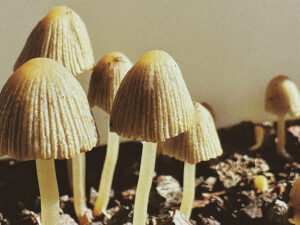
The fruiting bodies of the title refer to the mushrooms that Ang photographed in Melbourne’s parks. Ang’s mushrooms are earthy, found sculptures. These are small growths we may not notice at our feet: bodies with expanses of folds, wrinkles and yearnings for darkness and light. They have stems, caps, gills, and an unseen underground pulse. Ang gives them her full attention, harnessing the close-up’s ability to experiment with scale and reorganise hierarchies of attention.

Fruiting Bodies is, in part, about the possibilities of bodies in states of transition. It is about change that is neither loss nor gain, but something vital and not-yet named. Ang generates this post-menopausal narrative without relying on the human figure. Instead, she has a singular focus on the erupting blooms of mushrooms: growths sustained from below through mycelium, that hidden system of collective exchange.

Descriptions of non-reproductive bodies often invoke the language of loss or failure. Ang gifts us another vocabulary through her detailed portraits of mushrooms and their cycles of growth, decay and regeneration. Ang pulls her viewers to the ground, holding her camera at grass level to show us the arch of the stems, the wonder of cups, these tiny architectural yet fleshy wonders. She displays their cracks, dissolves, their tears, their delicacy and brute strength. In a deliberate engagement with the links between questions of ecology and feminist politics, Ang reveals how proximity (in this case, to soil, organic matter, imperfect fungi) can recalibrate what we know and value about bodies, community and connection.

Fruiting Bodies has a slower rhythm than Ang’s last photobook The Quickening: A memoir on matrescence (2021), and her first major photobook, Gold Coast (2014).  The Quickening reckons with the joys and seismic shifts of motherhood and post-partum anxiety. The photographs in The Quickening are like gasps for air: visceral fragments of life with an infant.  Gold Coast reckons with the contradictions of a city marbled with racism, crime and bodies at leisure. Fruiting Bodies is a different type of book. This book is not a reckoning but a proposition, a firm insistence that the realm beyond fertility has paths to other possibilities, other generative modes, ones that are vital, creative, meaningful, crucial.

Ang’s fruiting bodies are sometimes ruffled and plump, others are slender and reaching. A notebook held at ground level becomes an in-situ studio, a backdrop to highlight the dirt clinging to a stem or the impressive force of a mushroom that has pushed through earth and risen with a wood chip delicately balanced on its cap.

Photography has played a fundamental role in valuing some bodies more than others, in rendering some invisible, unnoticed, and others too closely surveyed. This awareness is embedded in Fruiting Bodies. Ang’s studies of foraged mushrooms photographed simply on a white background are reminders of how photography has been used to collect, identify and fetishise, but this is not Ang’s project.  

Ang’s visual language relies on seeing the mushrooms in a variety of ways. Ang mostly photographs the mushrooms in black and white. But the photobook has bursts of warm, earthy colour amongst its black and white pages. Some pages of the book reveal red eruptions, and bees forage near some of these fleshy forms. Others are fragile, almost transparent. Sometimes Ang’s mushrooms are at home in a tangle of woodchips, grass and dew. Other times, the mushrooms have been plucked and photographed later. Some of these mushrooms are dried and shrivelled. Some are palpably full and fleshy.

Ang’s mushrooms make me think about Simryn Gill’s series, Weeds in my Parents’ Garden (2018). In that series, Gill also photographs down near the ground, focusing on weeds in detail. Like Ang’s mushrooms, Gill’s weeds are personal (it is her parents’ garden) but also about a wider politics of attention to the unwanted or the devalued. Both Ang and Gill share a respect for the anti-monumental, and a speculative approach to thinking about nature, personal history and ways of knowing.

Ang’s curious eyes show us growth, decomposition, repair, and wonder. These are photographs to pore over. I recognise one mushroom as a shaggy mane mushroom, I look it up and learn that it matures fast, and as it does so, its gills liquify into an inky disintegration: a dissolving that releases and spreads spores. These fruiting bodies sometimes echo the human form. A pair of caps looks like breasts; the ruptures, splits and openings of several mushrooms are equally suggestive. But the point is not to anthropomorphise the fungal world, but rather to place those bodies in conversation with our own.

The figures of women are evoked directly in Fruiting Bodies through Ang’s exacting use of text. Ang is a photographer, but also a deft writer. The perspective here is born from the personal, but this is also about a collective experience of how women’s bodies are labelled, classified and devalued over a lifetime. Some things, Ang and her mushrooms tell us, are beyond the material body, outside anatomy. One page of text begins a list with mood and cognition and ends with hair and bones. Uterus sits in the middle of the list. I read the word and think of medical drawings and the persistent cultural imaginings of the uterus as a void or receptacle rather than the dense, powerful muscle it is. Just one misrecognition among many.

Opposite the list, a full page is dedicated to just two words: Kin Keeper. This role, so often undertaken by women, is, like the mushroom’s underground mycelium, part of a collective chain of reciprocity and care, shared stories, advice and memories. Ang references this type of work earlier in the book: ‘The quiet labour of what holds the world together.’

Fruiting Bodies has a line about a woman in the kitchen ‘peeling an orange, considering the weight of her own survival.’ Ang reminds us that ‘This, too, is a kind of freedom.’ It is the certainty of this felt freedom that knits together Ang’s beautiful, detailed mushroom portraits in this quiet force of a photobook. ♦

All images courtesy the artist and Perimeter Editions. © Ying Ang


Jane Simon is an academic and writer based in Sydney, Australia. She is Senior Lecturer at Macquarie University, where she researches and teaches in the areas of photography, screen media and visual culture. She is the author of
The Domestic Interior and the Self in Contemporary Photography (Routledge, 2024). Her research examines photography’s role in the imagination and construction of housing and intimate home life.


1000 Words favourites

• Renée Mussai on exhibitions as sites of dialogue, critique and activism

• Roxana Marcoci navigates curatorial practice in the digital age

• Tanvi Mishra reviews Felipe Romero Beltrán’s Dialect

• Discover London’s top five photography galleries

• Tim Clark in conversation with Hayward Gallery’s Ralph Rugoff on Hiroshi Sugimoto

• Academic rigour and essayistic freedom as told by Taous Dahmani

• Shana Lopes reviews Agnieszka Sosnowska’s För

• Valentina Abenavoli discusses photobooks and community

• Michael Grieve considers Ute Mahler and Werner Mahler’s posthumous collaboration with their late family member 

• Elisa Medde on Taysir Batniji’s images of glitched video calls from Gaza


Join us on Patreon today and be part of shaping the future of photographic discourse


The messiness of mothering and care

Currently on display at Centre for Contemporary Photography (CCP) in Melbourne/Naarm, Lisa Sorgini’s Behind Glass is a pandemic project comprising family portraits marked by art historical readings and an attempt to provoke discussion on the lack of awareness surrounding the relationships between children and mothers, as well as a wider misunderstanding concerning the messy realities of mothering and care, argues Catlin Langford.


A woman is seated, knees jutting forward. Her flesh compresses on the seat, a small, hollow dimple appearing on her left leg. Her face is obscured; hidden behind the naked baby she holds upwards, the child’s small foot skimming her upper thigh, and a hazy image of a cloudy blue sky and distant palm trees which falls across the woman’s face.

This layered imagery signals the driving concept informing Lisa Sorgini’s Behind Glass, a project comprising over 20 portraits of family groupings. Each work in the series was photographed through windows, or rather “behind glass”. The images reflected in the window glass become further characters in the portraits. It is multi-functional, serving as both a distinct aesthetic device, producing layered, painterly images, but also drawing attention to the unique circumstances under which the series was produced.

Behind Glass was conceived during the pandemic. Whilst social structures were significantly altered in this period of upheaval, mothers still found themselves undertaking most of the caring duties and were shouldered with even further responsibilities when other systems, like schooling, were not in place. Sorgini, at home with her two children and unable to work, responded to this personally and sought to document and reflect on the strange culture of parenting and care during the pandemic.

Created during the pandemic, Behind Glass was also held back by the pandemic. Its current showing at the Centre for Contemporary Photography (CCP) in Melbourne/Naarm is the first exhibition of the series in Australia. The images speak to both the collective and individual experience of the pandemic and undoubtedly resonate with the Melbourne population who were witness to a widely publicised ‘world’s longest lockdown’.[1] Sorgini is based in Bundjalung Country, in northern New South Wales. Like most of Australia, at some point this area was under stay-at-home orders, movement restricted to a five-kilometre radius. Complying with these rules, Sorgini sourced subjects within this perimeter via friends, neighbours or connections through contacts and social media. At their homes, she would direct her subjects via telephone or speaking through the glass, her six-month-old son sometimes strapped to her body as she photographed.

There is a naturalness to the photographs that one would not assume based on the circumstances of their creation and reveals Sorgini inherent understanding of her subjects. But there is also a theatricality, the works recalling art historical compositions. The scenes depicted are adorned in a golden light, a warmth permeating throughout the series. The light lifts the subjects, giving the everyday scenes a sense of grandeur. The presence of the windows serves as a framing device, recalling the presentation of artworks in galleries. It also evokes the Trompe-l’œil trickery of Northern Renaissance paintings, the frame painted into the image, questioning the audience’s conception of image versus reality. In Sorgini’s work, we are audience to two realities: the private interior world of the subject, shown through the window, and the exterior realities reflected in the glass. We capture glimpses, objects and scenes of interior domesticity, which contrast the outside expanse of forests, gardens or open blue skies. Whilst this outside world was off-limits to many during the pandemic, for mothers, leaving home can be difficult under the weight of responsibilities and the, at times, isolating and trapping experience of new motherhood. 

The present exhibition of Behind Glass at CCP draws attention to possible art historical readings. Photographs are grouped to encourage viewers to read and reflect on artistic depictions of the baby Jesus, the Three Graces and memento mori still lives. A secondary grouping depicts women nursing their infant children. Learned cultural understandings encourages a comparison to the Madonna and Child. But the mothers’ faces are obscured, hidden whilst in the midst of enacting caring duties.

This is a subtle signal to Sorgini’s wider concerns for the series and the themes embedded in her artistic practice. Sorigini is interested in the often-unacknowledged and unseen care given by mothers; a care that is widely accepted and expected, if unrecognised and unappreciated. In her exploration of care, Sorgini also considers the transferral and evolution of care and how it manifests in a variety of situations. In one work, a middle-aged woman looks out the window. Beside her, an elderly woman is seated, her unfocused gaze directed towards the viewer. The relationship between mother and daughter has altered, shifted and now swapped.

In curating the show, we discussed Sorgini’s recent travels to Italy and her experiences there of viewing works, including Renaissance paintings, in churches and galleries. We wanted to capture some sense of this experience, and the works have been purposefully shifted to above centre-line so the viewer must gaze upwards. This imbues the subjects with a greater sense of importance, as the role of care should be given, and further underlines their comparison to masterpiece artworks.

Such reverence is particularly notable given the unflinching honesty of the images. While expressing deep love and tenderness towards their family, the mothers appear tired in their role as central caregiver and provider. Interactions largely seem to be based on touch and need – grabbing, suckling, holding, supporting – an amalgamation of limbs and flesh. Flesh is a central motif, and Sorgini recognises and records the distinct changes which occur to the body during and following birth, and the caring duties which follow. The body wears the scars of such change, from stretch marks to ageing skin.

At a panel with fellow exhibiting artists Ying Ang and Odette England, Sorgini spoke of the misunderstandings surrounding her work and the tendency for the images to be viewed sexually, related to the depiction of flesh and touch. A discussion ensued on the lack of awareness surrounding the relationships between children and mothers, as well as a wider misunderstanding concerning the messy realities of mothering and care.

Home Truths: Photography and Motherhood curated by Susan Bright was first exhibited in 2013 at the Foundling Museum, in collaboration with The Photographers’ Gallery, London. The exhibition sought to challenge stereotypes and sentimental views of motherhood, pursuing a depiction which was candid and revealing. In the decade since, honest revelations around motherhood remain relatively rare, and can ignite endless criticisms, their voices heightened in the age of social media. There is still much work to be done in centring, envisioning and reflecting the stories and experiences of motherhood, mothering and care, as is central to Sorgini’s practice. ♦

All images courtesy the artist and the Centre for Contemporary Photography © Lisa Sorgini

Installation views of Behind Glass at the Centre for Contemporary Photography (CCP), Melbourne/Naarm until 9 April 2023. Photographs by Hannah Nikkelson. In a collaboration between the CCP and the V&A’s Women in Photography project, there will be a panel discussion with Ying Ang, Odette England and Lisa Sorgini, chaired by Susan Bright, on 5 April.


Catlin Langford is curator at the Centre for Contemporary Photography, Melbourne/Naarm. She has previously held positions at the V&A, Royal College of Art and Royal Collection Trust. She will be undertaking a fellowship at Cité internationale des arts, Paris in spring 2023 to continue her research on autochromes. 

Images:

1-Hannah and Ochre in the dining room, Clunes © Lisa Sorgini

2-Leah and Ethan in the bedroom #2, Pottsville © Lisa Sorgini

3-Jules and Alby in the dining room, St Helena © Lisa Sorgini

4-Amelia and Una in the dining room © Lisa Sorgini

5-Sarah and Ellaine in the living room, South Golden Beach © Lisa Sorgini

6-Beck with Matilda and Indigo at the front door #2, Mullumbimby © Lisa Sorgini

7-Hannah and Ochre in the dining room, Clunes © Lisa Sorgini

8-Abigail and Marigold in the kitchen #2, Federal © Lisa Sorgini

9-Installation ‘Behind Glass’ at Centre for Contemporary Photography © CCP/Hannah Nikkelson

10-Installation ‘Behind Glass’ at Centre for Contemporary Photography © CCP/Hannah Nikkelson       

References:

[1] Calla Wahlquist, “How Melbourne’s ‘short, sharp’ Covid lockdowns became the longest in the world”, The Guardian, 2 October 2021.