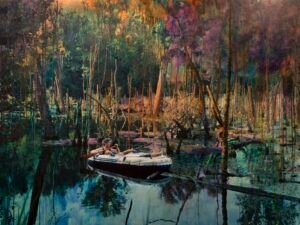
Top 10 (+1)

Photobooks of 2025

Selected by Tim Clark and Thomas King

As the year draws to a close, an annual tribute to some of the exceptional photobook releases from 2025 – selected by Editor in Chief, Tim Clark and Editorial Assistant, Thomas King.


1000 Words | Top 10 (+1) Photobooks of 2025 | 5 Dec 2025
Join us on Patreon

1. Mari Katayama, Synthesis
SPBH Editions

Mari  Katayama gathers six years of her practice, 2019 to 2025, into an artist’s book that reads as both playful and challenging. Those familiar with Katayama’s work will recognise the materially rich choreography. Her body appears, often entwined with hand-sewn sculptures, threaded forms and collaged papers, the objects acting less as adornments than as co-actors in a carefully staged performance of the self. The book’s nine photographic series were made in Katayama’s home studio in Gunma, a conscious return to her ‘rural roots’ after years in Tokyo. Upon return, she became mother. Yet in this turning back, she also looks forward. Synthesis is, in many respects, not a tidy catalogue but a layered fusion of self-portraiture, object-making and the living textures of experience.

2. Phoebe Kiely, She Could See Herself In The Darkness
Witty Books

From Torino’s ever-discerning Witty Books, founded by Tommaso Parrillo, comes a vivid compendium of prints created between 2020 and 2024 by artist Phoebe Kiely. Kiely’s images interlace tight, intimate fragments of the human body, guiding the eye through surfaces, gestures and the subtle slippages between presence and absence. Following her previous book, They Were My Landscape, which explored the anonymity of people, objects and street scenes, this new work continues such investigations, deepening attention to materiality, tactility and intimacy, in which darkness holds the contours of queerness together, producing a long-awaited next-part of her photographic practice. For Kiely, bodies are never the whole story, nor is the idea of a fully realised subject; what takes precedence are parts, textures and the distances between them.

3. Daniel Lee Postaer, Mother’s Land
Deadbeat Club

China’s vertiginous transformation over the past 15 years has been devastating if not dizzying (its high speed rail network now spans over 500 cities, all constructed since 2008, is just one example of this expansion). Postaer, who lived in the country in the early 2000s and returned repeatedly in the latter decade, witnessed the country’s rapid development firsthand (his grandparents fled the communist regime there more than 50 years ago). Mother’sLand, a 15 x 11″ hardcover monograph, documents these shifts with careful eye. The demolition of old structures, the emergence of new architectures, feeling signage and spaces glimpsed in passing… ‘a country in constant mutation’ as one description puts it. And yet, despite the scale of its subject on the surface, the book remains quietly intimate and reflective, an exploration as much of Postaer himself as of the country he photographs. In his words, ‘I could feel my mother. I could also feel that wonder of what it would have been like if I had grown up there.’

4. Rosie Harriet Ellis, The Boyfriend Casting
Libraryman

From the uncertain beginnings of a project while on her MA at the Royal College of Art, thwarted when her ex-boyfriend withdrew consent, Ellis’ The Boyfriend Casting has, over five years, evolved into a work that consummates the journey of its inception. What initially appeared as a personal and professional impasse has, over time, transformed into an act of reinvention. The book documents this evolution through short, diary-like chapters that feel disarmingly intimate, revealing a presence both within and beyond the frame, while testing how photography can function as tool for grief, yearning and reversed objectification. After the initial photographs of her former partner, Chapter 2 takes the shape of a pose guide. True to its titular promise, it functions as a casting, yet one that is inseparably bound to Ellis herself, her desires, her pursuits of intimacy, and her reckoning with what it means both to observe and to be observed.

5. Mimi Mollica, Moon City
Dewi Lewis

Mimi Mollica’s Moon City stages a spectral dialogue between the eternal and the engineered, juxtaposing the silent, cyclical pull of the moon with the stark, relentless ambition of London’s financial skyline. Shot in a film-noir style and loosely inspired by Luigi Pirandello’s Ciàula Scopre La Luna, the series positions the celestial body as a luminous, enduring counterpoint to high-rise towers, indifferent to human schemes. Through telescopic framing picturing deserted office blocks, Mollica creates a tension between vast skies and the city’s scale of power, choreographing space like a careful negotiator, drawing attention to the rhythms, shadows and silences that punctuate the square mile. As in Pirandello’s novel, the moon offers something else, perhaps a quiet resistance, to anyone daring to look up and escape the deceptive halo of capitalism.

6. Katherine Hubard, The Great Room
Loose Joints

In The Great Room, Hubbard is daughter, caregiver, artist, collaborator. Berger is mother, subject, co-maker. This is the first time Hubbard has photographed another person consistently, and the volume, published by Loose Joints, is shaped by that proximity and closeness, and this goes as far as one-to-one scale contact prints and monoprints made in the darkroom from the impressions of their skin. The house in which the photographs were made becomes a kind of palimpsest of life lived, and the book, in some respects, a record of care and change, of memory inscribed in gestures and the objects that fill it. At its centre lies the mother-daughter relationship, which is tender, uneasy, always shifting between attention and distance and Hubbard neither hides the discomfort nor leans into melodrama.

7. Mohamed Hassan, Our Hidden Room
Ediciones Posibles, Fundación Photographic Social Vision, PHREE

Another parental story, and sharing some similarities, is that of Mohamed Hassan, whose Our Hidden Room received the Star Photobook Dummy Award 2024 and was nominated for the Paris Photo–Aperture PhotoBook Awards 2025. At once a response to what some have called ‘the fall of Egypt’s democratic experiment,’ the book draws in part from the photographic archive of his late father, a gifted portraitist diagnosed with bipolar disorder at a young age. Interlacing his father’s surviving images with his own photographs and text, Hassan creates a triptych of inheritance, dialogue and in his own words – a ‘room,’ his and his father’s, as a shared space of return. In a candid conversation with Irene Alison, he reflected that, in photographing, he sometimes feels himself drawing nearer, meeting his father again.

8. Ying Ang, Fruiting Bodies
Perimeter Editions

Jane Simon wrote earlier this year in 1000 Words that Ying Ang’s latest offering (the artist’s third major book and her first with Perimeter Editions) arrives as ‘a provocation to think about abundance beyond the frame of the reproductive body.’ Taking a somewhat more declarative tone than Ang’s previous works, which are notable in their own right, Fruiting Bodies takes us to the unseen networks of mycelium, where ecology and feminist thought intertwine. Neither allegory nor anthropomorphism, it proposes another kind of vitality, subterranean poetics of reciprocity, where decay and regeneration are inseparable. Simon writes, ‘The perspective here is born from the personal, but this is also about a collective experience of how women’s bodies are labelled, classified and devalued over a lifetime.’ The result is strikingly original and surprisingly evocative.

9. Bharat Sikka, Ripples in the Pond
Fw: Books

Fw: Books’ Hans Gremmen continues his thoughtful collaboration with photographer Bharat Sikka, whose sepia-toned studies of Makharda (a peripheral township on Kolkata’s outskirts) and its surrounding landscape form the artist’s latest book, Ripples in the Pond. The softbound volume, with its intentionally unpolished edges, comprises photographs of the area’s many ponds, gently leading the viewer toward the project’s underlying preoccupation with the site’s layered temporal and socio-cultural rhythms. This comes to light in the way that, after each journey to Makharda, Sikka subjects the photographs to an extended practice of scanning and reworking, a slow, deliberate method that mirrors the reflective logic of the ponds themselves. It is a quietly powerful exploration of the ‘semi-rural imaginary’ that leans on the 1980s Indian television series Malgudi Days for inspiration, which portrayed the quiet life of a small town, and, has been described as a ‘personal act of return’.

10. Raymond Thompson Jr, It’s Hard To Stop Rebels That Time Travel
VOID

The ‘rebels’ for Raymond Thompson Jr are the maroons, the runaways, the Black people whose lives moved outside, between, beneath official historical records. Their ‘time travel’ is the movement between the visible and the invisible, the archival and the lived. The project is, in his words, ‘my portal to slip between the past, present and future,’ with focus especially on maroons, enslaved people who escaped but did not go north, instead finding refuge in the wild margin‑lands between plantations, swamps and borderlands, and how their survival practices (what he terms ‘freedom practices’) resonate with Black environmental imagination and presence in the American landscape. Fittingly, the book’s slim, rectangular form recalls a travel guide or field notebook, made to accompany a journey, including archival material such as reward advertisements, quotes, newspaper clippings and truly striking portraits.

+1 Martha Naranjo Sandoval, Small Death
MACK 

Martha Naranjo Sandoval’s debut book is a tactile, iterative object – its vivid red cover encasing not only the weight and texture of a generously bound volume, but that of an artist attuned to the material language of memory and making. Spanning some 300 pages, Small Death gathers photographs from Sandoval’s early years in New York, selected from her original contact sheets and reels, a return to beginnings made urgent in a time when ICE disappears people and sanctuary feels perilous. Sandoval’s images quietly respond to this moment through an intimacy reminiscent of a family archive. Photographs of her brother, parents, husband, cat, landscapes, and nude self-portraits stitch together the smaller stories that, in turn, prompt questions around displacement, border-crossing and the violent architectures of exclusion. ♦


Tim Clark is Editor in Chief at 1000 Words and Artistic Director for Fotografia Europea in Reggio Emilia, Italy, together with Walter Guadagnini, Luce Lebart and Arianna Catania. He also teaches at The Institute of Photography, Falmouth University.

Thomas King is Editorial Assistant at 1000 Words and currently undertaking an MA in Literary Studies (Critical Theory) at Goldsmiths, University of London.

Images:

1-Cover of Mari Katayama, Synthesis (SPBH Editions, 2025)

2-Mari Katayama, on the way home #005, 2016

3-Phoebe Kiely, She could see herself in the darkness (2025)

4-Daniel Postaer, Shanghai, (Anting), 2016 / 2020

5-Rosie Harriet Ellis, The Boyfriend Casting (2025)

6-Mimi Mollica, Moon City (2025)

7-Katherine Hubbard, The Great Room (2025)

8-Mohamed Hassan, Our Hidden Room (2023-ongoing)

9-Ying Ang, Fruiting Bodies (2025)

10-Bharat Sikka, Ripples in the Pond, (2025)

11-Raymond Thompson Jr, It’s hard to stop rebels that time travel (2025)

12-Martha Naranjo Sandoval, Small Death (2025)


1000 Words favourites

• Renée Mussai on exhibitions as sites of dialogue, critique and activism

• Roxana Marcoci navigates curatorial practice in the digital age

• Tanvi Mishra reviews Felipe Romero Beltrán’s Dialect

• Discover London’s top five photography galleries

• Tim Clark in conversation with Hayward Gallery’s Ralph Rugoff on Hiroshi Sugimoto

• Academic rigour and essayistic freedom as told by Taous Dahmani

• Shana Lopes reviews Agnieszka Sosnowska’s För

• Valentina Abenavoli discusses photobooks and community

• Michael Grieve considers Ute Mahler and Werner Mahler’s posthumous collaboration with their late family member 

• Elisa Medde on Taysir Batniji’s images of glitched video calls from Gaza


Join us on Patreon today and be part of shaping the future of photographic discourse


An art of distance: Hervé Guibert’s The Only Face

French writer Hervé Guibert (1955–1991) was the author of twenty-five novels and autobiographical works, but he also took photographs. The Only Face, Guibert’s second and final collection of photographs, was originally published on the occasion of a 1984 solo exhibition at Galerie Agathe Gaillard in Paris and has now been reissued by Magic Hour Press. Presented in its original sequence, this new edition largely comprises images of small private interiors, revealing itself not merely as an exhibition in book form, but as a novel in its own right, one that speaks to community, friendship and the distances that both separate and sustain them, writes Thomas King.


Thomas King | Book review | 27 Nov 2025
Join us on Patreon

‘To liberate every secret, to invent them’ was, for Hervé Guibert, the stake of artistic courage and the measure of friendship. In his roman à clef To The Friend Who Did Not Save My Life (1990), he introduced the character ‘Muzil,’ a thinly disguised Michel Foucault, and used him to recount previously untold stories from his friend and lover’s life. Following the book’s release, he appeared on French national television amid the furore it stirred to defend his disclosures, speaking of what he called a shared “common thanatological destiny” between the two men living with AIDS, which was to tragically end both their lives.

Some months after Foucault’s death, 6 years prior, Le Seul Visage (The Only Face) (1984) formed the basis of Guibert’s exhibition at Galerie Agathe Gaillard in Paris. Now reissued by Magic Hour Press, with images presented in their original sequence, the deceptively modest and slender volume of photographs reveals itself as a Guibertian novel in its own right. Characters move through and recede from its pages, and in its distinct photographic narrative mode, Guibert refuses to ground a community in a stable, constituent body, the very condition that elsewhere attests to the violence that keeps it intelligible.

This can be explained in part by Guibert and Foucault’s ways of considering homosexuality and friendship together against ‘the recognition that we are.’ Of course Foucault devoted much of his life to showing that the very idea of an ‘essential self’ must be abandoned; the task is not to uncover a hidden truth about who we are, but to renounce the search altogether, while Guibert’s ‘homosexuality’ has been described as ‘a quietly revolutionary stance in line with his particular brand of rebelliousness’.

It’s in this spirit that Guibert’s diaries anticipate a novel that will never be written, yet become novelistic through their ‘fictious’ narratives. From the moment Guibert writes ‘I’, any attempt to distinguish between figuration and the real is dismantled. By putting his body ‘at risk’ within narrations, situations, relations, as he writes, he becomes ‘his own character,’ neither seeking to return to nor magnify subjectivity. As the question is posed on the back cover of The Only Face: ‘Isn’t a book with figures and places a novel?’

The Only Face begins with bodies withheld, faces averted or obscured, silhouettes held just out of reach in the dimly lit interiors of private rooms. ‘Sienna’ recalls André Masson’s headless figure seated at a desk, slumped forward, bathed in a soft yet piercing beam of light from the open window, a thin plume of mist rising from the body. ‘The Friend,’ the first image, shows only a hand pressed firmly against the centre of a chest, establishing from the outset a tension and ambiguous relationality that resonates throughout. It is an image of distance, an art of distance.

Its rising action takes place through a series of portraits in which the characters ‘appear’ under their first names. Guibert photographs his parents and himself under the title ‘Moi’. French actress Isabelle Adjani, who haunts his writings, also enters the frame at the Jardin des Plantes. His gallerist, Agathe Gaillard, and his friend Thierry Jouno appear. So too does Mathieu Lindon, another soul who ‘shared their time, drugs, ambitions, and writings with the older Foucault,’ and the latter, famously pictured in a yukata in his Paris apartment, the meeting place for such activities.

I look at these images knowing Guibert’s refusal to be labelled a photographer meant, for him, an attention only to the relational: bearing witness, as he writes in the introduction, only to his ‘love’ for these bodies – the way they crash together or fail to, and the impermanence of presence that attends all such intimacies. Brigitte Ollier writes, ‘There was no parade, [Guibert’s] portraits were infused by simplicity, as if he were trying to conjure up, or get rid of, the mysterious link between him and his nearest and dearest.’

This ‘simplicity’ lies in what Guibert later describes as his ‘fractious, careful, and suspicious’ approach to photography, with shooting being a kind of liturgy for him. His attention to the ‘mysterious link’ and his play with narrative and framing to preserve its elusiveness recall the story behind the photograph titled ‘East Berlin.’ Lindon once recalled the outing when the image was made; later, having read Guibert’s account, Lindon told Foucault, ‘It hadn’t happened like that.’ Foucault replied: ‘Only false things happen to him.’

And yet, through the artifice of ‘falseness,’ friendship is conceived not as the affirmation of an interior ‘I,’, but its dislocation. Friendship, it has been argued, does not arise from recognising sameness or identity between subjects, but from exposure to internal dispossession, a desubjectification where the self no longer fully coincides with itself. It involves recognising one another only alongside an awareness of their finitude, the ongoing possibility of betrayal and irreconcilable strangeness; it is ‘precisely not recognising the self in the Other and not sharing common ground,’ that gives friendship its ‘particular queer, and thus activist, valence,’ writes Tom Roach. That is to say, Guibert’s portraits dwell in the nothingness at the heart of relationality. And friendship renders this nothingness (which is not the obliteration of difference, rather the opposite) tangible as proximity, and as an awareness of the singular, incommunicable death that eludes possession. There is a subtle, revealing power in these photographs, especially when they are seen as reflecting Guibert’s evolving concept of friendship – which recalls Patrick Ffrench’s musing that ‘The friend speaks to the friend already from beyond the grave, if the friend speaks to the friend at all… .’

What fascinates the young Guibert, though, is not the inventory of mortality that photography could provide, but what remains beyond its reach in the intervals, the silences and the margins. Of note is his preference for tight angles, paintings, windows; the light that enters at the side, the slanted shapes, the objects suspended as if condemned to an eternal foreground. Even the emptiest spaces seem quietly inhabited. All is relentlessly methodical.

These thoughts press harder with the images that follow, where his beloved bodies, no longer his characters, remain only as the image of absence. A pair of photographs titled ‘Writing’ shows a desk strewn with handwritten letters; the other, a figure turned away, seen from above. ‘Reading,’ taken from beneath the desk, draws depth from minimal means, with a book just about visible in the distance. The same sense of absence animates ‘Interior’ and ‘Cannes Festival,’ where one is replaced by a scattering of belongings – a blazer, a camera, a taxidermy owl, marbles in another. The titles are again sober and the images austere.

Writing in Narcissus in Bloom: An Alternative History of the Selfie, Mattie Colquhoun says, ‘Guibert loses himself in this fractal representation of atemporal non-selves, becoming alongside the objects in his possession. He makes himself hidden, emancipating from the gaze of self and other.’ As such The Only Face reminds us that community and friendship, absent among those who are there, are both an actuality and a potentiality. They are, what Maurice Blanchot describes: ‘an existence shattered through and through, composing itself only as it decomposes itself constantly, violently, and in silence.’ ♦

All images courtesy the Hervé Guibert Archive and Magic Hour Press.
© Hervé Guibert


Thomas King is Editorial Assistant at 1000 Words and currently undertaking an MA in Literary Studies (Critical Theory) at Goldsmiths, University of London.


1000 Words favourites

• Renée Mussai on exhibitions as sites of dialogue, critique and activism

• Roxana Marcoci navigates curatorial practice in the digital age

• Tanvi Mishra reviews Felipe Romero Beltrán’s Dialect

• Discover London’s top five photography galleries

• Tim Clark in conversation with Hayward Gallery’s Ralph Rugoff on Hiroshi Sugimoto

• Academic rigour and essayistic freedom as told by Taous Dahmani

• Shana Lopes reviews Agnieszka Sosnowska’s För

• Valentina Abenavoli discusses photobooks and community

• Michael Grieve considers Ute Mahler and Werner Mahler’s posthumous collaboration with their late family member 

• Elisa Medde on Taysir Batniji’s images of glitched video calls from Gaza


Join us on Patreon today and be part of shaping the future of photographic discourse


Metabolising violence: interview with J.A. Young

We speak with the winner of the OD Photo Prize 2025, J.A. Young, who turns to an ongoing body of work wrought from trauma, research and experiments in the darkroom. Between lived experience and occult inquiry, the series, Angels considers how violence, control and intuition inscribe themselves into the materiality of hand-made prints, and what it might mean to summon images from forces that, though invisible, are anything but absent. 


Thomas King | Interview | 25 Sept 2025
Join us on Patreon

Thomas King: Can you tell us about the point of departure for Angels, recently announced as the winner of OD Photo Prize 2025? How did the research first take form and what impulse or circumstances set it in motion? And what do you wish to conjure in your choice of title?

J.A. Young: My first series, Of Fire, Far Shining (2023-24), was a collection of prints I made almost entirely on a cheap laser printer. But I knew that I eventually wanted to move into hand making each print, and I was finally able to begin that process in late 2024 after getting the space to set up my current darkroom. Angels (2024-) is exclusively composed of silver gelatin prints that I’ve created over the past year, and in part, the change in series marks this shift toward a more alchemical printing process that results in unique material objects. 

My research has always been one of the primary drivers of my creative process, and it remains a consistent source of inspiration from series to series. But it’s not necessarily the source of the new title. Like any other creative urge, a word or phrase will just flash into my mind, and I will immediately recognise it as one of my titles. It then becomes a defining element of the series, in that it’s the only predetermined concept that I’m intentionally bringing with me into the creative process. By holding the title loosely in the back of my mind, I can play with all the associations it evokes.

The angels that I’ve had in mind while making the series aren’t benevolent figures of light; they’re more like the Archons of the Gnostics or the Vedic Asuras, ethereal beings that use their power to oppress and deceive. In the images I’m creating, I’m essentially positioning modern institutions as these very angels: vast, impersonal systems of control that function with a logic that is both overwhelmingly powerful and entirely indifferent to the suffering they inflict. These are the archetypes of control, judgement and power, now embodied by algorithms, corporate monopolies and the military industrial complex. So what you see playing out across the series is the visible impact of these invisible forces.

TK: You’ve said that your work draws on lived experience, on inhabiting a world not quite one’s own. How do questions, or perhaps disturbances, of selfhood root themselves in Angels? In what ways do they contour or complicate the work?

J.A.: I’ve experienced a lot of trauma in my life, and it’s made me feel very unsafe and very isolated in the world. A lot of violence has been inflicted on me, and most of it has been in response to core facets of my identity, like the fact that I’m trans and neurodivergent, among other things. This has altered how I view being in the world and human history in general, and that shows up in the atmosphere of my images. Beyond that, I can see in my images my own feelings of claustrophobia and of desperation about the all the tragedies and crises we’re facing: it’s like everything is constantly in motion; everything is speeding up; everything is swirling around us as we barrel towards so many terrible consequences of our actions.

My spiritual experiences and my research into the occult are also directly related to how I make my art. When I work, I’m trying to open myself up completely, to allow my unconscious to move through me, and to trust that process, to trust this other part of me to which I don’t normally have access, to do the work. So it feels like I’m surrendering to my intuition and letting my body act and react to the materials that I’m using, and that itself feels like a magical process. I feel the safest I’ve felt in my life when I’m making art in this way. I feel like I’m finally allowing the emotions I’ve held in my body to bubble up, and then somehow, when I make a piece of art that holds some of those feelings, it’s as if I’ve captured it and released it from my body.

TK: What are the visual sources for the images you use as foundational material? Could you expand on the process of transformation through which your multi-layered pieces come together, and the implications for the original image? How do these material encounters take shape, constrain or release the work’s possibilities?

J.A.: I use both my own negatives and images sourced from public domain digital archives as raw materials for transformation.

The first, most important, and most radical step in my alteration of the source material is creating a new composition. I deconstruct and throw away most of the image until I arrive at a very specific composition that’s often just a small detail from the original. It feels sculptural in this sense, in that I’m removing more and more of the raw material until I arrive at an object I’m satisfied with. And every single element in every composition that I make is intentional: every detail in every corner, the tonal range in the image, the textures, the shapes, the lines, everything. It’s not that I plan it ahead of time, but I know how I want it to feel, and I keep reworking it until it clicks into place. The content of the source material itself doesn’t dictate what I end up with; it’s insufficient on its own, and if I can’t create a composition that pleases me, I throw it away.

The extent of what happens next will vary depending on the image. In my darkroom, I’m experimenting with different emulsions and paper substrates, with exposure, with time, with temperature, with the chemicals I use and how I use them. After that, I might physically alter the print or rephotograph and reprocess it in some way – whatever it takes to get to the specific qualities I’m looking for. Again, I don’t plan any of the decisions I’m going to make ahead of time. It’s a process of trial and error that’s being guided by gut feelings. Either it feels right or it doesn’t.

TK: The subjects which you frame or focus on in Angels often intimate and depict violence… Are you constructing this series with a pre-visualised sense of narrative, a deliberate mapping of feeling and effect, or does it emerge more intuitively?

J.A.: My process is fundamentally intuitive and iterative. When I’m working, I’m completely absorbed in and devoted to the specific image in front of me. I’m not thinking about a broader, pre-visualised narrative. Instead, I’m following a non-verbal, often visceral pull, judging each creative decision by the way it feels in my body. It’s a process of feeling my way toward a very specific resonance. I’ve cultivated a deep trust in this somatic guidance; a trust that if I can make each individual piece as emotionally and psychically ‘correct’ as I can, the larger narrative coherence of the series will emerge organically on its own.

When I do step back to look at several finished prints together, the recurring elements of violence don’t surprise me. While the process is intuitive, my intuition isn’t drawing from a void. It’s tapping into a well filled with a lifetime of experience and research. Because I’ve experienced a significant amount of physical and systemic violence, that trauma is stored in my body, and my art is one of the primary ways I access and metabolise it. At the same time, my research is focused on the large-scale violence of state and corporate power. In the work, I’m essentially transposing my personal, embodied experience of harm onto this macro scale. 

Ultimately, I’m not trying to predetermine the content of an image, but I am trying to embed a specific feeling. I might want to create a sense of paranoia or disorientation, for example, and I will manipulate the materials until that feeling is present. I think of each piece as a tiny, emotionally charged fragment of a much larger event that is constantly unfolding. If the fragment is charged correctly, it will hopefully activate something in the viewer, and they can fill in the blanks in the narrative.

TK: Since you began this project in 2024, we increasingly find ourselves in a political landscape where mythologies are bound up in a war of images and modern society experiences an ever-growing sense of despair. What are your thoughts on the agitational relationship between photography and historiography?

J.A.: When it comes to my own art, many of the raw materials I start with are benign archival or personal photographs that don’t have any direct connection to the sociopolitical and environmental themes I’m exploring in my work. But, by reframing them in a specific way, decontextualising them, altering them, and placing them within the landscape of my series, I can give them a radically different emotional charge.

On the other hand, when I’m using raw materials that are directly connected to the themes I’m exploring (e.g., archival photographs that document a specific nuclear weapons test), I’m also deliberately removing the context, so that their meaning isn’t bound up in a single event. And I think that lack of context makes the experience of my images more confrontational and more immediate.

Many of the images I source from government archives were designed as propaganda, their basic function being to construct a state-approved reality; and part of the satisfaction I get out of altering them to the point of being unrecognisable is that I’m undoing their intended results. Being able to manipulate images in this way has given me a visceral understanding of the way that images can be used to penetrate into peoples’ subconscious and to elicit emotions and ideas about all kinds of things. I think this is a beautiful function for art, in that it allows for the possibility of a very deep connection between the work and the viewer. But in the hands of the institutions I’m critiquing, it’s weaponry, deployed on a mass scale.

TK: What’s next for Angels?

J.A.: Right now, I’m continuing to experiment in my darkroom, and I’m interested in taking more control of the physical materials themselves, for example, by hand-coating various substrates with liquid silver gelatin emulsion. I’m also exploring new ways to physically deconstruct and deteriorate the prints after they’re made.

Looking forward, I plan to incorporate additional mediums, like moving images and sound. And in the more immediate future, I’m excited to be working with OD Gallery, who will be making a selection of limited edition prints from the series available.

Angels is very much a living, expanding body of work, so my primary focus is to continue building its world.♦

All images courtesy the artist and Open Doors Gallery. © J.A. Young


J.A. Young is an experimental mixed media artist and photographer based in the American South. In 2025, she was selected as a Fresh Eyes x Hungry Eye Talent Award Winner, and her debut solo monograph was shortlisted for Les Rencontres d’Arles Author Book Award.

Thomas King is Editorial Assistant at 1000 Words and currently undertaking an MA in Literary Studies (Critical Theory) at Goldsmiths, University of London.

Images:

1-J.A. Young, Angels no. 7, 2025

2-J.A. Young, Angels no. 8, 2025

3-J.A. Young, Angels no. 11, 2025

4-J.A. Young, Angels no. 34, 2025

5-J.A. Young, Angels no. 56, 2025

6-J.A. Young, Angels no. 66, 2025

7-J.A. Young, Angels no. 81, 2025

8-J.A. Young, Angels no. 86, 2025

9-J.A. Young, Angels no. 89, 2025

10-J.A. Young, Angels no. 95, 2025

11-J.A. Young, Angels no. 110, 2025

12-J.A. Young, Angels no. 138, 2025


1000 Words favourites

• Renée Mussai on exhibitions as sites of dialogue, critique and activism

• Roxana Marcoci navigates curatorial practice in the digital age

• Tanvi Mishra reviews Felipe Romero Beltrán’s Dialect

• Discover London’s top five photography galleries

• Tim Clark in conversation with Hayward Gallery’s Ralph Rugoff on Hiroshi Sugimoto

• Academic rigour and essayistic freedom as told by Taous Dahmani

• Shana Lopes reviews Agnieszka Sosnowska’s För

• Valentina Abenavoli discusses photobooks and community

• Michael Grieve considers Ute Mahler and Werner Mahler’s posthumous collaboration with their late family member 

• Elisa Medde on Taysir Batniji’s images of glitched video calls from Gaza


Join us on Patreon today and be part of shaping the future of photographic discourse


What We’re Reading #5: Autumn 2025

From vaporwave-inflected exhibition-making to the recurring debates around Diane Arbus’ work, the latest instalment of What We’re Reading gathers texts that follow the circulation of style, ethics, politics, and power through curation, criticism and photography – exploring, by turns, where art is made palatable and where it speaks with urgency. Ariella Aïsha Azoulay considers how photographs from Gaza might resist their conscription into state propaganda, while Mariam Barghouti’s Eyes of Truth mourns the killing of Palestinian journalists, exposing an economy that prizes accolades over protecting media personnel.


Thomas King | Resource | 18 September 2025
Join us on Patreon

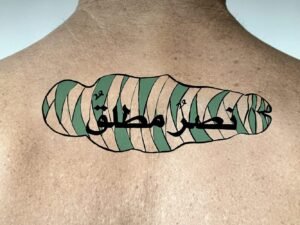
The Eyes of Truth | Mariam Barghouti for DAZED MENA, September 2025

“You see us only in trends of certain events, which would last for hours and then that’s it. We’re just numbers for the world, or non-existent.” So said photojournalist Mariam Riyad Abu Dagga, who was photographed and interviewed for DAZED MENA Issue 3. She was brutally killed just two weeks later by Israeli forces in a targeted strike on Nasser Hospital, along with four other journalists, Ahmed Abu Aziz, Hussam al-Masri, Mohammad Salama, and Moaz Abu Taha. Barghouti writes about Mariam’s wrenching decision to send her son Ghaith out of Gaza after their home was bombed, the loss of her mother soon after and Mariam’s own death.

As Israel’s campaign of slaughter continues, and a leaked White House plan reportedly calls for Gaza’s total displacement under U.S. trusteeship for a decade, Barghouti passionately denounces Western media that offers only belated awards, headlines and hollow sympathy, while never protecting or defending Palestinian media personnel: ‘Say their names, cite their work, defend their lives. Widen the record until it can be held. Allow Ghaith to inherit a world that finally learned to listen.’

Okwui Enwezor | Oluremi C. Onabanjo for 4Columns, September 2025

Duke University Press have published two volumes of selected writings from the larger-than-life figure, Okwui Enwezor, offering an invaluable resource for understanding his multifaceted contributions to contemporary art and curatorial practice. In her review on 4Columns, MoMA’s Oluremi C. Onabanjo casts a clear and discerning eye on the late writer’s intellectual and curatorial legacy; his essays and exhibitions (including his selection to curate the Documenta 11 in 2002) consistently challenging Western-centric art discourses, destabilising conventional notions of geography and periodisation, and foregrounding historically marginalised perspectives. While acknowledging Enwezor’s ‘lack of substantive engagement with Black feminist theorists’ and other contemporary critiques, Onabanjo emphasises a rare synthesis of literary sensibility, curatorial ambition and poetics that positions his varied contributions as foundational for future generations of artists, scholars and curators. These volumes, she writes, ‘demonstrate the continued utility of examining Enwezor’s positions – not only for what he engendered, but for what he provoked.’

A Massive Diane Arbus Exhibition Does So Little | Hakim Bishara for Hyperallergic, June 2025

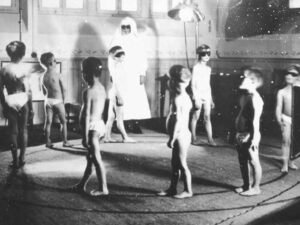
Hyperallergic’s coverage of the Diane Arbus: Constellation exhibition at New York’s Park Avenue Armory sparked a mixed chorus of responses in the publication’s Instagram comments, reflecting the contentious ethical debates still surrounding her work. In his review, Bishara immediately flags Arbus’ ‘freak photographs of disabled, disfigured, and disenfranchised people,’ often ‘ambushed in asylums and hospitals,’ as caught in a classist gaze and exhibited without confronting this long-standing ethical fault line. He argues the show’s labyrinthine installation, lack of chronology or thematic grouping, and ban on visitor photography turn 455 images into an ahistorical maze, stripped of context, labels and narrative. Pushing back, there are those reminding that Arbus’ work arose from long and sustained collaborations with those she photographed, suggesting there is more at stake in Arbus and photography more broadly than a Sontagian critique allows – which Bishara, unlike other viewers of the show, doesn’t seem to see past. 

A Story of Friendship, Fraud and Fine Art with Orlando Whitfield | Extraordinary Creatives, August 2025

Less what we’re reading and more about what we’re listening to is Ceri Hand’s podcast Extraordinary Creatives. Her vast experience and sensitivity as a host invite guests to share candid reflections and engage in thoughtful conversations about contemporary creative practice. In an episode with Orlando Whitfield, author of All That Glitters, he recounts meeting and befriending Inigo Philbrick at Goldsmiths, University of London, charting the dealer’s meteoric rise and the scheme that became one of the most audacious scandals in art-market history. Through Philbrick’s path – from an internship at White Cube to a network of connections that carried him through various corners of the art world – Whitfield reflects on the possibilities of betrayal in friendship, the breakdowns that ripple through personal and professional relationships, and the bewildering mechanics of value within contemporary art. He also opens up about his own struggles, sharing the moments that drove him away from a field where, in his words, “most artworks have no intrinsic value whatsoever… emotion becomes economics.”

Seeing Genocide: Weaponisation of Images | Ariella Aïsha Azoulay for Doubledummy, July 2025

Anonymous collective, NO-PHOTO, presented a site-specific activation during the opening week of Les Rencontres d’Arles 2025, and to mark the occasion, a new edition of Doubledummy’s free newspaper was released, featuring Ariella Aïsha Azoulay’s Seeing Genocide: Weaponisation of Images.

Azoulay, whom we also discussed in the previous What We’re Reading, following her interview with ArtReview, writes in this text (first published in Boston Review in 2023): ‘There is no such thing as an image of genocide. But images in plural, made over time, can be used to refute the terms of Israel’s battle of images.’ As urgent now as it was then, she goes on to say: ‘The images coming out of Gaza – at least when Israel hasn’t shut down the electricity and Internet – can only falsely be called images, since they capture the people who are calling to stop the genocide in rectangular immaterial forms. These are not discrete images of what has happened but visual megaphones calling us to recognise the decades-long genocide and to stop it now.’

The Rise of Vaporwave Curating | Rahel Aima for Frieze, July 2025

Writing to a malaise that haunts today’s global art exhibitions, Rahel Aima describes a drift toward a vaporwave-inflected curatorial style that cushions political crises in a haze of poetic vagueness and aestheticised melancholy. Its signature is a languid, lyrical framing, a ‘passive voice’ of curation favouring a soothing but hollow affect of community and care that anesthetises political urgency. I’m less convinced of this as a particular ‘style’, or mode, than as a symptom of spaces of suspension where power operates. The task, I think, is not simply to curate with greater ‘stakes,’ but to challenge the conditions that enforce palatability, that render ‘good feelings about bad situations’ comfortably consumable. Perhaps the pressing question, since it is all too true that there exists a ‘dangerous assumption that the art world is inherently progressive, even radical – and that a singular ‘art world’ exists at all,’ is where, and under what circumstances, curation might, if it can, escape these symptoms? ♦


Thomas King is Editorial Assistant at 1000 Words and currently undertaking an MA in Literary Studies (Critical Theory) at Goldsmiths, University of London.

Images:

1-Cover of DAZED MENA Issue 3: Eyes of Truth

2-Covers of Okwui Enwezor Selected Writings, Volume 1. Toward a New African Art Discourse and Okwui Enwezor. Selected Writings, Volume 2. Curating the Postcolonial Condition, edited by Terry Smith, Duke University Press

3-Installation view of Diane Arbus: Constellation, 2023–24, The Tower, Main Gallery, LUMA Arles, France © Adrian Deweerdt

4-Ceri Hand: Extraordinary Creatives

5-Cover of Ariella Aïsha Azoulay, Seeing Genocide: Weaponisation of Images, Doubledummy

6-Screenshot of frieze.com


1000 Words favourites

• Renée Mussai on exhibitions as sites of dialogue, critique and activism

• Roxana Marcoci navigates curatorial practice in the digital age

• Tanvi Mishra reviews Felipe Romero Beltrán’s Dialect

• Discover London’s top five photography galleries

• Tim Clark in conversation with Hayward Gallery’s Ralph Rugoff on Hiroshi Sugimoto

• Academic rigour and essayistic freedom as told by Taous Dahmani

• Shana Lopes reviews Agnieszka Sosnowska’s För

• Valentina Abenavoli discusses photobooks and community

• Michael Grieve considers Ute Mahler and Werner Mahler’s posthumous collaboration with their late family member 

• Elisa Medde on Taysir Batniji’s images of glitched video calls from Gaza


Join us on Patreon today and be part of shaping the future of photographic discourse


What We’re Reading #4: Summer 2025

Tensions resurface in different forms in our latest roundup of What We’re Reading. Criticism negotiates altered modes of circulation; imperial violence continues to determine who speaks, who is seen and under what terms; and the metaphysics of development and hierarchy remain inscribed in our institutions and imaginaries. Higher education vacillates between managerial complicity and the appearance of working for us. Meanwhile how are personal narratives, collective memory and the ontologies of works of art navigated in various spaces and public discourse? Thomas King writes.


Thomas King | Resource | 12 June 2025

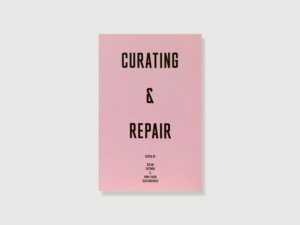
A Criticism Review 2.0 | Objektiv #25

If we are to carve out new ways of working and being published, what forms must we invent – what rhythms, structures or publics might we compose or dissolve? Who is brought into the fold of a writing community? What constitutes a ‘community’ and what do we call our ‘work’ and ‘practice’?

Objektiv Press describes its 25th issue as a manifesto in which a group of writers – including Susan Bright and Travis Diehl – explore the tensions of textual production, authorship and the shifting, porous networks their work inhabits. Reissued in 2024 with two new contributions, this third and final instalment of Objektiv Editions – a publishing and project initiative in collaboration with Kunstnernes Hus – emerged from the post-pandemic moment: an invitation to reexamine the fragile ecology of writing on photography. Certainly, from our vantage point, the past decade has sharpened awareness of a broader attrition with magazines and certainly newspaper columns folding or shifting online, commissions dwindling and book publishing within photography becoming increasingly rarefied.

Still, there is a sense that through certain publishing initiatives and the communities they cohere, we glimpse not only survival, but potential in other practices, other ways of ‘working’, writing and thinking that resist the logic of scalability and exhaustion. Less a declaration than a provocation, A Criticism Review brings together poetic, precise and contemplative approaches to these questions. It is a work whose provocations are rooted in a specific historical moment, yet the questions it poses resist any easy containment within it – a timely contribution to the ever-evolving conversation about what criticism, and its modes of circulation, might yet become.

‘The Interview: Ariella Aïsha Azoulay’ | ArtReview, April 2025

ArtReview Managing Editor, Yuwen Jiang, writes ahead of her interview that Ariella Aïsha Azoulay is one of today’s key proponents of, and thinkers around, the reversal of imperial violence. Cutting across any formalities, Azoulay asserts that imperial regimes, by positioning colonised peoples as epistemologically subordinate, have relied on a violent metaphysics of development and hierarchy – one that draws rigid boundaries between genres (academic, cinematic, literary, etc.), disciplines and even fundamental categories like adult and child. For Azoulay, these separations are not neutral or natural, but imperial technologies – ‘the colonial, imperial or capitalist way of imposing divisions with force – or amalgamating divisions, as with the imperial violence against diverse Jews, for example, who were forced to be identified as a singular people.’

Throughout the interview, Azoulay speaks across various subjects and phases of her work – at one point reflecting on Golden Threads, a book that draws on moments of Jewish and Muslim artisanship in Fèz, Morocco, as a counterpoint to colonial photographic practices. Confronted with the death of her parents and the birth of her first grandchild, Azoulay says that she had to reckon with her new position as an ancestor. With that, she claims the right to either passively reproduce the colonial disruption of transmission or reverse its curse.

‘Deutsche Börse prize review – Black cowboys, bonkers rock-huggers and a story of shocking loss’ | Charlotte Jansen for The Guardian, March 2025

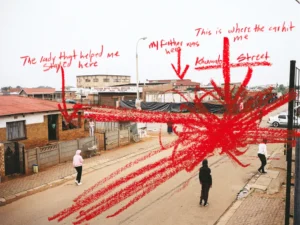
As the title of Charlotte Jansen’s piece for The Guardian suggests, the 2025 Deutsche Börse Photography Foundation Prize shortlist spans a range of forms – documentary, performance, staged scenes, family archive – all circling questions of place, memory and inheritance, even as they pull in radically different directions. Lindokuhle Sobekwa, a worthy (and indeed eventual) winner in Jansen’s view is nominated for his book I Carry Her Photo with Me published by MACK. His turn to this project seemingly driven by a need to cope with, understand, or immortalise the pain and tragic story of his sister, who suddenly vanished and returned a decade later, ill. Rahim Fortune, shortlisted for Hardtack, a photographic meditation on the American South that, as Taous R. Dahmani observes, finds unexpected resonance with Cowboy Carter, Beyoncé’s album.

Shadowings, an exhibition gathering two decades of Tarrah Krajnak’s work, positions itself as an intricately structured and quietly adversarial project – perhaps the most conceptually ambitious, not least for her work with the cyanotype process. Also shortlisted is Cristina de Middel for Journey to the Centre, exhibited at last year’s Les Rencontres d’Arles, which blends documentary and surrealism to trace the polarised narratives surrounding migration from southern Mexico to California. The flattest of the lot, Jansen writes in her pointed overview of the nominees and the broader concerns shaping their work – a worthy read even following the prize announcement that took place 15 May, followed by the exhibition closing a month later.

‘The Cowardice of Elites’ | Nathan J. Robinson for Current Affairs, April 2025

Harvard’s recent stand against Trump’s mounting demands – which initially included changes to the university’s governance, tighter oversight of international students and increased ‘viewpoint diversity’ in curriculum and hiring – may seem unexpectedly defiant. However, this vaunted ‘show of backbone’ seems little more than a strained performance that can’t quite hide its complicit teeth. The institution had already cancelled programmes on Palestine and adopted the IHRA definition of antisemitism, which equates criticism of Israel with antisemitism. As Nathan J. Robinson writes in Current Affairs, up to this point Harvard had struck a markedly compliant tone, raising fears it might follow Columbia’s path of appeasement to Trump’s orders.

It’s true that in earlier court filings, the university touted ‘meaningful discipline’ for protestors and promoted new efforts to enforce ‘ideological diversity’ and civil discourse in response to ‘erupting protests’. It quietly dismissed the faculty leads of the Centre for Middle Eastern Studies, Cemal Kafadar and Rosie Bsheer, and remained silent on the detention of Kseniia Petrova, leaving international students increasingly fearful for their lives and futures in the U.S. Robinson warns of America’s drift toward dictatorship, expressing concern about a fading reputation overseas – a gesture that feels beside the point in view of history. At this stage, the state’s lawlessness is not an aberration but a function of the order itself. Rights have been recoded as instruments of control and depoliticisation. Can the university be anything other than one of its quiet managers?

AIPAD New York: The photographers, collectors, and dealers who grew the art market, Subtext and Discourse | Art World Podcast

In the third episode of Subtext and Discourse’s special seven-part podcast – produced in collaboration with AIPAD and The Photography Show – Michael Dooney speaks with Howard Greenberg, the influential dealer who helped push photography into the heat of the contemporary art market. Founder of the Center for Photography in Woodstock (1977) and Howard Greenberg Gallery (1981), Greenberg has spent decades forging a cultural and commercial footing for photography equal to that of the so-called major arts.

He reflects on his passage from photographer to gallerist, recalling the generous reception extended by New York’s close-knit photographic community upon the founding of his space – a time when the medium’s institutional footprint was modest enough that “every exhibition could be seen in a single afternoon.” Asked to reflect on a turning point in the recognition of photography as a serious collectible, Greenberg recalls the Getty Museum’s 1984 acquisition of photographs for $30 million, a move that shifted capital, and with it, credibility, into the field. The moment was amplified by coverage in The Wall Street Journal, and the years that followed saw a steady quickening with rising valuations, growing institutional interest and landmark exhibitions, including William Klein’s first solo show at Greenberg’s gallery. Amid the rush, it was discovery – not just market heat – that sustained him. The thrill, he says, was always in uncovering someone new to show. ♦


Thomas King is Editorial Assistant at 1000 Words and a student on BA (Hons) Culture, Criticism, Curation at Central Saint Martins, University of the Arts London.

Images:

1-Cover for A Criticism Review 2.0 (Objectiv, 2024)

2-Ariella Aïsha Azoulay © Yonatan Vinitsky

3-Lindokuhle Sobekwa, Khumalo street where accident happened, Thokoza, Johannesburg, South Africa, 2023; from the series I Carry Her Photo with Me

4-Howard Greenberg © Bastiaan Woudt


1000 Words favourites

• Renée Mussai on exhibitions as sites of dialogue, critique and activism

• Roxana Marcoci navigates curatorial practice in the digital age

• Tanvi Mishra reviews Felipe Romero Beltrán’s Dialect

• Discover London’s top five photography galleries

• Tim Clark in conversation with Hayward Gallery’s Ralph Rugoff on Hiroshi Sugimoto

• Academic rigour and essayistic freedom as told by Taous Dahmani

• Shana Lopes reviews Agnieszka Sosnowska’s För

• Valentina Abenavoli discusses photobooks and community

• Michael Grieve considers Ute Mahler and Werner Mahler’s posthumous collaboration with their late family member 

• Elisa Medde on Taysir Batniji’s images of glitched video calls from Gaza

1000 Words

Photobook Conversations

£13.99

Click here to order your copy of Photobook Conversations

£13.99

Book launch/event
A Bigger Book Fair / Peckham 24
16-18 May 2025

Unit 8
Copeland Park 
133 Copeland Road
London 
SE15 3SN
Details here

Photobook Conversations foregrounds discussions on and around a range of positions, practices and politics that shape the landscape of contemporary photography and publishing today. With generosity and willingness to share personal histories, experience and knowledge, the contributors in this volume encompass artists such as Raymond Meeks and Sohrab Hura, as well as individuals and collectives responsible for the ‘afterlife’ of artists’ works – designers, editors, publishers, critics, and historians – including Bruno Ceschel, Yumi Goto, Hans Gremmen, and Valentina Abenavoli. Among the organisations whose activities and ambitions are represented within this volume are BLOWUP PRESS; Center for Contemporary Photography, Melbourne; Self Publish, Be Happy; Goliga; Nepal Picture Library; and Dikan Center and Photo Library, Accra.

Speaking with hope and humility, the concerns expressed by those who work with the photobook form vary from approaches to editing and sequencing images and building narrative structure to questions around the audience and market for photobooks and models for better ecosystems. Evident throughout are critical reflections on the significance of the shift of the book towards a design object, balancing choices between utilising specific materials or processes and the desire for access, the importance of books reaching other continents, and attempts to address sustainability in publishing. Exploring specific territories and different contexts for bookmaking, Photobook Conversations embraces and develops the ever-expanding space for the culture, study and appreciation of the photobook.

Featuring Valentina Abenavoli, Daniel Boetker-Smith, Miguel Del Castillo, Bruno Ceschel, Yumi Goto, Hans Gremmen, NayanTara Gurung Kakshapati, Sohrab Hura, Andrea Josch, Luis Juárez, Sanjay Kak, Aneta Kowalczyk, Anastasiia Leonova, Buen Lugar, Raymond Meeks, Paul Ninson, Ivan Vartanian

Editors Ana Casas Broda, Anshika Varma and Duncan Wooldridge
Series Editor Tim Clark

Copy Editor Alessandro Merola

Production Assistant Thomas King
Art Direction & Design Sarah Boris
Printed and bound in Great Britain by Clays Ltd, Elcograf S.p.A

Ana Casas Broda is an artist, educator and editor based in Mexico City. She is Co-Director of Hydra + Fotografía, a platform for projects related to the medium of photography.

Anshika Varma is a photographer, curator and artist from New Delhi, India. She is the Founder and Publisher of Offset Projects, an artist initiative working with photography and bookmaking.

Duncan Wooldridge is an artist, writer and curator, and is Reader in Photography at the School of Digital Arts, Manchester School of Art, Manchester Metropolitan University. He is the author of John Hilliard: Not Black and White (Ridinghouse, 2014), To Be Determined: Photography and the Future (SPBH Editions, 2021) and Co-Editor of Writer Conversations (1000 Words, 2023).

Publication date May 2025
Format Softcover

Dimensions 198 mm x 129 mm
Pages 160
Publisher 1000 Words (1000 Words Photography Ltd)
ISBN 978-1-0369-0147-9

Photobook Conversations is edited by Ana Casas Broda (Hydra + Fotografía), Anshika Varma (Offset Projects) and Duncan Wooldridge (Manchester Metropolitan University). Sitting alongside Writer Conversations (1000 Words, 2023), edited by Lucy Soutter (University of Westminster) and Duncan Wooldridge (Manchester Metropolitan University) and Curator Conversations (1000 Words, 2021), edited by Tim Clark, it completes the trilogy of publications that explores photography and mediation through examining exhibition making, critical writing and publishing practices.

Distribution

UK and Europe

Public Knowledge Books
90 Hoe Street, London
E17 4QS, United Kingdom
www.publicknowledgebooks.com
bryony@publicknowledgebooks.com

North America

ARTBOOK | D.A.P.
75 Broad Street Suite 630
New York, NY 10004, US
www.artbook.com
orders@dapinc.com

Australia and New Zealand

Perimeter Distribution
734 High Street Thornbury
3071 Melbourne Victoria, Australia
www.perimeterdistribution.com
hello@perimeterdistribution.com

What We’re Reading #3: Winter 2025

What We’re Reading returns for 2025 by picking up on works that expose the politics of narrative – how history, crisis, and dissent are mediated. From a critique of colonial reenactments that obscure lived realities to a clickbait piece that declares photography’s renaissance given ‘AI becomes harder to detect’, Thomas King traces docudrama, revisits Mike Davis’ urgent interventions on California’s wildfires, The Ecology of Fear: Los Angeles and the Imagination of Disaster, and explores uncompromising responses to institutional narratives – or their reinforcement – via the furore surrounding Nan Goldin’s recent speech at the Neue Nationalgalerie, Berlin.


Thomas King | Resource | 6 Feb 2025

A Kenyan Docudrama | Zoe Samudzi for ArtReview, October 2024

How can we weigh present materialities against historical wounds? In ArtReview, Zoe Samudzi writes about Max Pinckers’ State of Emergency, a close collaboration over ten years between Pinckers and members of the Mau Mau War Veterans Association (MMWVA), wherein the veterans perform vignettes of their experiences, which are juxtaposed against an extended cache of archival photographs and texts. She proffers that, in practice, the work perpetuates a sense of incuriosity about the African present and relies on a narrative approach that favours constant reference to the European archive rather than a fluid multi-directionality in which the violence of the past are readily made visible beyond the bodies of its still-living victims. Samudzi asks why Pinkers would recapitulate and foreground the British narrative by positioning the ‘demonstrations’ as rebuttals against his archival roundups of imperial panics about a wanton and ‘terroristic’ native insurgency or corroborations of the archive’s reluctant admissions of torture.  

For Samudzi, Pinckers’ reliance on the British colonial archive inadvertently re-centres imperial perspectives, undermining the possibility of crafting a genuinely decolonial narrative  reenactments are framed as either refutations or corroborations of imperial fears and reluctant admissions of torture. Yet, they ultimately recapitulate British vantage points, reinforcing rather than dismantling colonial epistemologies. It suggests that alternative epistemic frameworks might better honour the veterans’ agency and the lived realities of postcolonial dispossession. Thus, weighing present materialities against historical wounds demands an approach that neither collapses the past into the present nor isolates them entirely.

Mike Davis, The Ecology of Fear: Los Angeles and the Imagination of Disaster Verso Books, 1998

A close friend who studies at UCLA recently returned to Los Angeles after a weeklong evacuation. ‘Classes have resumed while the city burns around us, and Trump is now president,’ she writes. This served as a reminder of Mike Davis’ classic work, The Ecology of Fear (1998), where he demands that we confront the uncomfortable reality of a world where our environmental and social crises are inextricably bound, democracy has already crumbled, and unchecked economic greed chokes any possibility of ecological salvation. From earthquakes to floods, tornadoes, and a complete systematisation of disaster films and novels, he warns that the danger lies not in the absence of solutions but in a political climate that refuses to tackle problems deemed too vast to fix.

One essay in the book, The Fire Boom, reveals how policymakers and developers abandoned millennia of pre-colonial fire prevention practices in favour of rampant real estate overdevelopment in LA’s mountains. Here, Davis argues that fire-prone buildings prioritise aesthetics and property values over ecological balance, rejecting measures such as controlled burns that could mitigate fire risks: ‘Indeed, a growing risk of entrapment and death is inevitable as long as property values are allowed to dictate firefighting tactics.’ The Lever revealed a year before Davis’ death that efforts to limit high-risk construction, including some houses engulfed in the recent fires, had been blocked by powerful real estate lobbies. Now, his comprehensive exposé of urban vulnerability brings renewed attention to the long-standing environmental inequalities that amplify the impact of disasters, particularly on marginalised communities. ‘In Southern California, we bury our dead and forget,’ he writes.

‘As A.I Becomes Harder to Detect, Photography Is Having a Renaissance’ | Julia Halperin for The New York Times, October 2024

The death of photography has been declared almost since its inception. So, seeing an article in The New York Times touting its “renaissance” is enough to raise an eyebrow especially when juxtaposed with the supposed growing indistinguishability of AI-generated images. Halperin’s article starts with questions about representation, truth and the perception of images, but falters when it tries to shoehorn AI as a justification for the clickbait headline. Perhaps the more accurate assessment comes earlier in the article: Halperin cites those who suggest this alleged resurgence of interest reflects a cooling art market, photography commanding significantly lower price points than high-end painting or sculpture. The claim of this moment’s uniqueness considering the rise of AI stretches thin, amounting to little more than a brief overview of exhibitions indulging in the “nostalgia” of the photograph.

While these shows undoubtedly explore the medium’s rich history, can we genuinely put this down to the rise of AI? Consider the nostalgia surrounding film photography – its physical, tangible nature and graininess – existed long before the advent of AI-generated images (resoundingly familiar to discussions around the advent of digital and rise of the smartphone). It’s questionable whether we’ve reached a point where the rise of AI image generators – Grok-2 on Musk’s X being the latest – has made physical prints ‘all the more like fine art objects’, as the writer suggests. It’s perhaps more productive to explore the relationship between AI and photography with the understanding that if we frame the ease of producing hyper-realistic AI images as a threat to the photograph’s credibility as a truthful representation, we undermine the integrity of photojournalism and documentary photography, not to mention attendant issues around its use as instrument of control, exploitation of the most vulnerable or encroachment on intellectual property.

‘The Fabrication of a Scandal: Nan Goldin at Berlin’s Neue Nationalgalerie’ | The Left Berlin, December 2024

The Left Berlin delivers a trenchant analysis of the events surrounding Nan Goldin’s opening speech at her retrospective at the Neue Nationalgalerie, Berlin, last year. A rigorous critique is levelled not only at the museum director, Klaus Biesenbach, but also at the broader institutional apparatus and what it embodies, namely ‘the absence of genuine dialogue in Germany when it comes to Palestine, the monopoly of narrative in the current German cultural, institutional and political landscape, and the doggedness towards any voice not aligned with the Staatsräson.’

The Berlin publication observes that the controversy originated with a symposium that purported to offer a neutral platform for open discourse. However, as Strike Germany contended, it functioned instead as a pre-emptive defence against any criticism of Biesenbach for presenting the work of a vocal anti-Zionist like Nan Goldin (the strike group described the symposium as advancing a narrowly constrained, highly selective agenda.) Goldin subsequently withdrew and demanded the event’s cancellation. Additional reports of arbitrary exclusions, excessively stringent security protocols, and the barring of key participants compounded the tension. Nan Goldin’s defiance was more than admirable, as were the protesters’ actions during the chaotic opening. And just a little over a week later, we heard Turner Prize winner Jasleen Kaur’s powerful acceptance speech on Palestinian solidarity at Tate Britain. Yet, the impossibility of real dialogue persists within these institutions, including those that claim to support freedom of expression while continuing to perpetuate censorship and marginalise dissenting perspectives.

‘Subversive, warm and wild at heart: David Lynch deserves all his tributes’ | Barbara Ellen for The Observer, January 2025

David Lynch’s passing at the age of 78 has sparked an outpouring of tributes, and understandably so. It’s no exaggeration to say that Lynch didn’t just work within cinema – he remade it in his own image. A “Lynchian” universe is one of multiple genres, features, television, music, and art as a spiritual practice. It is also one of countless artists influenced across generations and all mediums. Lynch began his life’s work, “the art life,” when he attended art college in the 1960s and made his first experimental short, Six Men Getting Sick (1967), while a student at the Pennsylvania Academy of Fine Arts. 

He was notoriously taciturn about explaining away his artwork, uncompromising in his approach, and the eccentricity of much of his output fuelled his cult success, cementing his legendary reputation for capturing the absurdity that resides within all of us. Eraserhead would mark his first feature in 1977, a nightmarish plunge into the deepest recesses of dread and disorientation. Later would come a string of award-winning films, including Blue Velvet (1967), Wild at Heart (1990), Mulholland Drive (2002), and the landmark TV show Twin Peaks (1990). Out of all the comments and tributes to Lynch, the following stood out: “It did not occur to me that David Lynch could die; what a strange world we live in,” as if Lynch’s very existence was inseparable from the surreality of the strange worlds he created. That much is true. ♦


Thomas King is Editorial Assistant at 1000 Words and a student on BA (Hons) Culture, Criticism, Curation at Central Saint Martins, University of the Arts London.

Images:

1-Beninah Wanjugu Kamujeru, John Mwangi, Ndungu Ngondi, Joseph Gachina and Wilfred K. Maina (left to right), Murang’a, 2019; from Max Pinckers et al., State of Emergency, 2014–24. 

2-Cover for Mike Davis, The Ecology of Fear: Los Angeles and the Imagination of Disaster (Verso Books, 1998)

3-Klaus Biesenbach at the opening of the exhibition Nan Goldin. This Will Not End Well at Berlin’s Neue Nationalgalerie, November 2024

4-Kyle MacLachlan in Twin Peaks (1990)


1000 Words favourites

• Renée Mussai on exhibitions as sites of dialogue, critique and activism

• Roxana Marcoci navigates curatorial practice in the digital age

• Tanvi Mishra reviews Felipe Romero Beltrán’s Dialect

• Discover London’s top five photography galleries

• Tim Clark in conversation with Hayward Gallery’s Ralph Rugoff on Hiroshi Sugimoto

• Academic rigour and essayistic freedom as told by Taous Dahmani

• Shana Lopes reviews Agnieszka Sosnowska’s För

• Valentina Abenavoli discusses photobooks and community

• Michael Grieve considers Ute Mahler and Werner Mahler’s posthumous collaboration with their late family member 

• Elisa Medde on Taysir Batniji’s images of glitched video calls from Gaza

Top 10 (+1)

Photobooks of 2024

Selected by Tim Clark and Thomas King

As the year draws to a close, an annual tribute to some of the exceptional photobook releases from 2024 – selected by Editor in Chief, Tim Clark, with words from Editorial Assistant, Thomas King.


Tim Clark and Thomas King | Top 10 photobooks of 2024 | 05 Dec 2024 | In association with MPB

1. Adam Broomberg & Rafael Gonzalez, Anchor in the Landscape
MACK

Studied witnesses to the State of Israel’s attempt to erase a people and their history, Adam Broomberg and Rafael Gonzalez present a quiet yet forceful declaration of Palestinian resilience in Anchor in the Landscape. This striking series of 8×10 black-and-white photographs of olive trees, accompanied by a text from legal scholar and ethnographer Dr. Irus Braverman, made a bold statement at the 60th La Biennale di Venezia earlier this year. Each page of the book pairs a photograph with its precise geographical coordinates, where the olive tree – facing destruction and theft by settlers – anchors livelihoods, culture, and presence in a relentlessly seized and ravaged landscape. The result is a haunting yet beautiful rekindling of connection to Palestinian land in the occupied territories.

2. Karolina Spolniewski, Hotel of Eternal Light
BLOW UP Press

Winner of the 2022 BUP Book Award, Spolniewski’s seven-year multimedia project-turned-book – replete with holographic foil cover – details the psychological and physical scars of detention, drawing on Hannah Arendt’s writings on totalitarianism and isolation. At its heart is Hohenschönhausen, the notorious Stasi prison in East Berlin, dubbed the “Hotel of Eternal Light,” where unrelenting artificial lighting twisted inmates’ sense of time. Documentary photography, scans of physical traces, inmates’ belongings, portraits, X-rays, archival imagery, and fragments of memories from conversations with former prisoners are combined through the book’s design approach to enhance meaning, one that also speaks through the inmates: one page repeats ‘everlasting interrogations,’ while another chillingly declares, ‘Every three minutes you get… blinded by the lights.’

3. Agnieszka Sosnowska, För
Trespasser

Agnieszka Sosnowska’s debut monograph, För (meaning journey in Icelandic), takes readers on a raw, poetic journey through the artist’s life on a beautiful stretch of unmistable wilderness. Originally from Poland, she immigrated to the United States as a child, then as a young adult spontaneously visited Iceland, met her partner and built a life there. Where nature is both a solace and an ever-present force, Sosnowska’s photography – especially self-portraiture – charts the ongoing journey of self-discovery and belonging. Against the pulse of land and community, her images invite a deeper reading, culminating in a confident yet vulnerable self-portrait of the artist. But to what end? Sosnowska doesn’t just capture her subjects and surroundings; as SFMOMA’s Assistant Curator of Photography Shana Lopes recently writes in her review, Sosnowska invites us to reconsider how labour, heartbreak, death, landscape, and the quotidian shape our idea of home.

4. Carmen Winant, The Last Safe Abortion
Self Publish, Be Happy

Since the re-election of the man who played a key role in overturning Roe v. Wade, Carmen Winant’s sobering photo album-style work – winner of the Author Book Award at the 2024 Les Rencontres d’Arles Book Awards – feels more urgent than ever. Published by SPBH Editions and MACK and designed with a bold spiral binding, Winant’s contemplative exploration of care resists the relentless efforts of anti-abortion movements and the far right to control women’s bodies. Featuring images of health clinics, Planned Parenthood locations, and abortion clinic staff whose tireless commitment sustains this fight, the book spans 50 years – from 1973, when abortion rights were federally protected, to 2022, following their dissolution. Winant reframes the struggle for care and autonomy as a testament to courage, resistance, and hope – urgently needed qualities. Read Gem Fletcher’s review here.

5. Carla Williams, Tender
TBW Books

It’s often a posthumous exercise to uncover a hidden trove of photographs, but for Carla Williams, her artistic debut has thankfully arrived during her lifetime—adding a new chapter to her distinguished career as a photo historian. At 18, while studying photography at Princeton, Williams began creating black-and-white and colour portraits using Polaroid 35mm and 4×5 Type 55 film formats. Now published by TBW Books, Tender spans photographs taken between 1984 and 1999. The collection collapses time through a body of unapologetically vivid work – playful, provocative, and present. The intimate self-portraits reveal the evolution of her gaze, reclaiming, redefining, and becoming, charting her coming-of-age as an artist and a queer Black woman. Winner of the Paris Photo–Aperture Foundation First Photobook Prize and celebrated with a solo exhibition at Higher Pictures, Carla Williams: Circa 1985 marks the first time much of this work has been published or exhibited.

6. Magdalena Wywrot, Pestka
Deadbeat Club

When I look back on photos of myself as a child, they’re worlds apart from the grainy, high-contrast black-and-white images Magdalena Wywrot created in her project about her daughter, Barbara. These are far less sanitised and reflect the otherness of the universe Wywrot creates in Pestka – a name that means seed, shell, or kernel and is Barbara’s nickname. Accompanied by essays from David Campany and Barbara Rosemary, the series brims with a delicate intimacy yet hums with a raw, almost mystical energy. What began as a spontaneous act of documentation has become a richly layered work of magical realism and gothic narrative. Fragmentary and cinematic, the images possess a haunting poeticism that we might find in the avant-garde sensibilities of Vera Chytilová or Dušan Makavejev – full of the playful, subversive potential that Campany mentions in his text.

7. Johny Pitts, Afropean: A Journal
Mörel Books

Johny Pitts, founder of afropean.com and author of Afropean: Notes from Black Europe (Penguin, 2020), unites his expansive work in this thoughtfully curated photobook tracing a five-month journey encompassing Paris, Berlin, Lisbon, Brussels, Amsterdam, and Stockholm. Pitts, in his search for a different side of the continent, collates an epic travelogue that blends striking photography with personal ephemera – tickets, diary notes, maps, postcards – offers a tactile, immersive book that flies in the face of rising populism and far-right politics across the continent. New essays by Pitts deepen the conversation on the Black European experience alongside a six-part podcast, a soundtrack, and three short films shot on location – a bold, multi-layered exploration of Afropean life.

8. Ute Mahler, Werner Mahler, Ludwig Schirmer, Ein Dorf 1950–2022
Hartmann Books

Michael Grieve writes, ‘time, of course, is the great force here,’ in Ein Dorf 1950–2022; that force brings ‘an arbitrary photographic topography brought to reason.’ The village of Berka, Germany, has been captured over seven decades by three remarkable photographers united by a family story – coincidental or not – that ties together personal history with the sweeping political shifts from state socialism to the reunification of a divided country. Alongside essays by Jenny Erpenbeck, Steffen Mau, and Gary Van Zante, the 220 black-and-white images glimpse the subtle yet seismic moments that have redefined the village, its people, and its evolving identity. Here is a rivetting perspective, as sociological as it is a documentary, on a place that has witnessed history, and its political reality unfolding in real-time. Since we published our review, Ute Mahler and Werner Mahler have deservedly been awarded the Order of Merit of the Federal Public of Germany (2024) for services to photography.

9. Olivia Arthur, Murmurings of the Skin
VOID

After gracing festivals, museums, and galleries worldwide, Murmurings of the Skin now emerges as a striking publication from the mighty VOID. Nealy eight years ago, Olivia Arthur began her work on physicality, capturing the energy flowing through bodies and the sensation of skin on skin. Sparked by her experience of pregnancy, the work blossomed into a vivid exploration of youth, sexuality, and touch – charged moments of intimacy. In the stillness of pandemic isolation, these themes gained new urgency. The result is a tactile, sensitive work that remedies the struggle of feeling at home in our skin.

10. Máté Bartha, Anima Mundi
The Eriskay Connection

“Our world right now operates in code. So, if we’re talking about code, isn’t everything about how the universe functions?” There’s no denying that Máté Bartha’s latest work, Anima Mundi, leans into the obscure. If we begin with the title’s translation, Anima Mundi means “world spirit,” a concept rooted in Platonic thought, reflecting an ancient idea of a universal organising principle that connects all beings. Divided into chapters exploring urban phenomena ranging from the microcosmic to the cosmic, Anima Mundi composes intricate patterns, layered grid structures, and cryptic visual codes. Its poetic and philosophical approach to the desperate act of seeking structure and meaning invites us to return to the question: how do we make sense of the universe and its code? How do we find sense in arbitrariness?

+1 Flashpoint! Protest Photography in Print, 1950-Present
10×10 Photobooks

What is the relationship between visual culture and protest? Flashpoint!, both a powerful survey of activism and visual tour de force, is a meticulously curated, global collection of protest photography, zines, posters, pamphlets, and independent publications from the 1950s to the present. The latest offering from 10×10 Photobooks is born from the 2017 project AWAKE: Protest, Liberty, and Resistance collection, which organised protest photobooks by themes through an open call. Flashpoint! builds on this with seven expansive chapters, each containing multiple sub-themes. Across 500 pages, 750+ images, and a series of thought-provoking essays, the endlessly evocative collection reflects Arthur Fournier’s ‘aesthetic of urgency,’ contrasting the polished, institutional protest imagery with the raw, time-sensitive visuals of grassroots movements.♦


Thomas King is Editorial Assistant at 1000 Words and a student on BA (Hons) Culture, Criticism, Curation at Central Saint Martins, University of the Arts London.

Tim Clark is Editor in Chief at 1000 Words and Artistic Director for Fotografia Europea in Reggio Emilia, Italy, together with Walter Guadagnini and Luce Lebart. He also teaches at The Institute of Photography, Falmouth University.

Images:

1-Cover of Adam Broomberg & Rafael Gonzalez, Anchor in the Landscape (MACK, 2024). Courtesy MACK

2-Adam Broomberg & Rafael Gonzalez, Anchor in the Landscape (MACK, 2024). Courtesy MACK

3-Karolina Spolniewski, Hotel of Eternal Light (BLOW UP Press, 2024). Courtesy BLOW UP Press

4-Agnieszka Sosnowska, För (Trespasser, 2024). Courtesy Trespasser

5-Carmen Winant, The Last Safe Abortion (Self Publish, Be Happy, 2024). Courtesy Self Publish, Be Happy

6-Carla Williams, Tender (TBW Books, 2024). Courtesy TBW Books

7-Magdalena Wywrot, Pestka (Deadbeat Club, 2024). Courtesy Deadbeat Club

8-Johny Pitts, Afropean: A Journal (Mörel Books, 2024). Courtesy Mörel Books

9-Werner Mahler, Ein Dorf, 1977-78 in Ute Mahler, Werner Mahler, Ludwig Schirmer, Ein Dorf 1950–2022 (Hartmann Books, 2024). Courtesy Hartmann Books

10-Olivia Arthur, Murmurings of the Skin (VOID, 2024). Courtesy VOID

11-Máté Bartha, Anima Mundi (The Eriskay Collection, 2024). Courtesy The Eriskay Collection

12-Flashpoint! Protest Photography in Print, 1950-Present, edited by Russet Lederman and Olga Yatskevich (10×10 Photobooks, 2024). Courtesy 10×10 Photobooks


1000 Words favourites

• Renée Mussai on exhibitions as sites of dialogue, critique and activism

• Roxana Marcoci navigates curatorial practice in the digital age

• Tanvi Mishra reviews Felipe Romero Beltrán’s Dialect

• Discover London’s top five photography galleries

• Tim Clark in conversation with Hayward Gallery’s Ralph Rugoff on Hiroshi Sugimoto

• Academic rigour and essayistic freedom as told by Taous Dahmani

• Shana Lopes reviews Agnieszka Sosnowska’s För

• Valentina Abenavoli discusses photobooks and community

• Michael Grieve considers Ute Mahler and Werner Mahler’s posthumous collaboration with their late family member 

• Elisa Medde on Taysir Batniji’s images of glitched video calls from Gaza

The unseen effects of illness

Worry for the Fruit the Birds Won’t Eat is Sophie Gabrielle’s visual investigation into the unseen effects of illness. Responding to the emotional toll of all the male members of their family being diagnosed with stage IV cancer over two years, the artist employs optics, chemical interactions and investigative photography to render the invisible. Thomas King speaks with the winner of OD Photo Prize 2024 about the project and its deeply personal starting point.


Thomas King | Interview | 17 Oct 2024

Thomas King: Worry for the Fruit the Birds Won’t Eat, recently announced as the winner of OD Photo Prize 2024, features various images of early phototherapy practices, such as UV light exposure and ‘light baths’ used on children, alongside early X-ray experiments. How would you discuss your relationship with the archive in the context of this project? And what was the motivation to create a dialogue between the historical and the personal?

Sophie Gabrielle: I have always been a collector of images. From a young age I would cut pictures out in magazines for safekeeping. The use of scientific archive photography in my work began in university when I based the series BL_NK SP_CE on an MRI scan. Using archive photography relating to X-ray and UV exposure started during a period of research into my father’s stage IV cancer diagnosis. Wanting to understand what was happening, I came across an initial X-ray image and the collection began.

I felt drawn to these archive images after discovering that many of these initial experiments into ionising radiation (x-rays) and UV light baths were cancer-causing. There was this duality to them, experimentation into science that would eventually help treat my family and the initial causation of illness for those in the photographs themselves. During this period of time, I was documenting my family, photographing our lives as we went through this sudden upheaval. However, the images felt too personal to show, they became my secret garden. Using the archive, with its scientific detachment, allowed me to create a public dialogue about my experience while still maintaining a sense of privacy for my family. This project has let others share their own experiences of cancer with me, creating deep felt connection of both loss and joy.

TK: This series involves an intricate process of capturing and re-photographing images under glass plates. What challenges or unexpected discoveries did you encounter during this process, and can you comment on the way they influenced the final outcomes of your work?

SG: There were two main challenging points – touch and light. Handling the plates of glass was always tricky. Initially, I was focused on trying to only capture dust but my fingerprints, hair and fibre would interfere. Over time though I began to appreciate their presence in the works. They were uncontrollable parts of human existence, and ultimately that was a large part of the work.

Light was the other, the most controlled part of the works. Angling both flash and continuous light on specific parts of the photographs was laborious. This control was so important to the works, freezing time for a moment – something I could decide when, how and what it was doing in a time that felt so opposite. The interplay of control and accident in both light and touch ultimately shaped the tone of the final images.

TK: You’ve previously described the investigative processes involved in photographing worlds invisible to the naked eye. In your work, light seems to dissolve and mystify reality – what did you intend to conjure?

SG: In all my work, I aim to convey the tension between visibility and invisibility and the power of the photograph as an object with a duality of truth and lie. They seek to represent the complexity of something deeply felt yet difficult to fully articulate. Through abstraction, I create space for viewers to engage with the work on their own terms. By distorting the clarity of the image, I invite a more nuanced and subjective reading of illness and existential fragility. This approach allows my audience to explore the emotional landscape in ways that reflect their own experiences, emphasising the ambiguity and intricacies of human vulnerability. I’m particularly interested in what is missing in a photograph, what is left out and what we ultimately search for. What makes an image relatable, is what draws us in and creates tension.

TK: In your artist statement, you refer to the project as a form of self-portraiture through abstraction. How do you view the role of aesthetics in conveying personal trauma or existential themes?

SG: We live in a time where there’s an expectation to share our lives and identities in a digital, public way. I see art as fulfilling two essential roles: expressing the artist’s experience while also allowing space for the viewer to connect and interpret it in their own way. Aesthetics play a crucial part in this and through my methods I can engage with personal trauma without being overly literal, which mirrors the non-linear, fragmented nature of emotional processing. Rather than just communicating one perspective, the visual language in my work creates room for reflection on resilience, growth, and the inevitable changes we all undergo. It’s about offering both the artist and the viewer a way to connect deeply, yet individually.

The dust, made up of skin particles, connects the body and environment in a subtle way, entwining living presence with historical materials. This layering of dust and re-photographing became meditative and allowed me to reflect on the inevitable impact of time. It also connected these experiments to the people who would eventually be helped by them in the future. In this way it became self-portraiture, as I was a part of this process, my presence being the creator. I started this work in 2018 so it has been a long process and progression from where I first began. Speaking about this work now, both my grandfathers have passed and I have lost friends from cancer and it still feels just important to share this work, to hold open dialogue and openly grieve.

TK: Michel Foucault’s concept of the ‘medical gaze’ suggests a detached, often objectifying perspective on the body in medical contexts. In what ways does your work confront or complicate this idea, and how does the integration of personal bodily traces affect the perceived objectivity of medical imaging?

SG: I aim to reintroduce subjectivity and emotional resonance, emphasising the personal stories that exist beneath medical images. By transforming archival medical images into personal, poetic narratives, my practice directly engages with the relationship between the body, illness and the scientific gaze. Combining historical photographic processes with environmental interventions complicates this gaze, allowing me to reclaim the narrative of the body and illness. I integrate memory, grief and environmental decay to create something that resonates beyond the clinical sphere, inviting a deeper exploration of what these experiences mean on a personal level. ♦

All images courtesy the artist and Open Doors Gallery. © Sophie Gabrielle

Explore the full shortlist from OD Photo Prize 2024 via Open Doors Gallery.


Sophie Gabrielle is a photographer living and working on the lands of the Ngunnawal, Ngunawal and Ngambri people (Canberra, Australia). Their work uses biomaterials, photographic archives and the human body to investigate the connection between photography, history, memory and psychology. Gabrielle has exhibited in Australia, Malaysia, The Netherlands, France, Germany, South Korea, the USA and the UK. Recent commissions and collaborations include
The New Yorker: cover art for The Netherlands Philharmonic Orchestra and UK musician Seabuckthron’s album Through a Vulnerable Occur. They are a Foam Talent recipient (2018) and a finalist for the Lens Culture Emerging Talent Awards (2016).

Thomas King is Editorial Assistant at 1000 Words and a student on BA (Hons) Culture, Criticism, Curation at Central Saint Martins, University of the Arts London.


1000 Words favourites

• Renée Mussai on exhibitions as sites of dialogue, critique and activism

• Roxana Marcoci navigates curatorial practice in the digital age

• Tanvi Mishra reviews Felipe Romero Beltrán’s Dialect

• Discover London’s top five photography galleries

• Tim Clark in conversation with Hayward Gallery’s Ralph Rugoff on Hiroshi Sugimoto

• Academic rigour and essayistic freedom as told by Taous Dahmani

• Shana Lopes reviews Agnieszka Sosnowska’s För

• Valentina Abenavoli discusses photobooks and community

• Michael Grieve considers Ute Mahler and Werner Mahler’s posthumous collaboration with their late family member 

• Elisa Medde on Taysir Batniji’s images of glitched video calls from Gaza

1000 Words archive

15 Years, 15 Picks

Selected by Lucy Soutter

Marking 15 years of 1000 Words, Lucy Soutter takes us on a journey through our archive, offering a selection of features based on her own affinities across the magazine’s history. Capturing the richness of an archive and its ability to generate multiple routes through the material contained within, Soutter’s eclectic picks, as she writes, ‘celebrate the sweep of 1000 Words in embracing a range of 21st century photographic practices.’


Lucy Soutter | Archive highlights | 26 Sept 2024 | In association with MPB

I once spent a week time travelling to the 1960s. I was half-way through a PhD on photography in first-generation Conceptual Art when my supervisor sent me to the library to immerse myself in period art magazines – including Artforum for the avant-garde side of things, and Art in America for a mainstream view. She told me not to worry about reading every article (though I made some useful discoveries) but to skim every single page in chronological order, to immerse myself in the general culture of the time through the pictures, letters pages, ads, layout, etc. My week-long flashback to the decade of my birth gave me untold insights into the aesthetics, politics and general mood of the period. Magazines are traditionally classed as “ephemera,” cultural forms with fleeting significance, important primarily in the moment they are produced. That very topicality makes them an ideal form for studying the conscious and unconscious preoccupations of the time, whether the past or the near-present.

This assignment, to look back over 15 years of 1000 Words (particularly the last 12, as archived on the website) has taken me on a journey through my own past: exhibitions visited, books read, and articles shared in the classroom with students, as well as many important things I missed. At the same time, the exercise clarified trends that have emerged from the flow of visual and written materials. My selections are eclectic to celebrate the sweep of 1000 Words in embracing a range of 21st century photographic practices. I also want to draw attention to the ambition of the editorial teams over the years, led by Tim Clark, in extending the discussion of contemporary photography into new terrain. Although the pieces in this online magazine are short, they are bold in mobilising concepts from an array of academic and pop cultural contexts. The magazine has often been the first to publish emerging artists and writers, many of whom are now familiar names. Tracing the expansion of the field through evolving configurations of genres and presentation formats, it has also played a key role in promoting a broader range of practitioners.

Part of the richness of an archive is its capacity to generate multiple different routes through the material. This set of selections, loosely chronological, are based on my own affinities. I hope that they will invite you to dip in, whether to revisit familiar selections or make fresh discoveries.

1. Esther Teichmann, Drinking Air, and Mythologies
Interview by Brad Feuerhelm
Issue 14, 2012

When I started teaching at art schools in the early 2000s, the UK photography scene was dominated by documentary approaches. Contemporary photography is now so much more eclectic that it is hard to believe that a practice such as Esther Teichmann’s needed to take a stand against this orthodoxy to embrace symbolist themes, painterly gestures and mixed media installation. The images in this portfolio combine with the text to offer a rich field of possibility. Teichmann’s distinctive voice, her embrace of poetics, and the generosity of her approach are all evident in this interview. 1000 Words has provided a platform for a number of artists emerging in parallel expressive modes, including Tereza Zelenkova (28) and Joanna Piotrowska (30).

2. Daisuke Yokota, Back Yard
Essay by Peggy Sue Amison
Issue 15, 2012

‘There is a revolution going on in the work of emerging photographer Daisuke Yokota, a revolution that links the past with the future of Japanese photography.’ In a few deft paragraphs, Peggy Sue Amison provides several different points of entry for viewers seduced by Yokata’s evocative, mysterious images. She sketches in Yokata’s context in relation to the grainy, blurry aesthetic of the Provoke movement and describes how the photographer updates Japanese zine culture with collaborations and a participatory approach. Amison illuminates how his use of experimental processes such as solarisation and rephotographing combine with banal architecture, natural forms and faceless figures to create work that is distinctly Japanese and distinctly contemporary. As with Gordon Macdonald’s essay on Thomas Sauvin’s Beijing Silvermine project (15) or Sergio Valenzuela-Escobedo’s framing of Nadège Mazars’ Mama Coca (38) this concise piece provides essential context for interested readers to pursue further research into an important international practice.

3. Sara-Lena Maierhofer, Dear Clark, A Portrait of a Con Man
Interview by Natasha Christia
Issue 16, 2013

I confess that I was late to the photobook scene. It had been heating up for the first decade of the 2000s before I realised that this was not just a fad or nerdy subculture (though it has its fads and nerdy aspects) and that I needed to pay attention to it. 1000 Words was one of my go-to destinations for reading about new releases. I was so impressed by Natasha Christia’s interview with the author/artist/maker of Dear Clark that I ordered the book and looked with new eyes at its skilful combination of obsessive research, idiosyncratic reenactment and seductive, self-referential layout. As I have learned more about this aspect of contemporary photography culture, I have come to appreciate the extent to which the book reviewers for 1000 Words (variously photographers, writers, book-makers, curators and editors themselves) have contributed both to defining the photobook as a form with its own unique concerns, and to creating a canon-in-progress of its plural possibilities.

4. Julian Stallabrass, Memory of Fire: Images of War and the War of Images
Book Review by James McArdle
Issue 16, 2013

In 2008 – five years into a war that had seen the US, UK and allies invade and occupy Iraq – Julian Stallabrass curated the Brighton Photo Biennial as a searing critique of the uses of photography as a tool of pro-war propaganda, exploring the ways photographers past and present can work against the conventions of the genre to provoke other forms of understanding. How can war photography serve as a lesson or a warning rather than just pulling us into its quasi-pornographic thrall? James McArdle draws some of the key issues out of Stallabrass’ 2013 anthology of projects, essays, and interviews related to the festival, pointing to artists including Trevor Paglen, Adam Broomberg & Oliver Chanarin, and Coco Fusco, and writers including Sarah James and Stefaan Decostere.

5. Duane Michals, Storyteller: The Photographs of Duane Michals
Essay by Aaron Schuman
Issue 18, 2014

In this feature on Duane Michals, Aaron Schuman traces the historical roots of staged, narrative photography far beyond Cindy Sherman’s Untitled Film Stills to Victorian tableau photography. Schuman argues convincingly that in Michals’ hands the genre does not merely advance photography as an art form, but also grapples with aspects of experience that transcend ordinary vision. Although it may be difficult to identify the direct impact of Michals on contemporary photographers whose work, like his, is filmic (like Jeff Wall), fictive (like Gregory Crewdson) or constructed (like Matt Lipps), Schuman points out that the sophisticated use of series and sequence by photographers such as Paul Graham and Alec Soth owes a debt to Michals’ storytelling capabilities. (The final image in this portfolio, Michals’ This photograph is my proof is my all-time favourite image + text work).

6. Laura El-Tantawy, In the Shadow of the Pyramids
Book Review by Gerry Badger Issue 19, 2015
Matthew Connors, Fire in Cairo
Book Review by Max Houghton
Issue 20, 2015

It is difficult for a magazine, which in its previous format, only came out a couple of times a year to respond to current events or political crises like the Arab Spring, especially when photographic projects, like novels, sometimes take years to come to fruition*. Gerry Badger’s 2015 review of Laura El-Tantawy’s book In the Shadow of the Pyramids describes the artist’s response to the events in Tahir Square in 2011 in the context of her own life inside and outside Egypt. In response to this blend of document and personal archive, Badger provides a personal meditation on how we create photographic narratives out of the messy flow of life. Max Houghton’s review of Matthew Connors’ Fire in Cairo in the following issue is a more wrought, imagistic essay, a perfect fit for Connor’s disorienting, back-to-front combination of surreal images and fragmented fiction. Together, these two reviews open a space to consider how we see, remember and understand protest and its aftermath.

7. Saul Leiter Retrospective
Essay by Francis Hodgson
Issue 21, 2016

One of the important tasks of the critic is to return to older works and read them afresh in light of current developments. Events may be fixed in the past, but their importance for us shifts in significant ways that need to be acknowledged and articulated. This review illuminates one of the things we take for granted about contemporary photography – that most of it is in colour – and reminds us that it was not always so. Roving across Leiter’s street photography, fashion work and painterly ambitions, Hodgson’s essay and selection of images offer a celebration of Leiter’s glowing Kodachrome aesthetic and illuminate its contemporary appeal. 

8. Richard Mosse, Incoming
Essay by Duncan Wooldridge
Issue 25, 2017

1000 Words has provided a constructive platform for encountering 21st century social documentary photographers who use strategies from contemporary art. Photographers like Lisa Barnard (25), Salvatore Vitale (26) and Gideon Mendel (36) offer projects that are rigorously researched, visually and technically innovative, and presented in layered, imaginative forms designed to jolt us out of familiar understandings of social situations. Such work can be highly controversial. This essay by Duncan Wooldridge provides a response to a flurry of topical online debates (by writers including Daniel C. Blight, Lewis Bush and JM Colberg) around Richard Mosse’s exhibition at the Barbican Centre, London and book Incoming from 2017, and its controversial use of military-grade thermal imaging technology to create eerie, spectacular video and still imagery of migrants from the Middle East and Global South. Fiercely analytical and ethically engaged, Woodridge frames the project in the philosophy of Judith Butler and Giorgio Agamben, while keeping an eye on the economic and institutional dilemmas of being a (materially successful) political artist.

9. Lebohang Kganye, Dipina tsa Kganya
Interview with Sarah Allen
Issue 34, 2021

For centuries, self-portraiture has provided artists with a way to explore their own identity and self-presentation. A new generation of artist photographers including Arpita Shah (27) Kalen Na’il Roach (32) and Sheida Soleimani (38) are turning to archival imagery, family albums and strategies of montage to counter dominant colonial (and frequently racist) histories with imaginative autonarratives. In this interview with Sarah Allen, Lebohang Kganye (Deutsche Börse Photography Foundation Prize 2024 winner) explores the complexities of figuring her own identity within post-apartheid South Africa, and how the interweaving of family photography and performance gives her scope to recuperate personal, familial and tribal memory within the context of an exhibition in a Bristol slave owner’s 18th century home.

10. Curator Conversations #11: Alona Pardo Features, 2020

At their best, exhibitions can define practices and the ways they are understood, bringing new ideas into focus. To make this work happen, curators must embody various qualities: administrative, collaborative, critical and visionary. In her contribution to the Curator Conversations feature series, subsequently drawn together into a book, Alona Pardo discusses the layers of consideration that went into the exhibitions she curated at the Barbican before leaving to be Head of the Arts Council Collection. Her drive to facilitate spaces for creative discussion rather than promote her own point of view have led to a series of highly influential exhibitions including Masculinities: Liberation through Photography of 2020 and RE/SISTERS of 2023.

11. Stanley Wolukau-Wanambwa, One Wall a Web
Book Review by Taous R. Dahmani
Issue 30, 2019

Photographers are more likely than other kinds of artmakers to also be writers of non-fiction, fiction and/or criticism. This can sharpen the edges of the language they use in their work. In this review, Taous R. Dahmani looks at artist/writer/editor Stanley Wolukau-Wanambwa’s award-winning book One Wall a Web and describes the associative force of his filmic juxtapositions of text and image. Dahmani seeks precedents for his pointed appropriations in the scrapbooks of historical African Americans seeking to reclaim their own representation. On a related note, Dahmani’s response to questions provided by the 1000 Words feature series and book Writer Conversations (edited by myself and Duncan Wooldridge) convey a vivid sense that research and writing around photography are urgent and thrilling. She includes an inspiring list of classic and recent texts related to photography that made me want to run away on an extended reading retreat.

12. Cao Fei, Blueprints
Essay by Sergio Valenzuela-Escobedo Issue 34, 2021

While the cultures of contemporary art and photography share certain structures, there are ongoing disparities in their economic and cultural currency (one reason why many lens-based practitioners insist on being called “artists” rather than “photographers”). It is sometimes difficult for outsiders to decipher the coded language used to place a practice in one camp or the other, especially when some move fluidly between contexts. Sergio Valenzuela-Escobedo’s account of Cao Fei’s 2021 Deutsche Börse Photography Foundation Prize win provides a window into the world of a high-flying international artist, represented by mega-gallery Sprüth Magers and whose astonishingly polished, high-tech, multimedia work is more likely to be seen at Serpentine Gallery or the Venice Biennale than in a dedicated photography gallery. Escobedo’s essay explores the work’s push and pull between ironic simulation and fantastical techno-utopianism. The Chinese State’s role as a geopolitical and industrial superpower is never far out of the frame, but Fei’s relationship to it remains strategically ambiguous. As a productive counterpoint, this issue also features Fergus Heron’s exhibition review of Noémie Goudal’s Post Atlantica (34), a body of photographic and moving image installation work that sits firmly within a contemporary art sphere while also asking rich and probing questions about how photographs operate as documents, images and phantasms. For those interested in the representational politics of The Deusche Börse Photography Foundation Prize, the most prominent international art photography award, see Tim Clark’s impassioned 2020 editorial, ‘False signals and white regimes: an award in need of decolonisation.’

13. Laia Abril, On Rape: And Institutional Failure
Book Review by Jilke Golbach
Issue 36, 2022

1000 Words has devoted a significant number of its features to female experience and points of view, including the delirious layered portrait constructions of Dragana Jurišić (22), the intimate portraits of Yukuza women by Chloé Jafé (29) and Carmen Winant’s powerful lexicon of found images around abortion (43). Laia Abril’s On Rape is the middle piece of her trilogy of books On Misogyny, following On Abortion (2016) and leading towards On Mass Hysteria. Bodily harm, trauma, silence, guilt and victim-shaming weave through Jilke Golbach’s review, framing Abril’s investigative project with its evocative, visceral images in relation to the persistence of rape and its impacts in the contemporary world.

14. After the End of History: British Working Class Photography 1989–2024 Exhibition Review by Lillian Wilkie Issue 42, 2024

In photography, as in the rest of society, one of the anxieties about globalisation is that it will erode local cultures. At the same time, we live with the paradox that it is often in relation to each other’s intersectional differences that our own distinctive cultures come into focus. An important strand of 1000 Words essays and reviews has explored work by photographers from the UK and Ireland, well-known ones (like Brian Griffin, 20) and those deserving greater attention (Vanessa Winship, 16), those exploring private relationships (Matthew Finn, 25), those who record distinctive local places and material culture (Café Royal Books, 41), and those who explore the performance of Britishness (Simon Roberts, 27). In this review, Lillian Wilkie dives into Johnny Pitts’ unruly travelling exhibition of British photography since the fall of the Berlin Wall, her vivid language looping around the rich mix of photography to ask, as the exhibition does, how we might reimagine the cultural and creative force of the British working class after Thatcherism.

15. London City Guide
Tim Clark with Thomas King
Features, 2024

When I ask photography students to read magazines, it is to improve their knowledge of recent practices and debates, and to introduce them to the key figures, communities, activities, institutions and markets that make up the contemporary network. The intermittent city guides, festival highlights, annual photobook roundups and even obituaries provided by 1000 Words provide different angles on a scene that is growing, multifaceted and increasingly interconnected. The London City Guide sets the stage by providing an instructive analysis of the current crisis in UK arts and education funding before introducing a handful of the leading institutions, including the V&A, The Photographers’ Gallery and Autograph, as well as Flowers Gallery as a sample of a large commercial gallery, and Large Glass as an example of a smaller gallery making interesting propositions about photography within contemporary art. These features provide a vital way to trace flows of influence in the UK and internationally. They also fulfil one of the original key functions of art criticism: providing a pleasurable vicarious experience of things we may not be able to see in person. ♦


An artist, critic and art historian, Lucy Soutter is Reader in Photography at the University of Westminster where she is Course Leader of the Expanded Photography MA. She is author of
Why Art Photography? (2018) and co-editor with Duncan Wooldridge of Writer Conversations (2023) and The Routledge Companion to Global Photographies (2024).


1000 Words favourites

• Renée Mussai on exhibitions as sites of dialogue, critique and activism

• Roxana Marcoci navigates curatorial practice in the digital age

• Tanvi Mishra reviews Felipe Romero Beltrán’s Dialect

• Discover London’s top five photography galleries

• Tim Clark in conversation with Hayward Gallery’s Ralph Rugoff on Hiroshi Sugimoto

• Academic rigour and essayistic freedom as told by Taous Dahmani

• Shana Lopes reviews Agnieszka Sosnowska’s För

• Valentina Abenavoli discusses photobooks and community

• Michael Grieve considers Ute Mahler and Werner Mahler’s posthumous collaboration with their late family member 

• Elisa Medde on Taysir Batniji’s images of glitched video calls from Gaza