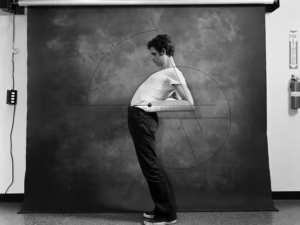
10 Must-See Exhibitions: Winter 2026

Our quarterly guide to the global art calendar is back with must-see exhibitions for Winter 2026, taking in galleries and museums from Vienna to San Francisco.


1000 Words | Resource | 8 Jan 2026
Join us on Patreon

Guido Guidi, A Casa / Guest appearance John Gossage – Large Glass Gallery, London
28 November – 28 February

One of Italy’s finest and most legendary photographers, Guido Guidi marks his seventh exhibition at the innovative, silk-sleek Large Glass Gallery on Caledonian Road, this one turning toward his home in Ronta as its subject. Photographer and bookmaker John Gossage, a longtime companion in Guidi’s roaming practice, has shared countless journeys with him over the decades, and for A Casa created a delicate suite of six small books, each filled with photographs made during visits to Guidi’s place. Speaking with Bartolomeo Sala, Guidi reflected on how Dutch landscape painting – ‘neither dramatic nor concerned with great, heroic deeds’ – had set the tone for his school of photographers. Certainly, that understated sensibility comes to the fore in images where tools lie in the corners of the frames, the spaces are rustic and wooden, and the rooms seem to belong to the humble interiors painted by those Dutch masters.

Lisette Model, Retrospective – The Albertina Museum, Vienna
30 October – 22 February

The Albertina Museum looks back to the photographs of Lisette Model (1901–1983) whose uncompromising vision reshaped 20th-century portraiture. Though born into a Viennese Jewish household, Model made her name far from Vienna yet remains unmistakably marked by the city. While her legacy is often framed in American terms, the exhibition’s lead curator, Walter Moser, suggests that a deeper story begins in the cultural voltage of her birthplace. She certainly grew up in a milieu alive with artistic agitation, where Expressionist painters once pushed the human figure toward distortion and emotional extremity. Perhaps, in her own way, Model used the camera to probe the same intensity. It was this instinct that caught the eye of Harper’s Bazaar and MoMA New York which recognised in her images a startling directness – a way of revealing character through gesture, posture, and the unexpected drama of ordinary life – and soon began publishing or exhibiting her works.

Philip Montgomery, American Cycles – Deichtorhallen, The House of Photography, Hamburg
28 November – 10 May

Spanning more than 100 works created between 2014 and the present, Phillip Montgomery’s photography offers a compelling portrait of a decade defined by ongoing political turbulence and the intensifying crises of our era. The House of Photography at Deichtorhallen Hamburg – one of Europe’s largest centres for contemporary art and photography, and set on the waterfront – hosts Montgomery’s first major institutional solo exhibition, bringing together an expansive vision of America from coast to coast. Alongside his celebrated projects for The New York Times Magazine and The New Yorker, it unveils, for the first time, previously unseen photographs and Montgomery’s most recent independent work. Far from fleeting snapshots, Montgomery’s images are carefully composed, often illuminated with dramatic contrast or flash. Their sense of ‘timeless urgency’ perhaps reaffirms that documentary photography, as Montgomery practices it, still matters deeply in an age of ubiquitous images.

Paul Mpagi Sepuya, Focus. Desire. – Fotomuseum Winterthur, Switzerland
28 February – 14 June

 In 2024, Taous Dahmani wrote for 1000 Words that ‘Sepuya skilfully navigates the frame, either concealing or unveiling fragments of his undressed body, and thus, his identity,’ drawing from a rich history of queer imagery – from the kouros figures of Ancient Greece to Rotimi Fani-Kayode’s Snap Shot (1987) and Caravaggio’s ephebes.. Promising to be a thoughtful and considered show, Sepuya’s latest exhibition brings together the artist’s now firmly established and impressive oeuvre with the curatorial vision of Fotomuseum Winterthur, marking his first major solo exhibition in Switzerland. Taking shape across three distinct spaces – Studio, Archive and Dark Room – each carries literal and metaphorical significance, staging a dialogue between early and recent works. The exhibition highlights the evolution of the US-American artist’s practice while continually questioning the acts of looking and the power structures they reinforce.

Lebohang Kganye, Le Sale ka Kgotso – Fotografiska, Berlin
12 September – 25 January

In Sesotho, ‘Le Sale ka Kgotso’ is the parting wish offered at the doorway, a gentle hope that peace will remain with the one who stays behind. But a slight shift of breath, ‘le sale le kgotso,’ calls forth an entirely different presence, that of the tokoloshe, the capricious and feared spirit of Xhosa and Zulu legend. In this slippage, language falters, revealing its own instability – an uncertainty that Lebohang Kganye draws into focus as she turns Fotografiska Berlin into something closer to a lived-in interior. The museum’s rooms soften into the contours of a home shaped by memory, where language, personal history and the lingering marks of architecture overlap and echo through one another. Working across photography, sculpture and installation, Kganye reshapes family stories and folklore into spaces meant not for resolution. Instead of offering the promise of reconstruction, her work reveals the breaks, absences and unresolved tensions that continue to haunt the idea of home.

Batia Suter and Zoe A. Keller, The Eranos Archives. Laboratory of the Anarchetype – Bibliothéque de Genève, Espace Ami-Lullin, Geneva
20 February – 9 May

A new exhibition from the Centre de la photographie Genève presents approximately 3,000 archetypal images assembled by the Dutch scholar Olga Fröbe-Kapteyn, founder of the Eranos conferences, which later developed into a lasting intellectual forum. The collection, now housed at the Warburg Institute, was formed between the mid-1930s and early 1940s, when Fröbe-Kapteyn, initially at the request of Carl Jung, undertook extensive research travels through European and American libraries to gather symbolic material. Shown alongside photographs and various materials of industrially manufactured objects from the same period (from artist Batia Suter’s own collection), the figures of the Eranos Archive shed any claim to timeless universality and are read as contingent forms, their meanings refracted through the economic pressures, ideological currents and material conditions of a rapidly transforming interwar world. Long unseen by the public, the archive is now accessible and acquires new critical resonance.

Seriously. – Sprüth Magers, London
21 November – 31 January

Humour finds its resonance in unexpected corners in Seriously., a group exhibition curated by Nana Bahlmann, featuring over 100 ‘conceptual’ photographs, prints and select films from the 1960s to the present. Revealing a shared willingness to flirt with absurdity, playfulness and critique, the exhibition frames the experimental possibilities of slapstick and wit – from masquerade and role-play to the staging of seemingly inexplicable scenarios – through the works of artists such as John Baldessari, Cindy Sherman, Thomas Demand, and others. Part of the exhibition meditates on the artist’s role and the fluidity of identity; the other explores the body in dialogue with objects and landscapes, where incisive satire and subtle mimicry reframe the ordinary and ask us to reconsider what we take for granted in images, representation and everyday life.

Early Gaze: Unseen Photography from the 19th Century – Fotomuseum, Antwerp
24 October – 1 March

A new exhibition at FOMU promises a rare glimpse into the first 60 years of Belgian photography, including previously unseen photographs, prints and archival material from the 19th century – many of which have never been publicly exhibited. This includes original cameras, along with extensive information on early photographic techniques, its technological birth and the debates surrounding the medium. The exhibition also confronts the darker side of Belgium’s 19th-century ambitions, including photographs taken in colonial contexts, such as those associated with the 1897 World’s Fair at Cinquantenaire Park in Brussels. Highlights range from the pioneering work of Belgium’s first female amateur photographer, Louise Le Ghait, to early crime scene photographs by the well-known Ghent portraitist Charles D’Hoy. A packed, assertive show illustrates that, from its very start, photography was not a neutral registration of reality but a powerful instrument that helped shape the story of the ruling class.

Alejandro Cartagena, Ground Rules – SFMOMA, San Francisco
22 November – 19 April

SFMOMA presents the first major retrospective of the celebrated photographer Alejandro Cartagena, including work from his seminal large-scale project Identidad Nuevo León (2005) where he portrayed hundreds of people from 25 municipalities, through to his latest video series We Are Things (2025). A meticulous researcher and, in a sense, an urban archaeologist, Cartagena has described how his walks through various landscapes, in ‘an attempt to understand Mexico,’ become inseparable from the photographs themselves, while also reflecting that ‘you’re never from here, yet you’re here.’ On display are more than 20 of his series, including documentary images, collages, vernacular photographs, and AI-generated videos, revealing the richness and diversity of Cartagena’s practice. Ground Rules coincides with the release of a fully bilingual (English/Spanish) monograph of the same title, published by Aperture, which compiles, contextualises and reflects on this comprehensive study.

Felicity Hammond, V4: Repository / Variations – Stills, Edinburgh
7 November – 26 February

V4: Repository is the culmination of Felicity Hammond’s Variations, a project exploring the overlaps between geological mining, data mining and the ways image-making engages with machine learning. This final chapter follows Model Collapse at The Photographers’ Gallery, London; Rigged at QUAD, Derby, presented during FORMAT International Photography Festival; and Content Aware, originally experienced as a public installation during Photoworks Weekender, Brighton, 2024. In many ways, a truly unique project – something that could only hsve emerged in our time, in the advent of artificial intelligence, and thus engaging the politics of surveillance, data extraction and the exploitation of land, resources and labour. If the fourth and final variation considers how hidden processes of extraction are stored, then Stills provides a fitting venue: as it approaches its 50th anniversary, the institution, in its own words, turns attention toward its archive.♦

–1000 Words

Images:

1-Guido Guidi, Ronta, 2023

2-Lisette Model, Lower East Side, New York City, 1940-1947. Courtesy baudoin lebon, Paris and Keitelman Gallery, Brussels

3-Philip Montgomery, George Floyd Memorial II, Minneapolis, June 2020; from the series American Mirror

4-Paul Mpagi Sepuya, Darkroom Mirror (_2070386), 2017

5-Lebohang Kganye, Beneath the Deep

6-Batia Suter & Zoe A. Keller, The Eranos Archive. Laboratory of the Anarchetypal, 2023-ongoing

7-Helen Chadwick, In the Kitchen (Washing Machine), 1977 © Helen Chadwick. Courtesy Richard Saltoun Gallery, London, Rome and New York and Sprüth Magers

8-Fernand Khnopff, Portrait of Marguerite Khnopff, ca. 1890. Courtesy FOMU

9-Alejandro Cartagena, Carpooler #8, 2011

10-Felicity Hammond, V4: Repository; from the series Variations, 2025


1000 Words favourites

• Renée Mussai on exhibitions as sites of dialogue, critique and activism

• Roxana Marcoci navigates curatorial practice in the digital age

• Tanvi Mishra reviews Felipe Romero Beltrán’s Dialect

• Discover London’s top five photography galleries

• Tim Clark in conversation with Hayward Gallery’s Ralph Rugoff on Hiroshi Sugimoto

• Academic rigour and essayistic freedom as told by Taous Dahmani

• Shana Lopes reviews Agnieszka Sosnowska’s För

• Valentina Abenavoli discusses photobooks and community

• Michael Grieve considers Ute Mahler and Werner Mahler’s posthumous collaboration with their late family member 

• Elisa Medde on Taysir Batniji’s images of glitched video calls from Gaza


Join us on Patreon today and be part of shaping the future of photographic discourse


Top 10

Photobooks of 2018

Selected by Tim Clark

An annual tribute to the most exceptional photo book releases from 2018 – selected by our Editor in Chief, Tim Clark.

In association with Spectrum.

1. Carmen Winant, My Birth
Self Publish, Be Happy Editions

My Birth by Carmen Winant is perhaps this year’s standout title from Bruno Ceschel’s famed Self Publish, Be Happy enterprise. Yet it is also utterly unlike any other. Deftly fusing image and text, the book – a facsimile of the artist’s own journal – combines photographs of Winant’s mother giving birth to her three children alongside found imagery of other, anonymous women undergoing the same experience. This visual strategy aims at “the flattening of cross-generational time and feeling”, while the title is a nod to Frida Kahlo’s 1932 painting of the same name. Immediate, precarious and utterly vulnerable, Winant’s project, which coincided with an on-site installation at MoMA’s Being: New Photography 2018, is also bold and fearless. Sensitive to the world, and to the world of images, My Birth asks probing questions that move beyond transgression to open up a space for considering childbirth and its representation as a political act.

2. Zanele Muholi, Somnyama Ngonyama, Hail the Dark Lioness
Aperture Foundation

What really matters now are the needs that art answers, and visual activist Zanele Muholi always delivers with great rigour. Having first emerged as a photographic spokesperson of members of the black queer community in South Africa and beyond, her long-awaited monograph sees Muholi turn the camera on herself to powerful effect. This arresting collection of more than 90 theatrical self-portraits first reclaim and then reimagine the black subject again in ways that resist, confront and challenge complacency to racism – both historic and contemporary. During these times when violence, misogyny and even white supremacy are rife, the photographs’ accumulative presence flies in the face of stereotypes and oppressive standards of beauty.

3. Raymond Meeks, Halfstory Halflife
Chose Commune

This is the kind of pleasurable photography that approaches something so eloquent yet understated but which we cannot altogether grasp. Master of the quiet photograph, Raymond Meeks is also a prolific photo book maker. Meeks’ current collaboration with Chose Commune bears all the hallmarks of his lyrical explorations; strong narrative and occasional riffs off poetry and short fiction, all the while concentrating on the symbiotic relationship between family, memory and a sense of place. Here, black and white photographs of young men, making their way through openings in hedgerow to access prime spots for river-jumping in the Catskill mountain region of New York, are both visceral and spontaneous. Their pale bodies fling themselves into the dark void, frozen as if mid-flight, pivoting from the point of view of an adult seemingly remembering a moment of fledgling sexuality and uncertain future.

4. Michael Schmelling, Your Blues
Skinnerboox and The Ice Plant

Taken between 2013 and 2014, and shot while on commission for the Museum of Contemporary Photography at Colombia College Chicago, Michael Schmelling’s photographs in Your Blues are our guide through the city’s vibrant and eclectic music scene, where “the dominant form is hybridity”. Musicians and revellers, parties and recording studios, lovers and strangers all collide, depicted through casual views and with feelings of familiarity. This then forms a ripe photographic account of the varying degrees of individualism within this community. Blues, punk, hip hop, psychedelic jazz, emo, hardcore and house music are all part of Chicago’s cultural inheritance and encompassed here via Schmelling’s vignettes and reflections on niche and local performers in unconventional venues. Akin to a novel of images, Your Blues provides a noteworthy contribution to this year’s offerings.

5. Max Pinckers, Margins of Excess
Self-Published

A response to the ‘post-truth’ era, Max Pinckers’ speculative documentary work revolves around the narratives of six protagonists who all momentarily achieved infamy in the US only to be ousted as fakes or frauds by the media. Such highly-idiosyncratic stories range from a self-invented love story set in a Nazi concentration camp to a man compulsively hijacking trains. With fever-dream urgency, Margins of Excess brings together fragments of these lives through staged photography, archival material, interviews and press clippings: the explicit folding of imagination into imaging “in which truths, half-truths, lies, fiction or entertainment are easily interchanged.” Pinckers’ take on embracing reality in all its complexity via this particular strand of storytelling offers an interesting reminder: that contemporary documentary practice might be more productively considered as small arguments, gestures or even critical methods.

6. Michelle Dizon and Việt Lê, White Gaze
Sming Sming Books

Readers of 1000 Words will recall the recent magazine feature on this gem of a photo book from collaborative duo Michelle Dizon and Việt Lê, which deserves much wider recognition in light of its poetry, playfulness, acuity and, most crucially, decolonising strategies. Intellectually energetic, White Gaze repurposes imagery from National Geographic to confront notions of white privilege and Western-centrism by reworking and negating image and text from the publication’s original pages. Countless uncomfortable truths hidden at the bottom of every lie, every act of denial or white complicity, come to bear through the interplay of the two languages, critiquing how meaning is constructed to administer imperialist narratives and racist histories.

7. Mimi Plumb, Landfall
TBW Books

As far as great discoveries go, the case of Mimi Plumb’s resurfaced archive has been a fairly recent but major breakthrough. Having taught photography throughout much of her career at San Jose State University and San Francisco Art Institute in the US, it has only been during the past five years that her work has really come to light following the 2014 exhibition of her Pictures from the Valley series. Now, a collection of images taken throughout the 1980s have been published by TBW Books under the title, Landfall, containing black and white photographs full of foreboding and unease, yet always delicate and beautiful in register. They appear to encapsulate a time when the world at large seemed out of kilter – with obvious parallels to our present moment. Stylistically, too, there’s a whiff of Robert Frank, Garry Winogrand and Henry Wessel to these images that certainly will not fade quickly.

8. Chloe Dewe Mathews, Caspian: The Elements
Aperture Foundation and Peabody Museum Press

It’s heartening to observe this renewed period for Aperture Foundation’s photo book publishing arm, albeit still very traditional in format. One of its many great, recent titles comes courtesy of British photographer and filmmaker Chloe Dewe Mathews who spent five years roaming the borderlands of the Caspian Sea, where Asia seamlessly merges into Europe, to come away with a compelling record of the region’s complex geopolitical trevails. Much of this of course is largely bound up in the singular importance of gas and oil reserves and the disparate economies of bordering countries – Russia, Iran, Azerbaijan, Kazakhstan and Turkmenistan – but it’s Mathews’ receptiveness and examination of the ties between people and the landscape, as well as the religious, artistic and therapeutic aspects of daily life, that are so intriguing.

9. Thomas Demand, The Complete Papers
MACK

While there is obviously no equivalent experience to viewing a Thomas Demand artwork at its intended size and scale, this new volume on the oeuvre of the acclaimed German artist more than makes up for it in scope, depth and scholarship. Edited by Christy Lange, and with texts from voices as diverse as the novelist Jeff Euginedes to curator Francesco Bonami, The Complete Papers provides a hugely comprehensive view of Demand’s past three decades of artistic production. Known for using pre-existing images culled from the media, routinely with political undertones, which he then recreates from cardboard and paper at 1:1 scale before photographing the assembled scene, admirers of the work will no doubt appreciate hitherto unseen pieces from the early 1990s when he first started making paper constructions for this sole purpose of photographing them. With the customary bibliography and full exhibitions listing, this is a researcher’s dream. A catalogue raisonné of the highest order.

10. Sunil Gupta, Christopher Street, 1976
Stanley/Barker

Sunil Gupta’s Christopher Street, 1976 performs an act of personal remembrance by bringing together photographs shot in in New York when the artist spent a year studying photography with Lisette Model in between cruising the city’s streets with his camera; part of a burgeoning, proud and public gay scene prior to ensuing AIDS epidemic that subsequently sent it underground. The photo book is minimally designed, presenting one black and white photograph on each right-hand page in a spiral-bound volume, marking the latest release in Stanley/Barker’s small but judicious selection of titles. It celebrates both a key moment in Gupta’s identity and the political value embedded in the struggle for LGBT liberation, the consequences of which were far-reaching.


Tim Clark is a curator, writer and since 2008, has been Editor in Chief and Director at 1000 Words. 

Thomas Demand

New Photographs

Essay by Duncan Wooldridge

Matthew Marks Gallery, Los Angeles
24.01.15 — 04.04.15

In the beginning was the model. And the model demonstrated that the idea worked, at least on paper. And what began on paper, was in turn mediated by it, and has returned to it, becomes it. In most accounts of his work to date, we have known Thomas Demand for his paper sculpture, and what we might also think of as his constructed, or staged photography of these objects. We are familiar with their laborious production, their 1:1 scale, and their origins in pre-existing photographs. Such contexts inspire a wonderment – upon the first viewing of Demand’s project we are drawn to its labour and spectacle, and perhaps justly so. But for those who return, what of the strange balance of familiarity and the novel? Is a different set of longer lasting questions at work?

It is strange that we might account for the role of paper in the work of Thomas Demand, and not that of the model. Apparent in Demand’s most recently completed work, in his exhibition at Matthew Marks in Los Angeles, is the evolving status of this very object. The philosopher Vilém Flusser wrote, in a lecture to L’Ecole Nationale Supérieure de la Photographie, in Arles, France, that photographs were models. He stated: “The true photographer intends to make pictures which may be used as models for the experience, the knowledge, and the evaluation of their receivers.”

The photographer, for Flusser, did not simply accept the apparent ‘realism’ of the image, but actively constructed it. For Demand, the model is a unifying theme, which brings together the artist’s method and subject matter. He is at once the maker of physical models, and the surveyor of photographs as models of meaning and information.

On the one hand, a model might be retrospective: it is an historical image existing as a blueprint. It functions as a marker or trace, the flicker of an event whose significance is only now becoming fully apparent – in Atelier, the brightly lit studio of Henri Matisse is represented at a late and overlooked stage of the artist’s career, at the moment of his cut-outs. Coloured paper is strewn on the floor, as if we were witnessing the moment after they were formed from their paper – just as they were made, and about to go out in to the world. More than simply a product of the artist’s age and ill health, which usually attempts to explain his move from painting, the cut-outs suggested a different strategy of art-making, made of paper and scissors, rather than brushes and paints. They point to reinvention, and the quick joy of assemblage over the slow process of painterly construction. In Demand’s hands they seem to return us back to one of the artist’s core obsessions: paper as material. Paper is both the material of proposition and the tool of historical record.

If Demand often portrays scenes from the past, so too are recent events made visible. Backyard represents the side steps up to the house of Tamerlan Tsarnaev, one of the suspects of the Boston Marathon bombings that took place in 2013. It is a work reminiscent of many of Demand’s accounts of recent history, presenting banal or familiar spaces – kitchens, homes, bars and gardens – loaded with the weight of the events that haunt them. This image of Tsarnaev’s home presents the vernacular wooden architecture of the Boston suburbs. The proximity of each house to the next suggests both density and community, but also sets a stage for a certain honest or straightforward living. Such an idyll is disrupted by objects strewn across the little patch of grass. These signifiers, in a culture in which one’s garden is often manicured to maintain the social contract, allows the portrayal of Tsarnaev to quickly form his status as an outsider.

It is worth noting Demand’s taste for criminals and their stories, not so much for the language of the crime scene photograph – as has so often been remarked upon – but for their subjects’ clearly defined and quickly formed place in our historical consciousness, as evil, unimaginable, other. Tsarnaev was crafted as a kind of model, or anti-model. Not interrogated for motive so much as simply represented to the public, he is held up as the very antithesis of reason, of sense. Caught in a context in which his immigrant status prefaces his brutal acts, Tsarnaev is suspended in history as an abstraction, as are many of Demand’s villains.

Thinking historiographically – rather than historically – permits a view of history subject to alteration, to the will of its authors, and to its casting and re-casting. Demand’s reconstruction of Matisse’s studio is similarly appropriate. It falls at the time of a re-evaluation of the artist’s collage in exhibitions at Tate and MoMA. At the very moment the viewer comes face to face with the notion of Matisse as a master collagist, history is recast, recomposed. Matisse himself becomes a model – an object of study, and a means of projecting into the future.

Usually, we think of the model as a forecast, as a form of pre-visualisation. A sleight of hand, which turns photography from an object obsessed with the past, into one concerned with the potentiality of the future, Demand began in 2011 to photograph the architectural models of John Lautner. The rough, scuffed and annotated cardboard structures in Model Studies showed the anticipation of an architecture yet to be built (of course, some of an architects’ models are realised, whilst many are not). Demand’s new photographs show working models by Kazuyo Sejima and Ryue Nishizawa of celebrated Japanese architects SANAA. Shaped and crumpled, and cut out by hand, what emerges are overlapping, opening and compressing volumes. Cleaner than Lautner’s models, they produce an architecture as space, and envisage the model as a vision of a built environment yet to come. They are as real as images of space as are photographs of architecture itself, for Demand is something of a realist, despite or perhaps because of, his paper constructions.

And so what is the status of the model after Demand’s treatment? It might be clear that – beyond our initial wonderment – the model is something that is made, crafted and forged, though it is not simple labour. The model is history written and brought into being. It is not a passive object, but a process of shaping: hence Demand’s distinctive matching of the model as process and subject of enquiry. Realism is the model that we opt to manifest.

All images courtesy of Matthew Marks Gallery. © Thomas Demand


Duncan Wooldridge is an artist, writer and curator. He is also course director of the BA(Hons) Photography at Camberwell College of Arts, University of the Arts London.