10 Must-See Exhibitions: Winter 2026

Our quarterly guide to the global art calendar is back with must-see exhibitions for Winter 2026, taking in galleries and museums from Vienna to San Francisco.


1000 Words | Resource | 8 Jan 2026
Join us on Patreon

Guido Guidi, A Casa / Guest appearance John Gossage – Large Glass Gallery, London
28 November – 28 February

One of Italy’s finest and most legendary photographers, Guido Guidi marks his seventh exhibition at the innovative, silk-sleek Large Glass Gallery on Caledonian Road, this one turning toward his home in Ronta as its subject. Photographer and bookmaker John Gossage, a longtime companion in Guidi’s roaming practice, has shared countless journeys with him over the decades, and for A Casa created a delicate suite of six small books, each filled with photographs made during visits to Guidi’s place. Speaking with Bartolomeo Sala, Guidi reflected on how Dutch landscape painting – ‘neither dramatic nor concerned with great, heroic deeds’ – had set the tone for his school of photographers. Certainly, that understated sensibility comes to the fore in images where tools lie in the corners of the frames, the spaces are rustic and wooden, and the rooms seem to belong to the humble interiors painted by those Dutch masters.

Lisette Model, Retrospective – The Albertina Museum, Vienna
30 October – 22 February

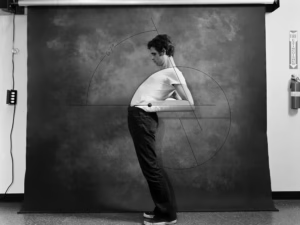
The Albertina Museum looks back to the photographs of Lisette Model (1901–1983) whose uncompromising vision reshaped 20th-century portraiture. Though born into a Viennese Jewish household, Model made her name far from Vienna yet remains unmistakably marked by the city. While her legacy is often framed in American terms, the exhibition’s lead curator, Walter Moser, suggests that a deeper story begins in the cultural voltage of her birthplace. She certainly grew up in a milieu alive with artistic agitation, where Expressionist painters once pushed the human figure toward distortion and emotional extremity. Perhaps, in her own way, Model used the camera to probe the same intensity. It was this instinct that caught the eye of Harper’s Bazaar and MoMA New York which recognised in her images a startling directness – a way of revealing character through gesture, posture, and the unexpected drama of ordinary life – and soon began publishing or exhibiting her works.

Philip Montgomery, American Cycles – Deichtorhallen, The House of Photography, Hamburg
28 November – 10 May

Spanning more than 100 works created between 2014 and the present, Phillip Montgomery’s photography offers a compelling portrait of a decade defined by ongoing political turbulence and the intensifying crises of our era. The House of Photography at Deichtorhallen Hamburg – one of Europe’s largest centres for contemporary art and photography, and set on the waterfront – hosts Montgomery’s first major institutional solo exhibition, bringing together an expansive vision of America from coast to coast. Alongside his celebrated projects for The New York Times Magazine and The New Yorker, it unveils, for the first time, previously unseen photographs and Montgomery’s most recent independent work. Far from fleeting snapshots, Montgomery’s images are carefully composed, often illuminated with dramatic contrast or flash. Their sense of ‘timeless urgency’ perhaps reaffirms that documentary photography, as Montgomery practices it, still matters deeply in an age of ubiquitous images.

Paul Mpagi Sepuya, Focus. Desire. – Fotomuseum Winterthur, Switzerland
28 February – 14 June

 In 2024, Taous Dahmani wrote for 1000 Words that ‘Sepuya skilfully navigates the frame, either concealing or unveiling fragments of his undressed body, and thus, his identity,’ drawing from a rich history of queer imagery – from the kouros figures of Ancient Greece to Rotimi Fani-Kayode’s Snap Shot (1987) and Caravaggio’s ephebes.. Promising to be a thoughtful and considered show, Sepuya’s latest exhibition brings together the artist’s now firmly established and impressive oeuvre with the curatorial vision of Fotomuseum Winterthur, marking his first major solo exhibition in Switzerland. Taking shape across three distinct spaces – Studio, Archive and Dark Room – each carries literal and metaphorical significance, staging a dialogue between early and recent works. The exhibition highlights the evolution of the US-American artist’s practice while continually questioning the acts of looking and the power structures they reinforce.

Lebohang Kganye, Le Sale ka Kgotso – Fotografiska, Berlin
12 September – 25 January

In Sesotho, ‘Le Sale ka Kgotso’ is the parting wish offered at the doorway, a gentle hope that peace will remain with the one who stays behind. But a slight shift of breath, ‘le sale le kgotso,’ calls forth an entirely different presence, that of the tokoloshe, the capricious and feared spirit of Xhosa and Zulu legend. In this slippage, language falters, revealing its own instability – an uncertainty that Lebohang Kganye draws into focus as she turns Fotografiska Berlin into something closer to a lived-in interior. The museum’s rooms soften into the contours of a home shaped by memory, where language, personal history and the lingering marks of architecture overlap and echo through one another. Working across photography, sculpture and installation, Kganye reshapes family stories and folklore into spaces meant not for resolution. Instead of offering the promise of reconstruction, her work reveals the breaks, absences and unresolved tensions that continue to haunt the idea of home.

Batia Suter and Zoe A. Keller, The Eranos Archives. Laboratory of the Anarchetype – Bibliothéque de Genève, Espace Ami-Lullin, Geneva
20 February – 9 May

A new exhibition from the Centre de la photographie Genève presents approximately 3,000 archetypal images assembled by the Dutch scholar Olga Fröbe-Kapteyn, founder of the Eranos conferences, which later developed into a lasting intellectual forum. The collection, now housed at the Warburg Institute, was formed between the mid-1930s and early 1940s, when Fröbe-Kapteyn, initially at the request of Carl Jung, undertook extensive research travels through European and American libraries to gather symbolic material. Shown alongside photographs and various materials of industrially manufactured objects from the same period (from artist Batia Suter’s own collection), the figures of the Eranos Archive shed any claim to timeless universality and are read as contingent forms, their meanings refracted through the economic pressures, ideological currents and material conditions of a rapidly transforming interwar world. Long unseen by the public, the archive is now accessible and acquires new critical resonance.

Seriously. – Sprüth Magers, London
21 November – 31 January

Humour finds its resonance in unexpected corners in Seriously., a group exhibition curated by Nana Bahlmann, featuring over 100 ‘conceptual’ photographs, prints and select films from the 1960s to the present. Revealing a shared willingness to flirt with absurdity, playfulness and critique, the exhibition frames the experimental possibilities of slapstick and wit – from masquerade and role-play to the staging of seemingly inexplicable scenarios – through the works of artists such as John Baldessari, Cindy Sherman, Thomas Demand, and others. Part of the exhibition meditates on the artist’s role and the fluidity of identity; the other explores the body in dialogue with objects and landscapes, where incisive satire and subtle mimicry reframe the ordinary and ask us to reconsider what we take for granted in images, representation and everyday life.

Early Gaze: Unseen Photography from the 19th Century – Fotomuseum, Antwerp
24 October – 1 March

A new exhibition at FOMU promises a rare glimpse into the first 60 years of Belgian photography, including previously unseen photographs, prints and archival material from the 19th century – many of which have never been publicly exhibited. This includes original cameras, along with extensive information on early photographic techniques, its technological birth and the debates surrounding the medium. The exhibition also confronts the darker side of Belgium’s 19th-century ambitions, including photographs taken in colonial contexts, such as those associated with the 1897 World’s Fair at Cinquantenaire Park in Brussels. Highlights range from the pioneering work of Belgium’s first female amateur photographer, Louise Le Ghait, to early crime scene photographs by the well-known Ghent portraitist Charles D’Hoy. A packed, assertive show illustrates that, from its very start, photography was not a neutral registration of reality but a powerful instrument that helped shape the story of the ruling class.

Alejandro Cartagena, Ground Rules – SFMOMA, San Francisco
22 November – 19 April

SFMOMA presents the first major retrospective of the celebrated photographer Alejandro Cartagena, including work from his seminal large-scale project Identidad Nuevo León (2005) where he portrayed hundreds of people from 25 municipalities, through to his latest video series We Are Things (2025). A meticulous researcher and, in a sense, an urban archaeologist, Cartagena has described how his walks through various landscapes, in ‘an attempt to understand Mexico,’ become inseparable from the photographs themselves, while also reflecting that ‘you’re never from here, yet you’re here.’ On display are more than 20 of his series, including documentary images, collages, vernacular photographs, and AI-generated videos, revealing the richness and diversity of Cartagena’s practice. Ground Rules coincides with the release of a fully bilingual (English/Spanish) monograph of the same title, published by Aperture, which compiles, contextualises and reflects on this comprehensive study.

Felicity Hammond, V4: Repository / Variations – Stills, Edinburgh
7 November – 26 February

V4: Repository is the culmination of Felicity Hammond’s Variations, a project exploring the overlaps between geological mining, data mining and the ways image-making engages with machine learning. This final chapter follows Model Collapse at The Photographers’ Gallery, London; Rigged at QUAD, Derby, presented during FORMAT International Photography Festival; and Content Aware, originally experienced as a public installation during Photoworks Weekender, Brighton, 2024. In many ways, a truly unique project – something that could only hsve emerged in our time, in the advent of artificial intelligence, and thus engaging the politics of surveillance, data extraction and the exploitation of land, resources and labour. If the fourth and final variation considers how hidden processes of extraction are stored, then Stills provides a fitting venue: as it approaches its 50th anniversary, the institution, in its own words, turns attention toward its archive.♦

–1000 Words

Images:

1-Guido Guidi, Ronta, 2023

2-Lisette Model, Lower East Side, New York City, 1940-1947. Courtesy baudoin lebon, Paris and Keitelman Gallery, Brussels

3-Philip Montgomery, George Floyd Memorial II, Minneapolis, June 2020; from the series American Mirror

4-Paul Mpagi Sepuya, Darkroom Mirror (_2070386), 2017

5-Lebohang Kganye, Beneath the Deep

6-Batia Suter & Zoe A. Keller, The Eranos Archive. Laboratory of the Anarchetypal, 2023-ongoing

7-Helen Chadwick, In the Kitchen (Washing Machine), 1977 © Helen Chadwick. Courtesy Richard Saltoun Gallery, London, Rome and New York and Sprüth Magers

8-Fernand Khnopff, Portrait of Marguerite Khnopff, ca. 1890. Courtesy FOMU

9-Alejandro Cartagena, Carpooler #8, 2011

10-Felicity Hammond, V4: Repository; from the series Variations, 2025


1000 Words favourites

• Renée Mussai on exhibitions as sites of dialogue, critique and activism

• Roxana Marcoci navigates curatorial practice in the digital age

• Tanvi Mishra reviews Felipe Romero Beltrán’s Dialect

• Discover London’s top five photography galleries

• Tim Clark in conversation with Hayward Gallery’s Ralph Rugoff on Hiroshi Sugimoto

• Academic rigour and essayistic freedom as told by Taous Dahmani

• Shana Lopes reviews Agnieszka Sosnowska’s För

• Valentina Abenavoli discusses photobooks and community

• Michael Grieve considers Ute Mahler and Werner Mahler’s posthumous collaboration with their late family member 

• Elisa Medde on Taysir Batniji’s images of glitched video calls from Gaza


Join us on Patreon today and be part of shaping the future of photographic discourse


Paul Mpagi Sepuya’s mirror to queer and black identity

A journey to Nottingham Contemporary prompts reflection on Tina M. Campt’s method of “writing to art” in Taous R. Dahmani’s review of Paul Mpagi Sepuya’s Exposure. Dahmani writes to Sepuya’s introspective world, where intricate dialogues between mirrors, photography and identity unfold, challenging traditional spectatorship dynamics. Through a lens of queer and black representation, Sepuya’s work invites viewers to confront societal norms, embrace complexity, and navigate the fluid boundaries of self-presentation.


Taous R. Dahmani | Exhibition review | 14 May 2024

On a morning train to Nottingham, I decided to revisit a passage from Tina M. Campt’s A Black Gaze (2021). When the book came out, I had highlighted this sentence: ‘Seated cross-legged on the floor is my go-to position for writing to art.’ The statement struck a chord with me, prompting a personal vow to try Campt’s method. This visit seemed the perfect chance, but once there, I feared the invigilators might find it unconventional. Would I be allowed to sit on the floor of Nottingham Contemporary, ‘sliding down a wall and claiming the undervalued real estate of a gallery floor,’ as Campt wrote? The reason why I wanted to attempt that strategy in order to “write toPaul Mpagi Sepuya’s exhibition was because Campt claimed it ‘minimis[ed] you as a viewer and maximis[ed] the work itself,’ adding: ‘Looking up at [the artwork] both breaks up and breaks down some of the traditional dynamics of spectatorship and visual mastery. And when the subject of that art is Black folks, challenging the dynamics of spectatorship and visual mastery is an extremely important intervention.’

I first encountered Sepuya’s work in 2020 at his solo show in London’s Modern Art, where black figuration and constructed stills through layered acts of looking were key. Four years later, upon entering Exposure at Nottingham Contemporary, I was greeted by a camera on a tripod before a black curtain held by a disembodied brown hand and bulldog clips. Facing this first photograph, I noticed my reflection in the protective glass, positioning my head’s shadow where the operator would be. At that moment, I realised that directly facing Sepuya’s work, rather than ‘looking up’ at it, might be beneficial. This exhibition wasn’t the place for Campt’s method of claiming gallery floors; Sepuya’s large-scale pieces demand that we meet them eye-to-eye.

As I approached Mirror Study (_Q5A2059) (2016), I understood that I was looking at Sepuya’s camera – meaning a mirror must have been placed between the lens and me. This apparatus, and placement of the mirror, suggests the artist is more concerned with what surrounds his camera – objects, people, himself – than with the eventual viewers. The mirror acts as a barrier, its thin reflective metal layer atop glass designed to bounce light back, prompting rumination on the idea of reflection, the image created by light and about photography. In The Mirror and the Palette (2021), Jennifer Higgie elucidated that Johannes Gutenberg opened a mirror-making business in 1438, and within just six years, he pioneered the invention of the printing press. This progression connects the concept of reflection to the notion of infinite reproduction, which ultimately lays the groundwork for photographic theory. Indeed, the coexistence of photography and mirrors has become paradigmatic. In his seminal 1978 essay, which serves as the introduction to the catalogue for his exhibition Mirrors and Windows: American Photography since 1960, John Szarkowski leveraged the metaphor of the mirror to explore the introspective and personal approaches photographers bring to their medium. Similarly, the mirror is an integral part of Sepuya’s artistic process, acting as a catalyst that facilitates layers of analysis of his surroundings. Since 2010, the artist has focused on the artist’s studio as a subject, employing a self-imposed limitation akin to the protocols of a conceptual artist. He describes this approach as a strategy to ‘limit the number of variables as the clearest way to pose a question.’

As I progressed to the next set of images, the initially elusive figure of the photographer gradually emerged. Sepuya skilfully navigates the frame, either concealing or unveiling fragments of his undressed body, and thus, his identity. He delicately reveals details of his anatomy, including the hairs on his neck and arms, and close-ups of his back and torso. Photograph after photograph, his progressive apparition transforms the studio into a stage. We are witnessing the documentation of a performance, a play with characters and, of course, a message. The photographs or the mirror – in Sepuya’s world they are in constant dialogue – predominantly depict self-portraits or portraits of close friends and lovers. Beyond mere self-recognition through self-representation, there is a definitive act of self-presentation; a celebration of the artist’s freedom and agency. The performed gestures subvert gender binaries and reclaim their fluidities, so much so that Sepuya quite literally blurs surfaces and thus boundaries. We observe the movement of bodies on a stage, enacting intimacy and at the same time rendering a political identity that is both queer and black. Sepuya’s photographs recall the words of Judith Butler, who noted in Bodies That Matter: On the Discursive Limits of Sex (1993) that the performative aspect of gender enables subversive actions capable of challenging and destabilising conventional norms. By inviting his friends to act for the mirror-camera in his studio-stage, Sepuya creates an experimental sanctuary for the development of a queer visual language. Engaging with Sepuya’s photographs is not straightforward; they challenge us to interpret and decode, but, at the same time, the repeated frameworks facilitate a steady understanding of his visual strategy. If, indeed, the mirror is not just a reflection but a boundary, then viewers are mere welcomed spectators. The exhibition feels like an invitation to partake in the acknowledgment of too often marginalised queer black and brown individuals. Viewers are brought into their proximity, invited to stand alongside them, yet rightfully kept at bay.

Sepuya’s work draws from a rich history of queer imagery, from the kouros figures of Ancient Greece to Rotimi Fani-Kayode’s Snap Shot (1987) and Caravaggio’s ephebes. These motifs have come to symbolise queer identity, thus raising the question: how can we interpret the revival of these motifs in today’s photographic production? As Sepuya bestowed, as an invitation to think complexly, ‘representation is not an agenda,’ and indeed his visual language strives for something more, something that revived, for me, José Esteban Muñoz’s Disidentifications: Queers of Color and the Performance of Politics (1999), Here, Muñoz discusses a process in which individuals tactically interact with societal norms to forge a self that critically diverges from mainstream culture. He emphasises behaviours and gestures as crucial to the identity formation of queers of colour, beginning his book with the statement: ‘There is a certain lure to the spectacle of one queer standing onstage alone, with or without props, bent on the project of opening up a world of queer language, lyricism, perceptions, dreams, visions, aesthetics and politics.” It leads one to question whether Muñoz is actually describing Sepuya’s own photographs some 20-odd-years before their creations.

The studio and its “inhabitants” are constants in Sepuya’s work, existing in a fluid space where time seems relative and ideas and iterations evolve and transform. In the second gallery, elements such as mobile mirror flats from the studio transition into exhibition structures showcasing his latest photographs. Unlike the first room where close examination was encouraged, here Sepuya invites viewers to navigate the photographs, guided by their spatial arrangement. He transforms the space by bridging the private theatricality of the studio with the shared communality of the gallery. Leaving the exhibition, and tucking away my copy with Campt’s book, I was reassured that sitting wasn’t necessary, as Sepuya himself ‘maximises’ his work. He shifts spectator dynamics, elevating and redefining engagement by challenging traditional approaches. On the train back to London, I was left with the feeling that visitors ought to stand in the gallery, embracing homoerotic pleasure, whilst also striving to become accustomed to nuanced discomfort and grappling with complex ideas about image-making. ♦

All images courtesy the artist and Galerie Peter Kilchmann Zurich/Paris © Paul Mpagi Sepuya

Paul Mpagi Sepuya: Exposure ran at Nottingham Contemporary until 5 May 2024.


Taous R. Dahmani is a London-based French, British and Algerian art historian, writer and curator. Her expertise centres around the intricate relationship between photography and politics, a theme that permeates her various projects. Since 2019, she has been the editorial director of 
The Eyes, an annual publication that explores the links between photography and societal issues. She is an Associate Lecturer at London College of Communication, University of the Arts London. Dahmani’s curatorial work was showcased at Les Rencontres d’Arles, France, where she curated the Louis Roederer Discovery Award (2022). Dahmani is set to curate two exhibitions at Jaou Tunis, Tunisia (2024).

Images:

1-Paul Mpagi Sepuya, Twilight Studio (0X5A4176), 2022.

2-Paul Mpagi Sepuya, Model Study (0X5A7126), 2021.

3-Paul Mpagi Sepuya, Daylight Studio Camera Lesson (0X5A2613), 2022.

4-Paul Mpagi Sepuya, Pedestal (0X5A8997), 2022.

5-Paul Mpagi Sepuya, Studio Mirror (_DSF6207), 2023.