Metabolising violence: interview with J.A. Young

We speak with the winner of the OD Photo Prize 2025, J.A. Young, who turns to an ongoing body of work wrought from trauma, research and experiments in the darkroom. Between lived experience and occult inquiry, the series, Angels considers how violence, control and intuition inscribe themselves into the materiality of hand-made prints, and what it might mean to summon images from forces that, though invisible, are anything but absent. 


Thomas King | Interview | 25 Sept 2025
Join us on Patreon

Thomas King: Can you tell us about the point of departure for Angels, recently announced as the winner of OD Photo Prize 2025? How did the research first take form and what impulse or circumstances set it in motion? And what do you wish to conjure in your choice of title?

J.A. Young: My first series, Of Fire, Far Shining (2023-24), was a collection of prints I made almost entirely on a cheap laser printer. But I knew that I eventually wanted to move into hand making each print, and I was finally able to begin that process in late 2024 after getting the space to set up my current darkroom. Angels (2024-) is exclusively composed of silver gelatin prints that I’ve created over the past year, and in part, the change in series marks this shift toward a more alchemical printing process that results in unique material objects. 

My research has always been one of the primary drivers of my creative process, and it remains a consistent source of inspiration from series to series. But it’s not necessarily the source of the new title. Like any other creative urge, a word or phrase will just flash into my mind, and I will immediately recognise it as one of my titles. It then becomes a defining element of the series, in that it’s the only predetermined concept that I’m intentionally bringing with me into the creative process. By holding the title loosely in the back of my mind, I can play with all the associations it evokes.

The angels that I’ve had in mind while making the series aren’t benevolent figures of light; they’re more like the Archons of the Gnostics or the Vedic Asuras, ethereal beings that use their power to oppress and deceive. In the images I’m creating, I’m essentially positioning modern institutions as these very angels: vast, impersonal systems of control that function with a logic that is both overwhelmingly powerful and entirely indifferent to the suffering they inflict. These are the archetypes of control, judgement and power, now embodied by algorithms, corporate monopolies and the military industrial complex. So what you see playing out across the series is the visible impact of these invisible forces.

TK: You’ve said that your work draws on lived experience, on inhabiting a world not quite one’s own. How do questions, or perhaps disturbances, of selfhood root themselves in Angels? In what ways do they contour or complicate the work?

J.A.: I’ve experienced a lot of trauma in my life, and it’s made me feel very unsafe and very isolated in the world. A lot of violence has been inflicted on me, and most of it has been in response to core facets of my identity, like the fact that I’m trans and neurodivergent, among other things. This has altered how I view being in the world and human history in general, and that shows up in the atmosphere of my images. Beyond that, I can see in my images my own feelings of claustrophobia and of desperation about the all the tragedies and crises we’re facing: it’s like everything is constantly in motion; everything is speeding up; everything is swirling around us as we barrel towards so many terrible consequences of our actions.

My spiritual experiences and my research into the occult are also directly related to how I make my art. When I work, I’m trying to open myself up completely, to allow my unconscious to move through me, and to trust that process, to trust this other part of me to which I don’t normally have access, to do the work. So it feels like I’m surrendering to my intuition and letting my body act and react to the materials that I’m using, and that itself feels like a magical process. I feel the safest I’ve felt in my life when I’m making art in this way. I feel like I’m finally allowing the emotions I’ve held in my body to bubble up, and then somehow, when I make a piece of art that holds some of those feelings, it’s as if I’ve captured it and released it from my body.

TK: What are the visual sources for the images you use as foundational material? Could you expand on the process of transformation through which your multi-layered pieces come together, and the implications for the original image? How do these material encounters take shape, constrain or release the work’s possibilities?

J.A.: I use both my own negatives and images sourced from public domain digital archives as raw materials for transformation.

The first, most important, and most radical step in my alteration of the source material is creating a new composition. I deconstruct and throw away most of the image until I arrive at a very specific composition that’s often just a small detail from the original. It feels sculptural in this sense, in that I’m removing more and more of the raw material until I arrive at an object I’m satisfied with. And every single element in every composition that I make is intentional: every detail in every corner, the tonal range in the image, the textures, the shapes, the lines, everything. It’s not that I plan it ahead of time, but I know how I want it to feel, and I keep reworking it until it clicks into place. The content of the source material itself doesn’t dictate what I end up with; it’s insufficient on its own, and if I can’t create a composition that pleases me, I throw it away.

The extent of what happens next will vary depending on the image. In my darkroom, I’m experimenting with different emulsions and paper substrates, with exposure, with time, with temperature, with the chemicals I use and how I use them. After that, I might physically alter the print or rephotograph and reprocess it in some way – whatever it takes to get to the specific qualities I’m looking for. Again, I don’t plan any of the decisions I’m going to make ahead of time. It’s a process of trial and error that’s being guided by gut feelings. Either it feels right or it doesn’t.

TK: The subjects which you frame or focus on in Angels often intimate and depict violence… Are you constructing this series with a pre-visualised sense of narrative, a deliberate mapping of feeling and effect, or does it emerge more intuitively?

J.A.: My process is fundamentally intuitive and iterative. When I’m working, I’m completely absorbed in and devoted to the specific image in front of me. I’m not thinking about a broader, pre-visualised narrative. Instead, I’m following a non-verbal, often visceral pull, judging each creative decision by the way it feels in my body. It’s a process of feeling my way toward a very specific resonance. I’ve cultivated a deep trust in this somatic guidance; a trust that if I can make each individual piece as emotionally and psychically ‘correct’ as I can, the larger narrative coherence of the series will emerge organically on its own.

When I do step back to look at several finished prints together, the recurring elements of violence don’t surprise me. While the process is intuitive, my intuition isn’t drawing from a void. It’s tapping into a well filled with a lifetime of experience and research. Because I’ve experienced a significant amount of physical and systemic violence, that trauma is stored in my body, and my art is one of the primary ways I access and metabolise it. At the same time, my research is focused on the large-scale violence of state and corporate power. In the work, I’m essentially transposing my personal, embodied experience of harm onto this macro scale. 

Ultimately, I’m not trying to predetermine the content of an image, but I am trying to embed a specific feeling. I might want to create a sense of paranoia or disorientation, for example, and I will manipulate the materials until that feeling is present. I think of each piece as a tiny, emotionally charged fragment of a much larger event that is constantly unfolding. If the fragment is charged correctly, it will hopefully activate something in the viewer, and they can fill in the blanks in the narrative.

TK: Since you began this project in 2024, we increasingly find ourselves in a political landscape where mythologies are bound up in a war of images and modern society experiences an ever-growing sense of despair. What are your thoughts on the agitational relationship between photography and historiography?

J.A.: When it comes to my own art, many of the raw materials I start with are benign archival or personal photographs that don’t have any direct connection to the sociopolitical and environmental themes I’m exploring in my work. But, by reframing them in a specific way, decontextualising them, altering them, and placing them within the landscape of my series, I can give them a radically different emotional charge.

On the other hand, when I’m using raw materials that are directly connected to the themes I’m exploring (e.g., archival photographs that document a specific nuclear weapons test), I’m also deliberately removing the context, so that their meaning isn’t bound up in a single event. And I think that lack of context makes the experience of my images more confrontational and more immediate.

Many of the images I source from government archives were designed as propaganda, their basic function being to construct a state-approved reality; and part of the satisfaction I get out of altering them to the point of being unrecognisable is that I’m undoing their intended results. Being able to manipulate images in this way has given me a visceral understanding of the way that images can be used to penetrate into peoples’ subconscious and to elicit emotions and ideas about all kinds of things. I think this is a beautiful function for art, in that it allows for the possibility of a very deep connection between the work and the viewer. But in the hands of the institutions I’m critiquing, it’s weaponry, deployed on a mass scale.

TK: What’s next for Angels?

J.A.: Right now, I’m continuing to experiment in my darkroom, and I’m interested in taking more control of the physical materials themselves, for example, by hand-coating various substrates with liquid silver gelatin emulsion. I’m also exploring new ways to physically deconstruct and deteriorate the prints after they’re made.

Looking forward, I plan to incorporate additional mediums, like moving images and sound. And in the more immediate future, I’m excited to be working with OD Gallery, who will be making a selection of limited edition prints from the series available.

Angels is very much a living, expanding body of work, so my primary focus is to continue building its world.♦

All images courtesy the artist and Open Doors Gallery. © J.A. Young


J.A. Young is an experimental mixed media artist and photographer based in the American South. In 2025, she was selected as a Fresh Eyes x Hungry Eye Talent Award Winner, and her debut solo monograph was shortlisted for Les Rencontres d’Arles Author Book Award.

Thomas King is Editorial Assistant at 1000 Words and currently undertaking an MA in Literary Studies (Critical Theory) at Goldsmiths, University of London.

Images:

1-J.A. Young, Angels no. 7, 2025

2-J.A. Young, Angels no. 8, 2025

3-J.A. Young, Angels no. 11, 2025

4-J.A. Young, Angels no. 34, 2025

5-J.A. Young, Angels no. 56, 2025

6-J.A. Young, Angels no. 66, 2025

7-J.A. Young, Angels no. 81, 2025

8-J.A. Young, Angels no. 86, 2025

9-J.A. Young, Angels no. 89, 2025

10-J.A. Young, Angels no. 95, 2025

11-J.A. Young, Angels no. 110, 2025

12-J.A. Young, Angels no. 138, 2025


1000 Words favourites

• Renée Mussai on exhibitions as sites of dialogue, critique and activism

• Roxana Marcoci navigates curatorial practice in the digital age

• Tanvi Mishra reviews Felipe Romero Beltrán’s Dialect

• Discover London’s top five photography galleries

• Tim Clark in conversation with Hayward Gallery’s Ralph Rugoff on Hiroshi Sugimoto

• Academic rigour and essayistic freedom as told by Taous Dahmani

• Shana Lopes reviews Agnieszka Sosnowska’s För

• Valentina Abenavoli discusses photobooks and community

• Michael Grieve considers Ute Mahler and Werner Mahler’s posthumous collaboration with their late family member 

• Elisa Medde on Taysir Batniji’s images of glitched video calls from Gaza


Join us on Patreon today and be part of shaping the future of photographic discourse


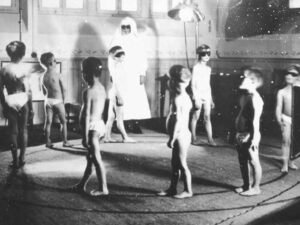
The unseen effects of illness

Worry for the Fruit the Birds Won’t Eat is Sophie Gabrielle’s visual investigation into the unseen effects of illness. Responding to the emotional toll of all the male members of their family being diagnosed with stage IV cancer over two years, the artist employs optics, chemical interactions and investigative photography to render the invisible. Thomas King speaks with the winner of OD Photo Prize 2024 about the project and its deeply personal starting point.


Thomas King | Interview | 17 Oct 2024

Thomas King: Worry for the Fruit the Birds Won’t Eat, recently announced as the winner of OD Photo Prize 2024, features various images of early phototherapy practices, such as UV light exposure and ‘light baths’ used on children, alongside early X-ray experiments. How would you discuss your relationship with the archive in the context of this project? And what was the motivation to create a dialogue between the historical and the personal?

Sophie Gabrielle: I have always been a collector of images. From a young age I would cut pictures out in magazines for safekeeping. The use of scientific archive photography in my work began in university when I based the series BL_NK SP_CE on an MRI scan. Using archive photography relating to X-ray and UV exposure started during a period of research into my father’s stage IV cancer diagnosis. Wanting to understand what was happening, I came across an initial X-ray image and the collection began.

I felt drawn to these archive images after discovering that many of these initial experiments into ionising radiation (x-rays) and UV light baths were cancer-causing. There was this duality to them, experimentation into science that would eventually help treat my family and the initial causation of illness for those in the photographs themselves. During this period of time, I was documenting my family, photographing our lives as we went through this sudden upheaval. However, the images felt too personal to show, they became my secret garden. Using the archive, with its scientific detachment, allowed me to create a public dialogue about my experience while still maintaining a sense of privacy for my family. This project has let others share their own experiences of cancer with me, creating deep felt connection of both loss and joy.

TK: This series involves an intricate process of capturing and re-photographing images under glass plates. What challenges or unexpected discoveries did you encounter during this process, and can you comment on the way they influenced the final outcomes of your work?

SG: There were two main challenging points – touch and light. Handling the plates of glass was always tricky. Initially, I was focused on trying to only capture dust but my fingerprints, hair and fibre would interfere. Over time though I began to appreciate their presence in the works. They were uncontrollable parts of human existence, and ultimately that was a large part of the work.

Light was the other, the most controlled part of the works. Angling both flash and continuous light on specific parts of the photographs was laborious. This control was so important to the works, freezing time for a moment – something I could decide when, how and what it was doing in a time that felt so opposite. The interplay of control and accident in both light and touch ultimately shaped the tone of the final images.

TK: You’ve previously described the investigative processes involved in photographing worlds invisible to the naked eye. In your work, light seems to dissolve and mystify reality – what did you intend to conjure?

SG: In all my work, I aim to convey the tension between visibility and invisibility and the power of the photograph as an object with a duality of truth and lie. They seek to represent the complexity of something deeply felt yet difficult to fully articulate. Through abstraction, I create space for viewers to engage with the work on their own terms. By distorting the clarity of the image, I invite a more nuanced and subjective reading of illness and existential fragility. This approach allows my audience to explore the emotional landscape in ways that reflect their own experiences, emphasising the ambiguity and intricacies of human vulnerability. I’m particularly interested in what is missing in a photograph, what is left out and what we ultimately search for. What makes an image relatable, is what draws us in and creates tension.

TK: In your artist statement, you refer to the project as a form of self-portraiture through abstraction. How do you view the role of aesthetics in conveying personal trauma or existential themes?

SG: We live in a time where there’s an expectation to share our lives and identities in a digital, public way. I see art as fulfilling two essential roles: expressing the artist’s experience while also allowing space for the viewer to connect and interpret it in their own way. Aesthetics play a crucial part in this and through my methods I can engage with personal trauma without being overly literal, which mirrors the non-linear, fragmented nature of emotional processing. Rather than just communicating one perspective, the visual language in my work creates room for reflection on resilience, growth, and the inevitable changes we all undergo. It’s about offering both the artist and the viewer a way to connect deeply, yet individually.

The dust, made up of skin particles, connects the body and environment in a subtle way, entwining living presence with historical materials. This layering of dust and re-photographing became meditative and allowed me to reflect on the inevitable impact of time. It also connected these experiments to the people who would eventually be helped by them in the future. In this way it became self-portraiture, as I was a part of this process, my presence being the creator. I started this work in 2018 so it has been a long process and progression from where I first began. Speaking about this work now, both my grandfathers have passed and I have lost friends from cancer and it still feels just important to share this work, to hold open dialogue and openly grieve.

TK: Michel Foucault’s concept of the ‘medical gaze’ suggests a detached, often objectifying perspective on the body in medical contexts. In what ways does your work confront or complicate this idea, and how does the integration of personal bodily traces affect the perceived objectivity of medical imaging?

SG: I aim to reintroduce subjectivity and emotional resonance, emphasising the personal stories that exist beneath medical images. By transforming archival medical images into personal, poetic narratives, my practice directly engages with the relationship between the body, illness and the scientific gaze. Combining historical photographic processes with environmental interventions complicates this gaze, allowing me to reclaim the narrative of the body and illness. I integrate memory, grief and environmental decay to create something that resonates beyond the clinical sphere, inviting a deeper exploration of what these experiences mean on a personal level. ♦

All images courtesy the artist and Open Doors Gallery. © Sophie Gabrielle

Explore the full shortlist from OD Photo Prize 2024 via Open Doors Gallery.


Sophie Gabrielle is a photographer living and working on the lands of the Ngunnawal, Ngunawal and Ngambri people (Canberra, Australia). Their work uses biomaterials, photographic archives and the human body to investigate the connection between photography, history, memory and psychology. Gabrielle has exhibited in Australia, Malaysia, The Netherlands, France, Germany, South Korea, the USA and the UK. Recent commissions and collaborations include
The New Yorker: cover art for The Netherlands Philharmonic Orchestra and UK musician Seabuckthron’s album Through a Vulnerable Occur. They are a Foam Talent recipient (2018) and a finalist for the Lens Culture Emerging Talent Awards (2016).

Thomas King is Editorial Assistant at 1000 Words and a student on BA (Hons) Culture, Criticism, Curation at Central Saint Martins, University of the Arts London.


1000 Words favourites

• Renée Mussai on exhibitions as sites of dialogue, critique and activism

• Roxana Marcoci navigates curatorial practice in the digital age

• Tanvi Mishra reviews Felipe Romero Beltrán’s Dialect

• Discover London’s top five photography galleries

• Tim Clark in conversation with Hayward Gallery’s Ralph Rugoff on Hiroshi Sugimoto

• Academic rigour and essayistic freedom as told by Taous Dahmani

• Shana Lopes reviews Agnieszka Sosnowska’s För

• Valentina Abenavoli discusses photobooks and community

• Michael Grieve considers Ute Mahler and Werner Mahler’s posthumous collaboration with their late family member 

• Elisa Medde on Taysir Batniji’s images of glitched video calls from Gaza