An art of distance: Hervé Guibert’s The Only Face

French writer Hervé Guibert (1955–1991) was the author of twenty-five novels and autobiographical works, but he also took photographs. The Only Face, Guibert’s second and final collection of photographs, was originally published on the occasion of a 1984 solo exhibition at Galerie Agathe Gaillard in Paris and has now been reissued by Magic Hour Press. Presented in its original sequence, this new edition largely comprises images of small private interiors, revealing itself not merely as an exhibition in book form, but as a novel in its own right, one that speaks to community, friendship and the distances that both separate and sustain them, writes Thomas King.


Thomas King | Book review | 27 Nov 2025
Join us on Patreon

‘To liberate every secret, to invent them’ was, for Hervé Guibert, the stake of artistic courage and the measure of friendship. In his roman à clef To The Friend Who Did Not Save My Life (1990), he introduced the character ‘Muzil,’ a thinly disguised Michel Foucault, and used him to recount previously untold stories from his friend and lover’s life. Following the book’s release, he appeared on French national television amid the furore it stirred to defend his disclosures, speaking of what he called a shared “common thanatological destiny” between the two men living with AIDS, which was to tragically end both their lives.

Some months after Foucault’s death, 6 years prior, Le Seul Visage (The Only Face) (1984) formed the basis of Guibert’s exhibition at Galerie Agathe Gaillard in Paris. Now reissued by Magic Hour Press, with images presented in their original sequence, the deceptively modest and slender volume of photographs reveals itself as a Guibertian novel in its own right. Characters move through and recede from its pages, and in its distinct photographic narrative mode, Guibert refuses to ground a community in a stable, constituent body, the very condition that elsewhere attests to the violence that keeps it intelligible.

This can be explained in part by Guibert and Foucault’s ways of considering homosexuality and friendship together against ‘the recognition that we are.’ Of course Foucault devoted much of his life to showing that the very idea of an ‘essential self’ must be abandoned; the task is not to uncover a hidden truth about who we are, but to renounce the search altogether, while Guibert’s ‘homosexuality’ has been described as ‘a quietly revolutionary stance in line with his particular brand of rebelliousness’.

It’s in this spirit that Guibert’s diaries anticipate a novel that will never be written, yet become novelistic through their ‘fictious’ narratives. From the moment Guibert writes ‘I’, any attempt to distinguish between figuration and the real is dismantled. By putting his body ‘at risk’ within narrations, situations, relations, as he writes, he becomes ‘his own character,’ neither seeking to return to nor magnify subjectivity. As the question is posed on the back cover of The Only Face: ‘Isn’t a book with figures and places a novel?’

The Only Face begins with bodies withheld, faces averted or obscured, silhouettes held just out of reach in the dimly lit interiors of private rooms. ‘Sienna’ recalls André Masson’s headless figure seated at a desk, slumped forward, bathed in a soft yet piercing beam of light from the open window, a thin plume of mist rising from the body. ‘The Friend,’ the first image, shows only a hand pressed firmly against the centre of a chest, establishing from the outset a tension and ambiguous relationality that resonates throughout. It is an image of distance, an art of distance.

Its rising action takes place through a series of portraits in which the characters ‘appear’ under their first names. Guibert photographs his parents and himself under the title ‘Moi’. French actress Isabelle Adjani, who haunts his writings, also enters the frame at the Jardin des Plantes. His gallerist, Agathe Gaillard, and his friend Thierry Jouno appear. So too does Mathieu Lindon, another soul who ‘shared their time, drugs, ambitions, and writings with the older Foucault,’ and the latter, famously pictured in a yukata in his Paris apartment, the meeting place for such activities.

I look at these images knowing Guibert’s refusal to be labelled a photographer meant, for him, an attention only to the relational: bearing witness, as he writes in the introduction, only to his ‘love’ for these bodies – the way they crash together or fail to, and the impermanence of presence that attends all such intimacies. Brigitte Ollier writes, ‘There was no parade, [Guibert’s] portraits were infused by simplicity, as if he were trying to conjure up, or get rid of, the mysterious link between him and his nearest and dearest.’

This ‘simplicity’ lies in what Guibert later describes as his ‘fractious, careful, and suspicious’ approach to photography, with shooting being a kind of liturgy for him. His attention to the ‘mysterious link’ and his play with narrative and framing to preserve its elusiveness recall the story behind the photograph titled ‘East Berlin.’ Lindon once recalled the outing when the image was made; later, having read Guibert’s account, Lindon told Foucault, ‘It hadn’t happened like that.’ Foucault replied: ‘Only false things happen to him.’

And yet, through the artifice of ‘falseness,’ friendship is conceived not as the affirmation of an interior ‘I,’, but its dislocation. Friendship, it has been argued, does not arise from recognising sameness or identity between subjects, but from exposure to internal dispossession, a desubjectification where the self no longer fully coincides with itself. It involves recognising one another only alongside an awareness of their finitude, the ongoing possibility of betrayal and irreconcilable strangeness; it is ‘precisely not recognising the self in the Other and not sharing common ground,’ that gives friendship its ‘particular queer, and thus activist, valence,’ writes Tom Roach. That is to say, Guibert’s portraits dwell in the nothingness at the heart of relationality. And friendship renders this nothingness (which is not the obliteration of difference, rather the opposite) tangible as proximity, and as an awareness of the singular, incommunicable death that eludes possession. There is a subtle, revealing power in these photographs, especially when they are seen as reflecting Guibert’s evolving concept of friendship – which recalls Patrick Ffrench’s musing that ‘The friend speaks to the friend already from beyond the grave, if the friend speaks to the friend at all… .’

What fascinates the young Guibert, though, is not the inventory of mortality that photography could provide, but what remains beyond its reach in the intervals, the silences and the margins. Of note is his preference for tight angles, paintings, windows; the light that enters at the side, the slanted shapes, the objects suspended as if condemned to an eternal foreground. Even the emptiest spaces seem quietly inhabited. All is relentlessly methodical.

These thoughts press harder with the images that follow, where his beloved bodies, no longer his characters, remain only as the image of absence. A pair of photographs titled ‘Writing’ shows a desk strewn with handwritten letters; the other, a figure turned away, seen from above. ‘Reading,’ taken from beneath the desk, draws depth from minimal means, with a book just about visible in the distance. The same sense of absence animates ‘Interior’ and ‘Cannes Festival,’ where one is replaced by a scattering of belongings – a blazer, a camera, a taxidermy owl, marbles in another. The titles are again sober and the images austere.

Writing in Narcissus in Bloom: An Alternative History of the Selfie, Mattie Colquhoun says, ‘Guibert loses himself in this fractal representation of atemporal non-selves, becoming alongside the objects in his possession. He makes himself hidden, emancipating from the gaze of self and other.’ As such The Only Face reminds us that community and friendship, absent among those who are there, are both an actuality and a potentiality. They are, what Maurice Blanchot describes: ‘an existence shattered through and through, composing itself only as it decomposes itself constantly, violently, and in silence.’ ♦

All images courtesy the Hervé Guibert Archive and Magic Hour Press.
© Hervé Guibert


Thomas King is Editorial Assistant at 1000 Words and currently undertaking an MA in Literary Studies (Critical Theory) at Goldsmiths, University of London.


1000 Words favourites

• Renée Mussai on exhibitions as sites of dialogue, critique and activism

• Roxana Marcoci navigates curatorial practice in the digital age

• Tanvi Mishra reviews Felipe Romero Beltrán’s Dialect

• Discover London’s top five photography galleries

• Tim Clark in conversation with Hayward Gallery’s Ralph Rugoff on Hiroshi Sugimoto

• Academic rigour and essayistic freedom as told by Taous Dahmani

• Shana Lopes reviews Agnieszka Sosnowska’s För

• Valentina Abenavoli discusses photobooks and community

• Michael Grieve considers Ute Mahler and Werner Mahler’s posthumous collaboration with their late family member 

• Elisa Medde on Taysir Batniji’s images of glitched video calls from Gaza


Join us on Patreon today and be part of shaping the future of photographic discourse


The unseen effects of illness

Worry for the Fruit the Birds Won’t Eat is Sophie Gabrielle’s visual investigation into the unseen effects of illness. Responding to the emotional toll of all the male members of their family being diagnosed with stage IV cancer over two years, the artist employs optics, chemical interactions and investigative photography to render the invisible. Thomas King speaks with the winner of OD Photo Prize 2024 about the project and its deeply personal starting point.


Thomas King | Interview | 17 Oct 2024

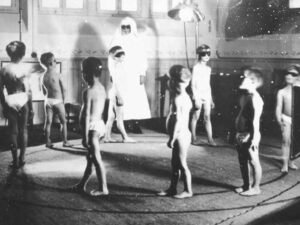
Thomas King: Worry for the Fruit the Birds Won’t Eat, recently announced as the winner of OD Photo Prize 2024, features various images of early phototherapy practices, such as UV light exposure and ‘light baths’ used on children, alongside early X-ray experiments. How would you discuss your relationship with the archive in the context of this project? And what was the motivation to create a dialogue between the historical and the personal?

Sophie Gabrielle: I have always been a collector of images. From a young age I would cut pictures out in magazines for safekeeping. The use of scientific archive photography in my work began in university when I based the series BL_NK SP_CE on an MRI scan. Using archive photography relating to X-ray and UV exposure started during a period of research into my father’s stage IV cancer diagnosis. Wanting to understand what was happening, I came across an initial X-ray image and the collection began.

I felt drawn to these archive images after discovering that many of these initial experiments into ionising radiation (x-rays) and UV light baths were cancer-causing. There was this duality to them, experimentation into science that would eventually help treat my family and the initial causation of illness for those in the photographs themselves. During this period of time, I was documenting my family, photographing our lives as we went through this sudden upheaval. However, the images felt too personal to show, they became my secret garden. Using the archive, with its scientific detachment, allowed me to create a public dialogue about my experience while still maintaining a sense of privacy for my family. This project has let others share their own experiences of cancer with me, creating deep felt connection of both loss and joy.

TK: This series involves an intricate process of capturing and re-photographing images under glass plates. What challenges or unexpected discoveries did you encounter during this process, and can you comment on the way they influenced the final outcomes of your work?

SG: There were two main challenging points – touch and light. Handling the plates of glass was always tricky. Initially, I was focused on trying to only capture dust but my fingerprints, hair and fibre would interfere. Over time though I began to appreciate their presence in the works. They were uncontrollable parts of human existence, and ultimately that was a large part of the work.

Light was the other, the most controlled part of the works. Angling both flash and continuous light on specific parts of the photographs was laborious. This control was so important to the works, freezing time for a moment – something I could decide when, how and what it was doing in a time that felt so opposite. The interplay of control and accident in both light and touch ultimately shaped the tone of the final images.

TK: You’ve previously described the investigative processes involved in photographing worlds invisible to the naked eye. In your work, light seems to dissolve and mystify reality – what did you intend to conjure?

SG: In all my work, I aim to convey the tension between visibility and invisibility and the power of the photograph as an object with a duality of truth and lie. They seek to represent the complexity of something deeply felt yet difficult to fully articulate. Through abstraction, I create space for viewers to engage with the work on their own terms. By distorting the clarity of the image, I invite a more nuanced and subjective reading of illness and existential fragility. This approach allows my audience to explore the emotional landscape in ways that reflect their own experiences, emphasising the ambiguity and intricacies of human vulnerability. I’m particularly interested in what is missing in a photograph, what is left out and what we ultimately search for. What makes an image relatable, is what draws us in and creates tension.

TK: In your artist statement, you refer to the project as a form of self-portraiture through abstraction. How do you view the role of aesthetics in conveying personal trauma or existential themes?

SG: We live in a time where there’s an expectation to share our lives and identities in a digital, public way. I see art as fulfilling two essential roles: expressing the artist’s experience while also allowing space for the viewer to connect and interpret it in their own way. Aesthetics play a crucial part in this and through my methods I can engage with personal trauma without being overly literal, which mirrors the non-linear, fragmented nature of emotional processing. Rather than just communicating one perspective, the visual language in my work creates room for reflection on resilience, growth, and the inevitable changes we all undergo. It’s about offering both the artist and the viewer a way to connect deeply, yet individually.

The dust, made up of skin particles, connects the body and environment in a subtle way, entwining living presence with historical materials. This layering of dust and re-photographing became meditative and allowed me to reflect on the inevitable impact of time. It also connected these experiments to the people who would eventually be helped by them in the future. In this way it became self-portraiture, as I was a part of this process, my presence being the creator. I started this work in 2018 so it has been a long process and progression from where I first began. Speaking about this work now, both my grandfathers have passed and I have lost friends from cancer and it still feels just important to share this work, to hold open dialogue and openly grieve.

TK: Michel Foucault’s concept of the ‘medical gaze’ suggests a detached, often objectifying perspective on the body in medical contexts. In what ways does your work confront or complicate this idea, and how does the integration of personal bodily traces affect the perceived objectivity of medical imaging?

SG: I aim to reintroduce subjectivity and emotional resonance, emphasising the personal stories that exist beneath medical images. By transforming archival medical images into personal, poetic narratives, my practice directly engages with the relationship between the body, illness and the scientific gaze. Combining historical photographic processes with environmental interventions complicates this gaze, allowing me to reclaim the narrative of the body and illness. I integrate memory, grief and environmental decay to create something that resonates beyond the clinical sphere, inviting a deeper exploration of what these experiences mean on a personal level. ♦

All images courtesy the artist and Open Doors Gallery. © Sophie Gabrielle

Explore the full shortlist from OD Photo Prize 2024 via Open Doors Gallery.


Sophie Gabrielle is a photographer living and working on the lands of the Ngunnawal, Ngunawal and Ngambri people (Canberra, Australia). Their work uses biomaterials, photographic archives and the human body to investigate the connection between photography, history, memory and psychology. Gabrielle has exhibited in Australia, Malaysia, The Netherlands, France, Germany, South Korea, the USA and the UK. Recent commissions and collaborations include
The New Yorker: cover art for The Netherlands Philharmonic Orchestra and UK musician Seabuckthron’s album Through a Vulnerable Occur. They are a Foam Talent recipient (2018) and a finalist for the Lens Culture Emerging Talent Awards (2016).

Thomas King is Editorial Assistant at 1000 Words and a student on BA (Hons) Culture, Criticism, Curation at Central Saint Martins, University of the Arts London.


1000 Words favourites

• Renée Mussai on exhibitions as sites of dialogue, critique and activism

• Roxana Marcoci navigates curatorial practice in the digital age

• Tanvi Mishra reviews Felipe Romero Beltrán’s Dialect

• Discover London’s top five photography galleries

• Tim Clark in conversation with Hayward Gallery’s Ralph Rugoff on Hiroshi Sugimoto

• Academic rigour and essayistic freedom as told by Taous Dahmani

• Shana Lopes reviews Agnieszka Sosnowska’s För

• Valentina Abenavoli discusses photobooks and community

• Michael Grieve considers Ute Mahler and Werner Mahler’s posthumous collaboration with their late family member 

• Elisa Medde on Taysir Batniji’s images of glitched video calls from Gaza