Paris Photo 2025: Essential Exhibitions Beyond The Grand Palais

A cultural primer for the week ahead, this guide highlights key exhibitions taking place across the city during Paris Photo, from major museum retrospectives to experimental presentations, offering readers an overview of what to see and where to go amid one of photography’s most anticipated moments in the events calendar.


1000 Words | Resource | 7 Nov 2025
Join us on Patreon

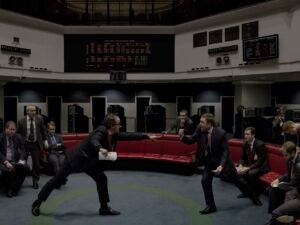
Luc Delahaye, The Echo of the World – Jeu de Paume
10 October – 4 January

Long recognised for his vastly significant contributions to the field of contemporary photography, Luc Delahaye is the focus of a monographic exhibition at Jeu de Paume showcasing work that spans the last 25 years. During this time, Delahaye has notably transitioned from photojournalism to fine art photography, deliberately moving away from the immediacy of reportage toward the creation of monumental, painterly tableaux that often depict the aftermath of war, the solemnity of international summits or the quiet dignity of displaced individuals. The exhibition, the first in Paris to show Delahaye’s work since 2005, brings together approximately 40 large-format photographs, including previously unseen works and a video installation centred on the Syrian conflict, and is a testament to the documentary form as it tipped into crafted construction.

Rebekka Deubner, Thermal Seasons – Shmorévaz, Photo Saint Germain
6 November – 29 November

For close to a month, Photo Saint-Germain animates venues across the Left Bank with a rolling programme of exhibitions. In the experimental, independent space of Shmorévaz, housed in a former shop and known for its feminist, queer, erotic and political programming, Rebekka Deubner’s Thermal Seasons (a work in progress since 2021) explores the usage of thermal contraception, probing intimacy, parenthood, masculinities, and the gendered distribution of mental labour. Through her careful, intimate gaze on bodies in close proximity, and her attention to the rhythms of communal life, Deubner restores them a kind of tender plasticity, offering a delicate vision of masculinity.

Edward Weston, Becoming Modern – MEP
15 October – 25 January

MEP pays tribute to the celebrated American photographer Edward Weston, offering a unique for Parisiens and visitors to Paris to experience the richness and precision of his modernist vision. Through more than one hundred vintage prints drawn entirely from the prestigious collection of the Wilson Centre for Photography, the exhibition reveals Weston’s fascination with form, texture and the interplay of light and shadow, alongside the gaze and pioneering practice that marked a major turning point in the history of photography. In tandem, MEP also presents the first solo exhibition in France by famed contemporary photographer Tyler Mitchell, meanwhile in the Studio space, the ever fascinating Felipe Romero Beltrán’s image-based series Dialect documents the liminal lives of nine young Moroccan minors navigating the asylum process in Spain.

Donna Gottschalk and Hélène Giannecchini with Carla Williams, (Nos Autres) We Others – Le Bal
20 June – 16 November

Donna Gottschalk and Carla Williams make their French debut in Le Bal’s latest exhibition, We Others, accompanied by an interpretive text by Hélène Giannecchini, bringing together first-person narratives and a wide range of photographs spanning decades to tell stories, explore invisibility and consider intergenerational connections. Gottschalk’s work, inseparable from the emerging movements for LGBT+ rights in which she was involved at a time when homosexual relationships were still illegal in the United States, is situated alongside Williams’ intimate self-portraits, continuing the memory and preservation of marginalised queer lives and framing archival practice as relational and intergenerational. The exhibition’s spatial design and vivid atmosphere owe much to Julie Héraut’s thoughtful curation and deft scenography of Cyril Delhomme, and powerfully forms a bio-dimensional experience that visitors have typically come to expect from this important institution.

Hoda Afshar, Performing the Invisible – Musée du quai Branly – Jacques Chirac
30 September – 25 January 

Hoda Afshar’s first major French solo takes place at the Musée du quai Branly – Jacques Chirac, uniting two chapters of her work: Speak the Wind (2015–20) and The Fold (2023–25). The latter draws on archival research at the museum, confronting orientalist and colonial legacies through photographs taken by psychiatrist Gaëtan de Clérambault in Morocco between 1918 and 1919. Speak the Wind, meanwhile, traces the beliefs, myths and stories carried on the winds that shape life on the islands of the Strait of Hormuz. Across photography, video, sound and printed mirrors, the unique installation threads Afshar’s projects into the living lines of her research. ♦

–1000 Words

Images:

1-Luc Delahaye, Trading Floor, 2013. Courtesy the artist and Galerie Nathalie Obadia, Paris/Brussels

2-Rebekka Deubner, Felix en sicile, 2022

3-Edward Weston, Charis, Santa Monica (Nude in doorway), 1936. Courtesy Wilson Centre of Photography

4-Donna Gottschalk, Self-portrait during a GLF meeting, E. 9th Street, New York, 1970

5-Hoda Afshar, Speak the Wind, 2015-20


1000 Words favourites

• Renée Mussai on exhibitions as sites of dialogue, critique and activism

• Roxana Marcoci navigates curatorial practice in the digital age

• Tanvi Mishra reviews Felipe Romero Beltrán’s Dialect

• Discover London’s top five photography galleries

• Tim Clark in conversation with Hayward Gallery’s Ralph Rugoff on Hiroshi Sugimoto

• Academic rigour and essayistic freedom as told by Taous Dahmani

• Shana Lopes reviews Agnieszka Sosnowska’s För

• Valentina Abenavoli discusses photobooks and community

• Michael Grieve considers Ute Mahler and Werner Mahler’s posthumous collaboration with their late family member 

• Elisa Medde on Taysir Batniji’s images of glitched video calls from Gaza


Join us on Patreon today and be part of shaping the future of photographic discourse


Restoring personhood to the immigrant body

The Foam Paul Huf Award 2023 and 2022 Aperture Portfolio Prize winner Felipe Romero Beltrán has released a new book with Loose Joints titled Dialect. Presenting the temporal dimension of the period of asylum which a group of nine young minors from Morocco navigate as they wait to be validated as documented citizens of Spain, it offers a possibility of restoring a personhood to the immigrant body, writes Tanvi Mishra. His solo exhibition at Foam Amsterdam runs until 1 May 2024.


Tanvi Mishra | Book review | 4 Sept 2023

Borrowing from the structural divisions of theatrical works, Felipe Romero Beltrán’s image-based series Dialect unfolds over three acts. Balancing between reality and recreation, it lies in the interstitial space of speculation. The photographs are not made in service of representation, but to gesture at the pace of a time. Flanked by two companion pieces – Recital and Instruction – which serve as prologue and epilogue, Dialect intersects with other theatrical forms of performance, choreography and film. Bringing these multiple pieces together, the book presents the temporal dimension of the period of asylum which a group of nine young immigrants from Morocco navigate as they wait to be validated as documented citizens of Spain.

The photograph has played a central role in the context of the recent migration to Europe and the refugee crisis. At certain times, to showcase its precarity – countless visuals of inflatable vessels at sea carrying tightly packed Black and Brown bodies. At others, its eventuality – images of people docking on the shores of Italy, Turkey and Spain, only to be confronted with the fortified system of border control. And this is with reference to those that make it alive. It is not just the photojournalistic image that has presented us this reality. Artists have staged the horror of bodies washed ashore, with an apparent motive of raising awareness. In these repeated acts of “bearing witness” or stirring a public conscience, there has emerged a surplus – thousands of images of groups of people in overloaded boats, in never-ending queues, in overcrowded refugee camps. They are not afforded names, nor any individuality, only pictured at the edge of a land that supposedly bears promise. Whilst the photograph no doubt serves to makes an incident visible, its repetition creates a numbness. Catalysed by this anaesthetisation, and depersonalisation, a public sentiment takes shape – the imminent “threat” associated with the immigrant from a foreign land.

In this archive of excess, the narrative often ends at the physical border. The immigrant is rendered nameless, but racialised. The border itself is imagined as the line that separates political boundaries, not one that extends far beyond it into detention or asylum centres or what Caterina Borelli refers to in her essay in the book as the ‘documentation regime’ that confronts every refugee. Beltrán’s commentary is located within the “custody and control” exercised by this extended border system, and the State’s desire – either by physical force or bureaucratic procedure – to organise the bodies that enter its territories. Both spatially and temporally, Beltrán expands the image archive beyond the repetitive documentation of the transgression of geographical boundaries.

Beltrán’s three-part act situates itself in an internment house in Seville, where a group of minors who have illegally crossed the border into Spain are housed until they reach adulthood and wait for their immigrant status to be shifted to naturalised citizens. It opens with, and periodically returns to, the impermeability of this edifice. All walls leading to a corner, the irony of doorways permanently sealed shut: serving as reminders of the futility of escape and the inevitable acceptance of the wait. Sociologist Pierre Bordieu recognised the act of making people wait, especially in anticipation of a favourable outcome, as an act of power and dominance. Youssef Elhafidi, one of the boys Beltrán photographs and author of one of the book’s essays, speaks about the desire for economic opportunity that motivated him to leave his family in Morocco and jump aboard a boat headed for the cold, dark Mediterranean in the dead of the night. It is this desire that is capitalised by the State as he enters its borders. The currency here is of time, or the ‘interlude’ as Albert Corbi refers to in his accompanying essay, which migrants must pay with to earn themselves a place in society. ‘[Illegal migrants] are exposed to an Interlude in which the language of the law and the language of Otherness are indistinguishable,’ Corbi states, referring to the limbo of one to three years that minor immigrants must endure once they reach adulthood in order to achieve a change in citizenship status. This process of waiting in and of itself, and the ‘strategy of delay’, serves to maintain the racial hierarchy of society[i].

Limbo, as an intermediate state, does not offer “incidents” to be photographed. It is in waiting, for the next condition that holds the prospect of movement, and freedom. In focusing on this period of suspension, Beltrán’s images oscillate between banality and theatricality. Mixing classical reportage with re-enacted scenes recalling the young men’s journey to Seville, the image-sequences allow us to speculate upon the documentary image, and the futility of these binaries imposed to evaluate its “truth” value. Moving through the three acts, the aesthetics deployed amplify the mundane – a pale colour palette, centre-weighted frames, often men looking back into the camera, reminiscent of images purposed for biometrics. In others, they are seen performing banal rituals of daily life. Unlike the theatre of the European coast, there is no drama in the images of the asylum walls, the unmade beds or the decaying fruit.

But the placid tenor of the edit is routinely disrupted by images charged with a speculative tension. A young man attempts to release two hands that grab his neck; two young men carry a third on their shoulders; another points two fingers to the right as if to aim fire. In these scenes of seemingly violent situations, the threat, however, appears to be muted. One of the two hands that grabs the neck holds the back of the head with care; the apparently collapsed body is carried against the backdrop of the familiar asylum walls; the hand that points beyond the frame has no weapon to hold. In collaboratively restaging experiences from the boys’ journeys to Spain, Beltrán places the record of waiting in the asylum in ‘dialogue with the crossing.’[ii] It is this dialogue, perhaps, that may offer a cathartic potential. Academic Zoé Samudzi refers to revisiting trauma as a space of potential knowledge production. In rejecting its ‘performative reiteration as a kind of re-wounding’ she advocates for a possibility to imagine healing ‘by learning how to refuse to reproduce it.’[iii]

The three works in the book borrow from reality, however, do not claim to be representative. Drawing from the experience of the body, each work elicits specific temporal characteristics of the immigrant ordeal. In positioning Recital as the precursor to the opening act of Dialect, Beltrán locates the narrative within the monotonous drone of bureaucracy and the legal system. Presented as a grid of screengrabs of three young men reading the first four pages of the Spanish immigration law, the book’s translation of the videos reinforces the repetitive burden and the simultaneous struggle to navigate a system built on the language of othering. Here, time acquires a circular characteristic, offering only an illusion of moving forward. Progressing from here to the three acts of waiting that follow, circular time mutates to dead time, and comes to a halt.

In choosing Instruction as the epilogue piece, Beltrán takes us back to the point of crossing, as if to initiate a recall to the initial point of rupture. Unlike Recital, the repetition of its frames is frenetic, and the pace charged. Performed by two dancers – one of whom, Bilal Siasse, is also one of the young immigrant men Beltrán photographs in Seville – the choreographed piece maps the movement of the body in response to an external destabilising force. Drawing from Siasse’s actual experience of crossing the border, Instruction is described as a ‘gesture performed within the jurisdictional limits of the State.’ In its visuality, however, it is reminiscent of the unpredictability of a body at sea and the surrender to its chaos through involuntary somatic responses. Whilst the legal border may begin near the shore, the impact on the body precedes its arrival on land.

In the description of this final piece lies the core inquiry of the work: how to translate a body? In contemplating this with respect to the performance, and the translation of Siasse’s visceral experience – for the choreographers and the dancers through the Stepanov notation [iv] – Beltrán acknowledges the impossibility of its complete representation. The book, then, can be seen as a compendium of praxis that records the movement across, and within, the border on multiple tenors. Piecing them together, Beltrán offers a possibility of restoring a personhood to the immigrant body that has for long been dispossessed – of the complexity of its identity, the dignity of its humanity and of the faith in the validity of its imagination.

All images courtesy the artist and Loose Joints © Felipe Romero Beltrán

Dialect is published by Loose Joints.

Felipe Romero Beltrán: Dialect runs at Foam Amsterdam until 1 May 2024.


Tanvi Mishra works with images as a photo editor, curator and writer based in New Delhi, India. Mishra has served as the Creative Director of The Caravan, a journal of politics and culture. She is part of the photo-editorial team of PIX, a South Asian publication and display practice. She works as an independent curator and has recently curated the Louis Roederer Discovery Award for the 54th edition of Les Recontres d’Arles (France). Mishra has also been part of the curatorial teams of Photo Kathmandu (Nepal), Delhi Photo Festival (India) and BredaPhoto (The Netherlands). 

Her writing on photography has been published in various platforms including Aperture, FOAM and 1000 Words. She has served on multiple juries, including World Press Photo, Chennai Photo Biennale Awards and the Catchlight Global Fellowship, and is currently part of the first international advisory committee of World Press Photo.

References:

[i] Shahram Khosravi, “Waiting bodies in dictatorial and bordering regimes” in The Funambulist (2021), available at thefunambulist.net/magazine/they-have-clocks-we-have-time/waiting-bodies-in-dictatorial-and-bordering-regimes, accessed 1 September 2023.

[ii] Felipe Romero Beltrán, “Stepanov Notation for the piece Instruction” in Dialect (Loose Joints, 2023).

[iii] Zoé Samudzi in conversation with Noor Asif, “Breath Back: An epistolary introduction to reparation and repair” in Parapraxis (2022), available at parapraxismagazine.com/articles/breath-back, accessed 1 September 2023.

[iv] Developed by the Russian dancer Vladmir Stepanov in the late 19th century, the Stepanov notation is a way of recording dance or body movement based on musical notation. By doing an anatomical analysis of movement, it deconstructs complex movements into elementary ones performed by individual body parts, identifying each of these moves as notes.