When the mask slips: Cindy Sherman

On the uninhabited island of Illa del Rei, where a former British naval hospital now houses Hauser & Wirth Menorca, Cindy Sherman’s latest exhibition and her first solo show in Spain in over two decades is on view. Spanning eight series from across her near 50-year career, The Women stages a carnival of ageing flappers, social climbers and fashion phantoms; with deadpan wit and grotesque precision, Sherman’s portraits expose the desperate contortions of femininity and the moment the mask begins to slip, writes Charlotte Jansen.


Charlotte Jansen | Exhibition review | 5 Sept 2025
Join us on Patreon

Cindy Sherman’s latest exhibition, The Women, can be viewed by taking a boat to the rugged, uninhabited island of Illa del Rei from the port of Mahon, Menorca. Disarming in its picturesque beauty, Illa del Rei was home to a large naval hospital from 1711 until 1964. More recently, Hauser & Wirth opened a gallery here, where currently Sherman’s works are on view until October, when the island closes to the public. A collection of the gruesome instruments and contraptions used for treatments is now housed in a neighbouring museum occupying the former hospital buildings.

The shadows of this past of physical suffering and transformation seem to be an appropriate prologue to viewing Sherman’s works, in which she contorts herself, often painfully, into embarrassing, awkward and desperate characters performed to perfection to her camera. The Women, though not intended to be comprehensive, encompasses eight series, made during different periods of Sherman’s near 50-year career, from stretched stereotypes of silver screen starlets, amalgams of fashion wannabes, to mash-ups of guffawing society women, and fading flappers. The exhibition engages head-on with Sherman’s persistent, preoccupying subject: the female figure. The women are never ‘real’ women, of course – they are pastiches of women, of women’s experiences, of women’s struggles and desperation. They are portraits about portraiture and the nature of representation, and the fallacy that being seen is the same as being understood.

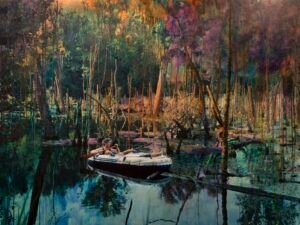
Arranged in a flipped chronology, the show starts with recent-ish large-format commissions for fashion magazines: works known as Ominous Landscapes (2010-12) for Pop magazine, using clothes from the Chanel archives, and a 2016 Harper’s Bazaar commission, where the details just don’t add up: Sherman’s model character wears a Marc Jacobs coat and bag and clutches an iPhone in a sylvan scene. In another image, dressed in couture and yellow elbow-length gloves she stands in front of a mountain, but the figure almost measures up to the landscape and her stockinged feet – left out of the frame – would logically be planted in the surrounding sea. This is all part of Sherman’s trenchant humour, playing with colour and scale to unapologetically take over spaces in and out of the frame with her women, their uncanny, grotesque grandeur unavoidable. Something is always off. It is just as hilarious to me that Sherman would do these editorials with actual couture given the fact she has smashed the market, sales-wise. I can’t imagine having one of these staring at me at home.

These fashion photographs that both mock the industry that forces women to be looked at this way, and are at the same time subsumed by it, are an intriguing entry point to the exhibition and the contradictions always present in Sherman’s portrayals of women. Through their fastidious observational details, Sherman perfectly captures the attitude of a type of woman, from a moment in time – familiar enough to feel, as exhibition curator puts it “I’ve been to a party at her house.” Sherman is certainly the most astute observer of female social mores, she an ‘impersonator’ of women, as Jerry Saltz wrote. Yet to me there is a shift from her gaze towards the women she performs as in the early years – in say the bus riders, or the femme fatales of the Untitled Film Stills – to something more daring and darkly ambiguous in later works. This, after all, is how women look at each other too. Repulsion became an essential part of Sherman’s works after the 1980s and she seems to abandon herself to it. Then again, that may be the ruse – repulsion is in the eye of the beholder. I had nightmares about the Fairy Tale and clown images I saw at the National Portrait Gallery in 2019, part of Sherman’s first UK retrospective. This exhibition doesn’t include those, but does well in varying the techniques, scale and pace – though endlessly inventive within each image, Sherman’s shows can have a strangely monotonous feel as a viewing experience.

As women we all find ourselves particularly cornered in this system of images, hyper aware of our own image, hypervisible or invisible – both fates equally awful. The Women are products of our image-based environment, one shaped first by theatre, cinema, and later the intrepid influence of fashion magazines, high society and celebrity worship culture. As a woman nearing 40, it’s excruciating at times to look at say the large-scale flappers – made between 2016-2018. Flappers are the perfect Sherman subject since they themselves often emulated Hollywood stars, and were progressive, sexually liberated figures of modernity. Sherman however depicts them long after their prime, glamorous but melancholic – sad, because they’re old? Again and again, Sherman presents the twisted acts of self-contortionism society demands of us, to stay youthful, dress well, groom, smile. Ageing will ultimately betray us, and Sherman shows us, through her grinning, gargoylesque female figures, that the camera’s role in all this isn’t kind. She reveals with a dead pan wit, the hideousness of a mask that’s slipping.

As I look, I also think about Sherman herself, and what happens to women artists when they become world famous. Sherman has managed to remain quite an enigma, by today’s standards. Her work has become, if anything, less commercial, less aesthetically appealing and politically appeasing over the years. Yet as famous as Sherman is, scholarly interest in her work seems relatively unvaried – certainly compared to male counterparts of her status. I’ve come to think of this as the Cindy Sherman paradox. Sherman is undoubtedly one of the most famous ‘photographers’ (some would dispute the categorisation) alive today, one of the only artists working in photography to truly be considered a household name. She is famous for being the most expensive female photographer, and still holds the biggest ever auction sale ($3.89 million) for a single photograph by a woman. (She has held that record since 2011, which is also an indictment of how little the market has moved for women in photography in more than a decade.)

These ideas about value, both in terms of her cultural cachet and commercial gravitas, often eclipse Sherman’s work. Here, curator Tanya Barson offers a fresh look at Sherman. This is one of a spate of new Sherman shows in smaller cities in Europe of late (FOMU Fotomuseum Antwerp, the Museum of Cycladic Art, Athens, in Switzerland at Photo Elysée, and now Hauser & Wirth, Menorca) seeking new ways to see Sherman in places she isn’t so well known. The Women is Sherman’s first exhibition in Spain in a generation (her last was at the Reina Sofia in 1996 – many of the works in The Women were not included in that show, or were made since then).

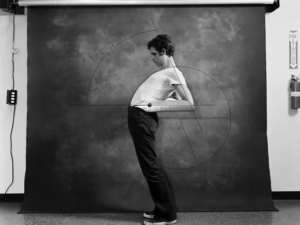
The real treat of this exhibition for me, though, were the very early series, the small black and white images known as the ‘murder mystery’ and ‘line up’ pictures made in 1976 and 1977, while still a student at Buffalo State College. Some of the images from this series were included in the National Portrait Gallery show, but here they have more space and vibrate differently. Here’s a young and unknown Sherman, aged 23, already rapt with self-staging: dressed in eclectic, everyday outfits I can imagine were thrifted on a budget, or borrowed from a friend’s or her own wardrobe, a kaftan and espadrilles, then stockings, suspenders and a bowler hat. The same belt is styled differently. Some wear masks, others are masked with heavy make-up. The bare wooden floorboards and the socket on the wall give them a looser, improvised edge – though with Sherman even then you can imagine it was all meticulously planned. They have energy, and so much to say with so little.

In the line-ups, her characters all take up the same strange pose, body turned slightly to the camera, hands spread in a typically off-kilter Sherman gesture – “Ta-da!” they seem to declare.♦

All images courtesy the artist and Hauser & Wirth Menorca. © Cindy Sherman

Cindy Sherman. The Women runs at Hauser & Wirth Menorca until 26 October 2025.


Charlotte Jansen is a British Sri Lankan author, journalist and critic based in London. Jansen writes on contemporary art and photography for The Guardian, The Financial Times, The New York Times, British Vogue and ELLE, among others. She is the author of Girl on Girl: Art and Photography in the Age of the Female Gaze, (HACHETTE, 2017) and Photography Now (TATE, 2021). Jansen is the curator of Discovery, the section for emerging artists, at Photo London.

Images:

1-Cindy Sherman, Untitled #566, 2016

2-Cindy Sherman, Untitled #568, 2016

3-Cindy Sherman, Untitled #550, 2010/2012

4-Cindy Sherman, Untitled Film Still #6, 1977

5-Cindy Sherman, Untitled Film Still #24, 1978

6-Cindy Sherman, Untitled #369, 1976/2000

7-Cindy Sherman, Untitled (the actress at the murder scene), 1976/2000

8-Cindy Sherman, Untitled #508, 1977/2011


1000 Words favourites

• Renée Mussai on exhibitions as sites of dialogue, critique and activism

• Roxana Marcoci navigates curatorial practice in the digital age

• Tanvi Mishra reviews Felipe Romero Beltrán’s Dialect

• Discover London’s top five photography galleries

• Tim Clark in conversation with Hayward Gallery’s Ralph Rugoff on Hiroshi Sugimoto

• Academic rigour and essayistic freedom as told by Taous Dahmani

• Shana Lopes reviews Agnieszka Sosnowska’s För

• Valentina Abenavoli discusses photobooks and community

• Michael Grieve considers Ute Mahler and Werner Mahler’s posthumous collaboration with their late family member 

• Elisa Medde on Taysir Batniji’s images of glitched video calls from Gaza


Join us on Patreon today and be part of shaping the future of photographic discourse


1000 Words archive

15 Years, 15 Picks

Selected by Lucy Soutter

Marking 15 years of 1000 Words, Lucy Soutter takes us on a journey through our archive, offering a selection of features based on her own affinities across the magazine’s history. Capturing the richness of an archive and its ability to generate multiple routes through the material contained within, Soutter’s eclectic picks, as she writes, ‘celebrate the sweep of 1000 Words in embracing a range of 21st century photographic practices.’


Lucy Soutter | Archive highlights | 26 Sept 2024 | In association with MPB

I once spent a week time travelling to the 1960s. I was half-way through a PhD on photography in first-generation Conceptual Art when my supervisor sent me to the library to immerse myself in period art magazines – including Artforum for the avant-garde side of things, and Art in America for a mainstream view. She told me not to worry about reading every article (though I made some useful discoveries) but to skim every single page in chronological order, to immerse myself in the general culture of the time through the pictures, letters pages, ads, layout, etc. My week-long flashback to the decade of my birth gave me untold insights into the aesthetics, politics and general mood of the period. Magazines are traditionally classed as “ephemera,” cultural forms with fleeting significance, important primarily in the moment they are produced. That very topicality makes them an ideal form for studying the conscious and unconscious preoccupations of the time, whether the past or the near-present.

This assignment, to look back over 15 years of 1000 Words (particularly the last 12, as archived on the website) has taken me on a journey through my own past: exhibitions visited, books read, and articles shared in the classroom with students, as well as many important things I missed. At the same time, the exercise clarified trends that have emerged from the flow of visual and written materials. My selections are eclectic to celebrate the sweep of 1000 Words in embracing a range of 21st century photographic practices. I also want to draw attention to the ambition of the editorial teams over the years, led by Tim Clark, in extending the discussion of contemporary photography into new terrain. Although the pieces in this online magazine are short, they are bold in mobilising concepts from an array of academic and pop cultural contexts. The magazine has often been the first to publish emerging artists and writers, many of whom are now familiar names. Tracing the expansion of the field through evolving configurations of genres and presentation formats, it has also played a key role in promoting a broader range of practitioners.

Part of the richness of an archive is its capacity to generate multiple different routes through the material. This set of selections, loosely chronological, are based on my own affinities. I hope that they will invite you to dip in, whether to revisit familiar selections or make fresh discoveries.

1. Esther Teichmann, Drinking Air, and Mythologies
Interview by Brad Feuerhelm
Issue 14, 2012

When I started teaching at art schools in the early 2000s, the UK photography scene was dominated by documentary approaches. Contemporary photography is now so much more eclectic that it is hard to believe that a practice such as Esther Teichmann’s needed to take a stand against this orthodoxy to embrace symbolist themes, painterly gestures and mixed media installation. The images in this portfolio combine with the text to offer a rich field of possibility. Teichmann’s distinctive voice, her embrace of poetics, and the generosity of her approach are all evident in this interview. 1000 Words has provided a platform for a number of artists emerging in parallel expressive modes, including Tereza Zelenkova (28) and Joanna Piotrowska (30).

2. Daisuke Yokota, Back Yard
Essay by Peggy Sue Amison
Issue 15, 2012

‘There is a revolution going on in the work of emerging photographer Daisuke Yokota, a revolution that links the past with the future of Japanese photography.’ In a few deft paragraphs, Peggy Sue Amison provides several different points of entry for viewers seduced by Yokata’s evocative, mysterious images. She sketches in Yokata’s context in relation to the grainy, blurry aesthetic of the Provoke movement and describes how the photographer updates Japanese zine culture with collaborations and a participatory approach. Amison illuminates how his use of experimental processes such as solarisation and rephotographing combine with banal architecture, natural forms and faceless figures to create work that is distinctly Japanese and distinctly contemporary. As with Gordon Macdonald’s essay on Thomas Sauvin’s Beijing Silvermine project (15) or Sergio Valenzuela-Escobedo’s framing of Nadège Mazars’ Mama Coca (38) this concise piece provides essential context for interested readers to pursue further research into an important international practice.

3. Sara-Lena Maierhofer, Dear Clark, A Portrait of a Con Man
Interview by Natasha Christia
Issue 16, 2013

I confess that I was late to the photobook scene. It had been heating up for the first decade of the 2000s before I realised that this was not just a fad or nerdy subculture (though it has its fads and nerdy aspects) and that I needed to pay attention to it. 1000 Words was one of my go-to destinations for reading about new releases. I was so impressed by Natasha Christia’s interview with the author/artist/maker of Dear Clark that I ordered the book and looked with new eyes at its skilful combination of obsessive research, idiosyncratic reenactment and seductive, self-referential layout. As I have learned more about this aspect of contemporary photography culture, I have come to appreciate the extent to which the book reviewers for 1000 Words (variously photographers, writers, book-makers, curators and editors themselves) have contributed both to defining the photobook as a form with its own unique concerns, and to creating a canon-in-progress of its plural possibilities.

4. Julian Stallabrass, Memory of Fire: Images of War and the War of Images
Book Review by James McArdle
Issue 16, 2013

In 2008 – five years into a war that had seen the US, UK and allies invade and occupy Iraq – Julian Stallabrass curated the Brighton Photo Biennial as a searing critique of the uses of photography as a tool of pro-war propaganda, exploring the ways photographers past and present can work against the conventions of the genre to provoke other forms of understanding. How can war photography serve as a lesson or a warning rather than just pulling us into its quasi-pornographic thrall? James McArdle draws some of the key issues out of Stallabrass’ 2013 anthology of projects, essays, and interviews related to the festival, pointing to artists including Trevor Paglen, Adam Broomberg & Oliver Chanarin, and Coco Fusco, and writers including Sarah James and Stefaan Decostere.

5. Duane Michals, Storyteller: The Photographs of Duane Michals
Essay by Aaron Schuman
Issue 18, 2014

In this feature on Duane Michals, Aaron Schuman traces the historical roots of staged, narrative photography far beyond Cindy Sherman’s Untitled Film Stills to Victorian tableau photography. Schuman argues convincingly that in Michals’ hands the genre does not merely advance photography as an art form, but also grapples with aspects of experience that transcend ordinary vision. Although it may be difficult to identify the direct impact of Michals on contemporary photographers whose work, like his, is filmic (like Jeff Wall), fictive (like Gregory Crewdson) or constructed (like Matt Lipps), Schuman points out that the sophisticated use of series and sequence by photographers such as Paul Graham and Alec Soth owes a debt to Michals’ storytelling capabilities. (The final image in this portfolio, Michals’ This photograph is my proof is my all-time favourite image + text work).

6. Laura El-Tantawy, In the Shadow of the Pyramids
Book Review by Gerry Badger Issue 19, 2015
Matthew Connors, Fire in Cairo
Book Review by Max Houghton
Issue 20, 2015

It is difficult for a magazine, which in its previous format, only came out a couple of times a year to respond to current events or political crises like the Arab Spring, especially when photographic projects, like novels, sometimes take years to come to fruition*. Gerry Badger’s 2015 review of Laura El-Tantawy’s book In the Shadow of the Pyramids describes the artist’s response to the events in Tahir Square in 2011 in the context of her own life inside and outside Egypt. In response to this blend of document and personal archive, Badger provides a personal meditation on how we create photographic narratives out of the messy flow of life. Max Houghton’s review of Matthew Connors’ Fire in Cairo in the following issue is a more wrought, imagistic essay, a perfect fit for Connor’s disorienting, back-to-front combination of surreal images and fragmented fiction. Together, these two reviews open a space to consider how we see, remember and understand protest and its aftermath.

7. Saul Leiter Retrospective
Essay by Francis Hodgson
Issue 21, 2016

One of the important tasks of the critic is to return to older works and read them afresh in light of current developments. Events may be fixed in the past, but their importance for us shifts in significant ways that need to be acknowledged and articulated. This review illuminates one of the things we take for granted about contemporary photography – that most of it is in colour – and reminds us that it was not always so. Roving across Leiter’s street photography, fashion work and painterly ambitions, Hodgson’s essay and selection of images offer a celebration of Leiter’s glowing Kodachrome aesthetic and illuminate its contemporary appeal. 

8. Richard Mosse, Incoming
Essay by Duncan Wooldridge
Issue 25, 2017

1000 Words has provided a constructive platform for encountering 21st century social documentary photographers who use strategies from contemporary art. Photographers like Lisa Barnard (25), Salvatore Vitale (26) and Gideon Mendel (36) offer projects that are rigorously researched, visually and technically innovative, and presented in layered, imaginative forms designed to jolt us out of familiar understandings of social situations. Such work can be highly controversial. This essay by Duncan Wooldridge provides a response to a flurry of topical online debates (by writers including Daniel C. Blight, Lewis Bush and JM Colberg) around Richard Mosse’s exhibition at the Barbican Centre, London and book Incoming from 2017, and its controversial use of military-grade thermal imaging technology to create eerie, spectacular video and still imagery of migrants from the Middle East and Global South. Fiercely analytical and ethically engaged, Woodridge frames the project in the philosophy of Judith Butler and Giorgio Agamben, while keeping an eye on the economic and institutional dilemmas of being a (materially successful) political artist.

9. Lebohang Kganye, Dipina tsa Kganya
Interview with Sarah Allen
Issue 34, 2021

For centuries, self-portraiture has provided artists with a way to explore their own identity and self-presentation. A new generation of artist photographers including Arpita Shah (27) Kalen Na’il Roach (32) and Sheida Soleimani (38) are turning to archival imagery, family albums and strategies of montage to counter dominant colonial (and frequently racist) histories with imaginative autonarratives. In this interview with Sarah Allen, Lebohang Kganye (Deutsche Börse Photography Foundation Prize 2024 winner) explores the complexities of figuring her own identity within post-apartheid South Africa, and how the interweaving of family photography and performance gives her scope to recuperate personal, familial and tribal memory within the context of an exhibition in a Bristol slave owner’s 18th century home.

10. Curator Conversations #11: Alona Pardo Features, 2020

At their best, exhibitions can define practices and the ways they are understood, bringing new ideas into focus. To make this work happen, curators must embody various qualities: administrative, collaborative, critical and visionary. In her contribution to the Curator Conversations feature series, subsequently drawn together into a book, Alona Pardo discusses the layers of consideration that went into the exhibitions she curated at the Barbican before leaving to be Head of the Arts Council Collection. Her drive to facilitate spaces for creative discussion rather than promote her own point of view have led to a series of highly influential exhibitions including Masculinities: Liberation through Photography of 2020 and RE/SISTERS of 2023.

11. Stanley Wolukau-Wanambwa, One Wall a Web
Book Review by Taous R. Dahmani
Issue 30, 2019

Photographers are more likely than other kinds of artmakers to also be writers of non-fiction, fiction and/or criticism. This can sharpen the edges of the language they use in their work. In this review, Taous R. Dahmani looks at artist/writer/editor Stanley Wolukau-Wanambwa’s award-winning book One Wall a Web and describes the associative force of his filmic juxtapositions of text and image. Dahmani seeks precedents for his pointed appropriations in the scrapbooks of historical African Americans seeking to reclaim their own representation. On a related note, Dahmani’s response to questions provided by the 1000 Words feature series and book Writer Conversations (edited by myself and Duncan Wooldridge) convey a vivid sense that research and writing around photography are urgent and thrilling. She includes an inspiring list of classic and recent texts related to photography that made me want to run away on an extended reading retreat.

12. Cao Fei, Blueprints
Essay by Sergio Valenzuela-Escobedo Issue 34, 2021

While the cultures of contemporary art and photography share certain structures, there are ongoing disparities in their economic and cultural currency (one reason why many lens-based practitioners insist on being called “artists” rather than “photographers”). It is sometimes difficult for outsiders to decipher the coded language used to place a practice in one camp or the other, especially when some move fluidly between contexts. Sergio Valenzuela-Escobedo’s account of Cao Fei’s 2021 Deutsche Börse Photography Foundation Prize win provides a window into the world of a high-flying international artist, represented by mega-gallery Sprüth Magers and whose astonishingly polished, high-tech, multimedia work is more likely to be seen at Serpentine Gallery or the Venice Biennale than in a dedicated photography gallery. Escobedo’s essay explores the work’s push and pull between ironic simulation and fantastical techno-utopianism. The Chinese State’s role as a geopolitical and industrial superpower is never far out of the frame, but Fei’s relationship to it remains strategically ambiguous. As a productive counterpoint, this issue also features Fergus Heron’s exhibition review of Noémie Goudal’s Post Atlantica (34), a body of photographic and moving image installation work that sits firmly within a contemporary art sphere while also asking rich and probing questions about how photographs operate as documents, images and phantasms. For those interested in the representational politics of The Deusche Börse Photography Foundation Prize, the most prominent international art photography award, see Tim Clark’s impassioned 2020 editorial, ‘False signals and white regimes: an award in need of decolonisation.’

13. Laia Abril, On Rape: And Institutional Failure
Book Review by Jilke Golbach
Issue 36, 2022

1000 Words has devoted a significant number of its features to female experience and points of view, including the delirious layered portrait constructions of Dragana Jurišić (22), the intimate portraits of Yukuza women by Chloé Jafé (29) and Carmen Winant’s powerful lexicon of found images around abortion (43). Laia Abril’s On Rape is the middle piece of her trilogy of books On Misogyny, following On Abortion (2016) and leading towards On Mass Hysteria. Bodily harm, trauma, silence, guilt and victim-shaming weave through Jilke Golbach’s review, framing Abril’s investigative project with its evocative, visceral images in relation to the persistence of rape and its impacts in the contemporary world.

14. After the End of History: British Working Class Photography 1989–2024 Exhibition Review by Lillian Wilkie Issue 42, 2024

In photography, as in the rest of society, one of the anxieties about globalisation is that it will erode local cultures. At the same time, we live with the paradox that it is often in relation to each other’s intersectional differences that our own distinctive cultures come into focus. An important strand of 1000 Words essays and reviews has explored work by photographers from the UK and Ireland, well-known ones (like Brian Griffin, 20) and those deserving greater attention (Vanessa Winship, 16), those exploring private relationships (Matthew Finn, 25), those who record distinctive local places and material culture (Café Royal Books, 41), and those who explore the performance of Britishness (Simon Roberts, 27). In this review, Lillian Wilkie dives into Johnny Pitts’ unruly travelling exhibition of British photography since the fall of the Berlin Wall, her vivid language looping around the rich mix of photography to ask, as the exhibition does, how we might reimagine the cultural and creative force of the British working class after Thatcherism.

15. London City Guide
Tim Clark with Thomas King
Features, 2024

When I ask photography students to read magazines, it is to improve their knowledge of recent practices and debates, and to introduce them to the key figures, communities, activities, institutions and markets that make up the contemporary network. The intermittent city guides, festival highlights, annual photobook roundups and even obituaries provided by 1000 Words provide different angles on a scene that is growing, multifaceted and increasingly interconnected. The London City Guide sets the stage by providing an instructive analysis of the current crisis in UK arts and education funding before introducing a handful of the leading institutions, including the V&A, The Photographers’ Gallery and Autograph, as well as Flowers Gallery as a sample of a large commercial gallery, and Large Glass as an example of a smaller gallery making interesting propositions about photography within contemporary art. These features provide a vital way to trace flows of influence in the UK and internationally. They also fulfil one of the original key functions of art criticism: providing a pleasurable vicarious experience of things we may not be able to see in person. ♦


An artist, critic and art historian, Lucy Soutter is Reader in Photography at the University of Westminster where she is Course Leader of the Expanded Photography MA. She is author of
Why Art Photography? (2018) and co-editor with Duncan Wooldridge of Writer Conversations (2023) and The Routledge Companion to Global Photographies (2024).


1000 Words favourites

• Renée Mussai on exhibitions as sites of dialogue, critique and activism

• Roxana Marcoci navigates curatorial practice in the digital age

• Tanvi Mishra reviews Felipe Romero Beltrán’s Dialect

• Discover London’s top five photography galleries

• Tim Clark in conversation with Hayward Gallery’s Ralph Rugoff on Hiroshi Sugimoto

• Academic rigour and essayistic freedom as told by Taous Dahmani

• Shana Lopes reviews Agnieszka Sosnowska’s För

• Valentina Abenavoli discusses photobooks and community

• Michael Grieve considers Ute Mahler and Werner Mahler’s posthumous collaboration with their late family member 

• Elisa Medde on Taysir Batniji’s images of glitched video calls from Gaza