Ying Ang’s ecological and feminist politics

Ying Ang’s Fruiting Bodies, the artist’s third major book and first with Perimeter Editions, emerges from walks through inner-city parks near her Melbourne home. Thinking through the fetishisation of fertility and its impact on cultural views of womanhood, Jane Simon writes that the work offers a meditative exploration of bodies beyond reproduction, using tactile, intimate images of mushrooms to speculate on nature, personal history and ways of knowing.


Jane Simon | Book review | 31 July 2025
Join us on Patreon

Ying Ang’s Fruiting Bodies, published by Perimeter Editions, is a quiet, precise manifesto. It is a provocation to think about abundance beyond the frame of the reproductive body. This photobook is, in equal parts, exacting in its political and conceptual delivery while also an unhurried meditation on the promise and organic beauty of fungal forms.

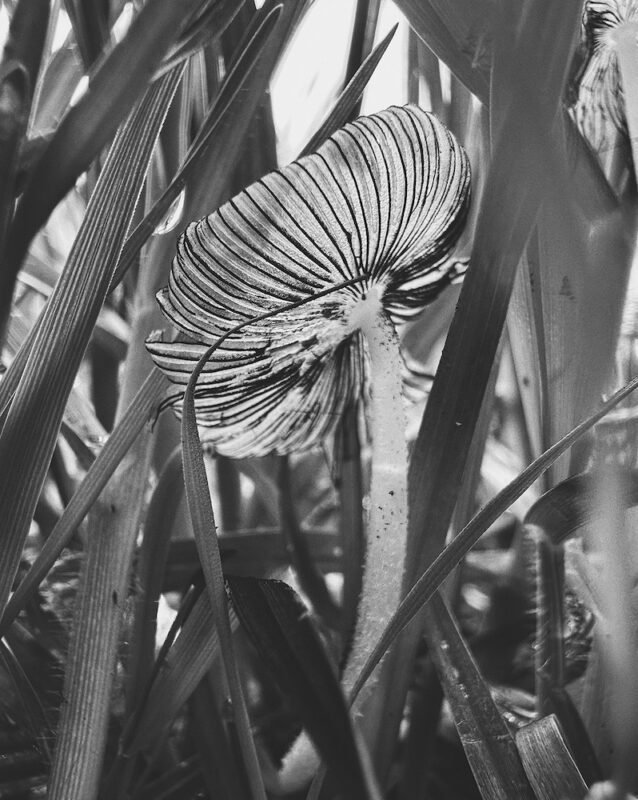
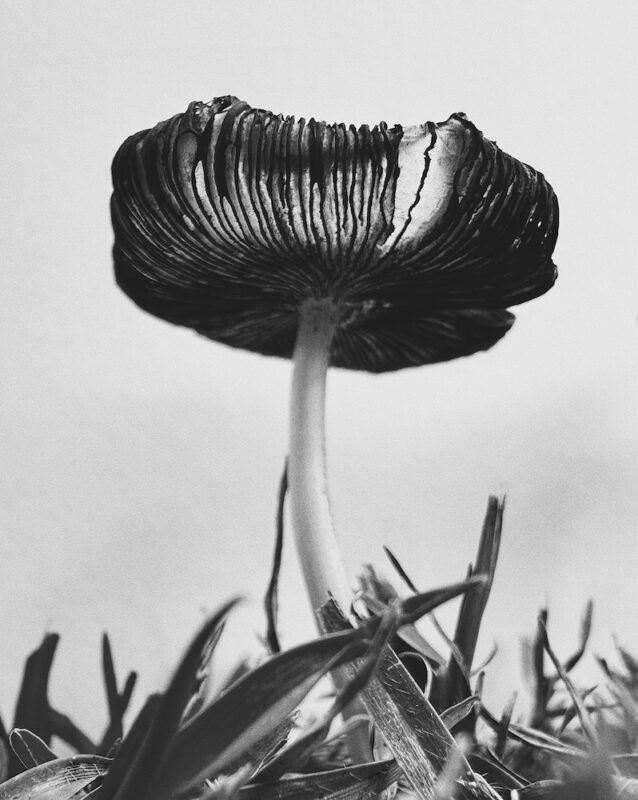
The fruiting bodies of the title refer to the mushrooms that Ang photographed in Melbourne’s parks. Ang’s mushrooms are earthy, found sculptures. These are small growths we may not notice at our feet: bodies with expanses of folds, wrinkles and yearnings for darkness and light. They have stems, caps, gills, and an unseen underground pulse. Ang gives them her full attention, harnessing the close-up’s ability to experiment with scale and reorganise hierarchies of attention.

Fruiting Bodies is, in part, about the possibilities of bodies in states of transition. It is about change that is neither loss nor gain, but something vital and not-yet named. Ang generates this post-menopausal narrative without relying on the human figure. Instead, she has a singular focus on the erupting blooms of mushrooms: growths sustained from below through mycelium, that hidden system of collective exchange.

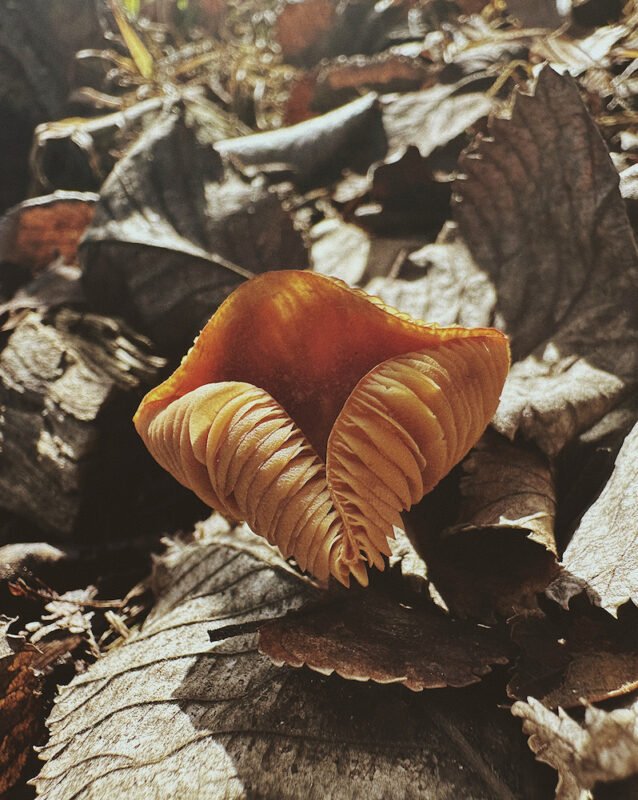
Descriptions of non-reproductive bodies often invoke the language of loss or failure. Ang gifts us another vocabulary through her detailed portraits of mushrooms and their cycles of growth, decay and regeneration. Ang pulls her viewers to the ground, holding her camera at grass level to show us the arch of the stems, the wonder of cups, these tiny architectural yet fleshy wonders. She displays their cracks, dissolves, their tears, their delicacy and brute strength. In a deliberate engagement with the links between questions of ecology and feminist politics, Ang reveals how proximity (in this case, to soil, organic matter, imperfect fungi) can recalibrate what we know and value about bodies, community and connection.

Fruiting Bodies has a slower rhythm than Ang’s last photobook The Quickening: A memoir on matrescence (2021), and her first major photobook, Gold Coast (2014).  The Quickening reckons with the joys and seismic shifts of motherhood and post-partum anxiety. The photographs in The Quickening are like gasps for air: visceral fragments of life with an infant.  Gold Coast reckons with the contradictions of a city marbled with racism, crime and bodies at leisure. Fruiting Bodies is a different type of book. This book is not a reckoning but a proposition, a firm insistence that the realm beyond fertility has paths to other possibilities, other generative modes, ones that are vital, creative, meaningful, crucial.

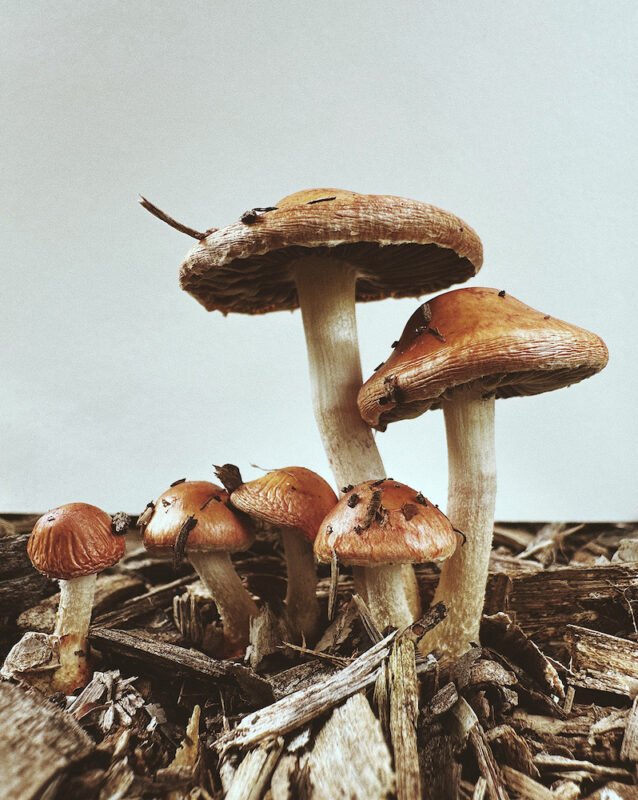
Ang’s fruiting bodies are sometimes ruffled and plump, others are slender and reaching. A notebook held at ground level becomes an in-situ studio, a backdrop to highlight the dirt clinging to a stem or the impressive force of a mushroom that has pushed through earth and risen with a wood chip delicately balanced on its cap.

Photography has played a fundamental role in valuing some bodies more than others, in rendering some invisible, unnoticed, and others too closely surveyed. This awareness is embedded in Fruiting Bodies. Ang’s studies of foraged mushrooms photographed simply on a white background are reminders of how photography has been used to collect, identify and fetishise, but this is not Ang’s project.  

Ang’s visual language relies on seeing the mushrooms in a variety of ways. Ang mostly photographs the mushrooms in black and white. But the photobook has bursts of warm, earthy colour amongst its black and white pages. Some pages of the book reveal red eruptions, and bees forage near some of these fleshy forms. Others are fragile, almost transparent. Sometimes Ang’s mushrooms are at home in a tangle of woodchips, grass and dew. Other times, the mushrooms have been plucked and photographed later. Some of these mushrooms are dried and shrivelled. Some are palpably full and fleshy.

Ang’s mushrooms make me think about Simryn Gill’s series, Weeds in my Parents’ Garden (2018). In that series, Gill also photographs down near the ground, focusing on weeds in detail. Like Ang’s mushrooms, Gill’s weeds are personal (it is her parents’ garden) but also about a wider politics of attention to the unwanted or the devalued. Both Ang and Gill share a respect for the anti-monumental, and a speculative approach to thinking about nature, personal history and ways of knowing.

Ang’s curious eyes show us growth, decomposition, repair, and wonder. These are photographs to pore over. I recognise one mushroom as a shaggy mane mushroom, I look it up and learn that it matures fast, and as it does so, its gills liquify into an inky disintegration: a dissolving that releases and spreads spores. These fruiting bodies sometimes echo the human form. A pair of caps looks like breasts; the ruptures, splits and openings of several mushrooms are equally suggestive. But the point is not to anthropomorphise the fungal world, but rather to place those bodies in conversation with our own.

The figures of women are evoked directly in Fruiting Bodies through Ang’s exacting use of text. Ang is a photographer, but also a deft writer. The perspective here is born from the personal, but this is also about a collective experience of how women’s bodies are labelled, classified and devalued over a lifetime. Some things, Ang and her mushrooms tell us, are beyond the material body, outside anatomy. One page of text begins a list with mood and cognition and ends with hair and bones. Uterus sits in the middle of the list. I read the word and think of medical drawings and the persistent cultural imaginings of the uterus as a void or receptacle rather than the dense, powerful muscle it is. Just one misrecognition among many.

Opposite the list, a full page is dedicated to just two words: Kin Keeper. This role, so often undertaken by women, is, like the mushroom’s underground mycelium, part of a collective chain of reciprocity and care, shared stories, advice and memories. Ang references this type of work earlier in the book: ‘The quiet labour of what holds the world together.’

Fruiting Bodies has a line about a woman in the kitchen ‘peeling an orange, considering the weight of her own survival.’ Ang reminds us that ‘This, too, is a kind of freedom.’ It is the certainty of this felt freedom that knits together Ang’s beautiful, detailed mushroom portraits in this quiet force of a photobook. ♦

All images courtesy the artist and Perimeter Editions. © Ying Ang


Jane Simon is an academic and writer based in Sydney, Australia. She is Senior Lecturer at Macquarie University, where she researches and teaches in the areas of photography, screen media and visual culture. She is the author of
The Domestic Interior and the Self in Contemporary Photography (Routledge, 2024). Her research examines photography’s role in the imagination and construction of housing and intimate home life.


1000 Words favourites

• Renée Mussai on exhibitions as sites of dialogue, critique and activism

• Roxana Marcoci navigates curatorial practice in the digital age

• Tanvi Mishra reviews Felipe Romero Beltrán’s Dialect

• Discover London’s top five photography galleries

• Tim Clark in conversation with Hayward Gallery’s Ralph Rugoff on Hiroshi Sugimoto

• Academic rigour and essayistic freedom as told by Taous Dahmani

• Shana Lopes reviews Agnieszka Sosnowska’s För

• Valentina Abenavoli discusses photobooks and community

• Michael Grieve considers Ute Mahler and Werner Mahler’s posthumous collaboration with their late family member 

• Elisa Medde on Taysir Batniji’s images of glitched video calls from Gaza


Join us on Patreon today and be part of shaping the future of photographic discourse


Arles 2025: staging radicality within safe limits?

Is the art world willing to take real political risks, or does it perform radicality within safe limits? What to make of aesthetic gestures of dissent without institutional accountability and without any attempts at broader movement building? Peter Watkins probes these questions and more in the context of Les Rencontres d’Arles 2025, arguing that a familiar absence remains despite this year’s theme of ‘disobedient’ images. Elsewhere, festival highlights include Nan Goldin’s recurring interventions, intergenerational collaboration between Carol Newhouse and Carmen Winant, a guerilla poster campaign by NO-PHOTO, and the deeply personal work of Diana Markosian.


Peter Watkins | Festival report | 24 July 2025
Join us on Patreon

The notion that images and their makers can be ‘disobedient’ implies that they hold the power to disrupt, to rebel and to resist the status quo. It suggests that they might serve as an outlet towards a more progressive politics – a means of confronting and reflecting on the systems of power that shape both cultural and political life, and a means to propose critical and aesthetic alternatives in response to the world around us.

In this moment of collective urgency, when the systems that govern us are becoming increasingly repressive and authoritarian, the idea of disobedience takes on an increased importance and risk. The current climate in Europe and the United States is marked by the widespread institutional cancellations of artists, slashing of cultural budgets, silencing of academics and student protests, increased state violence, and the suppression of free and open political and creative expression. Against the rise of “nationalism, nihilism and environmental crises,” as the festival put it in their opening gambit, we might do well to ask how seriously Les Rencontres d’Arles takes the artistic and political freedoms of those presented in this year’s edition, and address what has been left unsaid in the process. 

In a statement issued during the 2022 edition, Les Rencontres d’Arles declared its unilateral support for the Ukrainian people in their “fight for freedom,” dedicating the opening week to honouring the “artists and photographers whose lives are threatened by Russia’s aggression.” Fast forward three years, and while the war in Ukraine rages on, this year’s edition includes neither mention nor representation of Ukrainian artists, institutions or direct geopolitical issues related to the region.

While this year is marked by the inclusion of historically marginalised communities, issues surrounding colonial legacies and is notable for its work of inclusion and politics of representation, there remains a colossal elephant in the room. For a festival – and an industry – that has spent years championing diversity, flirting with decolonial discourse and sexual politics, the absence of any tangible mention of the political realities we find ourselves in the present is both deeply disappointing and troubling.

It was left to Nan Goldin, once again – leveraging her considerable artistic and cultural influence – to say what the festival would not. To kick off proceedings, her film Memory Lost (2019-21), underscored by answering machine recordings, seminal photographs of her and her friends, and revolving around abuse, friendship, love, deprivation, and loss, was accompanied by a live piano performance by Eliza McCarthy. It played out to the vast imposing Théâtre Romain, which was full to the brim with approximately 2500 people, comprising those from every corner of  the photography community. Goldin was presented with the Women in Motion award, which she accepted graciously, joking that Les Rencontres had shown bravery in honouring her at such a politically charged moment, and promised the audience a surprise at the end.

In the conversation that followed, she chose to speak out against the growing repression of trans and LGBTQIA+ communities, particularly in the context of increasingly draconian policies in the United States that have eroded decades of progress in terms of policy and rights. This was accompanied by a slideshow depicting her early photographs of drag queens, starting out with a portrait of David Armstrong depicted here as a young man dressed as a woman. “He wasn’t a queen himself,” she reflected, “he was just so androgynous and beautiful that men would divorce their wives when they saw him.”

As the moon shone brightly in the night sky, a spotlit Nan Goldin told the audience that “we need silence now.” The word Gaza appeared across the screen. The film was composed of video clips compiled from social media. It started like this: Children playing, laughing, bustling food markets, panoramas of cosmopolitan life. People congregating, families on the beach, kids flying kites, a birthday party, a father throwing his child into the air. Then, plumes of smoke, citizens evacuating, explosions, dead bodies, a man shaking uncontrollably with fear, people running, people dying, neighbourhoods reduced to rubble, dead journalists surrounded by living journalists, a man comforting a child. A child holding the head of a dead parent. And the unmistakable look of horror in the eyes of the children. Towards the end we see desperate unarmed Palestinians running for aid. A child no older than eight years old says: “we are tired of this darkness. We are tired of this life.” 

The video was silent, there was no audio, but for the wind catching the giant projection screen. What followed was a powerful speech by Goldin standing alongside writer Edouard Louis who shared the burden. At 71 years old, Goldin struggled at some points to stand, but her voice remained steady and erudite. Some of the audience left in a steady stream, but most stayed, and when one woman heckled passionately screaming about hostages, the palpable tension that had filled the air bubbled over, with Goldin moving off script, and addressing the woman directly, but keeping her cool. Free Palestine chants rang out in solidarity and Goldin completed what she had come to say. When she returned to her seat near to where I was sitting, she said in typical Nan Goldin style: “get me outta here,” to her youthful entourage. 

A wide range of UN bodies, the International Court of Justice, judicial panels, investigation committees as well as most major human rights NGO’s and experts, have characterised Israel’s military campaign in Gaza as Genocide, warning that it meets the criteria as defined by the Genocide Convention. More than 50,000 children have been killed or injured by one of the most sophisticated war machines on the planet. Food and aid is being used as a weapon of war. Genocide is occurring in Gaza, but also in Sudan, in Myanmar, in Congo. Our complicity in the West and in our industry is marked by the silence of our institutions, and the gatekeepers at their helms, prioritising corporate sponsorship above moral clarity. 

Change can only occur through lifting this silence, practicing disobedience and risking something of ourselves in what we believe in. It should not have to fall squarely on the shoulders of Nan Goldin to be the mouthpiece for an industry’s failures. We speak of care, inclusivity, decolonialism and progress, yet this festival has been unable to acknowledge the horrors of the present moment, nor create any tangible platform for them to be discussed. We have a collective duty to do more, and we must do so much more. 

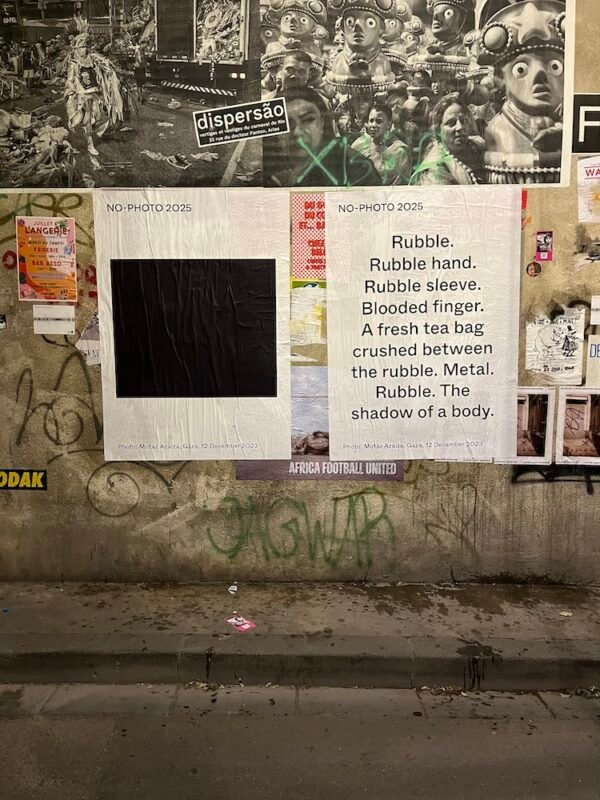
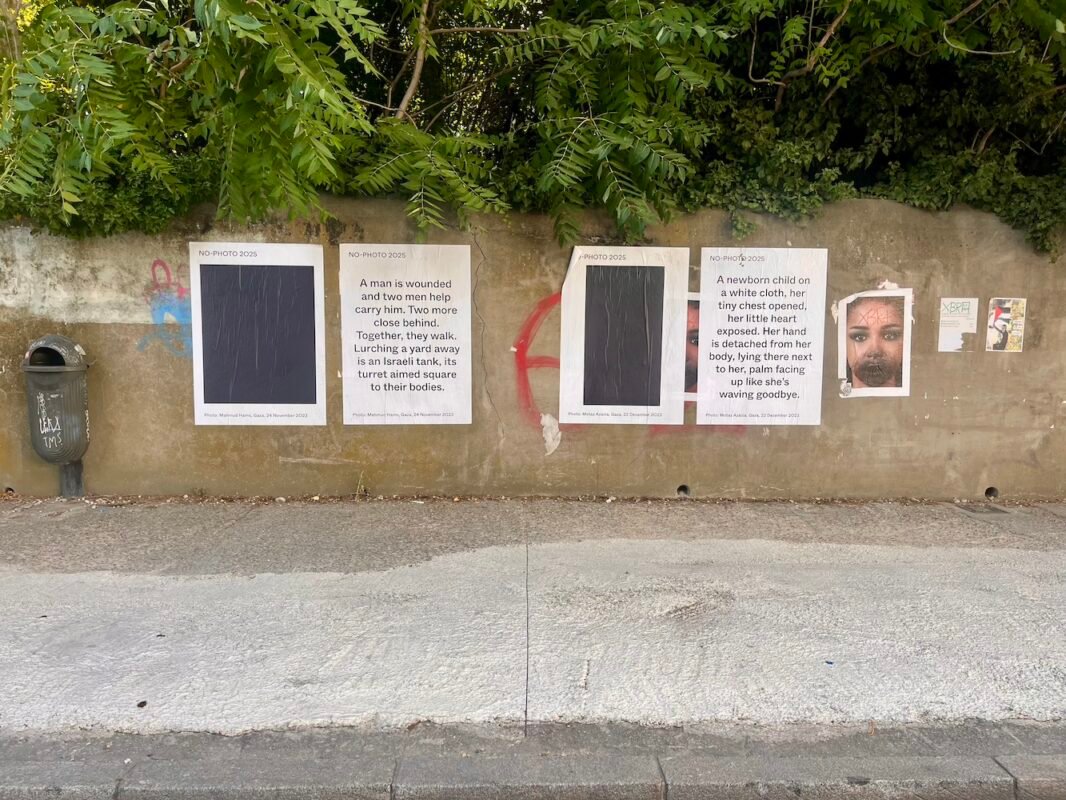
NO-PHOTO, a collective of artists and activists, were notable for their powerful campaign of posters plastered up on walls around Arles. Made up of textual descriptions of photographs from Gaza, the collective called for “cultural institutions to align their visual language with ethical clarity and action.” The power of these political works lies in their conceptual premise: a deliberate refusal to include photography. The image is replaced by a void, a black rectangle, representing a conscious rejection of resharing photographs of Palestinian suffering as tokens to evoke compassion, but rather referring back to the ubiquity of those images through their absence.

An accompanying newsprint featuring an essay from 2023 by Ariella Aïsha Azoulay argues that genocide cannot be captured in a single image, but must be traced across a body of images and actions over time. It asserts that Israel is a settler colonial regime built on the systematic displacement and elimination of Palestinians, using strategies such as expulsion, incarceration and militarised control, especially in Gaza. She talks about how the normalisation of Palestinian suffering through images frames their lives as disposable. She concludes by stating that we must acknowledge this genocide, our complicity, not only for the sake of the Palestinian cause, but for the sake of humanity, pluralism and justice. 

Carole Newhouse and Carmen Winant’s collaborative exhibition simply titled Double was quietly one of the highlights of the festival. Thoughtful, tender, their collaboration marks an intergenerational feminist alliance which looks to reclaim and amplify feminist strategies from the past and bring them to the present. Through the simple gesture of double-exposure, the two women collaborated on a series of works that were an aesthetic pleasure to behold. The exhibition invites us to consider the transformative potential of a radical reinvention and reclamation of the self. Neatly curated by Nina Strand, it is well executed, intelligent work.

Meanwhile the skyline dominating LUMA presents the work of late photographer David Armstrong, with a retrospective exhibition handled with the utmost care and precision by artist Wade Guyton and curator Matthieu Humery. Two rooms separate black and white and colour, with vast vitrines of contact sheets quietly footnoting the first room. Armstrong’s signature devil-may-care portraits of friends, lovers and fellow artists predominantly from the East Village in New York in the 1970’s through to the 90’s seduce with effortless cool and sexiness. He was a life-long friend of Nan Goldin, photographing people such as Cookie Mueller, Greer Lankton, Mark Morrisroe, and other members of the queer scene. The exhibition is handled beautifully, allowing for a kind of escapism from the visual noise dominating Arles over the opening week. 

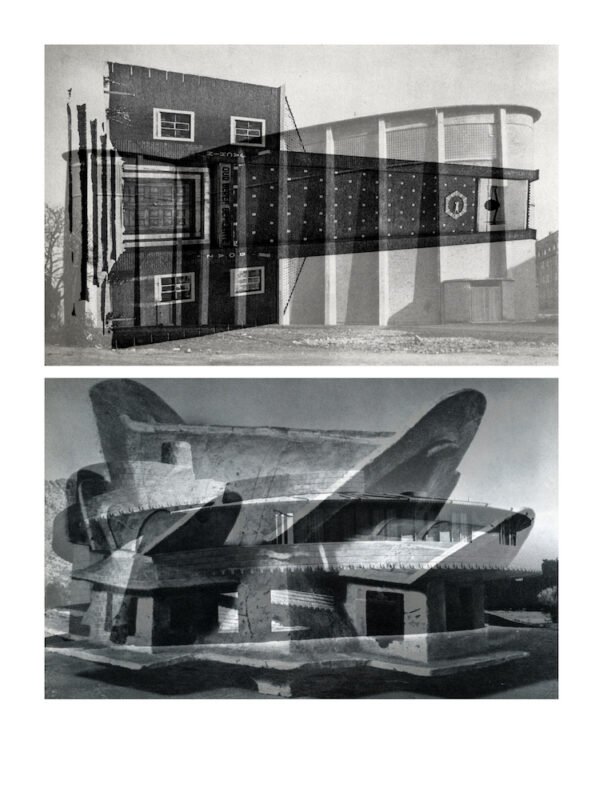
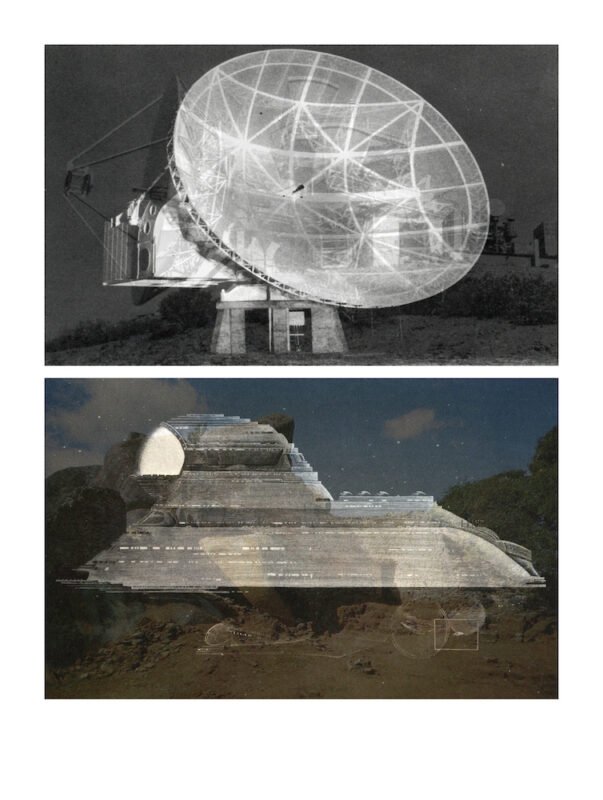
Escaping the midday heat of the festival, Batia Suter’s exhibition Octahydra curated by Francesca Marcaccio Hitzeman took us beneath the ancient Forum, into the Cryptoportiques and the bowels of the earth. In the cool, damp air, and dripping wet walls, two powerful projectors face each other from opposite ends of the cavernous corridor, separated by sheer fabric projection screens and smaller intermediary screens that catch fragments of the images as they pass through. Moving between them, the images dissolve and recombine, decontextualising and abstracting the architectural typologies first presented on the main screens. This is very much a bodily and sensory experience, one that demonstrates both restraint and a precise response to the unique nature of the space. Her work, which I had only experienced in book form until now, translates wonderfully into exhibition form – creating a new register of experience. Many photographers and exhibiting artists at the festival could learn from this kind of thoughtful translation. Too often, the visual and material strategies on display relied on a too-similar, now-familiar material language which permeates the photography world as distinct from the contemporary art world, often resulting in a total flattening of affect and experience. I was left wondering just how many of these exhibitions might have taken another, more appropriate form. Just as not every body of work needs to become a book, not every body of work should become an exhibition.

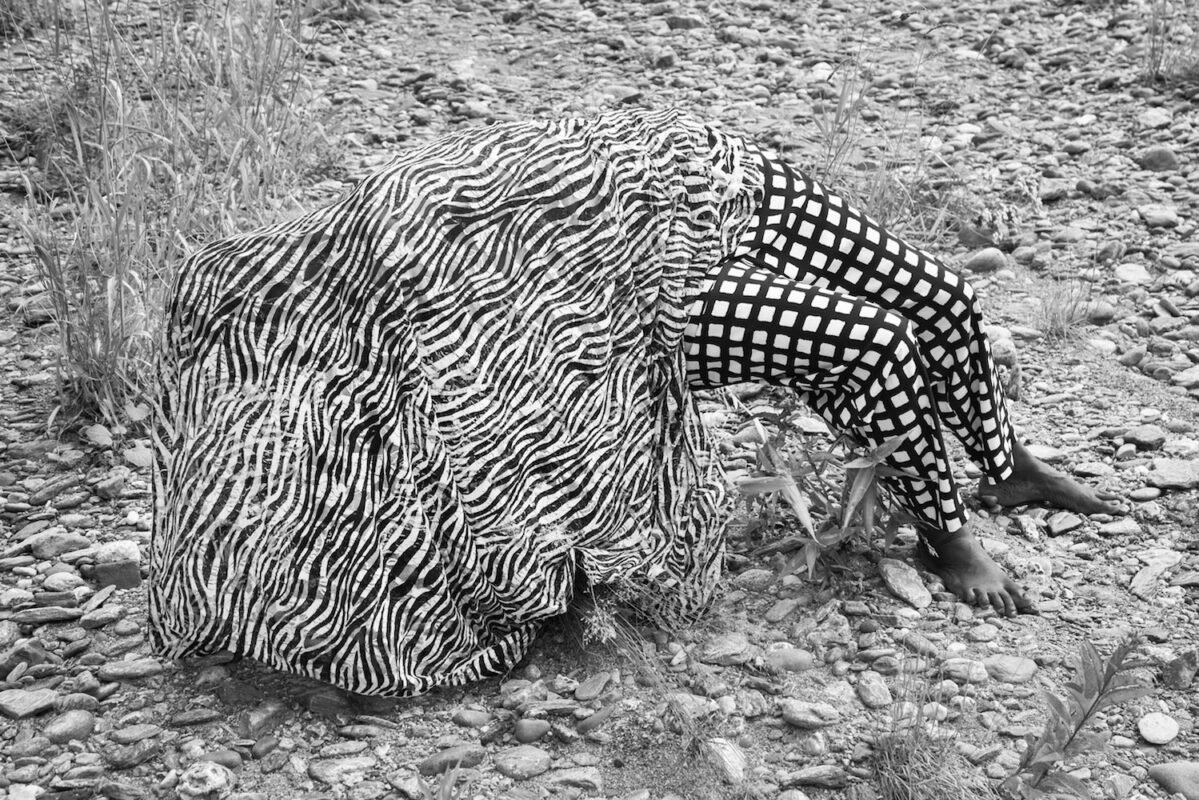
A notable mention goes to Keisha Scarville, whose work predominantly comprises self-portraiture, reappropriating and embodying the clothing and fabrics left behind by her late mother. We are told that she takes inspiration from Egúngún, also known as Ará Ọ̀run (‘The collective dead’), a masked or costumed figure, of the Yoruba people. Her work is playful, graphic, and working through the processes of grief and absence that so often permeate the material remains of the departed, but with the kind of energy that also takes the work outside of that register. She approximates the absence of the mother, through the positioning of herself in the frame, inhabiting the clothing of her mother, and moving between classical and more experimental forms. A pleasurably graphic mode of self-presentation and exploration.

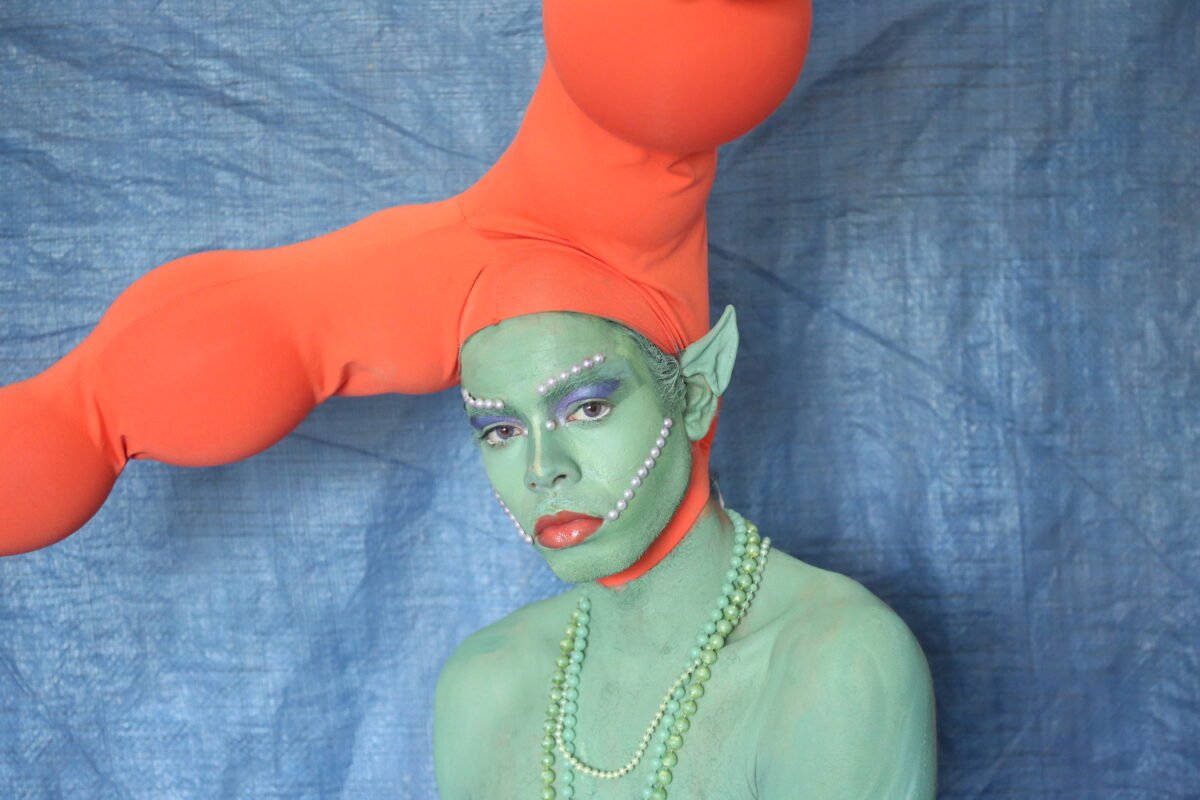
Meanwhile, Brandon Gercara’s exhibition draws on the volcanic landscape of La Réunion – specifically the Piton de la Fournaise – to forge a poetic and political language of resistance. Inspired by the geological formation of hyaloclastites, their art crystallises new, sustainable spaces for marginalised communities, particularly through the lens of Kwir identity, a Creole reimagining of ‘queer.’ In the films Playback de la pensée Kwir and Conversations and Lip sync de la pensée, Gercara uses drag to transmute personal and collective trauma into spectral, extraterrestrial figures that defy normative social structures. Their practice weaves together activism and art to expose and destabilise the lingering forces of colonialism – gender, racial and class-based oppression – suggesting an emancipatory territory rooted in intersectionality and resistance.

Finally, the talk of the town was undoubtedly Diana Markosian’s exhibition, tucked away upstairs in the Monoprix supermarket near the railway station. Markosian was just seven when her mother took her and her brother from Moscow to the United States in 1996, leaving their father behind without saying goodbye. He returned to an empty apartment and spent years searching for his missing children, desperately writing letters to authorities and strangers alike. In California, their mother cut him from family photographs, erasing his presence entirely. Markosian revisited this deeply personal history in her 2020 monograph Santa Barbara, which reconstructs their migration and her mother’s determination to start a new life. Fifteen years later, she travelled to Armenia in search of her father, an emotional reunion that became the foundation for Father, a project weaving together photography, archival documents and video to explore absence, reconciliation and the painful legacy of their estrangement. 

Markosian draws on every tool at her disposal to elicit an emotional response – at times, perhaps too insistently, as with the piano soundtrack that borders on instructive. But the music urges us to experience the work cinematically, inviting us to be swept up in the narrative and given space to dream. This cinematic quality makes the reunion feel as if it is both happening and not happening. On the day I saw it, like many others, I wept – moved by the simplicity of a black-and-white photograph of her father’s shirt, hanging in plastic after being laundered – perhaps reminded of my own photograph of my mother’s dress. There is a moment in the film where Markosian sits across from her father, and they briefly hold hands while staring into each other’s eyes. There is a flicker of pain and relief and love and awkwardness in the eyes of her father in this moment, and this felt direct, poignant and universal. This moment had me totally floored. 

When art and culture is at its very best it doesn’t rest on its laurels; it provokes us, it unsettles us, it carves out the space for renewal and reimagining, and it provides us with forms of collective empathy. Despite eternal precarity, art carries with it these responsibilities: to keep asking difficult questions, to do the hard work in the good times and the bad, and to offer a safe environment outside of the banalities and disappointments of everyday lived experience. 

That two of the most powerful moments at this year’s festival came not from the official programming – Nan Goldin after the award ceremony, and NO-PHOTO on the fringes – but from artists turning their work back onto the institution and the industry itself, is telling. It reveals the limits of representation without accountability, and of inclusion without political engagement. And yet, these moments also point towards a very different possibility – one where festivals like Les Rencontres d’Arles not only platform voices but also respond to the urgencies those voices name. A transformed festival would not just celebrate disobedience as a theme, but give more space to it as a practice: by refusing neutrality in the face of violence and divesting from oppressive structures, all the while creating meaningful space for dissent, dialogue and action.♦

Les Rencontres d’Arles runs until 5 October 2025.


Peter Watkins is an artist and educator based in Prague, Czech Republic. Watkins received his MA in Photography at the Royal College of Art in 2014, and has since exhibited his work internationally, receiving several awards for his ongoing practice. His work is held in the collections of the Victoria & Albert Museum, London, and Fotomuseum Winterthur, Switzerland. His book 
The Unforgetting was published by Skinnerboox in 2020. He is currently Associate Lecturer at Prague City University.

Images:

1-Nan Goldin. Young Love, 2024. Courtesy the artist and Gagosian.

2&3-NO-PHOTO 2025 poster campaign. Courtesy Double Dummy.

4-Carol Newhouse. Self-portrait made during an Art and Photography workshop, WomanShare, Summer 1975. Courtesy the artist.

5-Carol Newhouse and Carmen Winant, 2024. Courtesy the artists.

6-David Armstrong, Cookie at Bleecker St., NYC, 1977. Courtesy the estate of David Armstrong.

7-David Armstrong, George in the Water, Provincetown, 1977. Courtesy the estate of David Armstrong.

8&9-Installation views of David Armstrong, 2025, LUMA Arles. Courtesy the estate of David Armstrong. © Victor&Simon – Grégoire D’Ablon

10&11-Batia Suter, excerpt from Octahydra, video, 2024. Out of the Metropolis project, NŌUA, Bodø. Courtesy the artist.

12&13-Installation views of Batia Suter: Octahydra, 2025. Courtesy Out of the Metropolis.

14-Keisha Scarville, Untitled #18, Alma / Mama’s Clothes series, 2017. Courtesy the artist.

15-Brandon Gercara. Joseph 83; from the Conversations series, 2019. Courtesy the artist.

16-Diana Markosian, The Cut Out; from the Father series, 2014-24. Courtesy the artist.

17-Diana Markosian, Mornings with You; from the Father series, 2014-24. Courtesy the artist.


1000 Words favourites

• Renée Mussai on exhibitions as sites of dialogue, critique and activism

• Roxana Marcoci navigates curatorial practice in the digital age

• Tanvi Mishra reviews Felipe Romero Beltrán’s Dialect

• Discover London’s top five photography galleries

• Tim Clark in conversation with Hayward Gallery’s Ralph Rugoff on Hiroshi Sugimoto

• Academic rigour and essayistic freedom as told by Taous Dahmani

• Shana Lopes reviews Agnieszka Sosnowska’s För

• Valentina Abenavoli discusses photobooks and community

• Michael Grieve considers Ute Mahler and Werner Mahler’s posthumous collaboration with their late family member 

• Elisa Medde on Taysir Batniji’s images of glitched video calls from Gaza


Join us on Patreon today and be part of shaping the future of photographic discourse


Speaking to the future: Elle Pérez in New York

A constellation of images, films, collage, and poetry – over fifteen years in the making – comes to life at New York’s American Academy of Arts and Letters in Elle Pérez’s latest exhibition, The World Is Already Again Beginning, History with the Present. From the raw pulse of punk in Bronx basements to a tender reckoning with history and memory woven through Puerto Rican gardens, Pérez questions our image-world and, in this conceptually disruptive presentation, draws a line of undeniability through acts of feeling, witnessing and remembering, writes Gem Fletcher.


Gem Fletcher | Exhibition review | 10 July 2025
Join us on Patreon

In 2005, Elle Pérez began making photographs at The Bronx Underground, an all-ages music project where young Black and Latino punk bands could play their first show in the basement of the First Lutheran Church of Throgs Neck. The New York artist – a teenager at the time – found the scene through whispers and rebellious friends and wanted in, cunningly negotiating free entry in return for designing the ‘BXUG’ flyers.

The Bronx’s punk scene was different from its white, suburban counterparts. As Pérez puts it, “The protest culture of punk here isn’t about rebelling against going to college, getting a job, and being boring. It’s about survival. It’s about experiencing visceral life. It’s about getting away from your voucher housing and throwing down. It’s about showing how much you hate the government for messing up your mother’s WIC payments and making her take a three-hour round trip on public transit so that your baby sister can eat.”

Taken by the scenes’ urgency, passion and physicality, a sacred space they co-created with and for each other, Pérez began chasing a desire to approximate experience. To somehow imprint the scene’s ineffable shared energy and euphoria into an image. After every event, they would rush home to frantically edit and upload the photos online, eagerly awaiting the audience’s response. This rhythm of making and sharing pictures of BXUG continued every month for a decade, resulting in an archive of over 30,000 photographs. The scene concluded in 2015, and that energy moved in different directions.

It’s these cycles of life and culture that Pérez unravels in their latest exhibition, The World Is Already Again Beginning, History with the Present, at the American Academy of Arts and Letters, New York. Curated by Jenny Jaskey in collaboration with the artist, the show offers a constellation of images, films, collage and poetry traversing bodies of work created between 2009 and 2025. In one read, the exhibit gestures towards an abridged retrospective – bringing together slices of Pérez’s ever-expanding archive that honour the relationships and places that continue to shape their artistic vision from BXUG and the Empire Pro Wrestling troupe, to the fragile tendrils of family life and history in Puerto Rico and the Bronx. The exhibition hinges on a reflection of time; thinking about power and politics of presence, impermanence, remembering, continuity, and the role photography can play in these gestures.

This comes to the fore in new works like La Despedida [The Farewell], which sequences photographs of Pérez’s grandfather’s [Pedro] backyard in Puerto Real, a small village in the southwest of Puerto Rico with Monet’s garden in Giverny, France. Pedro’s yard is lined by large trees of quenepas and starfruit and filled with a pink outdoor bathroom, the shell of a Toyota Tercel and a beached boat named the Mona Lisa. In Giverny, Monet’s pink house is abundant with sprawling wildflowers, rich foliage and the infamous lily pond connected by a network of narrow shingle paths. The intention to cultivate and care for a wild, open, free space unites both men across time. Pérez recalls being struck by the garden as an artistic strategy: “I realised Monet had set up a studio paradigm for himself. By creating a garden that changed daily, Monet gave himself endless possibilities to see.” The potential born from a life dedicated to looking, listening and feeling through pictures and what that can reveal or open up is the beating heart of the exhibition.

In Perez’s life and practice, images transform into gestures of love and togetherness, representing something beyond their material reality. In March 2024, Pedro passed quietly at home and never had a funeral. La Despedida is both an audacious disassembly of hierarchy and more poignantly exists as a memorial to Pedro; Pérez honouring his passing with flowers from Monet’s garden. A fragment of nearby wall text reads: ‘The world is always ending and always again beginning. So, we tell stories to survive it.’

Throughout the exhibit, Pérez’s subversive and multivalent use of text attempts to create a new context to experience their work – an exercise made possible by the artist-first approach of the American Academy. Founded in 1898 for the ‘advancement of art and literature,’ the Academy has the look and somatic qualities of a museum but is more akin to a contemporary art space. With a deep commitment to centring new artistic visions, they empower artists to present new projects and reimagine their work’s spatial encounter. Like a wrestler who works things out on the mat, Pérez used the exhibit to play and develop new curatorial strategies that reverberate long after visitors leave the space. Firstly, there is no curatorial text upon entry. Instead, each visitor is handed a small white zine titled How the Sea Meets the Sky and advised to take it home and read it later. The first text you encounter is an invitation; ‘Please feel free to take a chair.’ 

Through absence, Pérez gives the audience presence, opening space for the transformative effects of inhabiting our individual feelings and responses to the work. From there, the orientation across three galleries and a screening room is entirely personal, punctuated only by short poetic aberrations which riff off the artist’s reflections on time and practice. The viewers don’t encounter any such statement about the show until they reach an interstitial space, and by then, they are already fully immersed in Pérez’s world. Likewise, captions exist as brief meta documents offering titles and elongated timestamps illuminating how bodies of work keep evolving, gaining new meanings as time shifts and the world changes. In gallery three, you encounter a large collage containing hundreds of images, texts, personal notes, references, and ephemera – a combination of aspiration, inspiration and juxtaposition. Affectionately known by the artist as “context backpacks,” the piece takes what happens in the studio and transplants it into the gallery. Now artworks in their own right, the collage becomes a wayfinding device conjuring a dynamic and visceral route into the impulses of the artist’s mind.

The World Is Already Again Beginning, History with the Present embodies Pérez’s unwavering pursuit of intimate moments, emotional exchanges and visceral details, and how these form a photographic expression of the ephemeral condition of living. And yet, it’s their side quest to reckon with the ever-mutating complexity of our image-world through a rallying call of optimism that proves most provocative about the show.

We live between two image worlds: the one we think we know and the one that actually exists. The former was organised by truth, fact and information – a society built upon the premise of the image as evidence. The new image world, catalysed by social media and AI’s unsettling ability to conjure realness untethered from reality, operates differently. A compelling image matters more than any indexical truth. In our current moment, photography is perhaps more consequential than ever. In riposte, Pérez’s work is about preserving history and the profound political implications of creating a line of undeniability in an era where collective memory is clouded by constant crisis, and the tools of power are weaponised to erase. At its core, the show is a blueprint for living, to slow down, feel and remember. As Pérez puts it, “the archives we each make allow us to speak to the future, to tell others we were here, to say we were alive.” ♦

All images courtesy the artist and 47 Canal, New York. © Elle Pérez

Elle Pérez: The World Is Already Again Beginning, History with the Present ran at the American Academy of Arts and Letters, New York, until 3 July 2025.


Gem Fletcher is a writer, consultant and podcaster. Her work has been published in FoamApertureDazedCreative Review and The British Journal of Photography. She also hosts The Messy Truth podcast, a series of candid conversations that unpack the future of visual culture and what it means to be a photographer today.

Images:

1-Elle Pérez, Avvon V.S. Tank, 2013/2025

2-Elle Pérez, DAINJA 730, 2013/2025

3-Elle Pérez, Flag, 2009/2025

4-Elle Pérez, In memory of Critic, Rest in peace John, 2009/2025

5-Elle Pérez, Kirsten at Orchard, 2009/2025

6-Elle Pérez, Kiss, 2009/2025

7-Elle Pérez, Pedro in his garden, 2025

8-Elle Pérez, The World Is Always Again Beginning, History with the Present, 2025

9-Elle Pérez, untitled (break shore), 2025

10-Elle Pérez, untitled (car body), 2025

11-Elle Pérez, untitled (king), 2025

12-Elle Pérez, untitled (plantain grove view), 2025

13-Elle Pérez, untitled (the world is always again beginning), 2025

14-Elle Pérez, untitled (water-lily view), 2025

15-Elle Pérez, untitled (wet and tired flowers), 2025


1000 Words favourites

• Renée Mussai on exhibitions as sites of dialogue, critique and activism

• Roxana Marcoci navigates curatorial practice in the digital age

• Tanvi Mishra reviews Felipe Romero Beltrán’s Dialect

• Discover London’s top five photography galleries

• Tim Clark in conversation with Hayward Gallery’s Ralph Rugoff on Hiroshi Sugimoto

• Academic rigour and essayistic freedom as told by Taous Dahmani

• Shana Lopes reviews Agnieszka Sosnowska’s För

• Valentina Abenavoli discusses photobooks and community

• Michael Grieve considers Ute Mahler and Werner Mahler’s posthumous collaboration with their late family member 

• Elisa Medde on Taysir Batniji’s images of glitched video calls from Gaza


Join us on Patreon today and be part of shaping the future of photographic discourse


Between history and fable: Mashid Mohadjerin at FOMU, Antwerp

Channelling the voice of a feminist naqqāl – a reciter of epic tales – Mashid Mohadjerin reweaves the fables and histories her father entrusted to her, threading memory and myth across generations as part of her new parallel book-exhibition project, Riding in Silence & the Crying Dervish. Through image, collage and legend, Mohadjerin rewrites inherited patriarchal narratives into a visual language of resistance; reframing memory, masculinity and the legacies of displacement against the broader landscape of Iranian politics and constructions of manhood, Taous Dahmani writes.


Taous Dahmani | Exhibition/photobook review | 26 June 2025
Join us on Patreon

Once upon a time, a little boy was playing in a shallow river winding through a sunlit mountain. One day, that same boy had to hide in the river’s meagre depths to escape blazing bullets. I grew up with that story – frightened for the boy, terrified of the men with guns. It was a bedtime story, but also a way of passing down history: the lived realities of colonial occupation in Algeria. The storyteller was my father. The little boy was my father, too.

For Mashid Mohadjerin, one of the many stories she heard from her father began like this: “A firing squad waiting for the smoke of their guns to clear.” An action-packed scene – gunfire, enemies and heroes – one of whom was the artist’s great-great-great-grandfather. But beneath the drama lies a deeper truth on of wars of ideology and territory. It’s another tale where history and bedtime fable meet, where legend is used to carry the weight of lived experience. In her latest book, Riding in Silence & the Crying Dervish (2025), Mohadjerin remembers an exchange with her own father: ‘“Do you want me to continue reading?” he asked, his voice low, as if not wanting to break the weight of the moment. “Yes, please,” she replied, lost in the threads of history that twist and loop around us, familiar yet foreign, like a story that feels both ours and not ours.’

Displaced, Mashid Mohadjerin’s father arrived in Belgium with his family in the 1980s; by then, my own father was already telling bedtime stories of 1950s Algeria to my sisters and then me in Paris. These stories may have been crafted to captivate children, but they were also a way to share a past too heavy or too painful to be spoken plainly – so it came cloaked in a different narrative form. In both our families – and in many others that have been shaped by the silences of displacement or colonial violence – history is often passed down, wrapped in narrative: it is rendered more fantastical than the brutal realities it conceals, skirting around political, religious, or personal taboos. Yet through storytelling, these histories endure. They keep alive those who left us too soon or disappeared without trace. Stories then offer continuity to the fragmented.

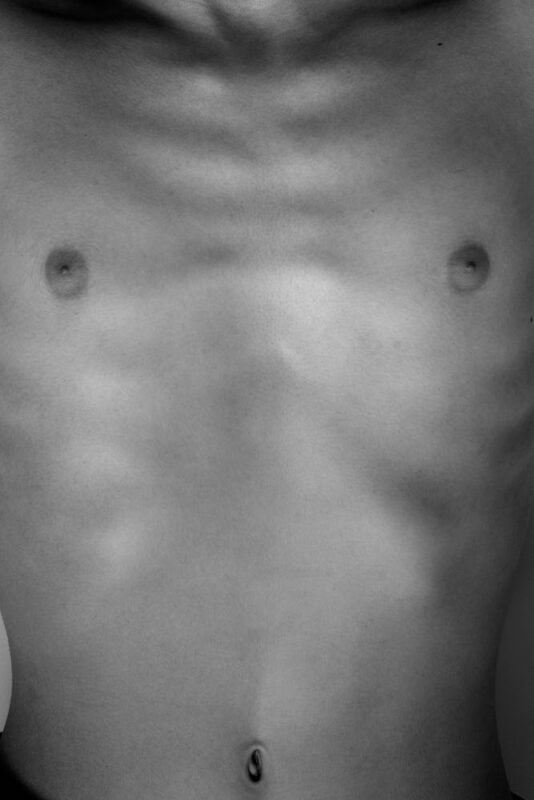
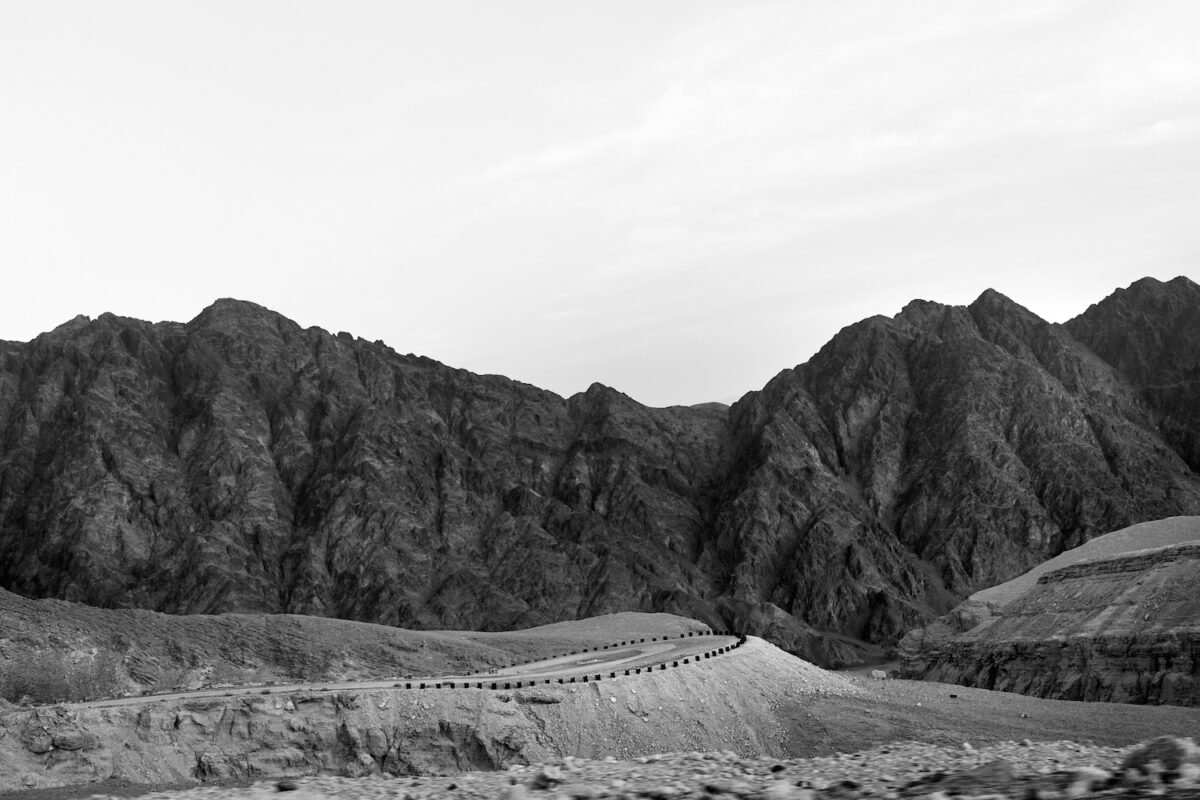
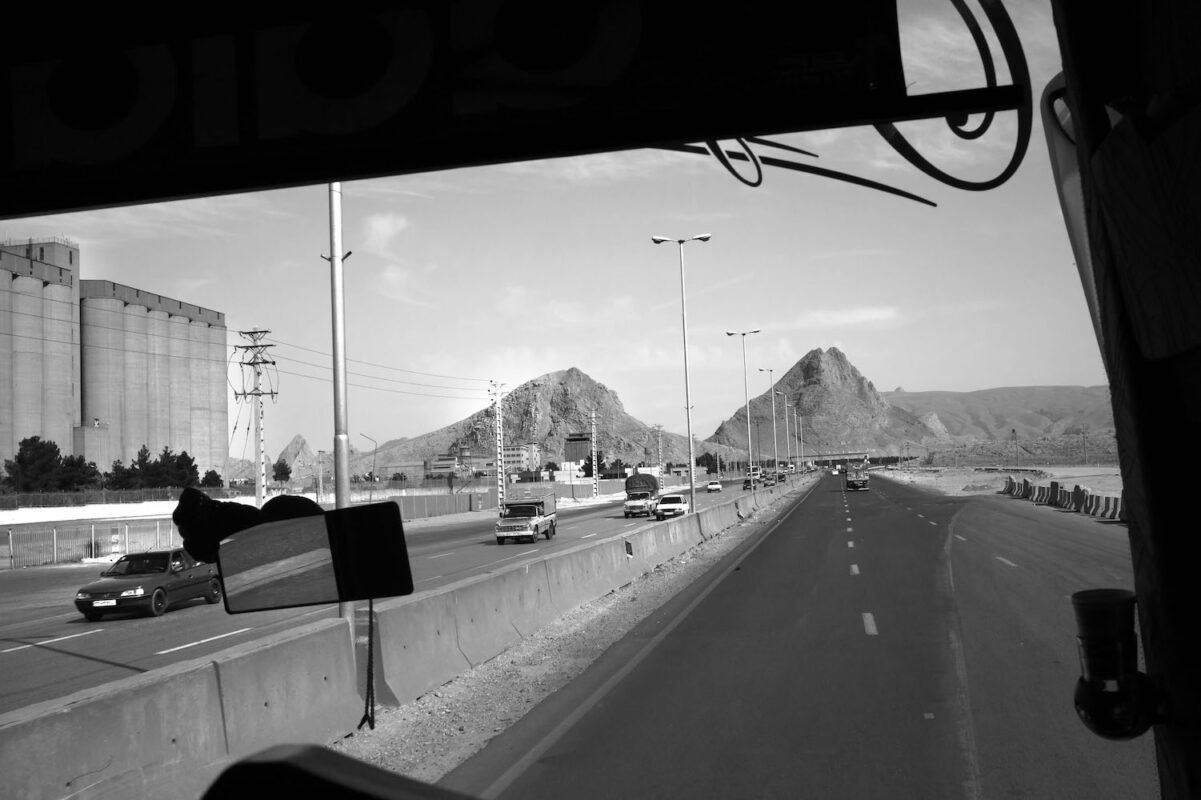
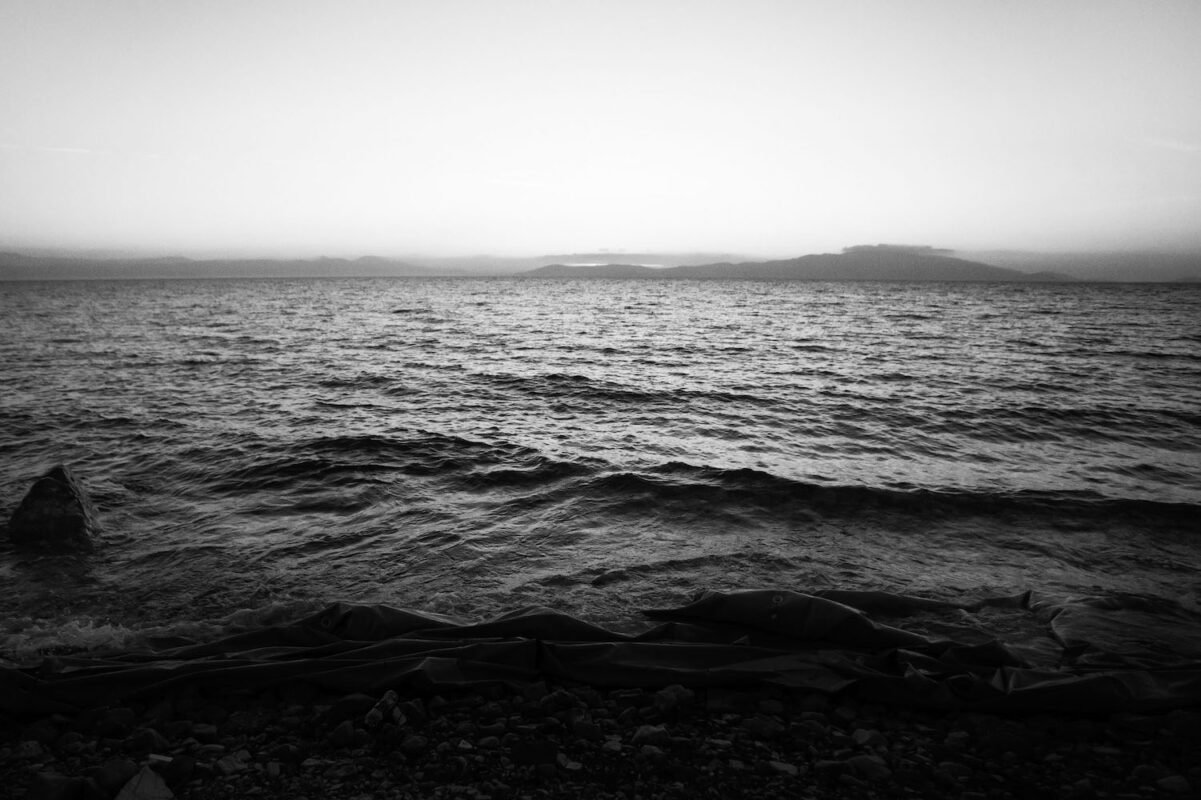
In light of this, Riding in Silence & the Crying Dervish becomes an experimental visual family tree, an autobiography made of tales: reimagined and retold from a position that resists silence. Mashid Mohadjerin weaves together peaceful black and white landscapes taken as she retraced the places where family stories may have unfolded. These images set the stage, grounding myth in geography, and searching for ancestral traces. The narrative drifts across time and place – leaping between centuries and countries – yet always returning to the thread of memory as story. Whether encountered in book form or in an exhibition (as recently shown at FOMU, Antwerp), Mohadjerin’s characters refuse to remain confined to the frame or the page. The figures escape the constraints of their own contours, reaching toward other forms and shapes, seeking to engage across time, space, and medium. This gesture is present throughout the work, but most vividly in the collages, where fragments converge and overlap.

Whether knights, princes, mullahs, boxers – Riding in Silence & the Crying Dervish is populated by characters of many forms. But it’s impossible not to notice that all these figures are men. History, like legend, has long privileged the bravery of men, casting them as the central actors of the past. And indeed, Mohadjerin’s project began with the discovery of a family manuscript from the 1850s – rich with twists, turns and dramatic episodes, but almost entirely devoid of female agency. These male-centred ancestral narratives did more than recount what happened; they shaped how the world was seen and remembered, reinforcing gendered hierarchies and social structures across generations. As Trinh T. Minh-ha wrote in her 1989 essay Grandma’s Story (recently republished by Silver Press, 2025), that kind of ‘story is either a mere practice of the art of rhetoric or a repository of obsolete customs.’ But at some point, displaced fathers began telling their stories to daughters – not simply to preserve tradition, but to offer the knowledge needed to question it.

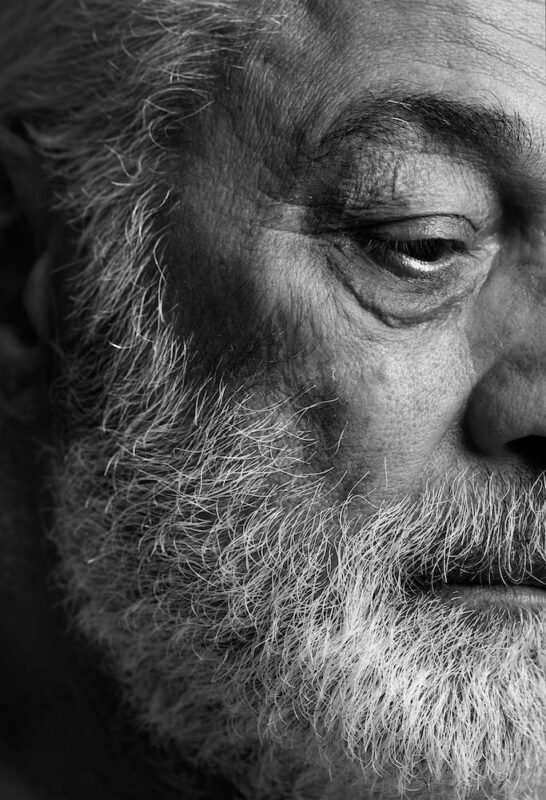
Mohadjerin’s narrative strategies deliberately unsettle these inherited power structures. She reclaims the storyteller’s role, becoming a contemporary feminist naqqāl – a reciter of epic tales – who reimagines the myths of kings and heroes through a woman’s gaze. She doesn’t just inherit the narrative; she takes control of it. In other words ‘Diseuse, Thought-Woman, Spider-Woman, griotte, storytalker, fortune-teller, witch’ (Trinh T. Minh-ha, 1989), Mohadjerin transformed the audible into the narratable, and the narratable into the visible. She created a visual language for family stories – one that also speaks to the longer histories of Iranian politics and constructions of manhood. In Riding in Silence & the Crying Dervish, metaphors of masculinity abound: rocks that stand firm, tensed muscles, men bearing arms, horsemen in motion – figures of strength, pride and endurance. But because the story is told by a woman, other images emerge too: portraits of vulnerable elders, colourfully dressed men, ageing bodies, men caught in moments of dance or struggle. These juxtapositions expand the visual vocabulary of manhood, revealing its tenderness, contradictions, and fragility alongside its inherited postures of power.

With Riding in Silence & the Crying Dervish, Mashid Mohadjerin challenges not only traditional photobook narratives but also prevalent modes of storytelling. Nothing is fixed; everything is pulled apart, non-linear, and layered. By attending to the silences and gaps, knowledge about one’s family and homeland takes on new, unexpected forms. Blending poetry, essay, archival collages, portraits, and landscape photography, Mohadjerin offers a radical reimagining of how stories embody identity, history and culture. To summon Trinh T. Minh-ha again: ‘The story is me, neither me nor mine. It does not really belong to me, and while I feel greatly responsible for it, I also enjoy the responsibility of the pleasure obtained through the process of transferring.’♦

All images courtesy the artist and FOMU, Antwerp © Mashid Mohadjerin

Mashid Mohadjerin – Spiralling Outward ran at FOMU, Antwerp until 8 June 2025. 

Riding in Silence & the Crying Dervish is self-published and available through Idea Books.

** This essay is dedicated to all the story tellers in Iran and beyond, who keep reading bedtime stories, despite it all.


Taous Dahmani is a London-based French, British and Algerian art historian, writer and curator. Her expertise centres around the intricate relationship between photography and politics, a theme that permeates her various projects. She is an Associate Lecturer at London College of Communication, University of the Arts London. Dahmani’s curatorial work was showcased at Les Rencontres d’Arles, France, where she curated the Louis Roederer Discovery Award (2022). In 2024 Dahmani curated exhibitions at Jaou Tunis, Tunisia; NŌUA, Norway; and Saatchi Gallery, London.


1000 Words favourites

• Renée Mussai on exhibitions as sites of dialogue, critique and activism

• Roxana Marcoci navigates curatorial practice in the digital age

• Tanvi Mishra reviews Felipe Romero Beltrán’s Dialect

• Discover London’s top five photography galleries

• Tim Clark in conversation with Hayward Gallery’s Ralph Rugoff on Hiroshi Sugimoto

• Academic rigour and essayistic freedom as told by Taous Dahmani

• Shana Lopes reviews Agnieszka Sosnowska’s För

• Valentina Abenavoli discusses photobooks and community

• Michael Grieve considers Ute Mahler and Werner Mahler’s posthumous collaboration with their late family member 

• Elisa Medde on Taysir Batniji’s images of glitched video calls from Gaza


Join us on Patreon today and be part of shaping the future of photographic discourse


Sirkka-Liisa Konttinen’s Geordie beaches

Originally published 25 years ago, the revised and expanded edition of Sirkka-Liisa Konttinen’s Writing in the Sand from Dewi Lewis Publishing reintroduces the lively, eccentric spirit of Geordie beachgoers into the present. With a deft balance of nostalgia and immediacy, Michael Grieve writes that Konttinen’s photographs not only celebrate the quirky nuances and contradictions of working-class life but also reveal an awkward yet tender relationship with the beach – a place both distant and intimate.


Michael Grieve | Book review | 19 June 2025
Join us on Patreon

‘The quality that we call beauty… must always grow from the realities of life.’ So wrote Japanese novelist Jun’ichirō Tanizaki. The documentary genre embodies this and seldom are there photobooks to which I feel personally connected, but the ones that do resonate are related to my youth and the region of my hometown of Newcastle upon Tyne in the UK. Tish Murtha’s photographs of the working class districts of Elswick and Benwell, where I was born, are stark reminders of the streets where I played during the 1970s; I could have been one of those scruffy kids jumping out of the window of a derelict terraced house onto a precarious pile of mattresses. Photographs by Chris Killip of The Station (2020), an anarcho punk music venue across the Tyne River in Gateshead, a space I regularly frequented from the very first day it opened back in 1981, capture those spiky haired and familiar faces; a visual portal transporting me back to the frenetic energy and pungent odorous array of hairspray, soap, glue, and sweat. And now, Writing in the Sand from Dewi Lewis Publishing: a homage to the sandy beaches of the North East of England and the people who relaxed there, by Finnish documentary photographer Sirkka-Liisa Konttinen. Photographs of places so familiar to me, inciting a myriad of archived memories including the Spanish City, an amusement park located near the seafront of Whitley Bay that I regularly escaped to while ‘nicking off’ school, eating chips and playing Space Invaders with my mates.

In 1969, before finishing her film studies at Regents Street Polytechnic in London, Konttinen moved to Newcastle upon Tyne and co-founded the Amber Film and Photography Collective, a group of concerned documentarians focused on capturing working class communities and the effects of the rapidly disintegrating industries and the distinct social and cultural identity of the North East. They believed in long-term commitments towards communities spanning years, to integrate as much as possible to achieve an honest representation. Konttinen exemplified this dedication. That said, since it opened in 1977, the collective’s adjunct Side Gallery has always had a hard time keeping afloat. But now it really is sinking into oblivion; as of this time of writing it is ‘currently closed’. The gallery is no longer supported as a National Portfolio Organisation by Arts Council England, which is a disgrace and though the commitment and hard work ingrained in the photographs will forever remain, the momentum of the Side Gallery will halt and disappear just like the communities its photographers faithfully documented, just as the writing in the sand.

There is wonderful footage from 1974 of a young Konttinen featured on the then popular BBC current affairs programme, Nationwide. The reporter is full of praise for Konttinen’s “remarkable collection of photographs” taken of Byker and the tight knit community of working class people who lived there. These Victorian houses in back to back terraces were classified as slums and demolished to make way for a new modern Scandinavian inspired urban design that culminated into the unique one-and-a-half mile long social housing block called the Byker Wall. The reporter is somewhat bemused about this middle class ‘girl’ from Finland who chose to live in Byker and who feels the warmth of the local community, describing the residents as genuine, gentle and worried that the very distinct social unity and character would be lost with people living in atomised flats of the Byker Wall. Such was the level of empathy that Sirkka felt towards the North East of England as she remained stoically dedicated to documenting the region to this day, with a remarkable level of intimacy and affection for the Geordies and their plight in an ever changing socio-political-economic environment. In an interview she told me that the collective “brought us together and served us well is our common goals. Our egalitarian constitution, self-determination, editorial control, creative freedom, sharing of resources, lasting friendships… We moved to the industrial north-east with the aim of giving voice to working class and marginalised communities.” The photobook, Byker, was published in 1983, and ranks as a seminal and important project in the humanist mode of documentary photography in the UK, and certainly on a par with Bruce Davidson’s East 100th Street social documentation of the inhabitants of appallingly impoverished living conditions in Harlem during the 1960s.

Writing in the Sand was originally published twenty-five years ago. The book features black and white photographs taken between 1973 and 1998 on the beaches at Cullercoats, Whitley Bay and Tynemouth – all in close proximity to each other. The beach is a concentrated space, a hive of human activity, and these photographs celebrate the eccentricities and odd juxtapositions of engagement. Most telling, especially photographs from the 70’s, and compared to today, is how the English working classes have an awkward relationship to the beach, wearing unsuitable attire for the environment; men smoking ‘tabs’ in their regular heavy twilled suits with trousers rolled up, cardigan wearing grandmothers, mothers and aunts allowing themselves the pleasure of feeling the grains of sand through their stockinged feet. A space to break free and let one’s hair down from the confines of the ‘hoose’ and drudgery of work. This is how it was. And somehow the beach equalises people, feral children turn upside down, metamorphose into mermaids and bury their dads with sand, lovers love and dogs go barking mad. In this uncluttered space people feel the sensuality of nature that allows the potential of unhindered free expression. The sea, sand and sky democratises an experience; the beach is a theatre of improvisation.

With humorous affection Konttinen’s observations embrace the energy and actions of quirky and intimate moments with absolute humility. Her distance is polite and her closeness is honest and balanced. This is photography of the humanist kind, and in skillful hands the emphasis is about the subject, not the photographer. With eloquence she captures the joy emanating from the gravitational pull to the sea, that place from which we crawled from the primordial soup. From time to time Konttinen punctuates the flow of pictures with quiet abstractions of sand, pebbles, seaweed and rocks, as if to accentuate the movement and perpetual cycle of nature, and put bizarre human presence into humbling perspective. Konttinen has a close affinity to these beaches. A few years ago we met at her local Tynemouth beach at King Edwards Bay where, with other women, she ritualistically swims, braving the north easterly weather even in the winter. She emerged fresh out of the sea and I photographed her portrait, wrapped in a terry towelling robe on that chilly morning before heading to the warmth of her home and a cup of tea.

The majority of working class people in the North East have endured a great deal of loss. By the 1970’s the industries of ship building, coal mining and steel manufacturing were virtually extinct and by the 1990’s had gone together with the communities it supported, and so began the onset of the grim reality of there being ‘no such thing as society’ anymore. Not to be sentimental about the good ole days of the working class as for sure it was always tough, but it seems the more we have the less we have; consumerism is an instant, addictive, gratification separating humans apart. Community, as Kottinnen prophesied in the Nationwide programme will be lost, and with it a sense of identity, dignity and bonding.

This is old school, classic documentary photography. Tony Ray-Jones, Homer Sykes, Martin Parr, to name but a few, spring to mind, all of whom focused on the peculiarities of the English at play. Konttinen’s project ended in 1998, and I wonder if such images could now be taken in our protectionist self-image controlled, hyper-ethical cultural environment. How refreshing to see the total absence of mobile phones and lack of homogenous, sweatshop clothing, though only a stone’s throw away as a common sight.♦

All images courtesy the artist and Dewi Lewis Publishing © Sirkka-Liisa Konttinen


Michael Grieve is a photographer, Director of ArtFotoMode, Hamburg Werkstatt Fotografie (HWF) and lecturer at Ostkreuzschule in Berlin. In 1997 he graduated from the MA Photographic Studies from the University of Westminster and then proceeded to work as a photojournalist and portrait photographer for publications internationally. He was Deputy Editor of 1000 Words and a writer for the British Journal of Photography. Since 2011 he has been Senior Lecturer at Nottingham Trent University, Nottingham, Akademia Fotografie Warsaw and the University of Art and Design, Berlin, and currently teaches at Ostkreuzschule für Fotografie, Berlin. He is currently working on Procession, a project documenting the peripheral space between Athens and Elifsina, Greece.


1000 Words favourites

• Renée Mussai on exhibitions as sites of dialogue, critique and activism

• Roxana Marcoci navigates curatorial practice in the digital age

• Tanvi Mishra reviews Felipe Romero Beltrán’s Dialect

• Discover London’s top five photography galleries

• Tim Clark in conversation with Hayward Gallery’s Ralph Rugoff on Hiroshi Sugimoto

• Academic rigour and essayistic freedom as told by Taous Dahmani

• Shana Lopes reviews Agnieszka Sosnowska’s För

• Valentina Abenavoli discusses photobooks and community

• Michael Grieve considers Ute Mahler and Werner Mahler’s posthumous collaboration with their late family member 

• Elisa Medde on Taysir Batniji’s images of glitched video calls from Gaza


Join us on Patreon today and be part of shaping the future of photographic discourse